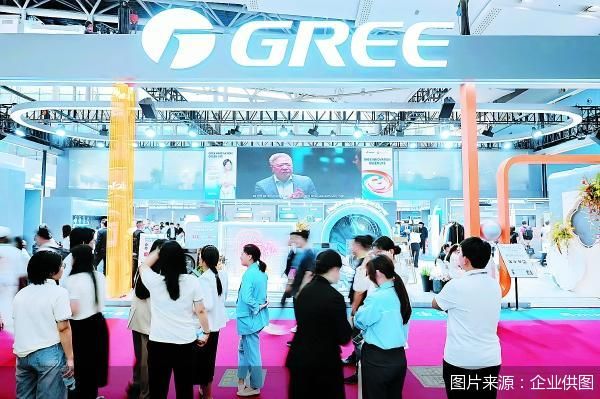
GREE(000651)

Search documents
11月3日投资时钟(399391)指数涨0.23%,成份股星辉娱乐(300043)领涨
Sou Hu Cai Jing· 2025-11-03 11:10
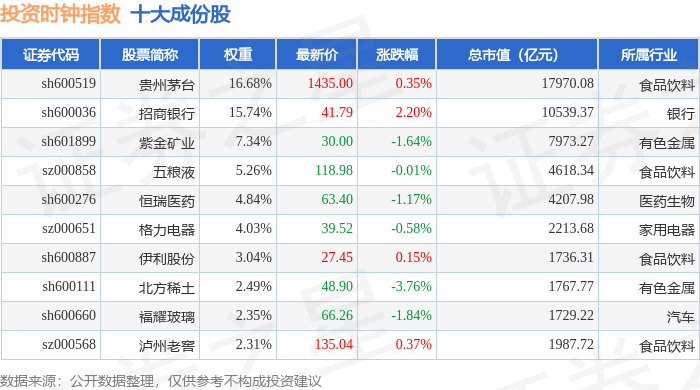
Core Points - The Investment Clock Index (399391) closed at 3364.41 points, up 0.23%, with a trading volume of 95.671 billion yuan and a turnover rate of 0.98% [1] - Among the index constituents, 66 stocks rose, with Xinghui Entertainment leading at a 9.29% increase, while 33 stocks fell, with Lingnan Holdings leading the decline at 5.24% [1] Index Constituents Summary - Major constituents include: - Kweichow Moutai (16.68% weight) at 1435.00 yuan, up 0.35%, with a market cap of 1797.008 billion yuan [1] - China Merchants Bank (15.74% weight) at 41.79 yuan, up 2.20%, with a market cap of 1053.937 billion yuan [1] - Zijin Mining (7.34% weight) at 30.00 yuan, down 1.64%, with a market cap of 797.327 billion yuan [1] - Wuliangye (5.26% weight) at 118.98 yuan, down 0.01%, with a market cap of 461.834 billion yuan [1] - Hengrui Medicine (4.84% weight) at 63.40 yuan, down 1.17%, with a market cap of 420.798 billion yuan [1] Capital Flow Summary - The index constituents experienced a net outflow of 2.407 billion yuan from institutional investors and 0.251 billion yuan from retail investors, while retail investors saw a net inflow of 2.658 billion yuan [3] - Notable capital flows include: - China Merchants Bank with a net inflow of 433.16 million yuan from institutional investors [3] - China Petroleum with a net inflow of 326 million yuan from institutional investors [3] - China Shipbuilding with a net inflow of 284 million yuan from institutional investors [3]







格力电器2025年三季报:单季利润率创历史同期新高海外自主品牌占比跃升至70%中期分红55.85亿元
Xin Lang Cai Jing· 2025-11-03 09:11
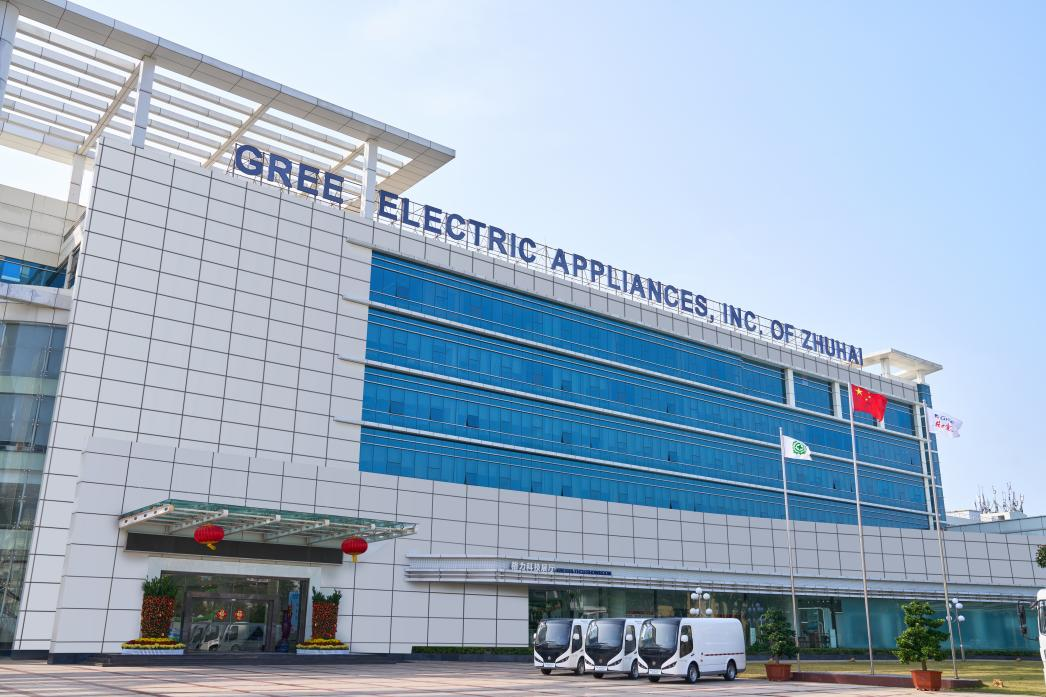
Core Insights - Gree Electric's total revenue for the first three quarters of 2025 was 137.65 billion yuan, a year-on-year decrease of 6.62%, while net profit attributable to shareholders was 21.46 billion yuan, down 2.27% [1] - The company plans to distribute a cash dividend of 10 yuan per 10 shares, totaling 5.585 billion yuan, which accounts for 26.02% of the net profit for the period [1][5] - Gree's self-owned brand market share in split air conditioners reached 70% in 2024, up from less than 30% in 2015, marking a significant rise in the brand's global standing [1][4] Financial Performance - Gree's net profit margin for the first three quarters of 2025 was 15.59%, an increase of 0.69 percentage points year-on-year [1] - In Q3 2025, the net profit reached 7.05 billion yuan, with a net profit margin of 17.61%, setting a historical high for the same period [1] Innovation and Technology - Gree has made multiple technological breakthroughs and product innovations in Q3 2025, emphasizing a "technology-driven" approach to meet consumer demands [2] - The launch of solar-powered air conditioners represents a new dual power supply model, showcasing Gree's commitment to green energy and advanced comfort technologies [3] Market Expansion - Gree has accelerated its national store layout, with a total of 1,012 stores across various cities, enhancing its market presence [4] - The company has established a strong foothold in international markets, with leading market shares in countries like Canada, Brazil, and Saudi Arabia [4] Shareholder Returns - Gree has consistently maintained high dividend payout ratios, with recent distributions of 44.60%, 41.58%, and 26.02% in 2025, significantly higher than industry peers [5] - Cumulatively, Gree has returned over 177.6 billion yuan to shareholders since its listing, reinforcing its commitment to shareholder value [5]

晓数点丨A股三季报风云
Di Yi Cai Jing· 2025-11-03 09:01
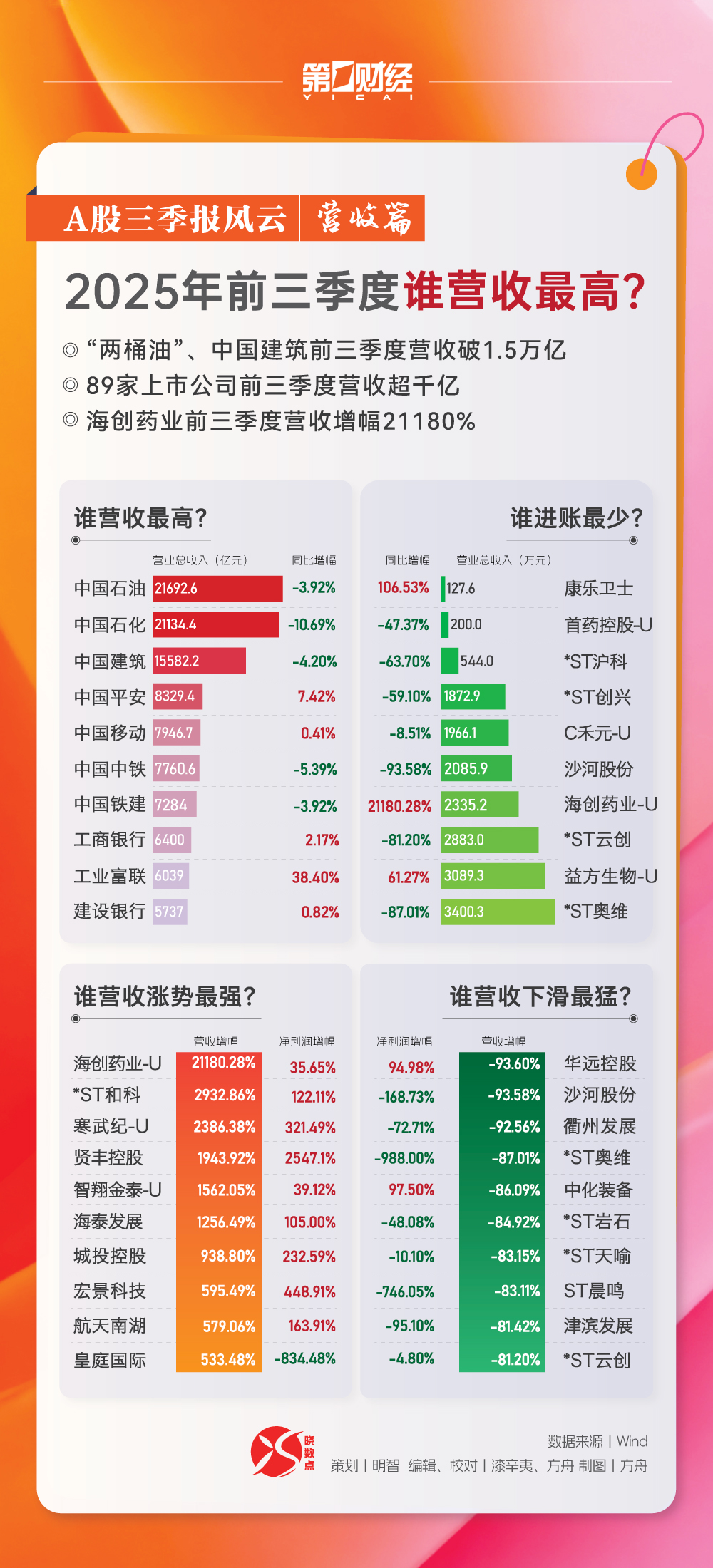
Revenue Summary - China Petroleum reported a total revenue of 216.93 billion yuan, with a year-on-year decrease of 3.92% [2] - China Sinopec's revenue was 211.34 billion yuan, reflecting a significant year-on-year decline of 10.69% [2] - China Construction's revenue stood at 155.82 billion yuan, down 4.20% year-on-year [2] - China Ping An achieved a revenue of 83.29 billion yuan, marking a year-on-year increase of 7.42% [2] - China Mobile's revenue was 79.47 billion yuan, with a slight increase of 0.41% year-on-year [2] - China Railway's revenue reached 77.61 billion yuan, down 5.39% year-on-year [2] - China Railway Construction reported a revenue of 72.84 billion yuan, with a year-on-year decrease of 3.92% [2] - Industrial Fulian's revenue was 60.39 billion yuan, showing a significant increase of 38.40% year-on-year [2] - China Construction Bank's revenue was 57.37 billion yuan, with a slight increase of 0.82% year-on-year [2] Profitability Analysis - Industrial Fulian reported a net profit increase of 61.27% [5] - China Ping An's net profit increased by 11.47% to 132.86 billion yuan [9] - China Life's net profit surged by 60.54% to 167.80 billion yuan [9] - China Petroleum's net profit decreased by 4.90% to 126.28 billion yuan [9] - China Mobile's net profit increased by 4.03% to 115.35 billion yuan [9] - Vanke A reported a significant net loss of over 28 billion yuan, a year-on-year decline of 56.14% [9] Industry Performance - The banking sector's net profit exceeded 1 trillion yuan, indicating strong performance [16] - The steel and non-ferrous metal industries showed signs of recovery [16] - The construction and decoration, as well as the oil and petrochemical industries, reported the highest revenues [16]




白色家电板块11月3日跌0.85%,美的集团领跌,主力资金净流出5.59亿元
Zheng Xing Xing Ye Ri Bao· 2025-11-03 08:47
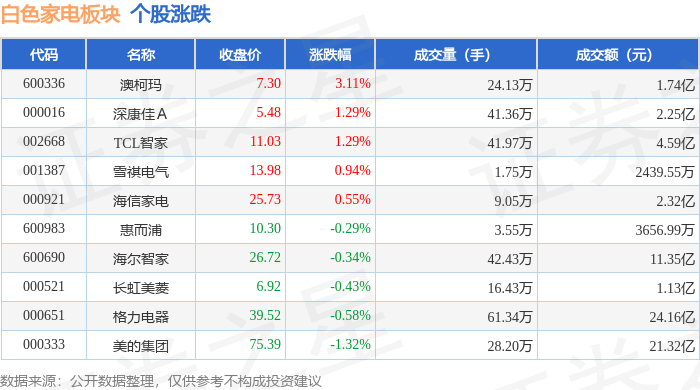
Market Overview - The white goods sector experienced a decline of 0.85% on November 3, with Midea Group leading the drop [1] - The Shanghai Composite Index closed at 3976.52, up 0.55%, while the Shenzhen Component Index closed at 13404.06, up 0.19% [1] Individual Stock Performance - Aokema (600336) saw a closing price of 7.30, with an increase of 3.11% and a trading volume of 241,300 shares, totaling 174 million yuan [1] - TCL Smart Home (002668) closed at 11.03, up 1.29%, with a trading volume of 419,700 shares, amounting to 459 million yuan [1] - Midea Group (000333) closed at 75.39, down 1.32%, with a trading volume of 282,000 shares, totaling 2.132 billion yuan [1] Capital Flow Analysis - The white goods sector saw a net outflow of 559 million yuan from institutional investors, while retail investors contributed a net inflow of 510 million yuan [1] - Among individual stocks, Hisense Home Appliances (000921) experienced a net outflow of 35.42 million yuan from institutional investors [2] - Aokema (600336) had a net inflow of 17.79 million yuan from institutional investors, while retail investors contributed a net inflow of 4.70 million yuan [2]



格力电器2025年三季报:单季利润率创历史同期新高 海外自主品牌占比跃升至70% 中期分红55.85亿元
Xin Lang Zheng Quan· 2025-11-03 08:14
Core Insights - Gree Electric's total revenue for the first three quarters of 2025 was 137.65 billion yuan, a year-on-year decrease of 6.62%, while net profit attributable to shareholders was 21.46 billion yuan, down 2.27% year-on-year, with a net profit margin of 15.59%, an increase of 0.69 percentage points [1][2] - The company plans to distribute a cash dividend of 10 yuan per 10 shares, totaling 5.585 billion yuan, which accounts for 26.02% of the net profit attributable to shareholders [1][13] Financial Performance - In Q3 2025, Gree achieved a net profit of 7.05 billion yuan, with a net profit margin of 17.61%, marking a historical high for the same period, up 1.01 percentage points year-on-year and 2.41 percentage points quarter-on-quarter [2] - The company has maintained a high dividend payout ratio, with cumulative dividends exceeding 177.6 billion yuan since its listing, reflecting a commitment to shareholder returns [13] Innovation and Product Development - Gree emphasizes independent innovation as a core value, with significant technological breakthroughs and product innovations in Q3 2025, including the launch of photovoltaic air conditioners and AI-enabled products [2][6] - New products such as the heat pump washing and drying machine and dual-system refrigerators showcase Gree's focus on energy efficiency, intelligence, and comfort [3] Market Position and Global Strategy - Gree's split air conditioner retail volume ranked first globally in 2024, with its self-owned brand market share rising from less than 30% in 2015 to 70% [1][9] - The company is expanding its market presence with over 1,012 stores nationwide, enhancing consumer awareness of its full range of smart home appliances [7][10] Long-term Growth Potential - Gree's commitment to core technology and user needs positions it well for long-term growth, with ongoing global expansion and a focus on high-quality development [11]
A股三季报核心指标环比改善,现金流ETF嘉实(159221)红盘蓄势,成分股亚翔集成、海陆重工10cm涨停
Xin Lang Cai Jing· 2025-11-03 03:29
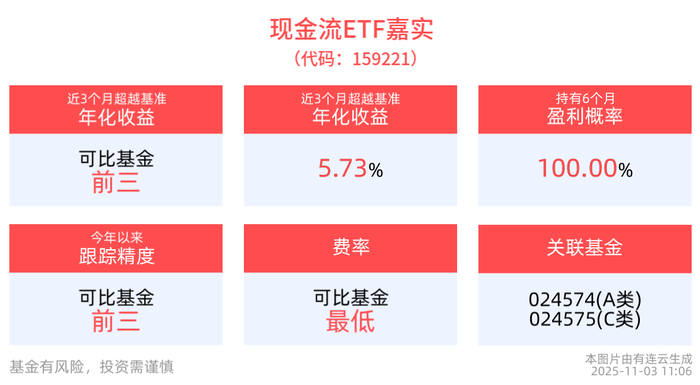
Core Insights - The National Index of Free Cash Flow has increased by 0.15% as of November 3, 2025, with notable stock performances from companies like Yaxing Integration and Hailu Heavy Industry reaching the daily limit up [1] - The Cash Flow ETF from Harvest has seen a net value increase of 20.15% over the past six months, indicating strong performance and investor interest [3] Group 1: Cash Flow ETF Performance - As of October 31, 2025, the Cash Flow ETF from Harvest has achieved a maximum monthly return of 6.91% since its inception, with an average monthly return of 3.13% [3] - The top ten weighted stocks in the National Index of Free Cash Flow account for 54.79% of the index, with China National Offshore Oil Corporation (CNOOC) being the largest at 9.80% [3][5] Group 2: Market Environment and Trends - Global monetary and fiscal easing expectations have positively influenced risk assets, creating a favorable macro environment for A-shares [5] - A-share third-quarter reports show improvements in key metrics such as profit, revenue, and ROE compared to the first half of the year, suggesting a potential transition to a fundamental bull market [5]





89家公司年内分红金额超10亿元,300红利低波ETF(515300)红盘蓄势,机构:红利板块或仍有演绎配置机会
Xin Lang Cai Jing· 2025-11-03 02:56
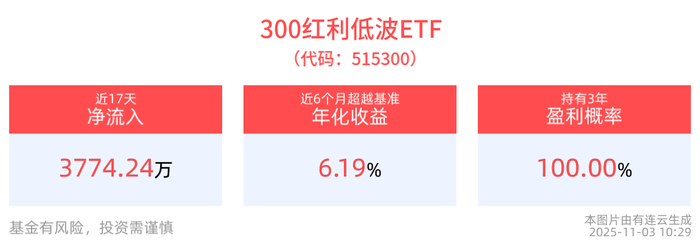
Core Insights - The CSI 300 Dividend Low Volatility Index has shown a positive performance with a 0.58% increase, driven by significant gains in stocks such as Baosteel and China Construction Bank [1][4] - The CSI 300 Dividend Low Volatility ETF (515300) has also increased by 0.45%, indicating strong investor interest and market activity [1][3] Market Performance - The CSI 300 Dividend Low Volatility ETF recorded a turnover rate of 0.92% with a transaction volume of 43.38 million yuan, reflecting active trading [3] - The ETF's latest scale reached 4.704 billion yuan, with a net inflow of 37.74 million yuan over the past 17 trading days, indicating a positive trend in investor sentiment [3] Dividend Distribution - As of October 31, 2025, a total of 1,033 listed companies have announced cash dividend plans, an increase of 141 companies compared to the previous year, with total cash dividends amounting to 734.9 billion yuan [3] - Notably, 89 companies have declared dividends exceeding 1 billion yuan within the year [3] Investor Sentiment - Market sentiment indicators have returned to a neutral zone, but there remains a willingness among investors to "buy the dip," suggesting that adjustments may present further investment opportunities [4] - The top ten weighted stocks in the CSI 300 Dividend Low Volatility Index account for 35.78% of the index, with companies like China Shenhua and Shuanghui Development leading the way [4][6] Stock Performance - The top performing stocks within the index include China Shenhua (up 1.93%), Shuanghui Development (up 1.59%), and China Petroleum (up 1.65%), while some stocks like Gree Electric and Huayu Automotive experienced declines [6] - Investors without stock accounts can access investment opportunities through the corresponding CSI 300 Dividend Low Volatility ETF linked fund (007606) [6]



中国消费脉搏 2025 年第三季度_体验式消费引领,高端需求反弹,消费市场格局分化-China Consumer Pulse 3Q25_ Experiential spending leads and Premium demand rebounds, amid mixed consumer landscape
2025-11-03 02:36
Summary of China Consumer Pulse Q3 2025 Industry Overview - **Industry**: Chinese Consumer Market - **Key Sectors Analyzed**: Alcohol, Apparel, Beauty, Travel, Luxury Goods, Autos Core Insights 1. **Mixed Consumer Sentiment**: Chinese consumer sentiment remains mixed, with a notable divergence in spending patterns across sectors [2][29][30] 2. **Experiential Spending Resilience**: Experiential categories such as restaurants (+24% YoY) and travel (+16% YoY) show resilience, indicating a shift towards experiences over goods [2][35] 3. **Premium Demand Recovery**: Onshore luxury spending has improved, with premium auto sales stabilizing and showing positive year-over-year growth in September, ending a 19-month decline [2][30] 4. **Digital Channels Outperform**: Digital retail channels continue to outperform traditional retail, although there are signs of weakness in specific segments like beauty e-commerce, which saw a -3% decline [2][29][30] 5. **GDP and Retail Growth Slowdown**: China's Q3 GDP growth slowed to 4.8% YoY, with retail growth easing to 2.1%, attributed to fading consumer incentives and macroeconomic uncertainties [3][29] 6. **Deflationary Trends**: Deflationary pressures persist across travel and hotel pricing, with moderate price declines observed [12][29] Sector-Specific Insights Premium Beverages - **Weak Demand**: Ultra-premium Baijiu prices continued to slide in Q3 due to weak demand, particularly around the Mid-Autumn Festival [4][30] Apparel and Sportswear - **Mixed Performance**: The apparel market is growing online but remains negative offline, with brands like Adidas showing over 20% growth while Nike faces challenges [5][22] Home Appliances - **Sector Contraction**: The home appliance sector contracted by 7% in Q3, with significant declines in both domestic and overseas exports [7][31] Luxury Goods - **Signs of Improvement**: Early signs of recovery in the luxury market, with brands like Hermès and Louis Vuitton performing well, while Kering struggles [8][9][30] Automotive - **Sales Growth Slowdown**: Auto sales growth slowed to +2.5% YoY in Q3, with EV sales decelerating to +12.5% YoY. However, EV penetration reached 55.1% [10][16][17] Hotels - **RevPAR Declines**: Domestic hotel RevPAR continues to decline, with luxury hotels being the only segment not experiencing persistent declines [10][23] Travel - **Resilient Growth**: The travel industry showed stable positive growth of 16% during the National Day Golden Week, reflecting ongoing domestic travel trends [11][12] Cosmetics - **Moderate Growth**: The cosmetics sector saw a +6.5% YoY increase in gross merchandise value, marking an improvement from previous quarters [13][29] Additional Considerations - **Cautious Consumer Behavior**: The macroeconomic environment is expected to lead to cautious, value-driven consumer behavior, highlighting the uneven recovery across sectors [3][32] - **Investment Implications**: The outlook for various sectors remains cautious, with potential growth in EVs and premium segments, while traditional sectors face challenges [16][17][22][23]



格力亮出黑科技,这才是董明珠和雷军赌约的下半场?
Sou Hu Cai Jing· 2025-11-02 23:10
Core Viewpoint - Gree Electric's introduction of the "zero electricity cost" air conditioning system has garnered significant attention, addressing consumer concerns about high electricity bills and potentially revolutionizing the air conditioning market [2][4][13]. Group 1: Product Innovation - Gree's "zero electricity cost" air conditioning system utilizes photovoltaic direct drive technology, allowing it to operate independently of the grid and significantly reduce electricity expenses for households [5][13]. - The system integrates solar power generation, energy storage, and air conditioning technology, achieving a high energy utilization rate of 99% by eliminating the need for traditional inverters [13][15]. - Gree claims that in sunny regions, the system can save approximately 4,000 kWh of electricity annually, equivalent to over half a year's electricity costs for an average household [15]. Group 2: Market Competition - The competitive landscape has intensified between Gree and Xiaomi, with both companies engaging in public disputes over market share and product quality [6][12]. - Xiaomi's rapid growth in air conditioning sales, with over 5.4 million units shipped in the first half of 2025 and a year-on-year growth rate exceeding 60%, has put pressure on Gree [12]. - Gree's market share remains strong at 29.42%, but the close competition in online sales, where Gree's share is 17.66% compared to Xiaomi's 15.92%, indicates a tightening market [12]. Group 3: Technological Advancements - Gree has made significant strides in research and development, with a reported R&D expenditure of 7.14 billion yuan in 2024, reflecting a 1.9% year-on-year increase despite overall revenue decline [17]. - The company has filed nearly 140,000 patents, including over 70,000 invention patents, establishing a strong foundation for its innovative products [18]. - Gree's breakthroughs in magnetic levitation technology for large central air conditioning systems could save approximately 20.48 billion yuan in electricity costs annually if adopted by 30% of public buildings nationwide [17]. Group 4: Environmental Impact - The "zero electricity cost" air conditioning system is expected to contribute to significant carbon reduction, with one system's annual carbon offset equivalent to 400 million trees [15]. - Gree's technology aligns with global sustainability goals, promoting a shift from energy-consuming products to energy-efficient systems, thereby enhancing China's position in the green technology sector [21].


格力提前“入冬”?
Bei Jing Shang Bao· 2025-11-02 16:01
Core Viewpoint - Gree Electric Appliances has reported a significant decline in both revenue and net profit for the third quarter, highlighting the company's internal struggles and external challenges in a tough market environment [1][3]. Financial Performance - For the first three quarters of the year, Gree's revenue was 137.18 billion yuan, a year-on-year decrease of 6.5%, while net profit attributable to shareholders was 21.461 billion yuan, down 2.27% [3]. - In the third quarter alone, Gree's revenue dropped to 39.855 billion yuan, with a year-on-year decline of 15.09%, and net profit fell to 7.049 billion yuan, down 9.92% [3]. - The company's heavy reliance on air conditioning, which accounted for 78.38% of its revenue in the first half of the year, means fluctuations in this core business directly impact overall performance [3]. Industry Context - The air conditioning industry is currently facing a downturn, with domestic production and retail sales both experiencing significant declines [3]. - Data from Aowei Cloud Network indicates that in November, domestic air conditioning production fell by 19.8% year-on-year, and retail sales dropped by 21.2% [3]. Competitive Landscape - The air conditioning market is characterized by intense competition and product homogeneity, making it difficult for companies to differentiate themselves [4]. - Xiaomi's new smart home appliance factory in Wuhan poses a direct threat to Gree, as it shifts from an OEM model to in-house production, enhancing supply chain efficiency and product quality [6][7]. - Xiaomi's recent financial performance shows a significant increase in revenue from IoT and consumer products, with air conditioning sales growing over 60% year-on-year [7]. Strategic Considerations - Gree needs to address both internal challenges and external competition to regain market momentum, focusing on inventory reduction and demand recovery [8]. - The company must innovate in channel strategies and ecosystem development to navigate the current market difficulties and seek growth opportunities [8].