GOTION(002074)

Search documents
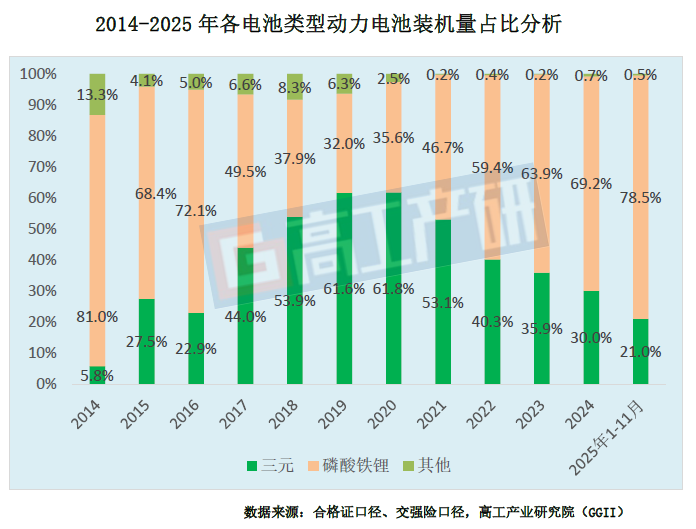
GGII:2025年1-11月国内磷酸铁锂动力电池装机份额高达78.5% 后市有望突破历史峰值
智通财经网· 2025-12-25 08:52
Core Insights - The domestic lithium iron phosphate (LFP) battery installation volume is projected to reach approximately 490 GWh from January to November 2025, representing a year-on-year growth of 55% and a market share of 78.5%, an increase of 10 percentage points compared to the same period last year [1][5]. Group 1: Market Trends - The significant increase in the market share of LFP batteries is primarily driven by market demand rather than policy incentives, contrasting with 2014 when policy was the main driver [3]. - The proportion of new vehicles equipped with LFP batteries has remained between 90% and 96% this year, with a notable increase from 92% to 94.5% in the second half of the year, indicating a growing preference among manufacturers for LFP technology [5]. Group 2: Product Offerings - The number of new energy passenger car models equipped with LFP batteries has risen from 213 to 536 over the past three years, with popular models like Geely Xingyuan, Xiaomi SU7, and XPeng MONA M03 accelerating production and delivery, further boosting the market share of LFP batteries [8]. Group 3: Competitive Landscape - The top 10 companies in the domestic LFP battery installation market accounted for 95.3% of the total volume from January to November 2025, with companies like CATL, EVE Energy, and Xinwangda showing steady growth over the past three years [10]. - CATL's market share is projected to increase from 34.42% in 2023 to 36.79% in 2025, while BYD's share is expected to decline from 43.49% to 29.19% during the same period [11].





长单潮带动4000亿大扩产,储能真爆发了
投中网· 2025-12-25 07:45
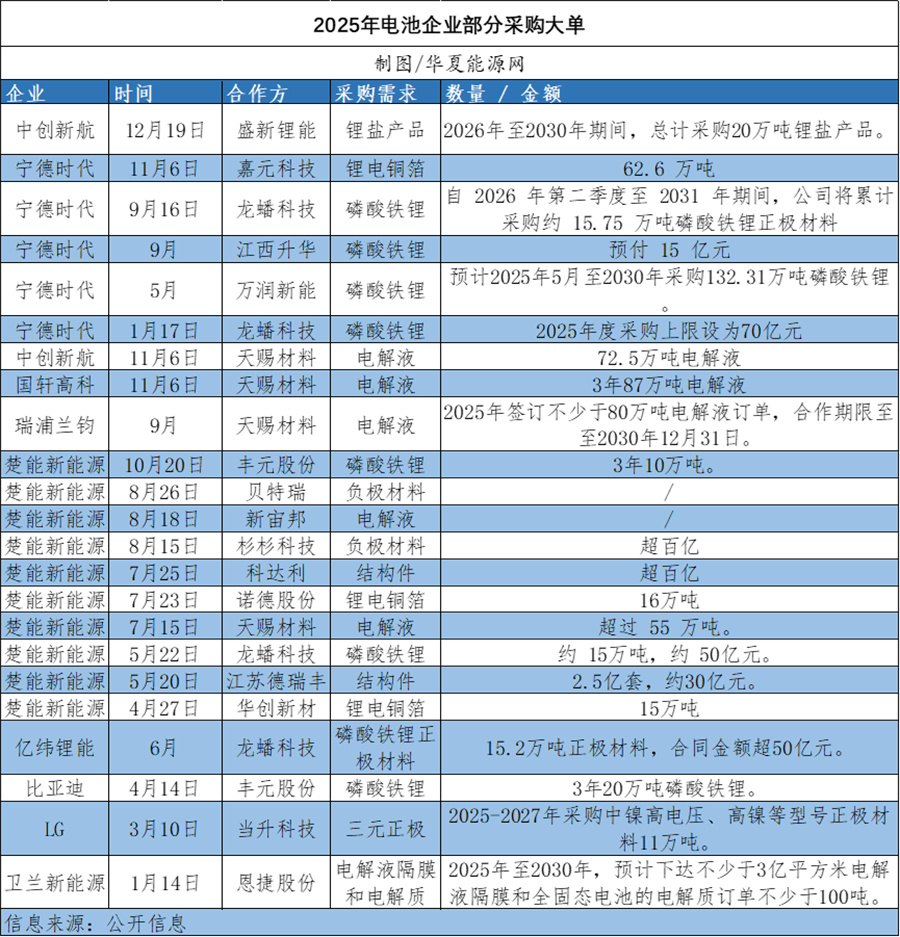
Core Viewpoint - The lithium battery industry is experiencing a surge in long-term contracts, driven by high demand and supply chain stability, but there are concerns about potential overcapacity similar to the solar industry in previous years [6][8][21]. Group 1: Long-term Contracts - Major companies in the lithium battery sector are signing significant long-term contracts, with examples including Longpan Technology's agreement to purchase 1.3 million tons of cathode materials worth approximately 45 billion yuan from Chuangneng New Energy [6]. - Other industry leaders like CATL and Yiwei Lithium Energy have also disclosed large procurement agreements, indicating a trend of securing supply for critical materials over multi-year periods [6][8]. - The trend of long-term contracts is seen as a response to the tight supply chain and high demand in the lithium battery market, with many contracts spanning 3 to 5 years [7][9]. Group 2: Market Demand and Growth - The global lithium battery storage market has seen explosive growth, with a reported 68% year-on-year increase in installed capacity, reaching 170 GWh in the first three quarters of 2025 [8]. - The demand for power batteries has also surged, with global installed capacity reaching 811.7 GWh, a 34.7% increase compared to the previous year [8]. - The industry is currently experiencing high operational rates, with companies like CATL and Yiwei Lithium Energy reporting utilization rates above 90% [10][11]. Group 3: Supply Chain and Material Costs - The high demand for raw materials has led to significant price increases across various components, including lithium carbonate and electrolytes, with lithium carbonate prices rising by 31.8% in two months [13]. - Companies are increasingly locking in long-term contracts for raw materials to mitigate production costs and ensure supply chain security [13]. - The current supply chain challenges are characterized by structural mismatches, particularly in high-capacity battery cells, leading to delivery difficulties for many companies [15]. Group 4: Capacity Expansion - The industry is entering a new phase of capacity expansion, with major players planning to increase production significantly, totaling over 510 GWh of new capacity and an investment of 176.2 billion yuan [17]. - This expansion is primarily driven by leading companies like CATL and Guoxuan High-Tech, which are ramping up production to meet the growing demand [18]. - However, there are concerns that this rapid expansion could lead to overcapacity, reminiscent of the solar industry's past experiences [21][22]. Group 5: Industry Outlook and Risks - Despite the optimistic outlook for growth in the lithium battery sector, there are warnings about the potential for overcapacity and the need for companies to avoid a race to expand production without careful consideration [20][21]. - The lessons learned from the solar industry highlight the risks associated with aggressive capacity expansion driven by order backlogs, which can lead to significant financial distress if market conditions change [22].

海内外全面开花,储能迈向市场化新阶段|2025中国经济年报
Hua Xia Shi Bao· 2025-12-25 02:20
Core Insights - The cancellation of mandatory energy storage requirements has not hindered the growth momentum of the energy storage industry, with both domestic and international markets experiencing unexpected growth in the second half of the year [2][4] - Energy storage is increasingly recognized for its economic value and importance in the consumption of green electricity, beyond just its role in energy transition [2] Industry Growth - The share of energy storage batteries in the lithium battery market has grown significantly, surpassing 25% in the first half of the year and reaching 28% in November [2] - Global lithium battery production reached 2058.44 GWh in the first 11 months of the year, a year-on-year increase of 48.59%, while cumulative production of energy storage batteries was 535.98 GWh, up 64.14% year-on-year [2] - The expected installed capacity of lithium energy storage in China for 2025 is projected to reach 157 GWh, representing an 82.9% year-on-year increase [2][4] Market Dynamics - The energy storage industry is transitioning from policy-driven growth to market-driven growth, with global lithium energy storage installations expected to reach 181 GWh in 2024, an 88% increase year-on-year [4] - China, Europe, and the United States account for approximately 90% of the energy storage market, with China holding a 50%-60% market share [4][5] - The European market is expected to see a significant increase in energy storage installations, with a projected growth rate of 92% and an addition of 48 GWh [4] Supply Chain and Production - Global energy storage cell shipments reached 410.45 GWh in the first three quarters of 2025, a year-on-year increase of 98.5%, with a record quarterly shipment of 170.24 GWh [5][6] - Chinese companies dominate the global energy storage cell market, with the top ten companies holding a market share of 89.9% [6] - The global energy storage battery market is expected to see a shipment volume of 746 GWh in 2026, with a year-on-year growth rate of 39% [6] International Expansion - Chinese companies are increasingly expanding into overseas markets, with significant growth in revenue from international operations, exemplified by CATL's overseas revenue rising from 0.59% to 30.48% of total revenue from 2015 to 2024 [7][8] - The overseas energy storage market is characterized by higher marketization and profitability due to significant price differentials between peak and off-peak electricity [8] - As of October 2025, 47 Chinese companies have signed or completed over 45 overseas strategic cooperation agreements, with a total scale of approximately 69 GWh [8]


海内外全面开花,储能迈向市场化新阶段
Zhong Guo Neng Yuan Wang· 2025-12-25 02:20
Core Insights - The cancellation of mandatory energy storage requirements has not hindered the growth momentum of the energy storage industry, with significant market expansion observed in both domestic and international markets in the second half of the year [1][2] - Energy storage is increasingly recognized for its economic value and importance in renewable energy consumption, with a notable rise in its share within the lithium battery market [1] Market Growth - The global lithium battery production reached 2058.44 GWh in the first 11 months of the year, marking a year-on-year increase of 48.59%, while the cumulative production of energy storage batteries was 535.98 GWh, up 64.14% year-on-year [1] - The energy storage battery's share of total lithium battery production exceeded 25% in the first half of the year and increased to 26% over the first 11 months, with November alone reaching 28% [1] - The expected installed capacity of lithium energy storage in China for 2025 is projected to reach 157 GWh, representing an 82.9% year-on-year growth [1] Regional Insights - China, Europe, and the United States account for approximately 90% of the energy storage market, with China holding a market share of 50%-60% [2] - The European market is expected to see a significant growth rate of 92%, with an anticipated addition of 48 GWh of installed capacity [2] - The U.S. market has experienced a slowdown in growth due to tariff fluctuations and lengthy project approval times, while the Middle East is emerging as a rapidly growing market driven by energy transition and decarbonization demands [3] Supply Chain Dynamics - In the first three quarters of 2025, global energy storage cell shipments reached 410.45 GWh, a year-on-year increase of 98.5%, with the third quarter setting a new record for quarterly shipments at 170.24 GWh [3] - Chinese companies dominate the global energy storage cell market, with the top ten companies holding a market share of 89.9% [4][5] Future Projections - The global energy storage battery shipment is expected to reach 746 GWh in 2026, with a year-on-year growth rate of 39% [5] - The global energy storage market is projected to have significant growth potential, with estimates suggesting that the peak annual installed capacity could exceed 1.5 TWh by 2035, indicating an 8.6 times growth potential from current levels [5] International Expansion - Chinese companies are increasingly expanding into overseas markets, with significant growth in international revenue observed, particularly for companies like CATL [6] - The overseas energy storage market is characterized by higher marketization levels and greater profit margins due to more pronounced peak-valley price differences [6] - As of October 2025, 47 Chinese companies have signed or completed overseas strategic collaborations and projects totaling approximately 69 GWh [6] Pricing Trends - The rising prices of energy storage cells reflect strong downstream demand, with major lithium battery material companies operating at full capacity [7] - Long-term contract negotiations for 2026 have already been completed, with price increases of 0.02-0.04 CNY per watt-hour compared to 2025 levels [7]
长单潮带动4000亿大扩产,储能走在了光伏过剩的老路上
3 6 Ke· 2025-12-25 02:17
Core Viewpoint - The lithium battery industry is experiencing a surge in long-term contracts, indicating a robust demand and supply chain stability, but there are concerns about potential overcapacity similar to past experiences in the solar industry [1][2][12]. Group 1: Long-term Contracts and Market Dynamics - Long-term contracts in the lithium battery sector have exploded, with significant agreements such as Longpan Technology's contract worth 45 billion yuan for 1.3 million tons of cathode materials from 2025 to 2030 [1]. - Major players like CATL and Wanrun New Energy have also signed substantial contracts, reflecting a trend of large-scale procurement across the industry [1][2]. - The storage market is booming, with companies like Haibosi Chuang and Hichain Energy entering into multi-year agreements for significant quantities of energy storage products [1][2]. Group 2: Supply Chain and Production Capacity - The lithium battery supply chain is currently under pressure due to high demand, leading to full production rates across various segments [3][4]. - Companies are reporting unprecedented production levels, with some indicating that December, typically a slow month, will see double-digit growth in battery production [4]. - The production capacity utilization rates for leading companies have exceeded 90%, with some reaching 100% [6][11]. Group 3: Price Increases and Material Demand - The surge in demand has led to rising prices for key raw materials, including lithium carbonate and electrolytes, with lithium carbonate prices increasing by 31.80% over two months [8]. - The price of hexafluorophosphate lithium has skyrocketed by over 260% in five months, prompting companies to secure long-term contracts to stabilize costs [8]. Group 4: Expansion Plans and Industry Outlook - The current expansion wave in the lithium battery sector is driven by the need to meet long-term orders, with over 510 GWh of new production capacity planned, involving investments of 176.2 billion yuan [11]. - Major companies are actively expanding their production capabilities, with CATL planning over 70 GWh of new capacity across multiple locations [9][11]. - Despite the optimistic outlook, there are concerns about potential overcapacity, as the industry may face challenges similar to those experienced in the solar sector [12][14].
锂电股,高光回归
Ge Long Hui A P P· 2025-12-23 09:59
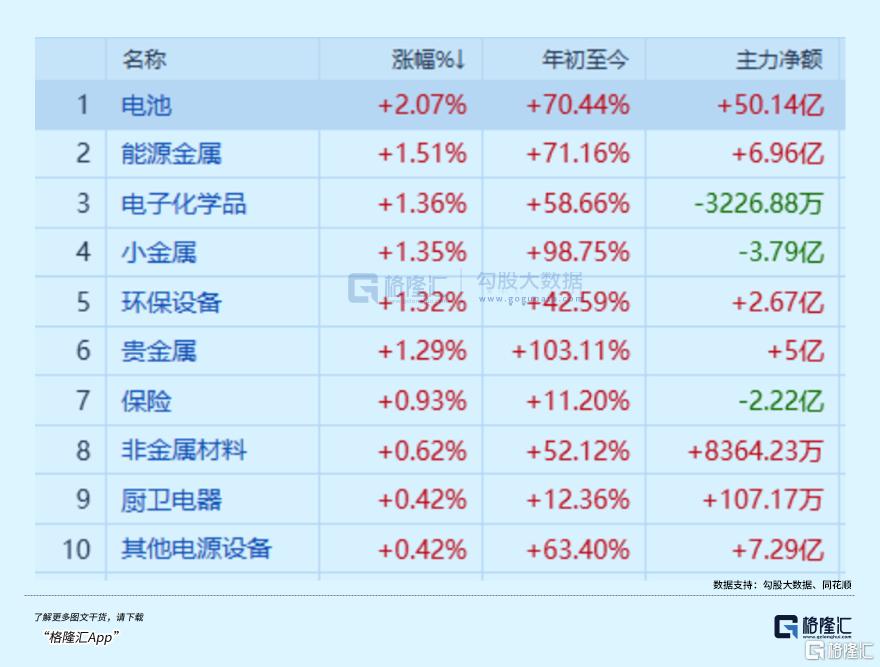
Core Viewpoint - The lithium battery sector has rebounded strongly after a two-month correction, with significant inflows of capital and a notable increase in stock prices, indicating a potential new upward trend for the industry [1][5]. Market Performance - As of December 23, the lithium battery concept index rose by 2.07%, with a net inflow of 5 billion in main capital, leading all sectors [1]. - The price of lithium carbonate futures surged by 5.96%, reaching 120,000 yuan/ton, marking a return to the high point seen in March 2024 [3]. Supply and Demand Dynamics - The recent price increase in lithium is attributed to a tight supply-demand balance, with domestic lithium carbonate production decreasing to a three-year low [7]. - In November 2025, domestic production of battery-grade lithium carbonate was approximately 66,000 tons, down 0.2% month-on-month, while imports of lithium carbonate fell by 7.6% [7]. - The demand for lithium remains robust, driven by the growth in the electric vehicle market, with November 2025 seeing production and sales of 1.88 million and 1.823 million units respectively, both up by over 20% year-on-year [7][8]. Price Trends and Industry Recovery - The price of battery-grade lithium carbonate has risen from 81,000 yuan/ton at the beginning of November to 92,000 yuan/ton by the end of the month, reflecting a monthly increase of 13.58% [5]. - The overall profitability of the lithium battery industry is recovering, with the net profit of 118 lithium battery concept stocks in the A-share market reaching 117.196 billion yuan in the first three quarters, a year-on-year increase of 26.97% [14]. Key Players and Financial Performance - Leading companies like Ganfeng Lithium reported a significant revenue increase of 44.1% year-on-year, with net profit soaring by 364.02% in the third quarter [15]. - Other companies such as Tianqi Lithium and Guoxuan High-Tech also reported substantial profit increases, indicating a positive trend across the sector [16]. Future Outlook - The global energy storage market is expected to see explosive growth, with predictions of lithium battery shipments reaching 580 GWh in 2025, a year-on-year increase of 65% [9]. - Major institutions are optimistic about the lithium battery sector, with forecasts suggesting a new upward cycle starting in 2026, driven by strong demand and favorable policies [18][19].



上游碳酸锂涨价延续至下游,产业进展频频,锂电产业链景气度持续攀升!电池ETF(159755)、储能电池ETF广发(159305)冲击3连涨!
Xin Lang Cai Jing· 2025-12-23 05:27
Group 1 - The lithium battery industry chain has seen a continuous increase in demand since December, driven by the energy storage sector, leading to price hikes across multiple segments [1] - Prices for lithium hexafluorophosphate, VC additive (ethylene carbonate), and FEC (fluoroethylene carbonate) are on the rise due to an expanding supply-demand gap [1] - Several lithium iron phosphate companies have announced price increases, with Suzhou Dejia Energy Technology Co., Ltd. planning a 15% price hike for its battery products starting December 16 [1] Group 2 - EVE Energy is planning to build a nearly 30GWh cylindrical battery factory near BMW's plant in Hungary, expected to be operational by 2026 [2] - The new generation BMW iX3, equipped with EVE Energy's cylindrical battery, achieved a real-world range of 1007.7 km, surpassing the official WLTP range of 805 km [2] - The lithium iron phosphate market is projected to see significant demand growth, with production expected to rise from 3.9 million tons in 2025 to 5.8 million tons by 2026 [2] Group 3 - As of December 22, 2025, the battery ETF has seen a significant growth of 1.05 billion yuan in scale over the past week [3] - The battery ETF has also experienced a substantial increase in shares, with a growth of 19.46 billion shares over the past three months [3] - The storage battery ETF has surged over 2%, with constituent stocks like Tongfei Co. and Penghui Energy showing notable gains [3] Group 4 - The battery ETF (159755) closely tracks the National Index for New Energy Vehicle Batteries, focusing on the electric vehicle battery industry chain [4] - The storage battery ETF (Guangfa, 159305) tracks the National Index for New Energy Batteries, emphasizing the storage battery sector and selecting 50 stocks with high market capitalization and liquidity [4]


从“增长”到“重塑”:解码2025锂电扩产潮里的产业变局
Xin Lang Cai Jing· 2025-12-23 04:58
Core Insights - The Chinese lithium battery storage industry is undergoing significant expansion, with 132 new lithium-ion battery manufacturing projects planned to achieve an annual capacity of 1803 GWh by the end of 2025, backed by a total investment of approximately 428.27 billion yuan [1][23][20] Regional Distribution - The geographical distribution of lithium battery production capacity is shifting from a previously concentrated model in the southeast coastal regions to a more collaborative structure involving East China leading, Central China rising, and Southwest China advancing [3][25] - East China remains a cornerstone, with Shandong, Jiangsu, and Zhejiang leveraging their mature chemical industry foundations and supply chain advantages to become core manufacturing hubs [3][25] - Central China, particularly Hubei, is emerging as a significant player with a storage industry cluster generating over 60 billion yuan, achieving over 20% of the national power battery capacity [5][28] - Southwest China, led by Sichuan, is attracting large-scale energy-sensitive storage battery projects due to its abundant hydropower resources and lower electricity costs [8][31] Technological Developments - Phosphate iron lithium (LFP) batteries maintain a dominant position, accounting for 81.2% of the loading volume in power and storage sectors, with a 51.4% year-on-year increase in exports [9][32] - Sodium-ion batteries are transitioning from laboratory to industrial production, presenting a strategic reserve for addressing lithium resource fluctuations [11][34] - Solid-state batteries are making strides in industrialization, with projects in Sichuan and Anhui exceeding 5 billion yuan in total investment [11][34] - The penetration of large cylindrical batteries is accelerating, with projections indicating global production capacity could exceed 300 GWh by 2026 [11][34] Competitive Landscape - Leading companies like CATL are expanding aggressively, with individual project investments exceeding 10 billion yuan and capacity planning reaching 10 GWh [12][35] - The second-tier players are intensifying their positioning battles, with companies like Guoxuan High-Tech and others focusing on niche markets and specific technologies [12][38] - The number of newly registered lithium battery-related companies reached approximately 37,000 in the first 11 months of 2025, indicating strong capital and entrepreneurial interest in the sector [12][38] Project Progress - As of November 2025, 74 projects are in substantial stages of construction, representing nearly 70% of the total planned projects, with 30 newly started, 23 under construction, and 21 already in production [16][39] - There are 28 projects in preliminary stages, with 12 already partially completed, indicating a steady influx of new capacity into the market [19][42] Structural Changes - The expansion of capacity is characterized by a supply-side structural reform, focusing on high-quality replacements rather than low-level repetitive construction [20][43] - New production lines are targeting high-capacity cells of 314 Ah and above, leading to the exit of outdated capacities under price and technological pressures [20][43] - Companies with integrated capabilities from lithium mining to recycling are gaining advantages in cost control and supply chain security [20][43] - Chinese storage enterprises are accelerating localized capacity layouts in Southeast Asia, Europe, and North Africa to navigate complex international trade environments [22][45]
国轩高科涨2.02%,成交额5.45亿元,主力资金净流入3038.88万元
Xin Lang Zheng Quan· 2025-12-23 02:07
Core Viewpoint - Guoxuan High-Tech's stock price has shown significant growth this year, with a year-to-date increase of 86.40%, despite recent fluctuations in trading volume and market activity [1][2]. Financial Performance - For the period from January to September 2025, Guoxuan High-Tech achieved a revenue of 29.508 billion yuan, representing a year-on-year growth of 17.21%. The net profit attributable to shareholders reached 2.533 billion yuan, marking a substantial increase of 514.35% [2]. Stock Market Activity - As of December 23, Guoxuan High-Tech's stock price was 39.37 yuan per share, with a market capitalization of 71.407 billion yuan. The stock experienced a trading volume of 5.45 billion yuan and a turnover rate of 0.80% [1]. - The company has seen a net inflow of main funds amounting to 30.388 million yuan, with significant buying and selling activity from large orders [1]. Shareholder Information - As of November 20, Guoxuan High-Tech had 271,900 shareholders, a decrease of 4.58% from the previous period. The average number of circulating shares per shareholder increased by 4.80% to 6,384 shares [2]. - The top ten circulating shareholders include notable entities such as Hong Kong Central Clearing Limited and various ETFs, with changes in their holdings reflecting market dynamics [3]. Business Overview - Guoxuan High-Tech, established on January 23, 1995, and listed on October 18, 2006, specializes in power lithium batteries and power distribution equipment. The revenue composition includes 72.37% from power battery systems, 23.52% from energy storage battery systems, and smaller contributions from other segments [1].
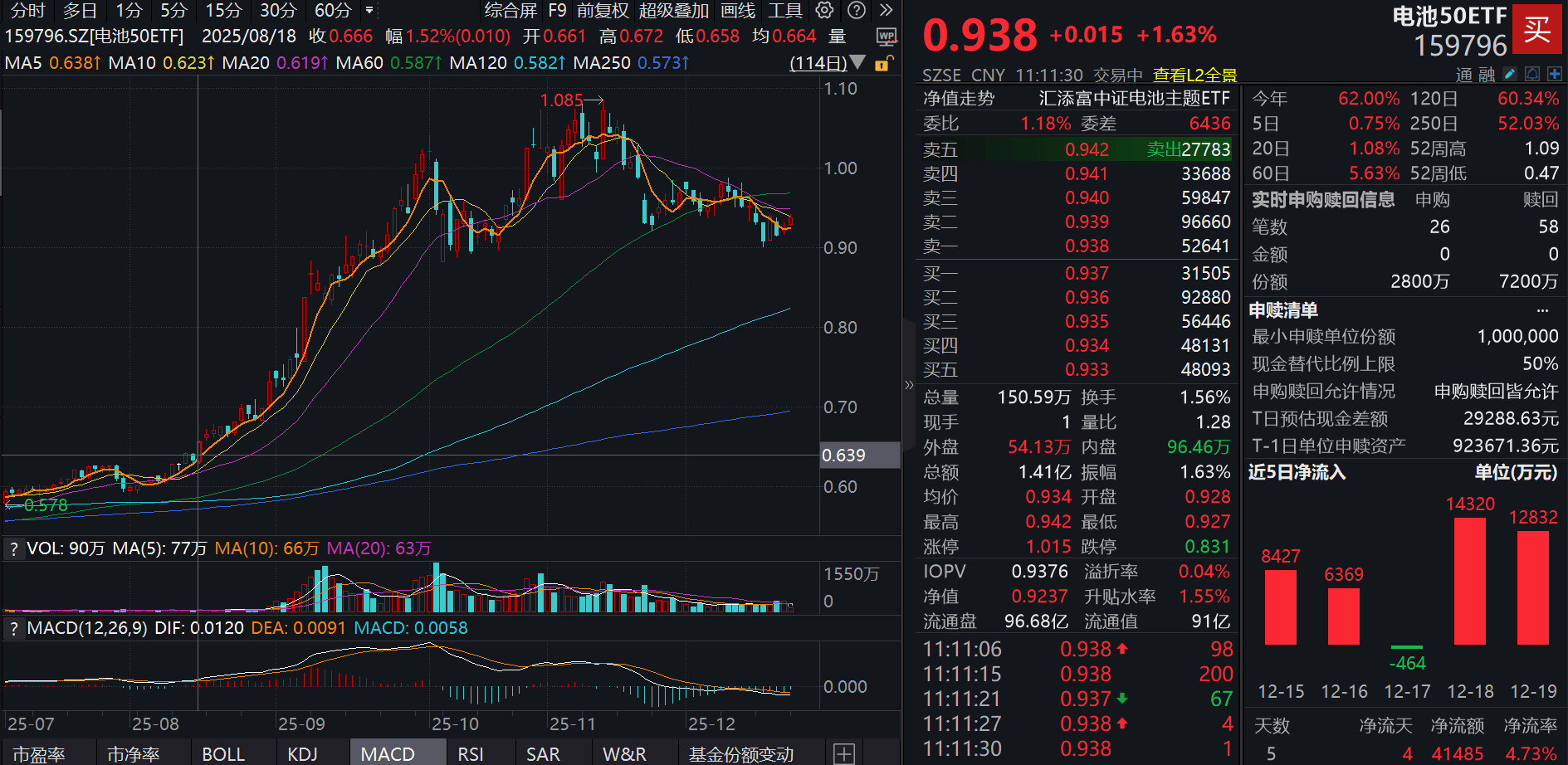
碳酸锂期货暴涨超4%,广期所调整交易限额!恩捷股份劲升超9%,并购重组进行中!电池50ETF(159796)一度涨近2%,储能出海大爆发!
Sou Hu Cai Jing· 2025-12-22 03:44
Core Viewpoint - The battery sector is experiencing significant growth driven by surging demand for energy storage solutions, with the Battery 50 ETF showing strong performance and capital inflow [1][3][21]. Group 1: Market Performance - As of December 22, the Battery 50 ETF (159796) rose by 1.63%, with a trading volume exceeding 1.4 billion yuan, indicating strong market interest [1]. - The ETF has seen a net inflow of 1.28 billion yuan on the latest trading day, with a total of 4.15 billion yuan in net inflows over the past five trading days [1]. Group 2: Stock Performance - Key stocks within the Battery 50 ETF saw significant gains, with Enjie Technology rising over 9% and multiple other stocks like Molybdenum and Xiwangda increasing by over 2% [3]. - The top ten constituent stocks of the ETF include major players like Ningde Times and Sunshine Power, with varying performance metrics [3]. Group 3: Lithium Price Trends - Lithium carbonate futures surged over 4%, with recent adjustments to trading limits on lithium contracts by the Guangxi Futures Exchange [3]. - Morgan Stanley has raised the target price for lithium carbonate to $18,000 per ton for Q4 2026, significantly above the current spot price of approximately $13,500 per ton [5]. Group 4: Demand Drivers - The growth in lithium demand is primarily driven by energy storage systems (ESS) and electric commercial vehicles (CV), with demand growth exceeding market expectations [5]. - The domestic energy storage market is experiencing a substantial increase in project bidding, with a year-on-year growth of 118% in capacity [10]. Group 5: Industry Outlook - The battery industry is expected to see a significant increase in demand, with projections indicating a global lithium battery demand of 2,721 GWh by 2026, reflecting a 30% year-on-year growth [15]. - The supply-demand balance is expected to improve, particularly in the electrolyte and separator segments, as industry capacity utilization rates exceed 75% [19][20]. Group 6: Investment Strategy - The Battery 50 ETF is highlighted as a strategic investment vehicle, with a high concentration in energy storage and solid-state battery technologies, making it well-positioned to benefit from market trends [21][23]. - The ETF's management fee is notably low at 0.15% per year, enhancing its attractiveness for investors [26].