TZE(002129)

Search documents
调研速递|TCL中环接受南方基金等24家机构调研 聚焦业绩与行业发展要点
Xin Lang Zheng Quan· 2025-08-25 12:31
Core Viewpoint - TCL Zhonghuan's performance in the first half of 2025 was under pressure due to market fluctuations, but cash flow showed a significant increase despite losses [2][3]. Financial Performance - In the first half of 2025, the company achieved operating revenue of 13.4 billion yuan, a year-on-year decrease of 17% [2]. - The net profit was -4.8 billion yuan, down 52% year-on-year, while the net profit attributable to shareholders was -4.2 billion yuan, a decline of 38% [2]. - Despite the losses, the operating net cash flow, including bills, reached 1.1 billion yuan, an increase of 177% year-on-year [2]. Industry Trends and Company Strategies - The photovoltaic industry is experiencing supply-demand fluctuations and uncertainties, with a supply-side reshuffle underway [3]. - The company plans to optimize its business model and ensure financial health for sustainable operations [3]. - Prices for photovoltaic products are gradually recovering, with an increase noted in July and August [3]. - The company has three production bases for battery components with a capacity of approximately 24 GW, focusing on efficiency and technological upgrades [3]. - The company aims to expand overseas production capacity and strengthen domestic ecological cooperation [3]. - The company is prepared to participate in mergers and acquisitions due to its cash flow and financial reserves [3]. Cost Reduction Initiatives - Cost reductions in silicon materials are attributed to improvements in internal raw material consumption rates and cleaning processing technology [4]. - Non-silicon cost reductions stem from increased single-furnace output and the promotion of finer wire technology [4]. - The company is actively cooperating with stable partners in non-barrier markets and is exploring overseas production opportunities due to growing demand in regions like Southeast Asia, India, and Europe [4].

TCL中环(002129) - TCL中环2025年半年度业绩交流会投资者关系活动记录表
2025-08-25 11:38
Group 1: Company Performance Overview - In the first half of 2025, TCL Zhonghuan reported a revenue of 13.4 billion CNY, a decrease of 17% year-on-year [2] - The net profit was -4.8 billion CNY, down 52% year-on-year, while the net profit attributable to shareholders was -4.2 billion CNY, a decline of 38% [2] - Despite losses, the company maintained a positive operating cash flow of 1.1 billion CNY, an increase of 177% year-on-year [2] Group 2: Market Conditions and Future Outlook - The photovoltaic industry is experiencing supply-demand fluctuations and uncertainties, with prices of silicon wafers continuing to decline [2] - The company anticipates a gradual recovery in prices across various segments, supported by recent industry self-regulation initiatives [3] - The company aims to optimize its business model and ensure financial health for sustainable operations [2] Group 3: Production and Technology Strategy - TCL Zhonghuan has a total production capacity of approximately 24 GW across three component production bases [4] - The company is focusing on enhancing production efficiency and technological upgrades, particularly in half-cell and BC products [4] - Plans are in place to strengthen overseas production capacity while enhancing domestic operations [4] Group 4: Strategic Focus on BC Technology - The market acceptance of BC technology is increasing, with a notable premium in various regions due to its performance and efficiency advantages [5][6] - The company is committed to improving cost competitiveness and enhancing product efficiency through R&D in BC technology [6] Group 5: Industry Integration and Cost Management - The industry faces challenges of excess supply and uncertain demand, prompting a need for horizontal and vertical integration to eliminate outdated capacity [6] - The company is well-positioned to participate in industry mergers and acquisitions due to its positive cash flow and financial reserves [6] - Cost reductions are being achieved through improvements in internal material consumption rates and processing technologies [6]
TCL中环(002129):盈利能力持续承压,Q2组件出货量环比增长翻倍
EBSCN· 2025-08-25 10:58
Investment Rating - The report maintains a "Buy" rating for the company, indicating an expectation of returns exceeding the market benchmark by more than 15% over the next 6-12 months [4][6]. Core Insights - The company reported a significant decline in revenue and increased losses in the first half of 2025, with total revenue of 13.398 billion yuan, down 17.36% year-on-year, and a net loss attributable to shareholders of 4.242 billion yuan, which is a larger loss compared to the previous year [1]. - Despite the challenges, the company has maintained its leading market share in silicon wafer shipments and has made progress in reducing production costs through technological improvements [2]. - The company's photovoltaic module shipments have shown a sequential increase, with Q2 shipments doubling compared to the previous quarter, indicating a gradual improvement in operational capabilities [3]. - The company is actively pursuing a global strategy and transforming its Maxeon business to focus on high-barrier markets in the U.S., although it faces challenges related to product returns and supply chain restructuring [4]. Financial Performance Summary - For the first half of 2025, the company's silicon wafer business revenue decreased by 44.62% to 5.777 billion yuan, with a gross margin of -23.74%, reflecting ongoing pressure on profitability [2]. - The photovoltaic module business saw a revenue increase of 39.22% to 3.846 billion yuan, although the gross margin decreased to -6.20% [3]. - The company's financial projections indicate a continued decline in revenue and net profit for 2025, with expected revenues of 25.231 billion yuan and a net loss of 4.123 billion yuan [5][9]. Market Position and Strategy - The company has achieved a cumulative shipment of over 200 GW of 210 silicon wafers, maintaining its position as the industry leader in market share [2]. - The focus on building a complete 210 ecosystem and enhancing partnerships in the BC technology space is part of the company's strategy to improve its competitive edge [3]. - The ongoing global expansion efforts, particularly in the Middle East and the Philippines, are aimed at establishing a robust overseas supply chain [4].
总市值超3000亿!这五家企业半年亏超170亿
第一财经· 2025-08-25 09:58
本文字数:2561,阅读时长大约4分钟 作者 | 第一财经 陆如意 8月23日,光伏产业主链企业隆基绿能(601012.SH)、通威股份(600438.SH)、晶澳科技 (002459.SZ)、天合光能(688599.SH)和TCL中环(002129.SZ)发布2025年半年财报,尽 管业绩依旧遇冷,截至今日收盘,除天合光能微跌0.12%,其他四家企业的股价全部飘红。 总市值超3000亿,半年亏超170亿元 虽然市值较巅峰时期普遍回调约六成,但截至第一财经记者今日发稿,隆基绿能、通威股份、晶澳科 技、天合光能和TCL中环的总市值约3359亿元,分别为1264亿元、970亿元、415亿元、366亿 元、344亿元。 不同于今天在二级市场全面飘红的表现,这5家总市值已超3000亿元的光伏企业,上半年均未走出 净亏损的"泥潭",上半年合计亏损172.64亿元,通威股份和TCL中环两家企业亏损近百亿元。 2025.08. 25 这五家企业中,除了隆基绿能实现同比减亏,其余四家企业未见业绩拐点的"苗头",均呈同比增亏 或同比盈转亏的态势。 综合各家企业的财报数据,隆基绿能上半年亏损25.69亿元,相较上年同期52.31 ...






半年盘点| 五家光伏企业半年亏超150个“小目标”,还都警示了这些风险
Di Yi Cai Jing Zi Xun· 2025-08-25 09:16
Core Viewpoint - The photovoltaic industry is facing significant challenges, with major companies reporting substantial losses in the first half of 2025 despite a positive stock market performance on the same day the financial reports were released [1][2]. Financial Performance - The total market capitalization of five major photovoltaic companies (LONGi Green Energy, Tongwei Co., JA Solar, Trina Solar, and TCL Zhonghuan) is approximately 335.9 billion yuan, with individual market caps of 126.4 billion, 97 billion, 41.5 billion, 36.6 billion, and 34.4 billion yuan respectively [2]. - Collectively, these companies reported a net loss of 17.264 billion yuan in the first half of 2025, with Tongwei and TCL Zhonghuan accounting for nearly 10 billion yuan of this loss [2]. - LONGi Green Energy reported a net loss of 2.569 billion yuan, a significant reduction from 5.231 billion yuan in the same period last year, primarily due to improved operational efficiency and reduced expenses [2][3]. - Tongwei Co. experienced a loss of 4.955 billion yuan, up from 3.129 billion yuan year-on-year, while Trina Solar reported a loss of 2.918 billion yuan, marking its first half-year loss since its listing in 2020 [3]. Industry Challenges - The industry is grappling with severe supply-demand imbalances, leading to significant price declines across various segments of the photovoltaic supply chain, which has eroded profit margins [3][4]. - From January to June 2025, the production growth rates for battery cells and modules fell below 15%, with polysilicon and wafer production experiencing negative growth [3]. - Average prices for mainstream products have dropped significantly, with reductions of 88.3%, 89.6%, 80.8%, and 66.4% compared to peak prices in 2020 [3]. Market Dynamics - Over 40 companies have announced delistings, bankruptcies, or mergers since 2024, with the first quarter of 2025 seeing 31 A-share listed photovoltaic companies collectively losing 12.58 billion yuan, a year-on-year increase of 274.3% in losses [4]. - The industry consensus indicates that the rapid expansion of production capacity has led to a systemic imbalance, pushing prices below the cost line and resulting in widespread losses [3]. Policy and Regulatory Environment - The domestic market is experiencing significant policy changes that impact industry dynamics, demand, and overall market structure [6][7]. - Companies have expressed concerns about the uncertainties arising from policy changes, particularly regarding land use for photovoltaic projects and market pricing mechanisms [7]. - The industry is currently in a deep adjustment phase, with some companies beginning to exit the market due to outdated production capacities and competitive disadvantages [8]. Future Outlook - There is a growing consensus within the industry for a "de-involution" approach, aimed at achieving high-quality development and maintaining fair competition [8][9]. - Recent trends indicate a potential recovery in prices for crystalline silicon, wafers, and modules, with expectations that prices may return above the industry cost level [9].
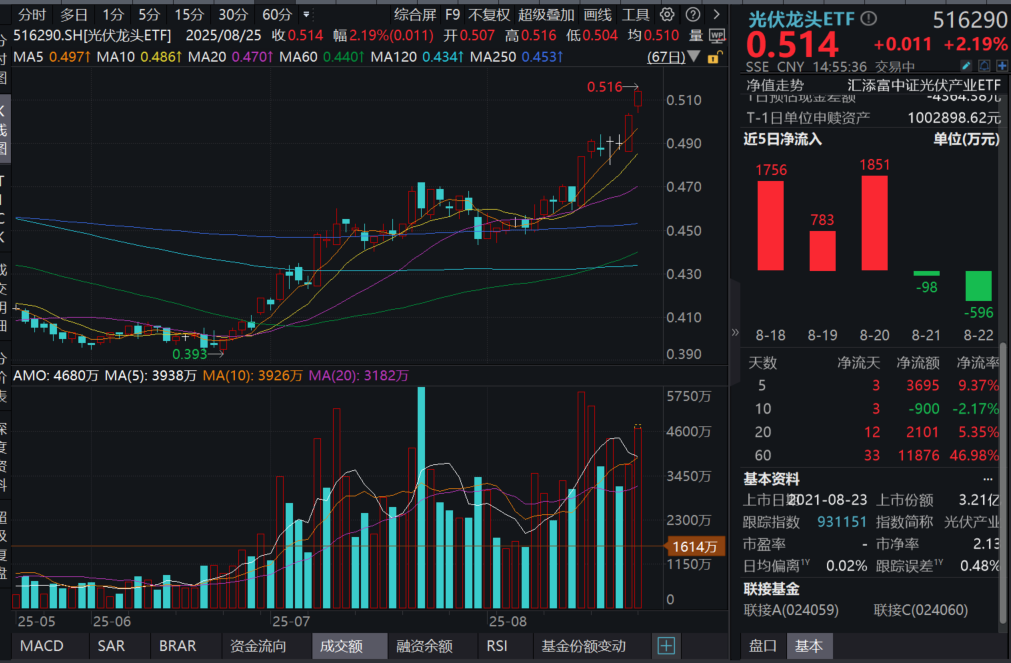
光伏行业“反内卷”再升级!罗博特科强势涨停,光伏龙头ETF(516290)涨超2%,高盛:“反内卷”有望为企业盈利注入新的动力
Xin Lang Cai Jing· 2025-08-25 07:16
Core Viewpoint - The A-share market continues to show an upward trend, particularly in the photovoltaic sector, with significant increases in key stocks and ETFs [1][3]. Industry Performance - The Zhongzheng Photovoltaic Industry Index rose by 1.81%, with notable stocks such as Robotech (300757) hitting the daily limit, Daqo Energy (688303) increasing by 11.55%, and Jiejia Weichuang (300724) up by 8.09% [3]. - Key stocks in the photovoltaic sector include: - Yangguang Electric (300274): up 4.02% with a transaction volume of 684 million - Longi Green Energy (601012): up 1.21% with a transaction volume of 2.949 billion - TBEA (600089): up 1.34% with a transaction volume of 2.097 billion [4]. Market Dynamics - A meeting on August 19 emphasized four key points for the photovoltaic industry: strengthening industry regulation, curbing low-price competition, standardizing product quality, and supporting industry self-discipline [5]. - Guosheng Securities suggests that optimizing supply-side through industry regulation and price control will benefit profitability recovery in the industry [5]. - Goldman Sachs indicates that successful "anti-involution" actions could enhance corporate profitability through interconnected channels, particularly in undervalued sectors like cement, photovoltaic, and chemicals [5]. Investment Opportunities - The photovoltaic sector is expected to experience a fundamental recovery, with positive sentiment anticipated for the sector [5]. - The photovoltaic leader ETF (516290) is highlighted as a low-fee option, with management fees at 0.15% and custody fees at 0.05%, significantly lower than the market average [5].





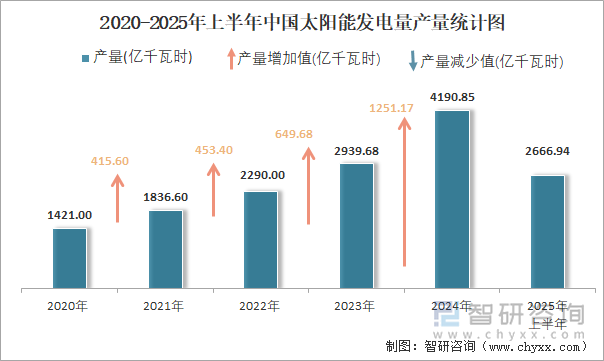
2025年1-6月中国太阳能发电量产量为2666.9亿千瓦时 累计增长20%
Chan Ye Xin Xi Wang· 2025-08-25 03:01
Group 1 - The core viewpoint of the article highlights the growth of China's solar power generation, with a production volume of 501 billion kilowatt-hours in June 2025, representing an 18.3% year-on-year increase [1] - In the first half of 2025, China's cumulative solar power generation reached 2,666.9 billion kilowatt-hours, marking a cumulative growth of 20% [1] Group 2 - The article lists key companies in the solar energy sector, including Longi Green Energy, Tongwei Co., Sunshine Power, JA Solar, Trina Solar, TBEA, Chint Electric, TCL Zhonghuan, Linyang Energy, and Sungrow Power [1] - The report referenced is the "2025-2031 China Solar Power Station Industry Market Situation Monitoring and Investment Prospects Report" published by Zhiyan Consulting [1]

格林美:筹划发行H股股票;天合光能:上半年净亏损超29亿元丨新能源早参
Mei Ri Jing Ji Xin Wen· 2025-08-24 23:21
Group 1 - Greeenmei plans to issue H-shares and list on the Hong Kong Stock Exchange to enhance its global development and brand image [1] - The move aims to leverage international capital markets for diversified financing and sustainable development [1] - This initiative indicates Greeenmei's focus on the international market and its intent to strengthen its capabilities [1] Group 2 - Trina Solar reported a net loss of 2.918 billion yuan in the first half of the year, with revenue of 31.056 billion yuan, a year-on-year decrease of 27.72% [2] - Despite a growth in photovoltaic module sales, the company faced losses due to supply-demand imbalance and low market prices [2] - The challenges in the photovoltaic industry, particularly regarding market supply and price fluctuations, are highlighted by Trina Solar's performance [2] Group 3 - TCL Zhonghuan announced a net loss of 4.242 billion yuan in the first half of the year, with revenue of 13.398 billion yuan, a year-on-year decline of 17.36% [3] - The company's losses were attributed to declining product prices affecting its photovoltaic materials business [3] - The long-term outlook for the photovoltaic industry remains optimistic despite current challenges, emphasizing TCL Zhonghuan's role as a key player [3]

格林美:筹划发行H股股票;天合光能:上半年净亏损超29亿元
Mei Ri Jing Ji Xin Wen· 2025-08-24 23:19
Group 1 - Greeenme plans to issue H-shares and list on the Hong Kong Stock Exchange to enhance its global development and brand image [1] - The move aims to leverage international capital markets for sustainable development and improved management [1] - This initiative indicates Greeenme's focus on international markets and its intent to strengthen its capabilities through capital markets [1] Group 2 - Trina Solar reported a net loss of 2.918 billion yuan in the first half of the year, with revenue of 31.056 billion yuan, a decrease of 27.72% year-on-year [2] - Despite an increase in photovoltaic module sales, the company faced losses due to supply-demand imbalance and low market prices [2] - The challenges in the photovoltaic industry, particularly regarding market supply and price fluctuations, are reflected in Trina Solar's performance [2] Group 3 - TCL Zhonghuan announced a net loss of 4.242 billion yuan in the first half of the year, with revenue of 13.398 billion yuan, down 17.36% year-on-year [3] - The company's losses were attributed to declining product prices affecting its photovoltaic materials business [3] - The current challenges in the photovoltaic industry, especially price volatility, significantly impact company performance [3]
【早报】鲍威尔暗示美联储或在9月降息;中国智能算力规模增长将超40%
财联社· 2025-08-24 23:09
Macro News - The State Council, led by Premier Li Qiang, discussed the implementation of large-scale equipment updates and the old-for-new policy for consumer goods, emphasizing the need for effective subsidy use and coordination to boost domestic demand [5] - The State Council also addressed the potential of sports consumption and the development of the sports industry, focusing on increasing supply, enhancing service levels, and fostering growth points in the sector [5] Industry News - Goldman Sachs reported that hedge funds have net bought Chinese stocks at the fastest pace in seven weeks, indicating a strong interest in the Chinese market [8] - The National Development and Reform Commission released a draft on internet platform pricing behavior, requiring platforms to adhere to transparent pricing rules and publicize subsidy activities [8] - Several express delivery companies in Guangdong and Zhejiang have raised prices for e-commerce clients, with price adjustments ranging from 0.3 to 0.7 yuan per item [8] - The China Photovoltaic Industry Association called for enhanced industry self-discipline to maintain fair competition and avoid harmful practices [10] - The Ministry of Industry and Information Technology published interim measures for the total control of rare earth mining and smelting, requiring companies to maintain records of product flows [10] - The insurance asset management industry showed a preference for stocks as the top investment asset for the second half of 2025, followed by bonds and securities investment funds [10] - The electronic sector's A-share market capitalization reached 11.54 trillion yuan, marking a historical high, with major companies like Industrial Fulian leading the market [11] - The Ministry of Industry and Information Technology emphasized the need for orderly development of computing power facilities to enhance resource supply quality [11] Company News - Changjiang Electric Power announced plans for its controlling shareholder to increase holdings by 4 to 8 billion yuan [14] - Vanke A reported a net loss of 11.947 billion yuan for the first half of the year [14] - TCL Zhonghuan disclosed a net loss of 4.242 billion yuan for the first half of the year [16] - Jiangsu Guotai announced plans to use up to 12 billion yuan of idle funds for entrusted wealth management [18] - Jiu Gui Jiu reported a 92.6% decline in net profit for the first half of the year [18]