
JONHON(002179)

Search documents
激浊扬清,周观军工第118期:军贸体系装备阔步“走出去”
Changjiang Securities· 2025-05-12 01:07
Investment Rating - The report maintains a "Positive" investment rating for the defense and military industry [2] Core Insights - The ongoing India-Pakistan conflict has reinforced the recognition of domestic equipment performance advantages, driving long-term high prosperity for domestic manufacturers in the military trade market [6][8] - The demand for advanced fighter jets is being driven by air combat needs, with the J-35 model leading the way in production expansion [50][59] - The development of a systematic combat approach is crucial for enhancing operational efficiency and decision-making speed in military engagements [103][111] Summary by Sections Section 1: India-Pakistan Conflict - The recent India-Pakistan conflict has escalated due to terrorist attacks and military friction, leading to significant military actions and heightened tensions [11][14] - Pakistan has demonstrated strong air superiority, utilizing Chinese-made J-10C fighter jets to achieve notable victories against Indian aircraft [19][22] Section 2: Military Trade Dynamics - Pakistan has been a core customer for Chinese military exports, with 62.17% of China's military trade weapons exported to Pakistan from 2015 to 2024 [23] - The global military trade market is significantly larger than the domestic market, with a financial value of at least $138 billion in 2022 [40][41] Section 3: Systematic Combat and Data Links - The systematic approach to combat has proven advantageous for Pakistan, allowing for better coordination and effectiveness compared to India's diverse procurement strategy [27][31] - Data links are essential for real-time information sharing and operational efficiency, significantly enhancing combat effectiveness [106][111] Section 4: Company Insights - AVIC Shenyang Aircraft Corporation - AVIC Shenyang is investing 11 billion yuan in production expansion and modernization to meet the demand for new aircraft models [76] - The company is focusing on supply chain management and lean production to ensure timely delivery and high-quality output [81][85] - Despite a decline in revenue due to external factors, the company maintains a high gross margin and is preparing for future demand increases [97][99]


研判2025!中国航空产业园行业产业链、相关政策及行业现状分析:产业园数量激增彰显政策红利效应,市场需求复苏与低空经济崛起共推产业景气攀升[图]
Chan Ye Xin Xi Wang· 2025-05-10 02:37
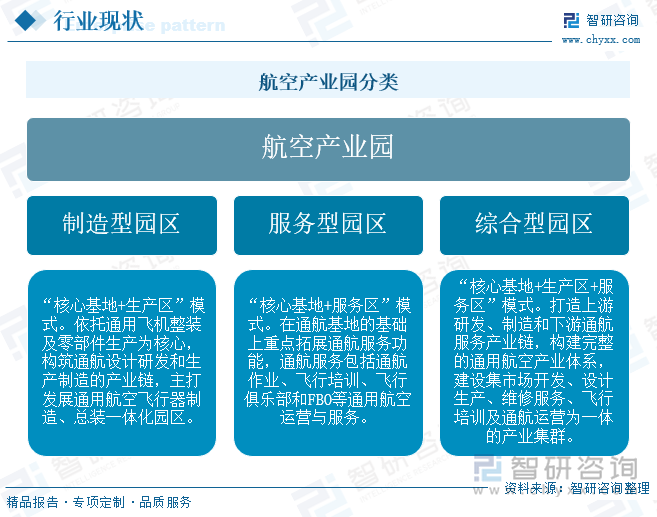
Core Viewpoint - The number of aviation industrial parks in China is projected to reach 128 in 2024, an increase of 14 parks year-on-year, driven by strong national strategic support and favorable policies [1][12]. Industry Overview - Aviation industrial parks are designated areas focused on aviation-related manufacturing, research, maintenance, and operations, created to foster industry clustering and collaboration through government incentives [1]. Industry Development History - The development of China's aviation industrial parks has progressed through three stages: 1. Initial stage (2003-2008) with only 8 parks established 2. Steady growth phase (2009-2014) with the number increasing to 44 3. Rapid growth phase (2015-present) where the number of parks has surged, averaging 10 new parks annually [3]. Industry Chain - The upstream of the aviation industrial park industry chain includes raw materials, components, and basic equipment, while the midstream focuses on operations and services, and the downstream involves airlines and maintenance companies [5]. Current Industry Status - The aviation industry is experiencing a recovery with passenger transport expected to reach 730 million in 2024, a year-on-year increase of 18.1%, and air cargo volume increasing by 22.1% [12]. Policy Support - Recent policies, such as the "General Aviation Equipment Innovation Application Implementation Plan (2024-2030)", aim to enhance the supply capacity and innovation ability of general aviation equipment by 2027, providing a three-dimensional drive for aviation industrial parks [9][11]. Industry Development Trends 1. **Technological Upgrades**: The industry is focusing on innovation-driven high-quality development, with key areas including unmanned, electric, and intelligent technologies [21]. 2. **Industry Clustering**: Aviation industrial parks are becoming core carriers for industry chain integration, with significant regional differentiation and specialization [22]. 3. **International Cooperation**: There is an increasing trend of international collaboration, with domestic companies engaging in joint ventures and technology transfers to enhance global competitiveness [23].


2025年军工行业订单有望迎来拐点,高端装备ETF(159638)最新规模创今年以来新高!
Xin Lang Cai Jing· 2025-05-09 02:55
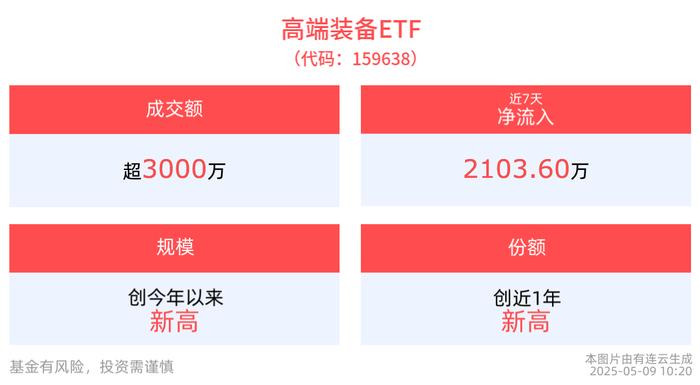
Group 1 - The China Securities High-end Equipment Sub-index 50 has decreased by 2.46% as of May 9, 2025, with mixed performance among constituent stocks, led by Aerospace Nanhai up 1.50% [1] - The High-end Equipment ETF (159638) has seen a cumulative increase of 8.55% over the past two weeks as of May 8, 2025 [1] - The High-end Equipment ETF recorded a turnover of 3.05% and a transaction volume of 36.1554 million yuan, with an average daily transaction volume of 97.8379 million yuan over the past week [3] Group 2 - The latest scale of the High-end Equipment ETF reached 1.237 billion yuan, marking a new high for the year, with the latest share count at 1.547 billion, also a new high for the past year [3] - The net inflow of funds into the High-end Equipment ETF was 30.633 million yuan [3] - The top ten weighted stocks in the China Securities High-end Equipment Sub-index 50 account for 45.74% of the index, including companies like AVIC Optoelectronics and AVIC Shenyang Aircraft [3] Group 3 - Institutions forecast a turning point in military industry orders by 2025, driven by new technologies aimed at enhancing equipment performance or reducing costs, and new markets from military trade and technology conversion [3] - Huatai Securities indicates that China has entered a phase of "self-research equipment as the main" military trade net surplus, with significant growth expected in domestic demand from 2025 to 2027 [3] - Investors can consider the China Securities High-end Equipment Sub-index 50 ETF linked fund (018028) to capitalize on industry rotation opportunities [3]


中航光电(002179):民品放量牵引收入增长 收入结构变化导致业绩下滑
Xin Lang Cai Jing· 2025-05-08 10:35
Core Viewpoint - The company reported a revenue of 4.839 billion yuan in Q1 2025, representing a year-on-year growth of 20.56%, while the net profit attributable to shareholders decreased by 14.78% to 640 million yuan [1] Group 1: Financial Performance - The company's revenue growth was driven by a rapid increase in civilian products, while the defense product segment saw a decline in proportion, contributing to the overall year-on-year profit drop [2] - The gross margin for the quarter decreased by 8.16 percentage points to 28.44% quarter-on-quarter and by 7.12 percentage points year-on-year, influenced by the production and delivery confirmation cycle [2] - The net profit margin decreased by 5.88 percentage points year-on-year to 13.91% [2] Group 2: Industry Outlook - The defense sector demand showed significant recovery in Q1 2025, with expectations for stable growth in the defense field throughout the year [3] - The company is actively expanding production capacity to ensure delivery confirmations and meet short-term demand, with high inventory levels supporting this strategy [3] - Capital expenditures during the 14th Five-Year Plan period included 3.4 billion yuan for a South China industrial base and 2.7 billion yuan for a high-end interconnection project, positioning the company for rapid growth in the upcoming 15th Five-Year Plan [3] Group 3: Profit Forecast and Valuation - The projected net profit attributable to shareholders for 2025-2027 is 3.73 billion, 4.11 billion, and 4.52 billion yuan, reflecting year-on-year growth rates of 11%, 10%, and 10% respectively [3] - Corresponding price-to-earnings ratios are expected to be 23, 21, and 19 times for the years 2025, 2026, and 2027 [3]
中航光电(002179):民品放量牵引收入增长,收入结构变化导致业绩下滑
Changjiang Securities· 2025-05-08 09:47
Investment Rating - The investment rating for the company is "Buy" and is maintained [8]. Core Views - The company's revenue growth is driven by rapid expansion in its civilian product business, which has led to a year-on-year revenue increase of 20.56% to 4.839 billion yuan, while the net profit attributable to shareholders decreased by 14.78% [2][6]. Summary by Sections Revenue and Profitability - In Q1 2025, the company achieved an operating revenue of 4.839 billion yuan, representing a year-on-year growth of 20.56%. However, the net profit attributable to shareholders was 640 million yuan, a decrease of 14.78% year-on-year [6][12]. Business Segments - The growth in civilian products has significantly contributed to the overall revenue increase, but the decline in the proportion of high-margin products has negatively impacted the overall net profit margin [2][12]. Market Outlook - The demand in the defense sector has shown significant recovery in Q1 2025, but due to production and delivery confirmation cycles, only a small portion was recognized in the first quarter. This has led to a decrease in the gross profit margin by 8.16 percentage points to 28.44% [12]. Future Projections - The company is expected to maintain a relatively high and stable growth rate during the 14th Five-Year Plan period, with projected net profits for 2025-2027 being 3.73 billion, 4.11 billion, and 4.52 billion yuan, respectively, reflecting year-on-year growth rates of 11%, 10%, and 10% [12].
军工行业2025年一季度公募基金持仓分析:1Q25机构低配军工,持仓“底部特征”明确
Minsheng Securities· 2025-05-08 09:35
Investment Rating - The report maintains a positive outlook on the military industry, suggesting it may enter a new upward cycle from 2025 to 2027 [6][5]. Core Insights - In Q1 2025, active funds have shifted to a low allocation in the military sector, marking a potential bottom signal for the industry [1][18]. - The scale of military-themed funds has decreased significantly, dropping nearly 50% from its historical peak [1][22]. - Active funds have increased their holdings across almost all sub-sectors, particularly in new materials and information technology [1][3]. Summary by Sections Fund Allocation Analysis - Active funds have reduced their allocation to the military sector for ten consecutive quarters, with a current low allocation of -0.21 percentage points [2][14]. - The total market value of military-themed funds has decreased by 8.30% to 32 billion yuan, down 47% from the historical high of 60.8 billion yuan [22][24]. - The top ten stocks held by military-themed funds account for an average of 56.53% of the fund's net asset value, indicating a decrease in concentration [22][25]. Industry Dominance and Fund Preferences - State-owned enterprises dominate the military sector, accounting for 70% of the market value, reflecting a focus on these entities by institutional investors [3][30]. - The allocation by industry chain shows that upstream companies hold the highest proportion at 49%, followed by assembly at 28% [3][31]. - Active funds have shown a preference for leading blue-chip stocks, with significant increases in holdings for companies like 中航光电 (AVIC) and 菲利华 (Feilihua) [4][34]. Changes in Fund Holdings - The number of funds holding top military stocks has increased, with 中航光电 (AVIC) and 菲利华 (Feilihua) seeing the most significant growth in fund count [34][35]. - The concentration of holdings among the top fifteen stocks has decreased to 68.95%, down 5.69 percentage points [25][26]. - The report highlights a shift back to blue-chip stocks after a period of focusing on new domains [4][5].


共享基经丨与AI一起读懂ETF(十三):央企科技和央企科创主题,有何不同?
Mei Ri Jing Ji Xin Wen· 2025-05-08 02:08
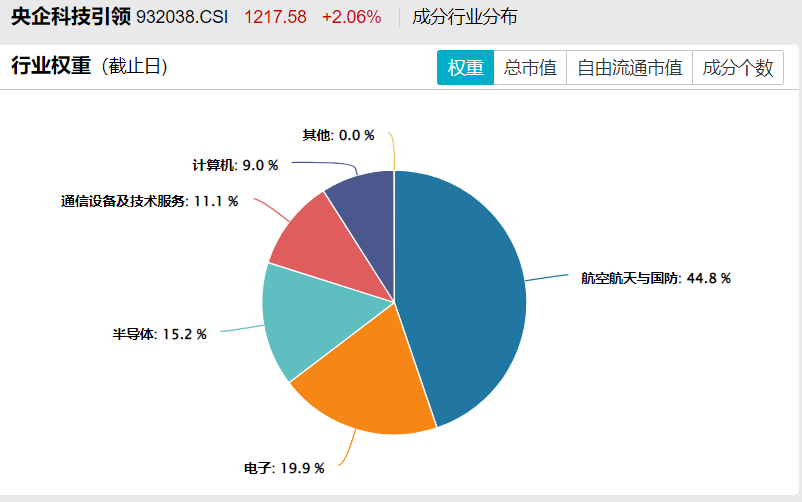
Core Viewpoint - The article discusses the differences and similarities between two indices related to central enterprise technology: the China Securities National New Central Enterprise Technology Leading Index and the China Securities Chengtong Central Enterprise Technology Innovation Index, highlighting their performance and characteristics in the context of recent market movements. Group 1: Differences Between the Indices - The China Securities National New Central Enterprise Technology Leading Index is customized by Guoxin Investment Co., Ltd., while the China Securities Chengtong Central Enterprise Technology Innovation Index is customized by China Chengtong Group [2]. - The selection methods differ: the National New Index scores based on net profit growth, revenue growth, total market capitalization, and R&D expenditure as a percentage of revenue, whereas the Chengtong Index evaluates based on the number and quality of patents and the implementation of equity incentives [3]. - Industry distribution varies significantly; the National New Index focuses heavily on aerospace and defense, electronics, and semiconductors, with a combined weight of nearly 80%, while the Chengtong Index has a more balanced distribution across telecommunications, aerospace and defense, and electronics, with the top five industries also exceeding 80% [4][6]. Group 2: Key Holdings and Performance - The top ten holdings of the National New Index account for 52.63% of the total, with Hikvision and AVIC Optoelectronics each exceeding 7% [8]. - In contrast, the Chengtong Index's top ten holdings represent 60.34% of the total, with China Telecom, Hikvision, and China Mobile each exceeding 7% [12]. - Historical performance shows that while the one-year returns of both indices are similar, the Chengtong Index outperforms the National New Index over three and five years, with the National New Index exhibiting higher volatility across all time frames [14]. Group 3: Valuation and Commonalities - As of now, the National New Index's TTM price-to-earnings ratio has risen to the historical 100th percentile, indicating a high valuation position [15]. - The Chengtong Index's TTM price-to-earnings ratio is also above the historical 80th percentile, suggesting a similarly high valuation, although its historical data is limited [17]. - Both indices select samples from listed companies under the State-owned Assets Supervision and Administration Commission, aim to reflect the overall performance of central enterprises in technology innovation, and emphasize that R&D expenditure as a percentage of revenue should not be less than 3% [20].




军工概念领涨全市场,军工ETF龙头(512680)午后涨超4%,冲击3连涨!
Xin Lang Cai Jing· 2025-05-07 05:45
Group 1 - The China Securities Military Industry Index (399967) has shown a strong increase of 4.24% as of May 7, 2025, with notable gains in constituent stocks such as AVIC Chengfei (302132) reaching a 20% limit up, and Zhongyun Drone (688297) rising by 16.37% [1] - The leading military ETF (512680) has also increased by 4.23%, marking its third consecutive rise, with a trading volume of 87.04 million yuan and a turnover rate of 2.31% [1] - The latest scale of the military ETF has reached 3.686 billion yuan, a new high for the year, with the latest share count at 3.544 billion, also a six-month high [1] Group 2 - The top ten weighted stocks in the China Securities Military Industry Index as of April 30, 2025, include China Shipbuilding (600150) and Guoke Technology (002625), accounting for a total of 37.03% of the index [2] - Positive signals have emerged in the military sector since 2024, with expectations of increased contract announcements and related transaction amounts in 2025, indicating a recovery in the military fundamentals [2] - According to GF Securities, the EU's defense industrial strategy is shifting towards self-sufficiency, aiming for 50% of defense equipment procurement to be sourced internally by 2030, which may benefit qualified Chinese companies with production capacity [2]


国防军工板块24A、25Q1业绩综述:冬去春来
Changjiang Securities· 2025-05-06 14:32
Investment Rating - The report maintains a "Positive" investment rating for the defense and military industry [3] Core Insights - The industry is experiencing a bottoming out phase due to multiple factors, but signs of improvement were observed in Q1 2025, particularly in upstream components and new directions [11][13] - Profitability has slightly fluctuated due to various influences, with ROE constrained by asset efficiency and net profit margin needing improvement [53][56] - Traditional main tracks show clear signs of recovery, while new directions are in the early stages of industrialization but exhibit initial growth potential [90][91] Summary by Sections Industry Overview - The military industry faced a decline in revenue and profit growth in 2024, but Q1 2025 showed a narrowing of profit decline to -24.6% [19][20] - The main track's revenue growth was affected by contract signing and delivery schedules, with a notable profit drop in Q4 2024, followed by a recovery in Q1 2025 [20][21] Main Track Performance - Upstream components are showing early signs of recovery, with revenue growth rates for upstream, midstream, and downstream segments varying significantly [25][29] - Downstream manufacturers experienced short-term performance pressure due to contract signing delays, but some companies like Hongdu Aviation showed strong growth [29][30] Profitability Analysis - The overall profitability of the military sector slightly decreased in 2024, with a marginal improvement in Q1 2025 [56][58] - The main track's profitability was impacted by price adjustments and demand fluctuations, with a slight recovery noted in Q1 2025 [58][61] New Directions - New directions in the industry, such as military trade and new equipment, are showing upward trends in Q1 2025, indicating potential for growth [101][110] - Specific segments like infrared and ammunition within new equipment are experiencing significant revenue growth, reflecting high market demand [104][110] Future Outlook - The report emphasizes the importance of selecting companies with enhanced product capabilities, increased penetration rates, and higher average transaction values as the industry approaches the end of the 14th Five-Year Plan [117][118] - Key investment opportunities are identified in companies like Aerospace Electric and Feiliwa, which are expected to benefit from the upcoming military spending and technological advancements [117][118]


对话中航光电吴泽华:解码车用“连接”国产突围路,筑基中国高端汽车制造
Zhong Guo Qi Che Bao Wang· 2025-05-06 01:23
Core Viewpoint - The company, AVIC Optoelectronics, has established itself as a leading player in the automotive connector market, particularly in the context of the rapid evolution towards electric and intelligent vehicles, showcasing its innovative technologies and strategic positioning at the Shanghai Auto Show [2][3][10]. Group 1: Technological Innovation and Market Position - AVIC Optoelectronics entered the automotive connector market early, filling a significant gap with its first-generation high-voltage connectors during the nascent stage of the domestic electric vehicle industry [3]. - The company has developed a comprehensive product matrix and established a dedicated New Energy Vehicle Division, enhancing its role as a key participant in the industry's transformation [5][10]. - The company has achieved a domestic market share exceeding 30% in high-voltage connectors, with annual sales surpassing 30 million sets, solidifying its leadership position [10]. Group 2: Product Development and Industry Trends - AVIC Optoelectronics has launched a series of innovative products, including high-power fast-charging connectors and Busbar solutions, addressing the stringent requirements of 800V high-voltage platforms [6][10]. - The company has introduced a full aluminum high-voltage solution, significantly reducing weight by over 20% while maintaining current-carrying capacity, thus addressing the industry's lightweight demands [6][10]. - The company has developed a smart networking system that covers the entire "vehicle-road-cloud" ecosystem, providing low-latency and high-reliability signal transmission for intelligent driving and connected vehicles [6][10]. Group 3: Strategic Vision and Future Outlook - The company aims to leverage its advanced connection technologies to create a seamless integration between vehicles, charging facilities, smart grids, and the internet, fostering a smart and efficient travel ecosystem [10][16]. - AVIC Optoelectronics is committed to expanding its international market presence, focusing on partnerships with leading global automotive manufacturers to enhance its competitive edge [16]. - The company recognizes the importance of addressing industry pain points, such as the reliability of high-voltage systems and the challenges of lightweight materials, as key drivers for innovation and industry advancement [14][16].
