
GUANGDONG TAPAI GROUP CO.(002233)

Search documents
A股行情走强,上市公司又要炒股了
第一财经· 2025-08-26 14:36
Core Viewpoint - The article discusses the resurgence of A-share companies engaging in stock trading, highlighting significant investment plans and the mixed results of these investments [3][4]. Group 1: Investment Plans - Jiangsu Guotai planned to use up to 120 billion yuan of idle funds for entrusted wealth management and 18.306 billion yuan for securities investment, but later terminated part of the plan [5][6]. - Other companies like Lio Co., Fanda Carbon, and Qipilang also announced substantial investments, with Lio Co. planning to invest up to 30 billion yuan [4][6]. - Companies such as Xiantan Co. and Tapai Group have also disclosed plans to invest over 10 billion yuan in stock trading [6][7]. Group 2: Investment Performance - Jiangsu Guotai reported a cumulative fair value change of -71.96 million yuan for its securities investments in the first half of the year, indicating a long-term trend of losses exceeding 200 million yuan [12]. - Lio Co.'s investment in Li Auto saw significant fluctuations, with a peak profit of 60 billion yuan in 2020, but a loss of 4.41 billion yuan in 2022 [13]. - Seven Wolves reported that its securities investment contributed over 70% to its total profit, despite experiencing a decline in revenue and net profit in the first half of the year [14][15]. Group 3: Notable Holdings - Seven Wolves' investment portfolio includes high-profile stocks such as Kweichow Moutai, Tencent Holdings, and China Shenhua, with significant book values for these holdings [10]. - Jiangsu Guotai's investments included shares in Shenda Co. and Tianji Co., with a reported fair value change of -14.3 million yuan for Shenda [8][12].



手握多只“明星股”、投入多达数十亿,行情走强上市公司又要炒股了!
Di Yi Cai Jing· 2025-08-26 13:41
Core Viewpoint - A-share companies are increasingly engaging in stock investments, with several firms planning significant allocations of their funds for this purpose, despite some plans being abruptly terminated [1][2][4]. Group 1: Investment Plans and Amounts - Jiangsu Guotai planned to use up to 138.3 billion yuan for financial management and securities investment, but later terminated part of this plan [1][2]. - Other companies like Lio Co. and Fangda Carbon have also announced substantial investment plans, with Lio Co. intending to use up to 30 billion yuan for securities investment [2][3]. - Companies such as Qipilang and Xiantan Co. have also disclosed plans to invest over 10 billion yuan in stock trading [2][3]. Group 2: Historical Context and Performance - Jiangsu Guotai has a history of stock trading dating back ten years, with significant investments made over the years [5][6]. - Lio Co. has also been involved in stock investments since 2016, with their investment amounts increasing from 20 billion yuan to 30 billion yuan [6][7]. - Seven Wolves holds several high-profile stocks, with investment income significantly contributing to their overall profits, despite facing a decline in their own performance [8][10]. Group 3: Investment Outcomes - Jiangsu Guotai reported a cumulative fair value change loss of 71.96 million yuan in the first half of the year, indicating poor investment performance [8]. - Lio Co.'s investment in Li Auto resulted in a significant profit in 2020, but subsequent years saw fluctuations in investment returns, including a net loss in 2022 [9][10]. - Seven Wolves reported that their investment income accounted for over 70% of their total profit, despite experiencing a decline in revenue and net profit [10][11].
周观点:建材中的“抱团”与“切换”-20250825
GUOTAI HAITONG SECURITIES· 2025-08-25 07:11
Investment Rating - The report maintains a positive outlook on the building materials sector, highlighting potential opportunities in both "grouping" and "switching" strategies within the industry [2][11]. Core Insights - The building materials market is experiencing a shift in focus, with technology stocks gaining momentum while the building materials sector presents viable options for investment [2]. - The report emphasizes the importance of monitoring production capacity and quality improvements in key segments such as electronic fabrics and Q fabrics, which are expected to see increased demand due to advancements in AI and PCB technologies [3][4]. - The report identifies a growing confidence in infrastructure projects in regions like Xinjiang and Tibet, driven by government investments and the necessity of transportation infrastructure [11][12]. - The consumer building materials segment is showing signs of recovery, with expectations of improved revenue performance as the market stabilizes [24][25]. Summary by Sections Grouping in Building Materials - The electronic fabric sector is expected to maintain its performance, with leading companies like Zhongcai Technology reporting strong sales and production growth [3]. - The AI industry's production expectations are advancing, with key suppliers anticipating increased output of Q fabrics by the end of the year [4]. - The report highlights the importance of monitoring the production capacity and quality of Q fabrics, which will determine the actual supply capabilities of companies [4]. Switching in Building Materials - Infrastructure projects in Xinjiang and Tibet are gaining traction, with significant government backing and a strong demand for cement due to the region's unique geographical advantages [11][12]. - The consumer building materials sector is entering a recovery phase, with sales and construction data indicating a bottoming out of the market [13][14]. - The report notes that the cement industry is poised for potential growth, driven by policy improvements and governance enhancements [15][29]. Cement Industry - The cement sector is entering a peak season, but market performance remains subdued due to high comparative bases from the previous year [29][30]. - The report emphasizes the importance of policy measures to limit overproduction in the cement industry, which could enhance profitability [30][33]. - Companies like Conch Cement and Huaxin Cement are highlighted for their strong cash flow and potential for shareholder returns [34][38]. Glass Industry - The float glass market is experiencing price stabilization, with environmental regulations expected to impact production costs [40][41]. - The report indicates that the glass industry is facing cash flow challenges, with many companies operating at a loss [42]. - Companies like Xinyi Glass are expected to maintain competitive positions despite market pressures, with a focus on improving operational efficiency [43]. Photovoltaic Glass - The photovoltaic glass segment is seeing a decline in inventory levels, with prices remaining stable amid increased demand from downstream component manufacturers [48]. - The report notes that while domestic prices are under pressure, overseas markets are performing better, which could benefit leading companies in the sector [49]. Fiberglass - The fiberglass market is characterized by a divergence in production and sales, with electronic fabrics maintaining a favorable outlook [50].


社保基金最新持仓动向揭秘


Sou Hu Cai Jing· 2025-08-24 07:34
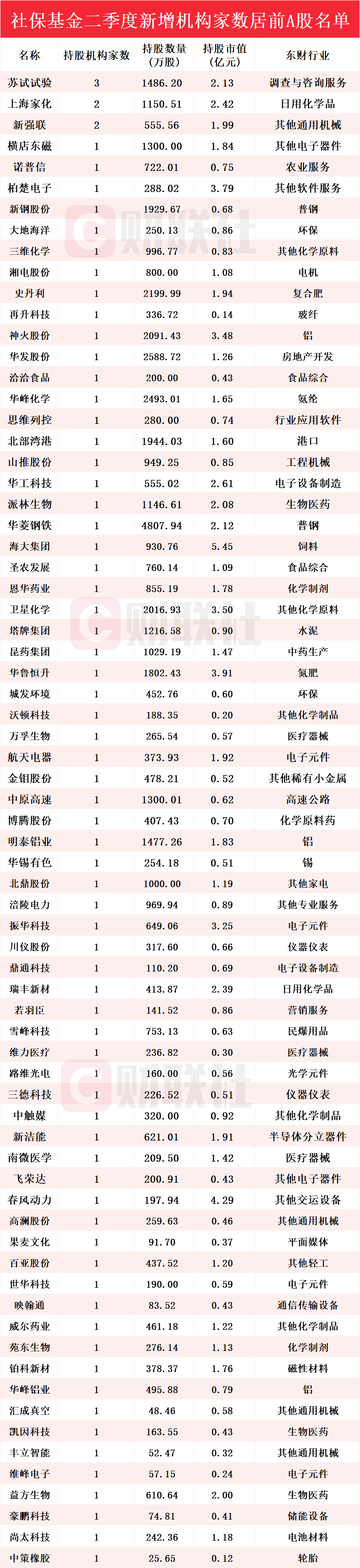
Group 1 - The core viewpoint of the article highlights the recent movements of social security funds in the A-share market, revealing that they have entered the top ten circulating shareholders of 71 new stocks in the second quarter of 2025 [1] - Su Shi Testing has the highest number of new social security fund holdings, with 3 new holdings, while Shanghai Jahwa and Xin Qiang Lian each have 2 new holdings [1] - The article provides a detailed list of companies that have seen new social security fund investments, including their respective shareholding numbers, quantities, and market values [2][3][4][5] Group 2 - Specific companies mentioned include Su Shi Testing with 1,486.20 thousand shares valued at 213 million yuan, Shanghai Jahwa with 1,150.51 thousand shares valued at 242 million yuan, and Xin Qiang Lian with 555.56 thousand shares valued at 199 million yuan [2][3] - Other companies with new social security fund holdings include Hengdian East Magnetic, Nuofushin, and Baichu Electronics, each with 1 new holding, along with their respective share quantities and market values [2][3][4] - The article lists a total of 71 companies that have received new investments from social security funds, indicating a diverse range of industries from agriculture to electronics and pharmaceuticals [2][3][4][5]
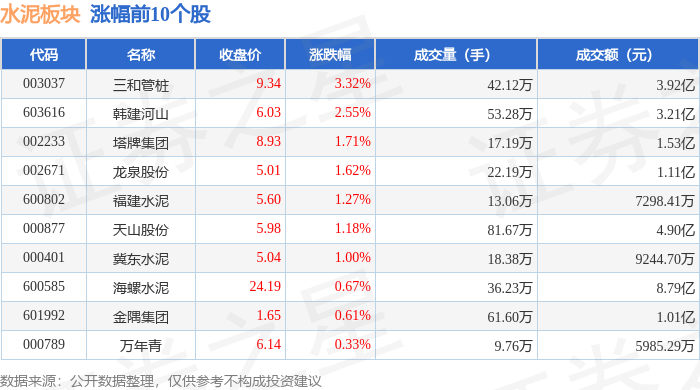
水泥板块8月21日涨0.27%,三和管桩领涨,主力资金净流出4.75亿元
Zheng Xing Xing Ye Ri Bao· 2025-08-21 08:38
证券之星消息,8月21日水泥板块较上一交易日上涨0.27%,三和管桩领涨。当日上证指数报收于 3771.1,上涨0.13%。深证成指报收于11919.76,下跌0.06%。水泥板块个股涨跌见下表: | 代码 | 名称 | 收盘价 | 涨跌幅 | 成交量(手) | 成交额(元) | | | --- | --- | --- | --- | --- | --- | --- | | 003037 | 三和菅桩 | 9.34 | 3.32% | 42.12万 | | 3.92亿 | | 603616 | 韩建河山 | 6.03 | 2.55% | 53.28万 | | 3.21亿 | | 002233 | 塔牌集团 | 8.93 | 1.71% | 17.19万 | | 1.53亿 | | 002671 | 龙泉股份 | 5.01 | 1.62% | ﯾﺎ 22.19万 | | 1.11亿 | | 600802 | 福建水泥 | 5.60 | 1.27% | 13.06万 | | 7298.41万 | | 000877 | 天山股份 | 5.98 | 1.18% | 81.67万 | | 4.90亿 | | 00040 ...

塔牌集团(002233)8月19日主力资金净流出1584.28万元
Sou Hu Cai Jing· 2025-08-19 15:29
天眼查商业履历信息显示,广东塔牌集团股份有限公司,成立于1995年,位于梅州市,是一家以从事非 金属矿物制品业为主的企业。企业注册资本119227.5016万人民币,实缴资本119227.5万人民币。公司法 定代表人为何坤皇。 通过天眼查大数据分析,广东塔牌集团股份有限公司共对外投资了26家企业,参与招投标项目802次, 知识产权方面有商标信息113条,专利信息11条,此外企业还拥有行政许可9个。 来源:金融界 金融界消息 截至2025年8月19日收盘,塔牌集团(002233)报收于8.64元,上涨0.35%,换手率1.06%, 成交量12.60万手,成交金额1.09亿元。 资金流向方面,今日主力资金净流出1584.28万元,占比成交额14.58%。其中,超大单净流出918.23万 元、占成交额8.45%,大单净流出666.05万元、占成交额6.13%,中单净流出流出536.09万元、占成交额 4.93%,小单净流入2120.36万元、占成交额19.51%。 塔牌集团最新一期业绩显示,截至2025中报,公司营业总收入20.56亿元、同比增长4.05%,归属净利润 4.35亿元,同比增长92.47%,扣非净利润 ...
水泥行业反内卷:过去,现在和未来
Tianfeng Securities· 2025-08-19 07:46
Investment Rating - The industry rating is "Outperform the Market" (maintained rating) [5] Core Insights - The necessity for "anti-involution" in the cement industry remains, with a competitive landscape characterized by high concentration and state-owned enterprise dominance [1][12] - The cement industry is experiencing a significant oversupply, with a projected capacity utilization rate of only 53% in 2024, indicating a need for supply-side reforms to reduce actual capacity [3][22] - Short-term measures such as peak-shifting production will continue to support the industry, while medium-term strategies will focus on administrative measures to limit overproduction [4][30] Summary by Sections Supply Structure - The cement industry is primarily led by state-owned enterprises, with a concentration ratio (CR10) of 57% and an expected state-owned enterprise capacity share of around 45% in 2024 [1][12] - The top ten cement companies include four state-owned enterprises, which collectively hold about 71% of the capacity, facilitating coordinated efforts to stabilize prices and enhance efficiency [12][1] Industry Profitability - The industry is projected to achieve a total profit of 260 billion yuan in 2024, with a profit margin of approximately 4.1%, although this represents an 86% decline from the peak levels seen in previous years [16][20] - The worst period in early 2024 saw over 55% of companies reporting losses, but a recovery is anticipated in the fourth quarter, with profits expected to reach 150-160 billion yuan in the first half of 2025 [20][16] Supply and Demand Dynamics - The total cement supply has peaked at around 1.81 billion tons, but demand continues to decline, leading to a significant oversupply issue [22][3] - The expected demand bottom is estimated to be between 1.2 to 1.5 billion tons, indicating a potential decline of 18% to 34% from 2024 levels [22][3] Review of Previous Supply-Side Reforms - Previous reforms included a ban on new capacity and the promotion of peak-shifting production, which successfully reduced new clinker capacity additions from a billion-ton level to a few million tons [2][26] - The industry's profit recovery from 518 billion yuan in 2016 to a historical high of 1867 billion yuan in 2019 was largely due to these reforms [2][29] Future Anti-Involution Strategies - The future governance of "anti-involution" will involve a combination of market, administrative, and legal measures, with a strong emphasis on reducing excess capacity through administrative controls [4][30] - The carbon trading policy expected to be implemented by 2027 will further pressure high-emission capacities to exit the market, promoting a shift towards more efficient production methods [33][35]

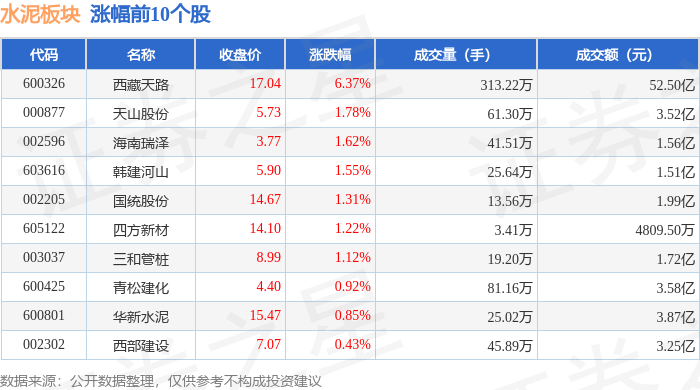
水泥板块8月18日涨0.98%,西藏天路领涨,主力资金净流入3.71亿元
Zheng Xing Xing Ye Ri Bao· 2025-08-18 08:39
Market Overview - The cement sector increased by 0.98% on August 18, with Tibet Tianlu leading the gains [1] - The Shanghai Composite Index closed at 3728.03, up 0.85%, while the Shenzhen Component Index closed at 11835.57, up 1.73% [1] Individual Stock Performance - Tibet Tianlu (600326) closed at 17.04, up 6.37% with a trading volume of 3.1322 million shares and a transaction value of 5.25 billion [1] - Tianshan Shares (000877) closed at 5.73, up 1.78% with a trading volume of 613,000 shares and a transaction value of 352 million [1] - Other notable performers include Hanjian Heshan (603616) at 5.90, up 1.55%, and Guotong Shares (002205) at 14.67, up 1.31% [1] Fund Flow Analysis - The cement sector saw a net inflow of 371 million from institutional investors, while retail investors experienced a net outflow of 93.33 million [2] - Major stocks like Tibet Tianlu had a net inflow of 34.5 million from institutional investors, indicating strong institutional interest [3] - Conversely, stocks like Hanjian Heshan and Guotong Shares experienced net outflows from retail investors, suggesting a mixed sentiment among retail participants [3]

周观点:AI材料行情继续扩散,传统建材进入提价旺季-20250818
GUOTAI HAITONG SECURITIES· 2025-08-18 06:11
Investment Rating - The report maintains a positive outlook on the building materials industry, particularly in AI materials and traditional building materials entering a price increase season [1][3]. Core Insights - The AI materials market continues to expand, driven by the anticipation of mass production in the AI industry chain, which is expected to boost demand for related products [2][3]. - The construction materials sector is showing signs of recovery, with consumption fundamentals expected to improve in the second half of 2025 [10][24]. - The cement industry is entering a peak season, with price increases already observed in the Yangtze River Delta region [30][33]. Summary by Sections AI Materials - The M9 production for switches is expected to ramp up ahead of schedule, with core Q fabric suppliers also increasing production capacity [2]. - The demand for low dielectric fabrics is anticipated to rise alongside the production of GB200 and GB300 cabinets [2][3]. - The overall production ramp-up is seen as a key support for market trends [2]. Cement Industry - The opening of major infrastructure projects in Xinjiang and Tibet is expected to enhance market confidence and drive demand for cement [8][30]. - The cement market has seen a slight price increase, with certain regions experiencing price hikes of 10-30 RMB per ton [33][34]. - The report highlights a potential supply reduction in the North China region due to planned production cuts for air quality improvement [32][33]. Building Materials - The report notes a significant policy shift in Beijing aimed at stimulating the real estate market, which is expected to positively impact consumption building materials [10][24]. - Companies in the consumption building materials sector are beginning to stabilize their earnings, with expectations of improved profitability in the coming quarters [25][26]. - The report emphasizes the importance of cost management and pricing strategies among leading companies in the sector [25][26]. Glass Industry - The float glass market is currently facing price pressures, with average prices declining [41][42]. - Environmental regulations are tightening, which may lead to increased costs for glass manufacturers [42][43]. - Companies like Xinyi Glass are expected to maintain competitive positions despite market challenges, with a focus on profitability in their automotive glass segment [44].

上市公司巨资炒股|塔牌集团拟用最高12亿元“炒股” 过去三年营收三连降
Xin Lang Zheng Quan· 2025-08-15 18:57
Core Viewpoint - Several companies are significantly increasing their investments in securities, with at least seven companies planning to invest over 1 billion RMB, indicating a trend of reliance on financial investments to bolster financial performance [1][2]. Group 1: Company Investment Plans - Seven companies, including Liou Co., Fangda Carbon, and Qipilang, are planning to invest over 1 billion RMB in securities, with Liou Co. leading at 3 billion RMB [1]. - Tapa Group plans to invest up to 1.2 billion RMB in securities, despite experiencing a decline in main business revenue for three consecutive years [1]. Group 2: Financial Performance Analysis - Tapa Group's revenue decreased by 21.76%, 8.29%, and 22.71% from 2022 to 2024, while its net profit showed fluctuations, with a significant drop of 85.50% in 2022, a rise of 178.55% in 2023, and a decline of 27.46% in 2024 [1]. - In the first half of 2025, Tapa Group reported a revenue of 2.056 billion RMB, a year-on-year increase of 4.05%, and a net profit of 435 million RMB, up 92.47% [1]. Group 3: Impact of Financial Investments - Tapa Group's fair value change income from trading financial assets reached 141 million RMB in the first half of 2025, a 546.17% increase year-on-year, indicating a strong impact from stock trading on net profit [2]. - The company faced significant losses from its investments in funds and stocks in 2022, and while losses decreased in 2023, they still persisted, highlighting the risks associated with high-stakes trading [2]. Group 4: Regulatory and Strategic Recommendations - To maximize the benefits of stock trading, regulatory bodies should establish clear investment limits and require companies to disclose their investment strategies and risk management practices [3]. - Companies should focus on their core business and treat investments as a supplementary strategy, establishing robust decision-making and risk control systems to avoid speculative behaviors [3].