
BYD(002594)

Search documents
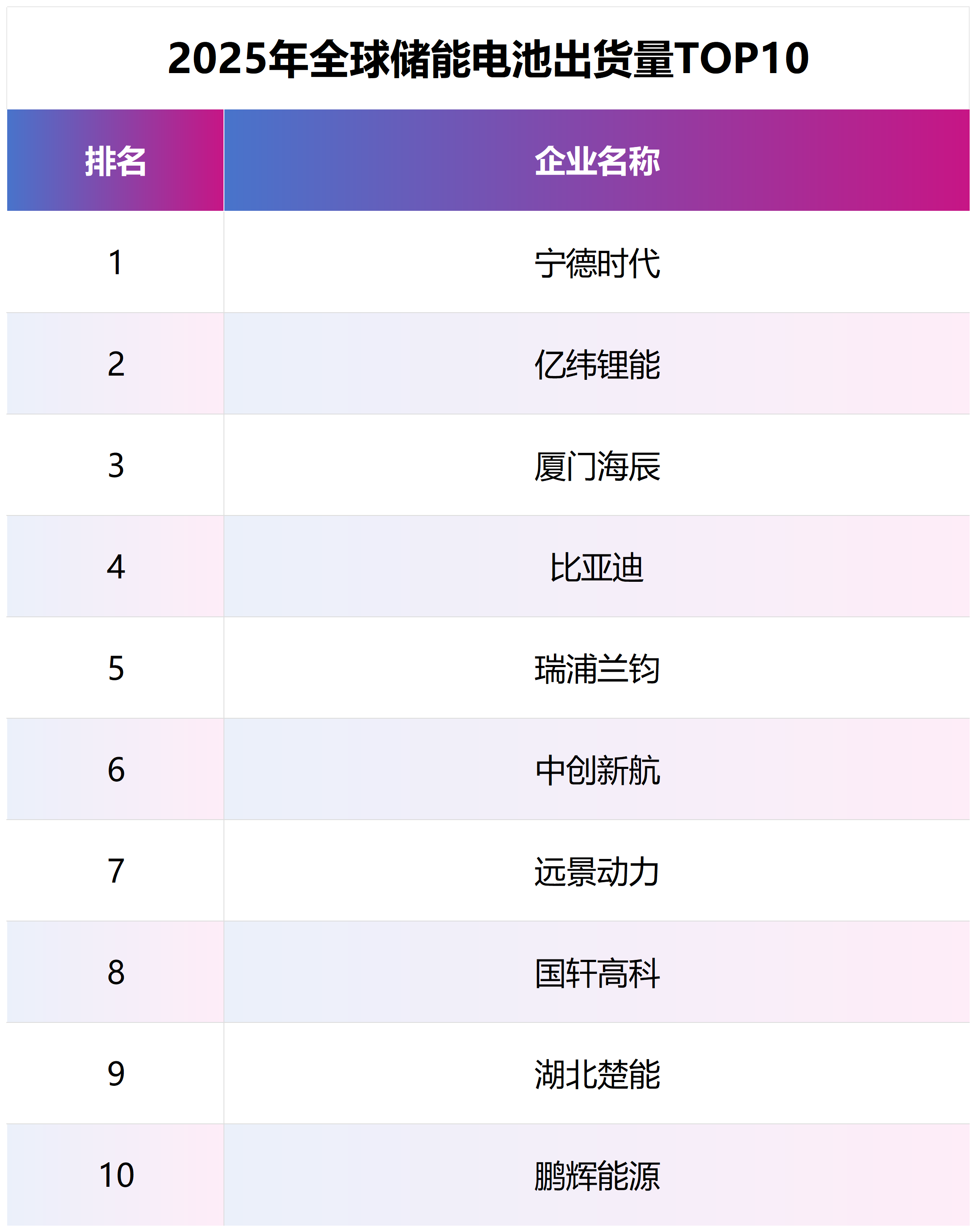
湖北储能新晋、鹏辉能源重返 2025年全球储能电池出货量TOP10出炉
Jing Ji Guan Cha Wang· 2026-02-12 07:55
Core Insights - The global energy storage battery market is experiencing explosive growth, with Chinese companies maintaining a dominant position and significant reshuffling occurring within the industry [1][8] - In 2025, global energy storage battery shipments are projected to reach 651.5 GWh, representing a year-on-year increase of 76.2%, with Chinese companies accounting for 614.7 GWh, or 94.4% of the total [1][9] Market Dynamics - The 2025 top 10 global energy storage battery companies include CATL, EVE Energy, Xiamen Hicharge, BYD, Ruipu Lanjun, Zhongxin Innovation, Envision AESC, Guoxuan High-Tech, Hubei Chuangneng, and Penghui Energy [7][9] - The top four companies (CATL, EVE Energy, Xiamen Hicharge, BYD) have maintained their positions, while there is increased competition among mid-tier companies, leading to notable ranking changes [7][9] New Entrants and Exits - Hubei Chuangneng has entered the top 10 rankings, marking a significant rise in its market presence, while established players Samsung SDI and LGES have exited the top 10 [8][9] - This shift indicates a transition in the competitive landscape from "China vs. foreign" to "internal competition" among Chinese firms [9] Industry Trends - The overall trend for 2025 shows a stable top tier and a more dynamic mid-tier, with the market share of the top ten Chinese energy storage battery companies slightly decreasing from 95% in 2024 to 90% in 2025, reflecting increased competition [9][10] - Technological advancements are accelerating the industrialization of large-capacity storage batteries, contributing to reduced costs and laying the groundwork for scalable development [10] Future Outlook - The global energy storage battery market is expected to enter a phase of high-quality development in 2026, with a shift in competitive logic towards technological innovation, capacity layout, and market expansion capabilities [10] - The reshuffling of the 2025 top 10 list is seen as a natural outcome of the industry's evolution and a reflection of the enhanced competitiveness of Chinese energy storage battery companies [10]





汽车和汽车零部件行业周报20260208:地补出台+需求见底,建议关注汽车板块
Guolian Minsheng Securities· 2026-02-12 07:45
Investment Rating - The report maintains a "Buy" rating for the automotive sector [3] Core Insights - The automotive sector is expected to stabilize and recover due to the introduction of local subsidies for vehicle replacement and the upcoming launch of new models after the Spring Festival [2][12] - The report highlights key investment opportunities in various segments, including passenger vehicles, automotive parts, and motorcycles, with specific company recommendations [2][19][34] Summary by Sections 1. Passenger Vehicles - The introduction of the 2026 vehicle replacement subsidy is expected to stimulate domestic demand positively [14] - The subsidy structure will improve the model mix, with new energy vehicles receiving 12% of the vehicle price as a subsidy (up to 20,000 yuan) and fuel vehicles receiving 10% (up to 15,000 yuan) [15][16] - Recommended companies include Geely, Xpeng, and BYD, with a focus on the left side of the demand bottom [2][19] 2. Automotive Parts - The report emphasizes the growth potential in the automotive parts sector, particularly in intelligent driving and new energy vehicle supply chains [19][23] - Recommended companies include Bertel, Horizon Robotics, and Top Group, focusing on the H and T chains [2][19] 3. Motorcycles - The report suggests a focus on mid-to-large displacement motorcycle manufacturers, with companies like Chunfeng Power and Longxin General recommended [31][34] - The market for mid-to-large displacement motorcycles is expected to expand, driven by supply and export efforts from leading manufacturers [34] 4. Commercial Vehicles - The heavy truck market is projected to recover due to the continuation of the vehicle replacement subsidy policy, with recommendations for Weichai Power and China National Heavy Duty Truck [35][36] 5. Tires - The tire industry is expected to benefit from ongoing globalization and the optimization of production structures, with recommendations for Sailun Tire and Senqilin [37][39]



福特汽车去年净亏82亿美元,福特全球销量首被比亚迪超越
Xin Lang Cai Jing· 2026-02-12 07:27
Core Insights - Ford Motor Company reported its largest annual loss since 2008, with a net loss of approximately $8.18 billion for the fiscal year 2025, a significant decline from a net profit of $5.88 billion in 2024 [1][1][1] - Despite achieving record annual revenue of about $187.3 billion in 2025, marking five consecutive years of revenue growth, the company's adjusted EBIT fell to $6.8 billion, down from $10.2 billion in 2024, indicating ongoing pressure on profit margins [1][1][1] - In a notable shift in the global automotive landscape, Ford's global sales were surpassed by Chinese automaker BYD for the first time, with BYD achieving approximately 4.6 million units sold compared to Ford's less than 4.4 million units [1][1][1] Financial Performance - Ford's total revenue for fiscal year 2025 reached approximately $187.3 billion, showing a slight increase from the previous year [1] - The company experienced a net loss of about $8.18 billion, contrasting sharply with the previous year's net profit of $5.88 billion [1] - Adjusted EBIT for 2025 was reported at $6.8 billion, a decrease from $10.2 billion in 2024, highlighting ongoing challenges in maintaining profitability [1] Market Position - Ford's global sales were overtaken by BYD, marking a significant milestone in the competitive landscape of the automotive industry [1] - BYD's global sales reached approximately 4.6 million units, while Ford's sales were reported at less than 4.4 million units [1] - This shift reflects the competitive advantages of Chinese automakers in terms of electrification and cost-effectiveness [1]

乘联分会:1 月全国乘用车市场零售 154.4 万辆,同比下降 13.9%
Xin Lang Cai Jing· 2026-02-12 07:27
Core Viewpoint - In January, the retail sales of passenger cars in China reached 1.544 million units, representing a year-on-year decline of 13.9% [1][7]. Group 1: Market Performance - The January retail sales decline is part of a historical trend where January sales have shown significant fluctuations, with previous years experiencing similar declines [3][9]. - The penetration rate of new energy vehicles (NEVs) in the overall passenger car market was 38.6%, down 3 percentage points from the previous year [3][9]. - Among domestic retail sales, the penetration rate of NEVs for independent brands was 61.7%, while luxury brands had a penetration rate of 16.1%, and mainstream joint venture brands only reached 4.3% [3][9]. Group 2: New Energy Vehicle Sales - In January, the retail share of NEVs for independent brands was 60.1%, a decrease of 12 percentage points year-on-year, while the share for mainstream joint venture brands increased to 3.9%, up 2 percentage points [3][9]. - The new forces in the market, including brands like Xpeng, Leap Motor, and Xiaomi, saw their share increase by 10 percentage points year-on-year, reaching 31.2% [3][9]. - Tesla's market share fell to 3.1%, a decrease of 1.5 percentage points compared to the previous year [3][9]. Group 3: Export Performance - In January, NEV exports reached 286,000 units, marking a year-on-year increase of 103.6%, accounting for 49.6% of total passenger car exports, up 12.5 percentage points from the previous year [4][10]. - Pure electric vehicles constituted 65% of NEV exports, while A00 and A0 class pure electric vehicles made up 50% of pure electric exports [4][10]. - The growth of NEV exports is attributed to the increasing recognition of Chinese brands in international markets, despite some external challenges [4][10]. Group 4: Manufacturer Performance - Leading manufacturers in NEV exports for January included BYD (96,859 units), Tesla China (50,644 units), and Geely (32,117 units) [5][11]. - The overall performance of NEV manufacturers remained strong, with 16 companies achieving monthly wholesale sales exceeding 10,000 units, accounting for 90.3% of total NEV sales [6][12]. - BYD led the market with 205,518 units sold, followed by Geely (124,252 units) and Tesla China (69,129 units) [6][12]. Group 5: Market Outlook - The outlook for February indicates a potential decline in sales due to the shorter effective production and sales time caused by the extended Spring Festival holiday [7][13]. - The rising costs of raw materials, driven by increased demand for electric power storage, are putting pressure on manufacturers [7][13]. - The anticipated decrease in promotional capabilities for NEV manufacturers may lead to a cautious consumer sentiment, potentially suppressing normal car purchase demand in the short term [7][13].

研报掘金丨长江证券:维持比亚迪“买入”评级,盈利能力有望继续提升
Ge Long Hui· 2026-02-12 07:10
Group 1 - BYD's overall sales in January reached 210,000 units, representing a year-on-year decline of 30.1% and a month-on-month decline of 50.0% [1] - Passenger vehicle sales totaled 206,000 units, with a year-on-year decrease of 30.7% and a month-on-month decrease of 50.5% [1] - Export sales remained strong at 100,000 units in January, showing a year-on-year increase of 43.3% [1] Group 2 - Domestic inventory reduction is ongoing, positioning the company to embrace a new cycle [1] - The expansion of the overseas vehicle matrix and the launch of plug-in hybrid models abroad are expected to sustain monthly export sales growth [1] - The introduction of high-end models such as Z9GT, Z9, Leopard 8, N9, and N8L is anticipated to enhance market penetration and improve per-vehicle profitability [1] Group 3 - The company is committed to its strategic transformation towards intelligent driving, with the release of the Super e platform marking a significant innovation in pure electric technology [1] - The product lineup for high-end markets is being accelerated with a rich reserve of models from brands like Tengshi, Yangwang, and Fangchengbao [1] - Continued efforts in overseas expansion and the enhancement of overseas channels and vehicle matrix are expected to further improve profitability [1] Group 4 - The company forecasts a net profit attributable to shareholders of 35 billion yuan by 2025, corresponding to a PE ratio of 23X, maintaining a "buy" rating [1]

“链”动区域|“河南造”新能源汽车驶向全球
Ke Ji Ri Bao· 2026-02-12 06:40
Core Insights - The core focus of the articles is on the rapid development of the new energy vehicle (NEV) industry in Henan Province, China, which has been recognized as a key area for growth within the advanced manufacturing sector, aiming to create a trillion-yuan industry cluster [1][10]. Group 1: Industry Growth and Achievements - Henan has integrated NEVs into its key manufacturing clusters, leading to a significant increase in production, with an expected output of 681,000 vehicles in 2024, representing a 117.3% year-on-year growth [1]. - The province's NEV exports are projected to reach 30.87 billion yuan in 2025, marking a growth of over 253% [1]. - Yutong Bus, a leading company in Henan, achieved a record of 49,518 bus sales in 2025, with a 5.54% increase, and 18,356 of these being new energy buses, reflecting a 22.94% growth [3]. Group 2: Technological Advancements and Innovations - Yutong Bus invests over 5% of its revenue annually in R&D, leading to innovations such as a battery management system capable of operating in extreme temperatures [3]. - The collaboration with CATL in Luoyang has established a battery production base that is among the top globally, producing battery cells at a rapid pace [7]. - Companies like Zhonghang Lithium Battery and LYC have developed advanced technologies and products that support the NEV supply chain, enhancing local production capabilities [8]. Group 3: Collaborative Ecosystem and Supply Chain Development - Yutong Bus has fostered collaboration with over 290 local suppliers, achieving a local supply rate of 41% [4]. - The establishment of a "10-minute industrial circle" in Luoyang has facilitated rapid development of related industries, including battery manufacturing and precision components [7][8]. - The government has implemented supportive policies and a "chief service officer" mechanism to enhance the business environment for NEV companies [9]. Group 4: Strategic Vision and Future Outlook - Henan aims to transition from a major automotive province to a strong automotive province by leveraging its full industrial chain and ecosystem [10]. - The province's strategic planning includes appointing the provincial governor as the leader of the NEV and intelligent connected vehicle industry chain, ensuring high-level support for development [9][10]. - The overall vision is to position Henan as a global player in the NEV market, with a comprehensive approach to industry development [5][10].

【月度分析】2026年1月份全国乘用车市场分析
乘联分会· 2026-02-12 06:06
Overall Market - In January 2026, the retail sales of passenger cars reached 1.544 million units, a year-on-year decrease of 13.9% [14] - The decline in retail sales is attributed to complex market factors and a historical pattern of fluctuating sales in January [14] - The end of the new energy vehicle purchase tax exemption in December 2025 has led to a recovery period for the new energy vehicle market, with some consumers having made purchases in December to take advantage of the policy [14] - January 2026 saw a significant increase in exports, with passenger car exports reaching 576,000 units, a year-on-year increase of 52.0% [16] - The production of passenger cars in January 2026 was 2.003 million units, a year-on-year decrease of 4.4% [16] - The wholesale volume for January 2026 was 1.973 million units, a year-on-year decrease of 6.2% [17] New Energy Market - In January 2026, retail sales of new energy vehicles (NEVs) totaled 596,000 units, down 20.0% year-on-year [18] - The penetration rate of NEVs in the domestic market was 38.6%, while the export penetration rate was 49.6% [15] - The production of NEVs reached 938,000 units, a slight decrease of 0.6% year-on-year [18] - The wholesale volume of NEVs was 864,000 units, down 3.3% year-on-year [18] - The export of NEVs reached 286,000 units, a significant increase of 103.6% year-on-year, accounting for 49.6% of total passenger car exports [22] Company Performance - BYD, Geely, and Chery are leading in the new energy vehicle market, with BYD's sales reaching 205,518 units in January 2026 [24] - The market share of domestic brands in the new energy sector is increasing, with a notable rise in the export of new energy vehicles to Europe and Southeast Asia [15][22] - The new energy vehicle market is characterized by a shift towards higher quality products, with an increase in the proportion of high-end NEVs [15] Market Outlook - February 2026 is expected to see lower sales due to the shorter working days caused by the extended Spring Festival holiday [27] - The market is anticipated to stabilize post-holiday, with potential recovery in the entry-level electric vehicle segment [28] - The overall sentiment in the consumer market remains cautious, influenced by high costs and economic factors [28]



2026格局与趋势丨(下):汽车制造商痛失定价权
3 6 Ke· 2026-02-12 01:52
Core Insights - Tesla is shifting its production focus from Model S and Model X to the Optimus robot, indicating a broader industry trend towards innovation and transformation amidst profit challenges [1] - The automotive industry is facing a profit crisis, with a projected profit margin of only 4.1% in 2025, significantly lower than the 5.9% margin of downstream industries [4][6] - The price war initiated by Tesla has spread across the entire automotive market, leading to a decline in revenue and profit margins for many manufacturers [6][8] Industry Challenges - The automotive sector is experiencing a "spiral of death" in profits due to five core factors: intense price competition, rising costs, imbalanced profit distribution, overcapacity, and the pains of electrification [3] - In December 2025, the industry's profit margin fell to a historic low of 1.8%, with revenues declining by 0.8% while costs increased by 0.8%, creating a "scissors gap" [6][8] - The overall capacity utilization rate for the automotive industry is projected to be 73.2% in 2025, below the healthy threshold of 75%, with some joint ventures operating at only 40-60% [8][9] Financial Performance - The automotive industry's revenue is expected to reach approximately 11.18 trillion yuan in 2025, reflecting a year-on-year growth of 7.1% [4] - The cost of production is anticipated to rise by 8.1% in 2025, leading to a decrease in per vehicle revenue by 1.6 million yuan and continuous pressure on gross profit margins [8] - The average profit margin for automotive dealers is projected to be around 4.1%, with over 58% of dealers expected to incur losses in 2025 [10][12] Supply Chain Dynamics - The supply chain is experiencing a bifurcation, with suppliers showing moderate improvement while dealers face significant losses [12] - The dominance of battery manufacturers like CATL is evident, as they captured 76.9% of the net profits in the industry, with CATL alone accounting for 68.1% [27][29] - The shift in value from traditional automotive manufacturers to technology and battery suppliers is reshaping the industry's profit landscape [14][27] Future Outlook - The automotive industry is expected to face ongoing challenges from rising costs in chips and materials, with potential cost increases of 4,000 to 7,000 yuan per vehicle due to supply chain pressures [35] - The transition towards electric and smart vehicles is creating a competitive environment where traditional manufacturers are losing pricing power to tech companies and battery suppliers [21][29] - The long-term outlook suggests that while battery suppliers currently hold significant power, this may shift as competition intensifies and manufacturers seek to reduce dependency on external suppliers [33]

中汽协:绝大多数重点车企已把账期压缩至60天内,一些车企要求供应商下调价格
Xin Jing Bao· 2026-02-12 01:41
Core Insights - The China Automotive Industry Association (CAAM) released a report indicating that most key automotive companies have reduced their payment terms to within 60 days, with an average payment term of approximately 54 days, which is a reduction of about 10 days compared to the same period last year [1] - All surveyed companies are committed to fulfilling their payment term promises, with many establishing special task forces and implementing institutional documents to ensure compliance [2] - By June 2025, 17 automotive companies, including GAC, Dongfeng, FAW, Geely, and BYD, have pledged to standardize supplier payment terms to within 60 days [3] Payment Terms and Practices - The average payment term for key automotive companies is around 54 days, with four companies having terms below 50 days [1] - All 15 surveyed companies utilize cash or bank acceptance bills for payments, with five companies having a cash payment ratio exceeding 50% and two companies exceeding 70% [1] - 17 key companies have set a maximum payment term of 60 days from the acceptance of goods, with 14 companies offering additional preferential policies for small and medium-sized enterprises (SMEs) [1] Process Optimization - Many companies have optimized their financial processes and improved information systems to facilitate automatic payments, reducing delays caused by manual operations [2] - Some companies have changed the starting point for payment terms from the billing date to the date of delivery acceptance, and increased the frequency of settlements from monthly to bi-weekly [2] - Several companies are preparing special funds exceeding 10 billion to improve payment terms for suppliers [2] Challenges and Issues - Despite the improvements, some companies still face issues in supplier payment practices, such as varying starting points for payment terms and management inconsistencies leading to extended payment periods [2] - A few companies have pressured suppliers to lower product prices or accept unreasonable terms under the guise of shortened payment terms [2]
历史性时刻!出口乘用车中新能源占比首次超一半
Di Yi Cai Jing· 2026-02-12 01:03
Group 1 - In January 2026, China's automobile exports reached 681,000 units, marking a year-on-year increase of 44.9% [1] - Passenger car exports accounted for 589,000 units, with a year-on-year growth of 48.9%, while commercial vehicle exports were 93,000 units, up 23.6% [1] - The export of new energy vehicles (NEVs) significantly contributed to this growth, with 302,000 units exported, representing a year-on-year increase of 100% [1] Group 2 - The structure of NEV exports showed that pure electric vehicle exports were 202,000 units, doubling year-on-year, while plug-in hybrid vehicle exports reached 99,000 units, up 97.3% [1] - The shift in the export landscape indicates a historic change, with NEVs now dominating over traditional fuel vehicles in terms of export volume [1] - The report from the China Passenger Car Association highlighted that plug-in hybrid vehicles are becoming a new growth point for exports, particularly in the pickup segment [2] Group 3 - Among the top ten automobile exporters in January, nine companies reported positive growth, with Chery leading at 119,000 units, followed by BYD (100,000 units) and SAIC (97,000 units) [3] - The overall export volume for Chinese automobiles is projected to reach 8.32 million units in 2025, reflecting a year-on-year increase of 30% [3] - The growth is attributed to enhanced overseas market presence and brand investment by Chinese automakers, alongside improvements in the domestic supply chain [3] Group 4 - Recent trends indicate strong performance in automobile exports to regions such as Central and South America, Southeast Asia, and the Middle East, with expectations for continued growth as international market conditions stabilize [4]