BANK OF QINGDAO(002948)

Search documents
青岛银行(002948) - 2025年5月12日投资者关系活动记录表
2025-05-12 11:50
Group 1: Investor Relations Activities - The investor relations activity was held on May 12, 2025, from 15:00 to 17:00 via an online platform [2] - Participants included the board secretary Ms. Zhang Qiaowen and the general manager of the planning and finance department Mr. Li Zhenguo [2] Group 2: Dividend Policy and Shareholder Returns - The bank has maintained an average cash dividend payout ratio of over 33% over the past five years, exceeding the industry average [2] - The total cash dividend amount has consistently been 931 million CNY over the last four years, marking the highest annual dividend in the bank's history [2] - The company’s articles of association stipulate that at least 20% of the distributable profit should be allocated to common shareholders annually [2] Group 3: Capital Adequacy and Financial Strategy - As of the end of Q1 2025, the bank's core Tier 1 capital adequacy ratio stood at 8.96% [3] - The bank has focused on capital-intensive and refined management to improve capital efficiency and achieve better net profit growth [3] - There is still room for improvement in the bank's core Tier 1 capital adequacy level, necessitating continued support for the real economy [3] - The bank aims to establish a stable, timely, and sustainable investment return mechanism while rationally planning the frequency and proportion of cash dividends [3]
资金维度看银行股投资:宽货币落地+公募改革+保险预定利率或进一步下调,银行有望跑出超额收益
Orient Securities· 2025-05-12 10:46
Group 1 - The report highlights that the implementation of a loose monetary policy, coupled with fiscal reforms and potential further reductions in insurance premium rates, is expected to lead to excess returns for banks [1][2][9] - The current phase of intensive policy implementation for stable growth is anticipated to have a profound impact on the banking sector's fundamentals in 2025, with increased fiscal policy support expected to boost social financing and credit, benefiting cyclical stocks [2][9] - The report identifies two main investment themes: the effectiveness of low-volatility dividend strategies in a declining interest rate environment and the potential for public funds to increase their allocation to banks due to recent reforms [2][9][23] Group 2 - The report notes that the recent reforms in public funds emphasize the importance of performance benchmarks, which may drive increased allocation to previously underweighted stocks, particularly in the banking sector [23][26] - It is indicated that insurance premium rates may be further reduced in the third quarter of 2025, which could enhance the tolerance for dividend yields among insurance funds, thereby supporting absolute returns for banks [9][10] - The report suggests that banks are currently underrepresented in public fund portfolios, with significant potential for increased capital inflow, particularly for major banks like Industrial and Commercial Bank of China and China Merchants Bank [10][26]





银行业本周聚焦:2024年末,42家上市银行的债券投资对业绩贡献度如何?
GOLDEN SUN SECURITIES· 2025-05-11 10:23
Investment Rating - The report maintains an "Increase" rating for the banking sector [5] Core Insights - The report highlights that by the end of 2024, the bond investments of 42 listed banks significantly contributed to their performance, particularly due to the continuous decline in bond market interest rates, with a cumulative drop of 88 basis points in the 10-year government bond yield [1] - The report emphasizes the substantial floating profits accumulated in the FV-OCI financial assets due to fair value changes, which banks have utilized to support their performance through timely disposals of financial assets [1][4] - The report identifies that the floating profits from FV-OCI assets are particularly significant for certain city commercial banks and rural commercial banks, with some banks showing floating profit to profit ratios exceeding 100% [2][3] Summary by Sections 1. FV-OCI Floating Profit Situation - State-owned banks dominate the floating profit scale, with China Construction Bank and Agricultural Bank of China exceeding 50 billion yuan in floating profits by the end of 2024 [1] - City and rural commercial banks show high ratios of FV-OCI floating profits to profits, with Lanzhou Bank reaching 126.9% [2] - The contribution of FV-OCI floating profits to core Tier 1 capital is significant for several city and rural commercial banks, with notable increases year-on-year [3] 2. Financial Asset Disposal Income Situation - In 2024, listed banks disposed of AC financial assets generating a total income of 50.29 billion yuan, an increase of 82.5% year-on-year, and FV-OCI financial assets generating 85.36 billion yuan, an increase of 134.4% year-on-year, leading to a total disposal income of 135.6 billion yuan [4][8] - The report notes that while the disposal income is significant, it does not imply a substantial increase in the scale of asset disposals, as the gains are influenced by the declining interest rates in the bond market [4] 3. Sector Outlook - The report suggests that while short-term impacts from tariff policies may affect exports, long-term domestic policies aimed at stabilizing real estate, promoting consumption, and enhancing social welfare are expected to support economic growth [9] - The banking sector is anticipated to benefit from policy catalysts, with specific banks like Ningbo Bank, Postal Savings Bank, and China Merchants Bank highlighted as potential investment opportunities [9]

见证历史!机构:增持!
券商中国· 2025-05-11 07:16
Core Viewpoint - The banking sector in the A-share market demonstrates strong resilience amid market fluctuations, with significant capital inflows into undervalued, high-dividend banking assets reflecting an increased demand for defensive sectors [1][2][4]. Group 1: Market Performance - On May 9, the banking sector outperformed the market, with the China Securities Banking Index rising for three consecutive trading days, and several banks, including Chengdu Bank, Shanghai Pudong Development Bank, and Jiangsu Bank, reaching historical highs [1][2]. - The Huabao China Securities Banking ETF saw a single-day increase of 1.35%, also hitting a historical peak, with total trading volume for the top 12 banking ETFs reaching 9.55 billion yuan, of which Huabao accounted for 3.93 billion yuan [2]. Group 2: Investment Insights - The banking sector's current dividend yield is approximately 6.5%, ranking second among all Shenwan first-level industries, with a PE ratio of 6.5 and a PB ratio of around 0.53, both of which are the lowest across sectors [3]. - Historical data indicates that the banking sector has consistently outperformed the CSI 300 index since 2011, with a 70% annual win rate and ranking in the top five for historical returns in seven out of 30 industry years [5]. Group 3: Policy and Economic Support - Recent policies aimed at stabilizing growth, including a 0.5 percentage point reduction in the reserve requirement ratio and a 0.1 percentage point decrease in policy interest rates, are expected to enhance the banking operating environment and support the overall economy [4]. - The "national team" remains a steadfast holder of banking stocks, with significant positions in major banks, indicating confidence in the sector's long-term value [3].



多只银行股创新高!什么原因
21世纪经济报道· 2025-05-09 12:20
Core Viewpoint - The banking sector is experiencing a resurgence, with significant stock price increases and a strong performance in 2024, leading to new historical highs for several banks [2][4][5]. Group 1: Stock Performance - As of May 9, the banking sector rose by 1.46%, with a year-to-date increase nearing 7% [2][5]. - Notable banks such as China Construction Bank, Shanghai Pudong Development Bank, and Jiangsu Bank saw their stock prices rise over 1%, reaching historical highs [2][5]. - Qingdao Bank led the gains with a 3.4% increase, closing at 4.86 yuan per share, marking a five-year high [5][6]. - The banking index has increased by 6.95% this year, outperforming the CSI 300 index by 28 percentage points [5][6]. Group 2: Earnings and Dividends - In 2024, the total dividend payout from banks reached 616.126 billion yuan, with the six major banks contributing over 70% of this total [10]. - Industrial and Commercial Bank of China led with a dividend of 109.773 billion yuan, followed closely by China Construction Bank with 100.754 billion yuan [10]. - The first quarter of 2025 saw a decline in total operating income and net profit for listed banks, with a year-on-year decrease of 1.7% and 1.2%, respectively [7][8]. Group 3: Market Trends and Investment Outlook - The banking sector is characterized by a relatively stable fundamental outlook compared to other industries, with a potential upward trend in revenue and profit growth anticipated in 2026 [8][11]. - Northbound capital has significantly increased its holdings in bank stocks, with a total market value of 227.572 billion yuan as of the end of the first quarter [8]. - Analysts suggest that the high dividend yield of bank stocks enhances their attractiveness in a low-interest-rate environment, making them a viable investment option [11].

多只银行股股价创新高,红利行情持续发酵
2 1 Shi Ji Jing Ji Bao Dao· 2025-05-09 11:45
Core Viewpoint - The banking sector is experiencing a resurgence, with significant stock price increases and a strong performance in 2024, leading to historical highs for several banks [1][2][3]. Group 1: Stock Performance - As of May 9, the banking sector rose by 1.46%, with a year-to-date increase of nearly 7%, outperforming other industry sectors [1][2]. - Among 42 bank stocks, 24 showed varying degrees of increase, with Qingdao Bank leading at a 3.4% rise, reaching a closing price of 4.86 yuan per share [2]. - The banking index has increased by 6.95% this year, making it the top performer among 30 sectors, with a cumulative rise of 43% in 2024, surpassing the CSI 300 index by 28 percentage points [2][3]. Group 2: Earnings and Financial Metrics - In Q1 2025, listed banks reported a 1.7% year-on-year decline in total operating income and a 1.2% drop in net profit attributable to shareholders, primarily due to reduced non-interest income and weakened profit smoothing [4]. - The net interest margin decreased by 13 basis points to 1.43%, with expectations of a slight narrowing of the decline to 10-15 basis points for the year [4]. - Total assets of listed banks grew by 7.5% year-on-year, indicating a return to normal growth levels, with city commercial banks maintaining higher growth rates [4]. Group 3: Dividend Trends - The banking sector is entering a dividend season, with total disclosed dividends for 2024 amounting to 616.13 billion yuan, of which the six major banks accounted for over 70% [6][7]. - Industrial and Commercial Bank of China led with a dividend of 109.77 billion yuan, followed by China Construction Bank with 100.75 billion yuan [7]. - Analysts highlight the importance of sustainable dividend policies, emphasizing that increasing dividend frequency can enhance investor confidence and stabilize stock prices [8].


A股三大股指低收:银行股再度走强 两市成交11920亿元
Xin Lang Cai Jing· 2025-05-09 07:30
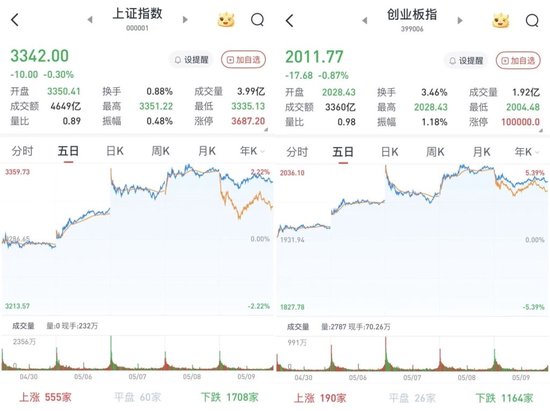
Market Overview - The three major A-share indices opened slightly lower on May 9, with the Shanghai Composite Index down 0.3% to 3342 points, the ChiNext Index down 0.87% to 2011.77 points, and the STAR Market 50 Index down 1.96% to 1006.32 points [3][4] - A total of 1212 stocks rose while 4061 stocks fell across the exchanges, with a total trading volume of 11.92 billion yuan, a decrease of 1.014 billion yuan from the previous trading day [4][5] Sector Performance - Bank stocks continued to rise, with several banks reaching new highs, including China Construction Bank and Jiangsu Bank, both gaining over 2% [6] - The semiconductor sector faced significant declines, with companies like Huahong Semiconductor and Espressif Systems dropping over 7% [6] - The textile and apparel sector showed strong performance, with multiple stocks hitting the daily limit or rising over 10% [6] - The real estate sector performed poorly, with several companies declining over 3% [7] Market Sentiment and Outlook - Analysts expect the market to maintain a steady upward trend in the short term, supported by structural monetary policy and anticipated fiscal measures aimed at boosting domestic demand [8][9] - The market is likely to experience a structural rally driven by both policy and earnings, with a focus on sectors with high earnings certainty and clear policy catalysts [9] - The military and defense sector is expected to benefit from ongoing geopolitical tensions, with growth potential in military trade and increased competitiveness of Chinese military products [10]


全市场超4100只个股下跌,这一板块跌幅居前→
第一财经· 2025-05-09 04:04
Market Overview - The Shanghai Composite Index fell by 0.26% to 3343.38, while the Shenzhen Component Index decreased by 0.84% to 10112.17, and the ChiNext Index dropped by 0.99% to 2009.26 [1][2] - Over 4100 stocks in the market experienced declines, indicating a broad market downturn [1][4] Sector Performance - The textile manufacturing, banking, and electric power sectors showed positive performance, with notable gains in specific stocks [1][5] - Conversely, the semiconductor, film and television, and humanoid robot sectors faced significant declines, with the semiconductor sector particularly affected [1][4][10] Notable Stock Movements - Jin控电力 saw a surge, closing at a 9.93% increase, while 淮河能源 experienced a remarkable rise of 1003% [6] - The banking sector was active, with 建设银行 reaching a historical high and several other banks like 青岛银行 and 重庆银行 rising over 1% [9] Technology Sector - The Hang Seng Technology Index saw a decline of 2%, with 华虹半导体 dropping nearly 12% and 中芯国际 falling over 6% [3][10] - The technology sector's struggles were reflected in the broader market, with significant losses reported across various tech stocks [3][10] Currency and Monetary Policy - The People's Bank of China conducted a 770 billion yuan reverse repurchase operation at a rate of 1.40%, maintaining previous levels [13] - The Chinese yuan depreciated against the US dollar by 22 basis points, with the central parity rate reported at 7.2095 [14]





一揽子金融政策稳预期,机构看好银行红利+复苏属性,银行ETF天弘(515290)逆市涨超1%冲击三连涨
Sou Hu Cai Jing· 2025-05-09 02:33
Core Viewpoint - The recent financial policies introduced by the Chinese government aim to stabilize the market and expectations, with a focus on supporting the banking sector as a key financing channel for the economy [2][3]. Group 1: Market Performance - On May 9, A-shares opened lower, but the banking sector saw gains, with the Tianhong Bank ETF (515290) rising over 1% and several constituent stocks like Chongqing Bank and Qingdao Bank performing well [1]. - The Tianhong Bank ETF has recorded a net inflow of over 100 million yuan over four consecutive trading days, indicating strong investor interest [1]. - The Dividend Low Volatility ETF (159549) also saw an increase of over 0.62%, with several constituent stocks gaining more than 2% [1]. Group 2: Financial Policies - The People's Bank of China has implemented a series of measures including a 50 basis point reduction in reserve requirements and interest rate cuts to support economic stability [2]. - The policies include a total of over ten measures focusing on quantity, price, and structure adjustments, aimed at enhancing liquidity and supporting key sectors [2]. Group 3: Investment Outlook - The banking sector is viewed as having both dividend and recovery attributes, with a focus on the long-term sustainability of policies rather than short-term fluctuations in net interest margins [3]. - The current low-risk interest rates and the ability of state-owned banks to manage provisions suggest a stable growth outlook for bank earnings, with a maintained dividend payout ratio of around 30% [3]. - Optimism regarding the banking sector is supported by improved risk management in real estate, stock markets, and foreign trade, which alleviates concerns about asset quality deterioration [3].

政策“组合拳”发力 银行股持续活跃
Shang Hai Zheng Quan Bao· 2025-05-08 18:45
Core Viewpoint - The recent surge in A-share bank stocks is attributed to a series of supportive financial policies, including interest rate cuts and reserve requirement ratio reductions, which enhance the stability and profitability of banks [1][2]. Group 1: Financial Policies Impact - On May 7, the People's Bank of China announced a package of financial measures, including a 0.1 percentage point reduction in policy interest rates and a 0.5 percentage point decrease in the reserve requirement ratio [2]. - The introduction of 500 billion yuan for consumer and pension re-loans is expected to further stimulate bank lending and improve asset quality [2]. - Analysts believe that these policies will lead to a stable credit supply and manageable asset quality pressures for banks [2]. Group 2: Market Performance - On May 8, bank stocks continued to perform strongly, with Shanghai Pudong Development Bank reaching a new high of 11.69 yuan per share, and Jiangsu Bank closing up 2.46% at 10.41 yuan per share, pushing its market capitalization above 191 billion yuan [1]. - Other banks, such as Qingnong Commercial Bank and Qingdao Bank, also saw significant gains, with increases exceeding 3% [1]. - Bank-related ETFs also performed well, with several ETFs showing gains of over 1% [1]. Group 3: Institutional Investment - Insurance funds have shown a strong preference for bank stocks, holding 27.82 billion shares valued at 265.78 billion yuan as of the end of the first quarter, making banks the top holdings [3]. - The trend of institutional investment in bank stocks is expected to accelerate, enhancing the dividend value of the banking sector [3]. - Analysts suggest that the high dividend yield characteristic of bank stocks makes them attractive for long-term investors, reinforcing their strategic value in both short and long-term portfolios [3].