
EASTMONEY(300059)

Search documents
首批券商三季报披露,业绩延续高增速;本周25只新基启动发行,权益类占八成 | 券商基金早参
Mei Ri Jing Ji Xin Wen· 2025-10-28 01:12
Group 1: Brokerage Firms' Performance - The first batch of brokerage firms' Q3 reports shows a continuation of high growth in both revenue and net profit, indicating a sustained improvement in industry conditions [1] - CITIC Securities, as the leading brokerage, reported a revenue of 55.815 billion yuan, a year-on-year increase of 32.70%, and a net profit of 23.159 billion yuan, up 37.86% [1] - Other firms like Dongfang Caifu and Guosheng Securities also reported significant growth, with Guosheng's net profit increasing by 191.21% [1] Group 2: Fund Distribution Trends - A year-end fund distribution trend is emerging, with bond and passive index funds becoming the main focus, particularly ETFs, which are leading in distribution amounts [2] - Several ETFs have reported single distributions exceeding 2 billion yuan, with the Huaxia CSI 300 ETF distributing 2.87 billion yuan and the E Fund CSI 300 ETF distributing 2.76 billion yuan and 1.473 billion yuan in two instances [2] - This trend reflects a preference for stable returns among institutions, potentially guiding funds towards blue-chip stocks and core assets [2] Group 3: New Fund Issuance - The public fund issuance market is experiencing a unique pattern of "reduced quantity but increased efficiency," with 25 new public products launched this week, down 16.67% from the previous week [3] - The average subscription period for new funds has decreased from 27.8 days to 21.92 days, indicating a faster fundraising pace [3] - The high proportion of equity funds, accounting for 80% of new issuances, suggests a renewed market preference for equity assets [3] Group 4: Information Disclosure Assessment - The Shanghai Stock Exchange has released its information disclosure assessment results, with 10 brokerage firms receiving an A rating, highlighting their superior disclosure quality [4] - The leading firms include CITIC Securities and Guotai Junan, which may enhance investor confidence and attract more capital [4] - Improved disclosure quality is expected to increase market transparency and support the healthy development of the capital market, benefiting the brokerage sector's valuation recovery [5]


官泽帆2025年三季度表现,易方达中证500增强策略ETF基金季度涨幅26.11%
Sou Hu Cai Jing· 2025-10-27 23:31
Core Viewpoint - The best-performing fund managed by manager Guan Zefan is the E Fund CSI 500 Enhanced Strategy ETF, which achieved a quarterly net value increase of 26.11% by the end of Q3 2025 [1] Fund Performance Summary - Guan Zefan manages a total of 3 funds, with the following performance metrics: - E Fund CSI 500 Enhanced Strategy ETF: 1.17 billion yuan, annualized return of 11.08%, quarterly increase of 26.11%, top holding in Gan Hong Technology with a weight of 2.21% [2] - E Fund CSI 500 Index Quantitative Enhanced C: 4.59 billion yuan, annualized return of 3.59%, quarterly increase of 24.17%, top holding in Gan Hong Technology with a weight of 1.57% [2] - E Fund CSI 500 Index Quantitative Enhanced A: 3.34 billion yuan, annualized return of 3.90%, quarterly increase of 24.27%, top holding in Sheng Hong Technology with a weight of 1.57% [2] Historical Performance and Stock Adjustments - During Guan Zefan's tenure as manager of E Fund Yi Bai Intelligent Quantitative Strategy A, the cumulative return was 23.67% with an average annualized return of 6.97%. The fund made 96 adjustments to its holdings, achieving a win rate of 60.42% with 58 profitable adjustments [2] - Notable stock adjustments include: - Longi Green Energy: Bought in Q2 2020, sold in Q2 2021, with an estimated return of 226.03% and a company performance growth of 47.68% [3][5] - Wuliangye: Bought in Q2 2020, sold in Q2 2021, with an estimated return of 96.30% and a company performance growth of 17.15% [6] - Bohai Leasing: Bought in Q1 2018, sold in Q3 2018, with an estimated return of -35.68% despite a company performance growth of 14.91% [7]







东方财富(300059):证券业务驱动高增,看好中长期竞争力
Changjiang Securities· 2025-10-27 23:30
Investment Rating - The investment rating for the company is "Buy" and is maintained [10]. Core Insights - The company's Q3 profit growth has significantly improved, driven by its securities business. The strong market has led to a notable increase in securities revenue, and overall platform traffic is recovering. Cost control on the expense side is effective, resulting in enhanced profitability. As a benchmark for internet brokerages, the company shows significant competitive advantages in customer acquisition and cost management. In the short term, the impact of public fund fee reductions is nearly cleared, and the market share in the securities business continues to rise, with commission rates bottoming out ahead of the industry. Given the market recovery, the long-term growth potential of its securities business is promising [2][14]. Summary by Sections Financial Performance - In the first three quarters of 2025, the company achieved total revenue of 115.9 billion yuan, a year-on-year increase of 58.7%, and a net profit attributable to shareholders of 91.0 billion yuan, up 50.6%. The weighted average return on equity (ROE) increased by 2.6 percentage points to 10.7% [7][14]. Business Segments - For Q3, the company reported total revenue of 53.0 billion yuan and a net profit of 35.3 billion yuan, reflecting year-on-year growth of 69.6% and 77.7%, respectively. The revenue from various business lines includes e-commerce income of 25.4 billion yuan, net interest income of 24.1 billion yuan, net commission income of 66.4 billion yuan, and investment income of 19.7 billion yuan, with year-on-year changes of +13.4%, +59.7%, +86.8%, and -18.2% respectively [14]. Market Environment - The average daily trading volume in Q3 was 2.1 trillion yuan, a year-on-year increase of 209.7%, with a financing balance of 2.40 trillion yuan, up 66.2%. The market environment is significantly better than the same period last year [14]. Cost Management - The company effectively controlled costs, with sales, management, and R&D expenses amounting to 2.6 billion yuan, 19.0 billion yuan, and 7.5 billion yuan, reflecting year-on-year changes of +20.9%, +11.5%, and -11.2% respectively. The net profit margin improved by 4.9 percentage points to 67.1% [14]. Future Outlook - The company is expected to achieve net profits of 119.8 billion yuan and 138.1 billion yuan in 2025 and 2026, representing year-on-year growth of 24.6% and 15.3%, respectively, with corresponding price-to-earnings ratios of 34.1 and 29.6 times [14].
多家上市券商三季报“破浪”:业务结构优化与市场回暖同频共振
Shang Hai Zheng Quan Bao· 2025-10-27 20:50
Core Viewpoint - The performance of listed securities firms in the third quarter of 2025 shows significant growth, driven by an active A-share market and increased margin trading, indicating potential investment opportunities in the brokerage sector [2][4][5]. Group 1: Financial Performance - Seven securities firms reported a total revenue of 72.36 billion yuan for the first three quarters, representing a year-on-year increase of 18.89%, with total net profit reaching 38.22 billion yuan, up 29.94% [1][3]. - CITIC Securities, as the leading firm, achieved a record revenue of 55.81 billion yuan, a year-on-year growth of 32.70%, and a net profit of 23.16 billion yuan, increasing by 37.86% [3][5]. - Oriental Fortune, a representative of internet brokerages, reported a net profit exceeding 9 billion yuan for the first three quarters, with a quarterly revenue of 4.73 billion yuan, marking a 100.65% year-on-year increase [3][4]. Group 2: Market Dynamics - The A-share market has seen a daily average trading volume of approximately 1.65 trillion yuan, up 51.65% year-on-year, with some days exceeding 3 trillion yuan [5]. - The average margin trading balance for the first three quarters was about 1.94 trillion yuan, reflecting a year-on-year increase of over 23% [5]. Group 3: Future Outlook - Analysts predict that the securities industry could see a net profit of 67.2 billion yuan for the third quarter of 2025, representing an 87% year-on-year increase, and a total net profit of 180 billion yuan for the first three quarters, up 55% [4]. - The brokerage sector is expected to benefit from a combination of low valuations and high growth expectations, with a strategic opportunity for investment as the industry transitions to high-value-added services [6][7].
非银金融行业周报:把握非银三季报业绩增长和金融街论坛政策催化机遇-20251027
Donghai Securities· 2025-10-27 14:59
Investment Rating - The report assigns an "Overweight" rating to the non-bank financial industry, indicating that it is expected to outperform the CSI 300 index by at least 10% over the next six months [34]. Core Insights - The non-bank financial index rose by 2% last week, outperforming the CSI 300 index by 1.2 percentage points. The brokerage and insurance indices also saw increases of 2.1% and 1.8%, respectively, indicating a synchronized upward trend in these sectors [3][8]. - The report highlights the rapid growth in third-quarter earnings for brokerages, driven by a market recovery. Major brokerages like CITIC Securities and Huaxin Securities reported year-on-year profit increases of 37.9% and 66.4%, respectively, with a significant rise in average daily A-share trading volume [4][8]. - The upcoming Financial Street Forum is expected to provide policy-driven catalysts that could further enhance market activity and valuations in the brokerage sector [4]. Market Data Tracking - The average daily trading volume for stock funds was 23,307 billion yuan, a decrease of 16.2% from the previous week. The margin trading balance increased by 1.1% to 2.46 trillion yuan, while the stock pledge market value rose by 2.1% to 2.99 trillion yuan [16][22]. - The report notes that the insurance sector is also experiencing strong earnings growth, with major insurers like China Life and New China Life projecting profit increases of 50%-70% and 45%-65%, respectively, for the first three quarters of 2025 [4][14]. Industry News - The China Securities Regulatory Commission (CSRC) emphasized the importance of enhancing the resilience and risk management capabilities of the capital market during a recent meeting. This includes improving the inclusiveness and adaptability of market regulations and promoting deeper capital market openness [32]. - The report mentions that the new regulatory framework aims to support high-quality development in the financial sector, focusing on risk prevention and regulatory compliance [32].



东方财富大宗交易成交23.00万股 成交额598.92万元
Zheng Quan Shi Bao Wang· 2025-10-27 13:54
(原标题:东方财富大宗交易成交23.00万股 成交额598.92万元) 两融数据显示,该股最新融资余额为286.16亿元,近5日增加1.41亿元,增幅为0.50%。 据天眼查APP显示,东方财富信息股份有限公司成立于2005年01月20日,注册资本1580403.7675万人民币。(数据宝) 10月27日东方财富大宗交易一览 东方财富10月27日大宗交易平台出现一笔成交,成交量23.00万股,成交金额598.92万元,大宗交易成交价为26.04元。该笔交易的买卖双方均为机 构专用席位。 进一步统计,近3个月内该股累计发生14笔大宗交易,合计成交金额为1.25亿元。 证券时报•数据宝统计显示,东方财富今日收盘价为26.04元,上涨0.54%,日换手率为3.55%,成交额为124.16亿元,全天主力资金净流出9.06亿 元,近5日该股累计上涨4.08%,近5日资金合计净流入6157.76万元。 | 成交量 | 成交金额 | 成交价格 | 相对当日 收盘折溢价 | 买方营业部 | 卖方营业部 | | --- | --- | --- | --- | --- | --- | | (万股) | (万元) | (元) | ...
东方财富(300059) - 东方财富信息股份有限公司关于子公司东方财富证券股份有限公司2025年面向专业投资者公开发行公司债券(第六期)发行结果的公告
2025-10-27 12:58
证券代码:300059 证券简称:东方财富 公告编号:2025-076 东方财富信息股份有限公司 关于子公司东方财富证券股份有限公司 2025 年面向专业投资者 公开发行公司债券(第六期)发行结果的公告 东方财富信息股份有限公司子公司东方财富证券股份有限公司(以下简称 "东方财富证券")于 2025 年 3 月收到中国证监会《关于同意东方财富证券股 份有限公司向专业投资者公开发行公司债券注册的批复》(证监许可〔2025〕618 号),中国证监会同意东方财富证券向专业投资者公开发行面值总额不超过 200 亿元公司债券的注册申请。近日,东方财富证券完成了 2025 年面向专业投资者 公开发行公司债券(第六期)(以下简称"本期债券")发行工作,具体发行结 果如下: 本期债券采取网下面向专业投资者询价配售的方式发行,网下实际发行规模 为 27 亿元,债券简称为"25 东财证券 07",债券代码"524483.SZ",期限为 3 年期,票面利率为 2.05%,发行价格为每张 100 元。本期债券拟在深圳证券交易 所上市交易,募集资金用于偿还东方财富证券债务及补充东方财富证券营运资 金。 认购本期债券的投资者均符合《公司 ...
兵临4000点,“旗手”放量躁动,三季报强助攻,中信、东财成交额齐超百亿,券商ETF(512000)带头吸金
Xin Lang Ji Jin· 2025-10-27 11:51
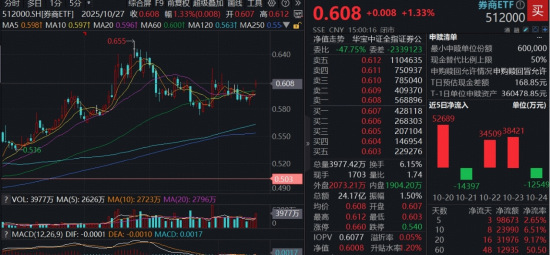
Core Viewpoint - The Shanghai Composite Index has shown strong performance, reaching a peak of 3999.07 points, just shy of the 4000 mark, closing up 1.18% at 3996.94 points, driven by the brokerage sector's momentum [1][3]. Brokerage Sector Performance - The brokerage sector is experiencing a rally, with major firms like Dongxing Securities leading gains of over 6%, and other firms such as Xiangcai Securities and Industrial Securities also showing significant increases [3]. - Major brokerages, CITIC Securities and Oriental Fortune, reported impressive third-quarter earnings, with CITIC achieving a record high quarterly profit of 94.40 billion yuan and Oriental Fortune's revenue growing by 100.65% year-on-year [3][4]. - A total of six listed brokerages have released their third-quarter reports, indicating strong overall performance, with expectations for continued growth in the sector due to increased market trading volume and margin financing [3][4]. ETF and Market Trends - The brokerage ETF (512000) has reached a record size of over 388 billion yuan, with a daily average trading volume exceeding 10 billion yuan, making it a leading investment tool in the A-share market [6]. - The ETF has attracted significant inflows, with nearly 9.87 billion yuan in the last five days, indicating strong investor interest in the brokerage sector [5]. - The current price-to-book ratio of the brokerage index stands at 1.57, which is relatively low compared to historical performance, suggesting potential for valuation recovery [4][5].
主力资金 | 2股尾盘获主力资金大幅出手
Zheng Quan Shi Bao Wang· 2025-10-27 11:20
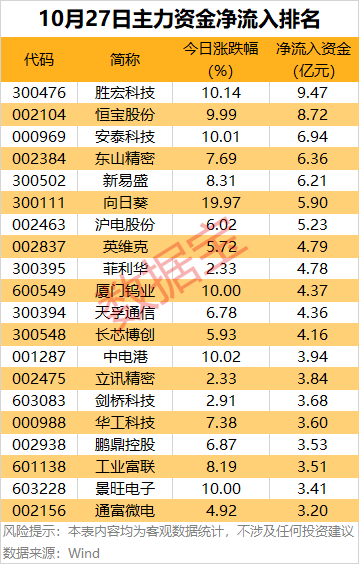
Group 1: Market Overview - The A-share market continued its strong performance on October 27, with the Shanghai Composite Index approaching the 4000-point mark [1] - Most industry sectors saw gains, particularly electronic chemicals, small metals, shipbuilding, energy metals, semiconductors, steel, and electronic components [1] - The main funds in the market experienced a net outflow of 7.59 billion yuan, with 10 sectors seeing net inflows, notably electronics and communications [1] Group 2: Fund Inflows - The electronics and communications sectors had significant net inflows of 3.866 billion yuan and 2.25 billion yuan, respectively, far exceeding other sectors [1] - Other sectors with net inflows included non-ferrous metals (0.877 billion yuan), steel (0.44 billion yuan), and pharmaceutical biology (0.39 billion yuan) [1] Group 3: Individual Stock Performance - 12 stocks saw net inflows exceeding 400 million yuan, with Shenghong Technology leading at 0.947 billion yuan, followed by Hengbao Co. at 0.872 billion yuan [2][3] - Shenghong Technology has become one of the few companies globally capable of mass-producing HDI with 6 layers and above, and is actively developing ultra-thick board technology [2] - Hengbao Co. experienced a limit-up increase, with significant net purchases from institutional investors [2] Group 4: Fund Outflows - 40 stocks experienced net outflows exceeding 200 million yuan, with Dongfang Wealth, Kehua Data, and Sanhua Intelligent Control seeing outflows over 700 million yuan [4] - The top outflow stock was Dongfang Wealth with a net outflow of 0.918 billion yuan, followed by Kehua Data at 0.910 billion yuan and Sanhua Intelligent Control at 0.844 billion yuan [5] Group 5: Tail-End Fund Activity - At the end of the trading day, the main funds saw a net inflow of 168 million yuan, with electronics, pharmaceutical biology, and public utilities sectors each exceeding 100 million yuan in inflows [6] - Individual stocks with significant tail-end inflows included Luxshare Precision and Ningde Times, both exceeding 150 million yuan [6][7] - Conversely, stocks like New Yisheng and Chuangjiang New Materials saw tail-end outflows exceeding 100 million yuan [8][9]



东方财富:东财创新资本持有妙道咨询的母公司29.96%股份
Mei Ri Jing Ji Xin Wen· 2025-10-27 10:46
Group 1 - The core point of the article is that Dongfang Caifu has a significant stake in Miaodao Consulting, holding 29.96% of its parent company [1] Group 2 - Dongfang Caifu Securities' alternative investment subsidiary, Dongcai Innovation Capital, is the entity that holds the shares in Miaodao Consulting [1] - The inquiry was made by an investor on the interactive platform regarding the relationship between Dongfang Caifu and Miaodao [1]