
Mindray(300760)

Search documents
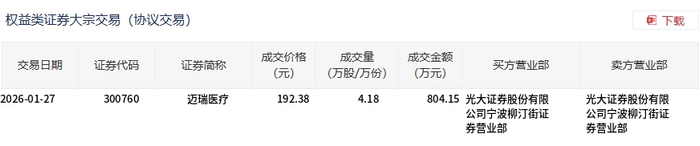
迈瑞医疗今日大宗交易溢价成交4.18万股,成交额804.15万元
Xin Lang Cai Jing· 2026-01-27 08:57
| 交易日期 | 证券代码 | 证券简称 | 成交价格 (元) | 成交量 (万股/万份) | 成交金额 买方营业部 (万元) | 卖方营业部 | | --- | --- | --- | --- | --- | --- | --- | | 2026-01-27 | 300760 | 迈瑞医疗 | 192.38 | 4.18 | 804.15 光大证券股份有限 | 光大证券股份有限 | | | | | | | 公司宁波柳汀街证 | 公司宁波柳汀街证 | | | | | | | 券营业部 | 券营业部 | 1月27日,迈瑞医疗大宗交易成交4.18万股,成交额804.15万元,占当日总成交额的0.43%,成交价 192.38元,较市场收盘价192.16元溢价0.11%。 ...


Q4公募基金整体和全基医药重仓持仓均创18年以来新低:医药行业25Q4基金持仓分析
Huafu Securities· 2026-01-27 07:30
Investment Rating - The report maintains an "Outperform" rating for the pharmaceutical industry [1] Core Insights - The overall and weighted holdings of public funds in the pharmaceutical sector reached a new low since 2018 in Q4 2025, with the pharmaceutical heavy holdings accounting for 8.0% of all public funds, down 1.7 percentage points quarter-on-quarter [2][9] - The total scale of pharmaceutical funds in Q4 2025 was 394.6 billion yuan, a decrease of 9.2% from the previous quarter, with active pharmaceutical funds at 177.7 billion yuan, down 14% [20] - The proportion of passive pharmaceutical funds has increased significantly from 18% in Q1 2018 to 55% in Q4 2025, indicating a shift towards passive investment strategies in the sector [20] Fund Holdings Analysis - In Q4 2025, the pharmaceutical sector saw a decrease in active fund holdings, with active pharmaceutical funds accounting for 33% of the total pharmaceutical heavy holdings, up 2 percentage points, while non-pharmaceutical active funds accounted for 26%, down 5.1 percentage points [3][13] - The top five holdings by market value in public funds included Heng Rui Medicine (31.7 billion), WuXi AppTec (29.6 billion), and Innovent Biologics (16.6 billion) [6] - The top three increases in active fund holdings were for Tigermed (1.7 billion), Yimeng Biologics (1.4 billion), and CSPC Pharmaceutical Group (1.3 billion) [6] Sector-Specific Trends - The report highlights a shift in fund holdings towards innovative drugs and CXO services, while traditional Chinese medicine and high-value consumables are underweighted [6] - The report notes that the proportion of holdings in traditional Chinese medicine and biotech has increased, while holdings in BioPharma and CXO have decreased significantly [6][28] - The overall market value of holdings in the Bio-Tech sector reached 7.25% in Q4 2025, marking the highest level since Q1 2018, with active pharmaceutical funds holding 4.9% [28]



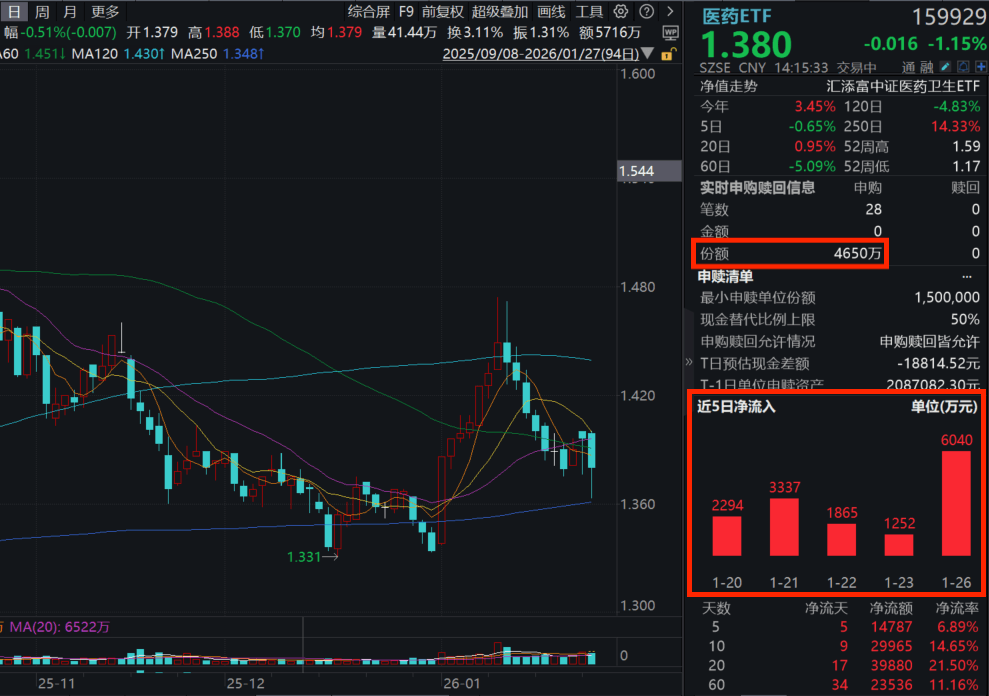
印度疫情再起,中科院新药高效抑制病毒活性!三生国健业绩"亮瞎眼",净利预增311%!医药ETF(159929)跌超1%,盘中再获6400万元资金大举加仓
Sou Hu Cai Jing· 2026-01-27 06:42
Core Viewpoint - The recent Nipah virus outbreak in India has led to increased attention and investment in the A-share pharmaceutical sector, with significant capital inflows into medical ETFs despite some declines in stock prices [1][3]. Group 1: Market Activity - The medical ETF (159929) experienced a drop of over 1% today, following a previous day of gains, but attracted 64 million yuan in capital [1]. - Over the past 10 days, the ETF has seen net inflows for 9 days, accumulating nearly 300 million yuan [1]. - Trading activity remains robust, with intraday trading volume exceeding 120 million yuan [1]. Group 2: Nipah Virus Research - The Nipah virus outbreak in West Bengal, India, has resulted in deaths and the isolation of close contacts [3]. - A significant research study published in the journal Emerging Microbes & Infections confirms that the oral nucleoside drug VV116 shows promising antiviral activity against the Nipah virus, providing new hope for treatment and prevention [3]. Group 3: Company Updates - Sanofi's (三生国健) 2025 annual performance forecast indicates a net profit of approximately 2.9 billion yuan, reflecting a year-on-year increase of 311.35%, driven by a collaboration with Pfizer [4]. - Junshi Biosciences (君实生物) has completed the issuance of its first phase of technology innovation bonds for 2026, totaling 1 billion yuan, aimed at supporting drug research and development [4]. Group 4: Sector Trends - The pharmaceutical industry is expected to benefit from a favorable investment environment and policy support, particularly for innovative drugs and technologies [6][8]. - The medical manufacturing sector has shown a slight increase in industrial value added, while revenue and profit have seen minor declines [7]. - The healthcare expenditure in China has shown a year-on-year growth of 4.7% for the first 11 months of 2025, marking a recovery after two years of decline [7]. Group 5: Investment Strategies - Investment strategies for 2026 focus on innovation, international expansion, and marginal improvements in the pharmaceutical sector [8][9]. - Key areas of interest include innovative drugs, medical devices, and the integration of new technologies such as AI and brain-machine interfaces [8][9].


迈瑞医疗:公司的供应链驾驶舱整合了各个环节的数据,打破信息孤岛
Zheng Quan Ri Bao Wang· 2026-01-27 03:47
Core Viewpoint - Digital transformation is a core driving force for the company's development, enhancing collaboration across the entire business chain from suppliers to clients [1] Group 1: Digital Transformation and Supply Chain Management - The company has achieved full-link operation support for its supply chain business through digital construction, improving operational analysis, cash flow management, and compliance processes [1] - The supply chain cockpit integrates data from various stages, breaking down information silos to ensure compliance and quality in every step from material supply to delivery [1] Group 2: Focus on Digital Infrastructure - In 2024, the company will strengthen digital construction at headquarters and production bases, as well as system integration with overseas factories and warehouses [1] - The newly established production base in Dangshan has achieved full coverage of digital supply chain systems and completed system connectivity with the Nanjing production base for production collaboration [1] Group 3: International Expansion and Efficiency - The digital system at the Wuhan production base is operational, supporting high-value medical consumables business [1] - The company has initiated localized construction of the digital system at its European production base, enhancing regional finished product delivery capabilities through efficient integration with domestic and European warehouse systems [1] Group 4: Data Management and Future Development - The company continues to expand the coverage and depth of its information systems, building platforms for digital integrated product development, digital supply chain, digital services, and global marketing management [1] - The company is advancing its digital process, improving data asset management, and conducting data and information audits to support ongoing digital transformation [1]
国信证券医药生物业2026年投资策略:关注创新出海 重视新技术方向
智通财经网· 2026-01-27 02:48
Group 1 - The core viewpoint is that innovative drugs are expected to show significant excess returns in 2025, driven by continuous BD overseas expansion, excellent clinical data, and policy support [1] - The CXO sector is anticipated to experience substantial growth due to the recovery in demand and improved investment environment in the global pharmaceutical industry [1] - The report emphasizes the importance of focusing on new technologies, particularly bispecific antibodies, small nucleic acid drugs, AI healthcare, and brain-computer interface innovations [3] Group 2 - Domestic supply and demand are relatively stable, with national health expenditure showing a year-on-year growth of 4.7% from January to November 2025, marking a positive turnaround after two years of decline [2] - The medical insurance fund's income and expenditure growth rates continue to decline, with total income of 2.63 trillion yuan (+2.9%) and expenditure of 2.11 trillion yuan (+0.5%) from January to November [2] - The report suggests that the commercialization of new drug forms is entering a critical phase, with significant clinical data supporting the application of B-cell depletion therapies in autoimmune diseases [3] Group 3 - Investment recommendations include focusing on innovative overseas expansion and new technology directions, with suggested stocks such as Mindray Medical, WuXi AppTec, and others [4] - The report highlights the potential for explosive growth in the global market for brain-computer interfaces, supported by policy incentives and technological breakthroughs [3]






中国科学家首次证实VV116对尼帕病毒的治疗潜力,医疗创新ETF(516820)连续7天净流入
Xin Lang Cai Jing· 2026-01-27 02:39
Group 1 - The core viewpoint of the news highlights the performance of the China Medical and Medical Device Innovation Index, with notable stock movements, including a leading increase of 8.29% by Sangfor Technologies [1] - The Medical Innovation ETF has seen continuous net inflows over the past week, with a maximum single-day net inflow of 40.537 million yuan, totaling 114 million yuan [1] - A significant research breakthrough was reported regarding the oral nucleoside drug VV116, which shows promising antiviral activity against the Nipah virus, providing a potential treatment option for high-risk populations [1] Group 2 - Guosen Securities noted that the innovative drug sector exhibited significant excess returns in 2025, driven by international business development, continuous positive clinical data, and supportive policies [2] - The Medical Innovation ETF closely tracks the China Medical and Medical Device Innovation Index, which selects 30 profitable and growth-oriented companies to reflect the overall performance of the sector [2] - As of December 31, 2025, the top ten weighted stocks in the index include WuXi AppTec, Heng Rui Medicine, and Mindray Medical, collectively accounting for 63.75% of the index [2]



医药生物周报(26年第3周):25Q4公募基金医药持仓分析
Guoxin Securities· 2026-01-27 00:45
Investment Rating - The report maintains an "Outperform" rating for the pharmaceutical and biotechnology sector [5] Core Views - The pharmaceutical sector underperformed the overall market, with a 0.39% decline in the biopharmaceutical sector compared to a 1.17% increase in the overall A-share market [32] - The TTM price-to-earnings ratio for the pharmaceutical sector is 38.51x, which is at the 84.35 percentile of the historical valuation over the past five years [32][37] Summary by Sections Market Performance - The overall A-share market increased by 1.17%, while the Shanghai and Shenzhen 300 index decreased by 0.62%. The biopharmaceutical sector saw a decline of 0.39% [32] - Among sub-sectors, chemical pharmaceuticals fell by 1.11%, while medical services dropped by 2.17%. Conversely, medical commercial and traditional Chinese medicine sectors saw increases of 4.26% and 0.89%, respectively [32] Fund Holdings Analysis - As of Q4 2025, the net asset value of pharmaceutical funds reached 358.4 billion, a decrease of 9.0% from the previous quarter [11] - The proportion of pharmaceutical holdings in all funds was 7.97%, down by 1.71 percentage points [16] - The largest sub-sectors by holdings were chemical preparations (37.5%) and other biological products (20.8%) [19] Key Company Earnings Forecasts and Investment Ratings - Major companies such as Mindray Medical (237 billion market cap, outperform rating), WuXi AppTec (293.6 billion market cap, outperform rating), and Aier Eye Hospital (105.4 billion market cap, outperform rating) are highlighted for their strong earnings forecasts [4] - The report lists several companies with outperform ratings, including New Industry, Huatai Medical, and others, with projected earnings growth over the next few years [4] Investment Strategy - The report emphasizes the importance of the CXO sector and recommends focusing on investment opportunities within this area due to its competitive advantages [41] - It also suggests continued recommendations for innovative drugs and the associated industry chain, with a specific investment portfolio for January 2026 including companies like Mindray Medical and WuXi AppTec [42][43]
医药生物行业2026年投资策略:关注创新出海,重视新技术方向
Guoxin Securities· 2026-01-26 15:27
Core Insights - The report emphasizes the importance of innovation in the pharmaceutical and biotechnology industry, particularly focusing on the overseas expansion of innovative drugs and the adoption of new technologies [1][4]. - The investment rating for the sector is maintained at "outperform the market" [2]. Group 1: Market Overview and Trends - The overseas market for innovative drugs and the CXO industry is expected to perform exceptionally well in 2025, driven by continuous business development (BD) activities, strong clinical data, and supportive policies [4]. - The domestic supply and demand remain stable, with a shift in payment systems favoring innovation. National health expenditure increased by 4.7% year-on-year in the first 11 months of 2025, marking a recovery after two years of decline [4]. - The report highlights the significant growth potential in new drug forms such as dual antibodies and small nucleic acid drugs, as well as innovations in AI healthcare and brain-machine interfaces [4]. Group 2: Investment Recommendations - The report recommends focusing on companies with global competitiveness and differentiated innovation capabilities, as well as domestic CXO leaders with high barriers in cost control, technology accumulation, and production capacity [4]. - Recommended stocks include Mindray Medical, WuXi AppTec, Kelaiying, Aier Eye Hospital, and several others, with specific mention of H-shares like Kelun-Bio and CanSino Biologics [4][5]. Group 3: Financial Performance and Projections - The report provides a detailed strategy portfolio for 2026, listing companies along with their projected net profits and price-to-earnings (PE) ratios, indicating a generally positive outlook for the sector [5]. - The pharmaceutical sector's overall performance in 2025 was strong, with significant gains in sub-sectors such as medical services and chemical pharmaceuticals, driven by BD collaborations and clinical data releases [12][23]. Group 4: Fund Holdings and Market Sentiment - As of Q4 2025, the net asset value of pharmaceutical funds decreased by 9.0%, with a notable shift where passive funds surpassed active funds for the first time since 2019 [25][32]. - The report indicates a decline in the proportion of pharmaceutical holdings in both active and non-pharmaceutical funds, with a concentration in chemical preparations and other biological products [32][40].

医药生物周报(26年第3周):25Q4公募基金医药持仓分析-20260126
Guoxin Securities· 2026-01-26 11:03
Investment Rating - The report maintains an "Outperform" rating for the pharmaceutical and biotechnology sector [5][41]. Core Views - The pharmaceutical sector has shown weaker performance compared to the overall market, with a TTM P/E ratio of 38.51x, which is at the 84.35th percentile of the past five years [1][37]. - The report highlights the importance of the CXO sector, emphasizing the competitive advantages of Chinese companies in the chemical CDMO field, and suggests that the sector's valuation is expected to recover [41]. - The report recommends focusing on innovative drugs and the associated industry chain, with a notable mention of the upcoming JPM conference and the clinical progress of innovative drugs overseas [41][42]. Summary by Sections Market Performance - The overall A-share market increased by 1.17%, while the biotechnology sector declined by 0.39%. The medical services sector was the worst performer, dropping by 2.17% [1][32]. - The report notes that the largest sub-sectors by holding percentage are chemical preparations (37.5%) and other biological products (20.8%) [19]. Fund Holdings Analysis - As of Q4 2025, the total net asset value of pharmaceutical funds reached 358.4 billion, a decrease of 9.0% from the previous quarter [11]. - The report indicates that the pharmaceutical holdings of all funds accounted for 7.97%, down by 1.71 percentage points [16]. Key Company Earnings Forecasts - The report provides earnings forecasts for several key companies, all rated "Outperform": - Mindray Medical (300760.SZ): 2024A net profit of 11.67 billion [4] - WuXi AppTec (603259.SH): 2024A net profit of 9.35 billion [4] - Aier Eye Hospital (300015.SZ): 2024A net profit of 3.56 billion [4] - New Industry (300832.SZ): 2024A net profit of 1.83 billion [4] - Huatai Medical (688617.SH): 2024A net profit of 670 million [4] Investment Strategy - The report recommends a portfolio of stocks including Mindray Medical, WuXi AppTec, Aier Eye Hospital, and others, focusing on companies with strong growth potential in the innovative drug sector [42][43].
医药生物周报(26年第3周):5Q4公募基金医药持仓分析-20260126
Guoxin Securities· 2026-01-26 09:52
Investment Rating - The report maintains an "Outperform" rating for the pharmaceutical and biotechnology sector [5] Core Views - The pharmaceutical sector underperformed the overall market, with a 0.39% decline in the biopharmaceutical sector compared to a 1.17% increase in the total A-share market [32] - The TTM price-to-earnings ratio for the pharmaceutical sector is 38.51x, which is at the 84.35th percentile of the historical valuation over the past five years [32][37] - The report highlights a shift in fund holdings, with a decrease in the proportion of pharmaceutical holdings in both pharmaceutical and non-pharmaceutical funds [11][16] Summary by Sections Market Performance - The overall A-share market increased by 1.17%, while the Shanghai and Shenzhen 300 index decreased by 0.62% [32] - The biopharmaceutical sector's performance was weaker than the overall market, with specific declines in chemical pharmaceuticals (-1.11%) and medical services (-2.17%) [32] Fund Holdings Analysis - As of Q4 2025, the net asset value of pharmaceutical funds reached 358.4 billion, a decrease of 9.0% from the previous quarter [11] - The proportion of pharmaceutical holdings in all funds was 7.97%, down 1.71 percentage points [16] - The largest sub-sectors by holdings were chemical preparations (37.5%) and other biological products (20.8%) [19] Company Earnings Forecasts and Ratings - Key companies such as Mindray Medical (237 billion market cap, "Outperform" rating) and WuXi AppTec (293.6 billion market cap, "Outperform" rating) are highlighted for their strong earnings forecasts [4] - The report lists several companies with projected earnings growth, including Aier Eye Hospital and New Industry, both rated "Outperform" [4] Investment Strategy - The report recommends focusing on innovative drugs and the CXO sector, emphasizing the competitive advantages of Chinese companies in the chemical CDMO space [41] - A portfolio of recommended stocks includes Mindray Medical, WuXi AppTec, and Aier Eye Hospital, among others [42][43]
