
AMD(AMD)

Search documents
Nvidia vs. AMD: Which Is the Better AI Chip Stock for 2026?
The Motley Fool· 2025-12-07 05:00
Core Viewpoint - The competition between Nvidia and AMD in the AI infrastructure market is intensifying, with AMD showing strong performance in 2025 and potential for further growth in 2026 [1][3]. Nvidia's Position - Nvidia holds over 90% market share in the data center GPU space, benefiting from its established CUDA software platform, which is crucial for training large language models [3][5]. - Nvidia's stock is trading at a forward P/E of 24, lower than AMD's 34, and it has experienced faster revenue growth, with a 62% increase last quarter compared to AMD's 36% [5]. - The company has a market capitalization of $4,433 billion and a gross margin of 70.05% [4]. AMD's Potential - AMD's data center revenue is significantly lower than Nvidia's, but capturing market share in the AI infrastructure space could lead to substantial growth [6]. - AMD has established a niche in the inference market, where it can compete more effectively against Nvidia, as the inference market is expected to grow larger than the training market [7]. - AMD has partnered with OpenAI, which includes a potential 10% stake in AMD and a supply agreement for up to six gigawatts of GPUs, valued at over $200 billion [9][10]. - AMD aims for over 35% compound annual revenue growth over the next three to five years, with more than 60% growth in data center revenue and an 80% increase in AI revenue [11]. Conclusion - Both Nvidia and AMD are expected to perform well in 2026, but AMD may have the edge due to its partnerships and growth potential in the AI market [13].



【数智周报】华为任正非:大量建设大模型是正确的探索,未来算力一定过剩;豆包手机助手触发微信账号强制下线?豆包、微信双方回应;亚马逊推出定制AI芯片Tra...
Tai Mei Ti A P P· 2025-12-07 03:21
Group 1 - Huawei's founder Ren Zhengfei emphasized that the future will see an excess of computing power, stating that building numerous large models is a correct exploration [2][3] - Ren highlighted that AI's true value lies in its application rather than invention, asserting that AI could contribute significantly to various industries, such as coal washing and steel production [2][3] - SoftBank's Masayoshi Son expressed regret over selling Nvidia shares, indicating that the sale was driven by the need for capital to invest in AI projects like OpenAI [3] Group 2 - Google CEO Sundar Pichai called for a national AI regulatory framework in the U.S. to avoid regulatory chaos and maintain competitive advantage [4] - Elon Musk predicted that AI could resolve the U.S. debt crisis within three years, suggesting that productivity gains from AI will soon outpace inflation [4] - The gap between China and the U.S. in AI capabilities has reportedly narrowed, with fewer doubts expressed about this disparity in the current market [4] Group 3 - Nvidia's CFO refuted claims of an AI bubble, stating that the current phase is an early stage of transitioning to AI-required data center infrastructure [5] - Nvidia's CEO Jensen Huang noted that AI will not directly eliminate jobs but will create new, unconventional roles [6] - UBS reported that the likelihood of an AI bubble in China is low, citing limited financing and a pragmatic approach to AI investments by leading internet companies [7] Group 4 - AMD's CEO Lisa Su downplayed concerns about an AI bubble, asserting that the demand for chips will continue to grow as AI technology develops [8] - Morgan Stanley projected explosive growth in Google's TPU production, raising estimates significantly for the coming years [9][10] - SemiAnalysis indicated that Google's advantage lies in its AI infrastructure rather than chip performance, suggesting a competitive threat to Nvidia [11] Group 5 - DeepSeek announced the release of two official model versions, aiming to enhance reasoning capabilities and support various applications [12] - The first domestic GPU company, Moore Threads, saw a significant stock price increase upon its debut, raising substantial funds for AI chip development [13] - HSBC partnered with Mistral AI to integrate generative AI tools across its operations, enhancing efficiency and customer service [13] Group 6 - The Ministry of Industry and Information Technology reported that China's software business revenue reached 125.1 billion yuan, reflecting a 13.2% year-on-year growth [16] - The first AI crop "genetic scientist" in China is set to launch globally next year, showcasing advancements in agricultural research [17] - Alibaba released an updated image generation model, Qwen-Image, which has been integrated into its app for user access [18]



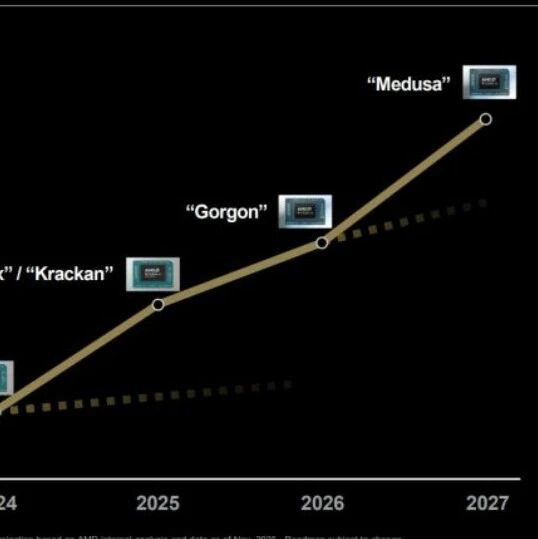
AMD产品路线图,令人失望
半导体行业观察· 2025-12-07 02:33
公众号记得加星标⭐️,第一时间看推送不会错过。 AMD之所以面临更高的发热量和更低的每瓦性能,原因很简单:Zen 5及其所有前代产品都是为数据 中心市场而设计的。知情工程师不断向我们透露,Infinity Fabric架构在移动领域功耗过高,难以实 现高效设计。此外,AMD也缺乏强有力的小核心策略。 福雷斯特·诺罗德领导的数据中心团队之所以能够蓬勃发展,得益于以数据中心为先导、覆盖面广且 功能强大的核心战略。而消费者和商业移动业务部门则不得不接受 Zen 5 的不足之处。 4nm工艺很难与英特尔18A和台积电3nm工艺竞争。 上周,AMD向金融和行业分析师展示了其未来几年的人工智能、数据中心和消费级产品计划。尽管 在数据中心市场取得了巨大成功,人工智能领域也取得了一定的进展,并且未来发展路线图清晰明 确,但我仍想指出其消费级产品路线图的一个不足之处,尤其是在2026年方面。 计算与图形事业部高级副总裁兼总经理Jack Huynh及其团队正朝着正确的方向前进;X3D台式机的 成功对微软来说是一项重大胜利。然而,在消费业务的某些关键领域,尤其是在消费级和商用笔记本 电脑领域,不太可能在2026年就立即取得成功。公 ...
美参院拟立法冻结对华先进芯片出口至少30个月,英伟达等面临直接冲击
Jing Ji Ri Bao· 2025-12-06 22:59
美国参院两党议员4日提出一项法案,旨在将现行对先进半导体的出口管制措施正式立法,要求行政部 门未来至少30个月内拒发任何先进芯片出口至中国大陆、俄罗斯等国家的许可。此举可能导致英伟达无 法向中国大陆出口其先进AI芯片;AMD与Google的芯片也将受到规范。 这项被称为《安全芯片法案》(SAFE Act)的提案,要求美国商务部在未来两年半内,停止核发高于 现有许可性能标准的芯片出口许可。 SAFE法案提出的时机,恰巧发生在英伟达执行长黄仁勋与参院银行委员会共和党议员闭门会谈的隔 天,该委员会负责出口管制政策。黄仁勋前一天也和美国总统川普私下会面,他表示双方讨论出口管制 议题,但未透露细节。 法案获参议院外交委员会跨党派议员支持,被视为维持美国在人工智能领域对中国优势的关键举措。 这也对英伟达构成新挑战,该公司一直在游说川普政府与国会放宽出口限制,以维持其在中国AI芯片 市场的领先地位。此项法案提出前一天才传出,英伟达才刚成功游说国会暂缓另一项出口管制法案 GAIN AI Act(保障国家人工智能获取与创新法案)。 目前川普政府正评估是否允许英伟达对中国销售H200芯片。若同意放行,将显著偏离自2022年起实施 ...
2 Artificial Intelligence Stocks That Can Have Their Nvidia Moment in 2026
The Motley Fool· 2025-12-06 16:15
Core AI Stocks Overview - AI stocks are experiencing significant upward momentum, with Nvidia being a standout performer, having increased nearly 1,500% from its 2022 low [1][2] - The focus is on identifying stocks that could replicate Nvidia's success, with expectations for substantial growth in the AI sector by 2026 [2] CoreWeave Analysis - CoreWeave has seen a volatile trading history since its March debut, with a peak followed by a nearly 60% decline [4] - The company specializes in cloud infrastructure tailored for AI workloads, distinguishing itself from established platforms like AWS and Azure [4] - Grand View Research projects a 32% compound annual growth rate (CAGR) for the AI market through 2033, which could benefit CoreWeave's future [5] - In Q3 2025, CoreWeave reported revenue of nearly $1.4 billion, a 134% increase year-over-year, despite a net loss of $110 million [6] - The company's price-to-sales (P/S) ratio is just over 7, comparable to levels before its recent stock surge [6] - Anticipated revenue growth of 136% for 2026 aligns with Q3 2025 performance, supported by $1.9 billion in liquidity [8] Advanced Micro Devices (AMD) Insights - AMD is making strides in the AI accelerator market, particularly with its MI350 accelerators, as it seeks to catch up to Nvidia [9][10] - The company projects a 35% revenue CAGR over the next three to five years, with data center business growth expected to exceed 60% annually [10] - In Q3 2025, AMD's revenue grew 36% to over $9.2 billion, with 47% from the data center segment [11] - Net income for Q3 reached over $1.2 billion, a 61% increase from the previous year, indicating strong profit growth [12] - AMD's stock has shown volatility but has increased nearly 60% over the past year, suggesting positive market sentiment [12][15]

AMD纪朝晖:AI智能体元年开启 边缘侧算力将重塑生产力范式
2 1 Shi Ji Jing Ji Bao Dao· 2025-12-06 11:41
Group 1 - The forum held in Guangzhou focused on the theme "Innovation Without Boundaries, Intelligence to See the Future," highlighting the significance of AI Agents in transforming work and life by 2025 [1] - IDC predicts that by 2026, 40% of jobs will be completed in collaboration with AI Agents, and by 2027, the usage of AI Agents among the world's top 2000 companies will increase tenfold, with a 1000-fold increase in workload [1] - AMD's Vice President emphasized that AI Agents will not completely replace humans but will enhance the competitiveness of those who can work collaboratively with AI [1] Group 2 - The emergence of the AI economy necessitates high-memory, high-computing edge devices as key infrastructure for businesses and individuals to achieve "AI+" transformation [2] - A mature AI Agent requires at least 50GB of memory to support large models and extensive knowledge bases, which AMD addresses with a new solution that reduces costs significantly [2] - This deployment model is transforming industries such as education and healthcare, with local deployments assisting young doctors and automating content creation processes [2] Group 3 - AMD has established a comprehensive AI strategy covering cloud, edge, and endpoint solutions, maintaining leadership in supercomputer CPUs while also expanding in consumer and workstation markets [3] - Under CEO Lisa Su's leadership, AMD has achieved significant capital returns and recognition for its technological direction, including being named CEO of the Year by Time magazine [3]
"ZEN" MODE BY AMD | Your Business Upgrade
AMD· 2025-12-06 11:30
Hi, and welcome to this tour of a typical corporate office. Let's see what chaos each door hides. Where stress lives.Decisions. Deadlines. Breakdown.Hey there. Apparently not. Surely this room is full of debates and power plays.Why does this feel like a retreat. Oh, we should have entered this room first. Any delays, fixes and glitches.People are always here. Fixing. Looking for chaos.You won't find it here. Because we are all in "Zen" mode by AMD. Zen what."Zen" mode by AMD with up to 55 TOPS of AI power i ...

TD Cowen Reiterates Buy on AMD, Calls Helios a Major AI Inflection Point
Yahoo Finance· 2025-12-06 09:29
Group 1 - Advanced Micro Devices, Inc. (AMD) is recognized as a significant player in the AI sector, with TD Cowen reiterating a "Buy" rating and a price target of $290, indicating confidence in AMD's potential as an AI winner due to the Helios launch [1][2] - The Helios AI rack-scale architecture is highlighted as an integrated platform that will enhance AMD's AI business, despite concerns about a volatile AI spending environment [2][3] - The recent decline in AMD's shares is viewed as an attractive entry point, with analysts suggesting that the stock is undervalued ahead of the Helios launch, projecting a compelling value at less than 10 times the estimated EPS for 2030 [3][4] Group 2 - AMD's hardware roadmap and progress in the ROCm software ecosystem, along with customer wins, bolster confidence in its ability to capture value in the AI compute market [3][4] - The Helios rack and MI450 are expected to mark a significant inflection point for AMD starting in mid-2026, with projections indicating a potential EPS run-rate exceeding $10 by Q4 2026, representing a year-over-year and quarter-over-quarter increase of approximately 2 times [4]
10 Fastest-Growing Semiconductor Stocks to Buy
Insider Monkey· 2025-12-06 04:59
Industry Overview - The semiconductor industry has rebounded in 2024 after a downturn in 2023, entering an AI-driven growth phase with global chip sales projected to reach approximately $728 billion in 2025, a 15% increase year-over-year, and nearly $800 billion in 2026, driven by demand for Memory and Logic chips used in AI systems [1] - Capital spending trends indicate that global investment in 300mm fab equipment is expected to exceed $100 billion in 2025, rising to around $116 billion in 2026 and $138 billion by 2028, fueled by AI compute demand and regional supply-chain diversification [2] - The semiconductor industry is expected to experience sustained double-digit growth through 2027, supported by advancements in High Bandwidth Memory (HBM), CoWoS/2.5D packaging, and capacity scaling from N3 to N2 nodes [5] Demand Dynamics - AI compute demand is a dominant force, with NVIDIA reporting Q3 FY26 revenue of $57 billion, of which $51.2 billion came from its Data Center unit, marking a 66% year-over-year increase [3] - TSMC has raised its 2025 capital expenditure guidance to $40–$42 billion, focusing on investments in N3/N2 nodes and advanced packaging, although AI demand for advanced-node capacity currently exceeds supply by a ratio of 3-1 [3] Supply Constraints - Memory and packaging are identified as the most constrained layers in the semiconductor stack, with High Bandwidth Memory (HBM) becoming critical for AI workloads; SK hynix is projected to hold a ~65% market share in HBM through 2026, with sold-out supply windows reported [4] - Micron Technology is investing $9.6 billion in a new HBM facility in Japan to expand its capacity [4] Company Highlights - Advanced Micro Devices, Inc. (NASDAQ:AMD) has shown a revenue growth of 31.83% year-over-year and a 3-year revenue growth of 11.95%, with a strong analyst consensus rating of Buy or equivalent from over 80% of analysts [9][10] - AMD's recent advancements include the training of ZAYA1, a large-scale Mixture-of-Experts foundation model on its Instinct MI300X GPUs, which outperformed several benchmarks against competitors [11][12] - MACOM Technology Solutions Holdings, Inc. (NASDAQ:MTSI) reported a revenue growth of 32.58% year-over-year and a 3-year revenue growth of 12.73%, with strong demand in data centers driving its performance [14][16] - MACOM's Q4 FY25 revenue reached approximately $261.2 million, with a full-year revenue of $967.3 million, reflecting a 32.6% year-over-year increase [16]


IDC:大陆IC设计市占2026年上看45%,超越台湾地区
Jing Ji Ri Bao· 2025-12-05 23:37
Group 1 - The global semiconductor market is projected to reach $889 billion by 2026, driven by AI advancements and companies like NVIDIA and AMD [1] - Chinese mainland IC design companies are expected to surpass Taiwan's market share by 2025, with projections indicating a market share of approximately 45% for mainland China and about 40% for Taiwan by 2026 [1] - The lack of self-developed AI chips is a key factor in Taiwan's declining market share, as most Taiwanese firms, except for MediaTek, have minimal AI chip revenue [1] Group 2 - The rapid expansion of China's IC design landscape is supported by semiconductor self-sufficiency policies and domestic market demand, with companies like Huawei's HiSilicon and Cambricon making significant technological advancements [2] - Despite competitive pressures, Taiwan's critical position in the global semiconductor supply chain remains unchanged, with TSMC's revenue growth rate projected to be between 22% and 26% by 2026, maintaining a market share of approximately 73% [2] - The advanced packaging sector is expected to see a significant increase in TSMC's CoWoS capacity by about 72% by 2026, but demand from AI giants will keep the market in a supply-demand imbalance [2]