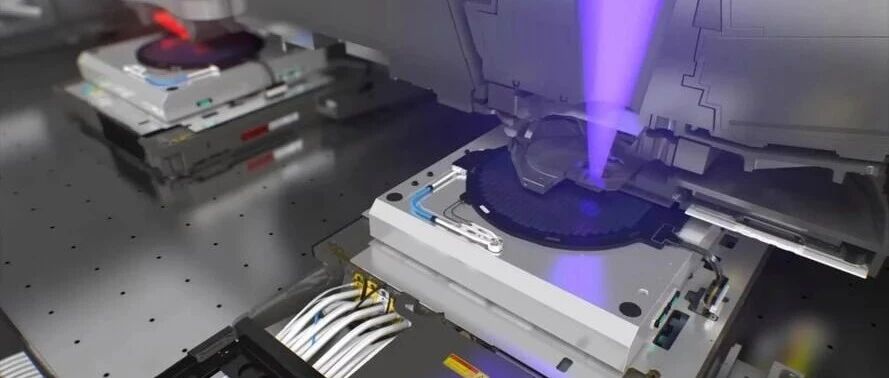
ASML Holding(ASML)

Search documents
High-NA光刻机从验证走向部署 股价萎靡已久的阿斯麦(ASML.US)终于等来“复苏时刻”
智通财经网· 2025-09-05 03:21
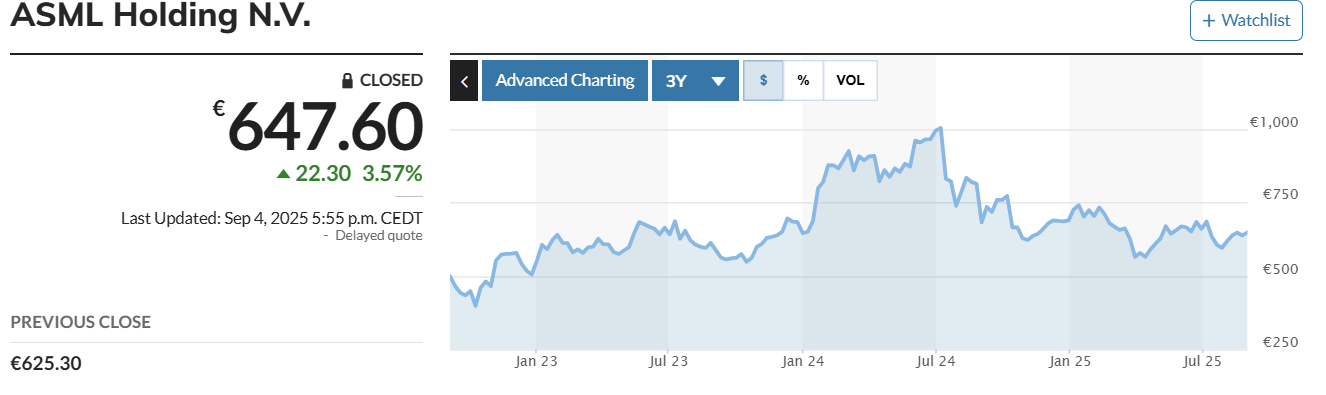
Core Viewpoint - UBS maintains a bullish rating on ASML, raising the 12-month target price from €660 to €750, driven by strong demand for High-NA EUV lithography machines from major chip manufacturers [1][4]. Group 1: Company Performance and Financials - ASML's market capitalization is approximately $290 billion, with a current P/E ratio of 27x and a history of 19 consecutive years of dividend payments [1]. - The company reported a revenue growth of 26.4% over the past 12 months, with a healthy gross margin of 52.5% [4]. - ASML's second-quarter orders reached €5.5 billion, a 41% increase quarter-over-quarter, exceeding market expectations [6]. Group 2: Market Trends and Future Outlook - The demand for High-NA EUV lithography machines is expected to transition from the validation phase to deployment in chip manufacturing, with significant growth anticipated in 2027 and 2028 [5][8]. - UBS forecasts a compound annual growth rate (CAGR) of 20% in earnings per share from 2026 to 2030, supported by strong financial fundamentals [4]. - Major chip manufacturers like TSMC, Samsung, and SK Hynix are expected to drive demand for High-NA technology, with ASML's shipments projected to be 6 units in 2027 and 10 units in 2028, contributing approximately 30% to ASML's revenue growth in those years [5]. Group 3: Competitive Landscape and Industry Position - ASML is the sole supplier of advanced EUV lithography machines necessary for producing cutting-edge chips, making it a critical player in the semiconductor industry [9][10]. - The transition to High-NA technology is seen as a long-term positive catalyst for ASML's performance, with significant implications for the production of 2nm and below nodes [10]. - Competitors like Deutsche Bank and Wolfe Research have varying outlooks on ASML, with target prices adjusted based on concerns over EUV shipment growth and macroeconomic uncertainties [7].


阿斯麦(ASML.US)涨逾2% 公司积极拓展印度业务
Zhi Tong Cai Jing· 2025-09-04 23:29
Core Viewpoint - ASML's CEO Christophe Fouquet announced plans to deepen collaboration with Indian companies at the semiconductor summit in New Delhi, indicating potential growth opportunities in the Indian market for ASML's equipment [1] Group 1: Company Developments - ASML's stock rose over 2% to $755.10 following the announcement of its strategic intentions in India [1] - The company aims to leverage India's push for a domestic semiconductor industry, which aligns with the Indian government's goal to establish a reliable local chip manufacturing capability [1] Group 2: Industry Context - Indian Prime Minister Modi anticipates that the first domestically manufactured chips will be available by the end of the year, creating a new market for ASML [1] - India is collaborating with countries like the United States, Japan, and China to enhance its semiconductor manufacturing capabilities, driven by the need to reduce dependency on other regions [1]
4 AI Stocks To Consider As Nvidia Shares Slide
Benzinga· 2025-09-04 17:34
Group 1: Nvidia Corp. Overview - Nvidia's stock has rallied nearly 100% since April but has traded flat over the last month, indicating a potential loss of momentum [1] - The company's recent fiscal Q2 2026 earnings report did not significantly impact the stock price, and it is now facing political pressure regarding sales in China [1] Group 2: Alternative AI Stocks - Four stocks have been identified that could provide portfolio gains as Nvidia's momentum wanes, each offering crucial components or services to the AI sector [2] Group 3: ASML Holdings N.V. - ASML holds a near-monopoly on Extreme Ultraviolet (EUV) lithography, essential for semiconductor production, with a market cap of $289 billion and annual sales exceeding $30 billion [3] - The company reported a 12% upside surprise on earnings per share (EPS) for Q2, yet its P/E ratio of 25.8 is significantly lower than Nvidia's 48.6 and the sector average of 49.7 [3] - ASML shares are up only 6% year-to-date, but bullish signals are emerging, with expectations for Q3 earnings of $8.81 billion [5] Group 4: KLA Corp. - KLA specializes in quality control processes for semiconductors, boasting a market cap of $112 billion and annual sales of approximately $12 billion, with net profit margins of 33% [6] - Despite a recent 10% decline, KLA shares have gained over 30% year-to-date, indicating potential for new investors [6] - The stock has shown signs of losing momentum but has a strong history of beating earnings expectations [8] Group 5: Broadcom Inc. - Broadcom is a major player in the semiconductor market with a market cap exceeding $1.4 trillion and annual sales of $56 billion, having seen a 30% increase in stock price this year [9] - The company benefits from its VMware acquisition and provides critical components for data centers, with Q2 revenue reported at $15 billion and expectations for $15.8 billion in Q3 [9] - Despite a recent dip in share price, Broadcom's stock remains supported by its 50-day SMA, indicating potential for recovery [11] Group 6: Advantest Corp. - Advantest offers automated testing equipment and has a market cap of $52.9 billion, with a P/E ratio around the industry average of 47.7 [12] - The stock has increased by 39% in the last three months, supported by a recent Golden Cross, although it has experienced a slight pullback [14] - Advantest reported record revenue growth of 90% year-over-year in its most recent Q2 earnings release, highlighting its importance in the semiconductor testing market [14]



美股异动 | 阿斯麦(ASML.US)涨逾2% 公司积极拓展印度业务
Zhi Tong Cai Jing· 2025-09-04 15:44
Core Insights - ASML's CEO Christophe Fouquet announced plans to deepen collaboration with Indian companies at the semiconductor summit in New Delhi, indicating a strategic move to tap into the growing Indian semiconductor market [1] - Indian Prime Minister Modi aims to establish a reliable domestic chip industry, with expectations for the first locally manufactured chips to be launched by the end of the year, potentially creating new market opportunities for ASML's equipment [1] - India is working alongside the US, Japan, and China to enhance its semiconductor manufacturing capabilities, driven by the need to reduce dependency on other regions [1]
Where Will ASML Stock Be in 5 Years?
The Motley Fool· 2025-09-04 08:35
Core Viewpoint - The demand for AI chips is expected to positively impact ASML's future, despite its cyclical nature and recent struggles in performance [1][3]. Company Overview - ASML is a leading semiconductor equipment maker, essential for the production of advanced chips, particularly through its extreme ultraviolet lithography (EUV) technology [5][6]. - The company’s highest-end EUV machines are priced over $400 million, and clients spend billions annually on maintenance, indicating a strong dependency on ASML's products [7]. Market Dynamics - The AI chip market is projected to grow at a compound annual growth rate (CAGR) of 29% through 2030, which is expected to drive ASML's sales significantly [7]. - Major competitors in the advanced chip manufacturing space include TSMC, Samsung, and Intel, limiting ASML's client base for its most advanced equipment [8]. Financial Performance - In the first half of 2025, ASML reported revenue of €15.4 billion ($18.0 billion), a 34% increase from the same period in 2024, with a gross margin of 53.7% [10]. - The company maintained controlled growth in costs and expenses, resulting in a net income of over €4.6 billion ($5.4 billion) for the first two quarters [11]. - Despite positive first-half results, ASML's outlook for the second half of the year has become less optimistic, expecting a 15% annual net sales growth for 2025 and a decrease in gross margins to 52% [11]. Valuation and Future Outlook - ASML's current P/E ratio of 28 is at a multiyear low, suggesting potential for multiple expansion as the market for AI-ready semiconductors grows [12]. - Over the next five years, ASML is expected to outperform the market, driven by the increasing demand for AI chips and its critical role in the semiconductor supply chain [13][14].
4亿美元的光刻机,开抢
3 6 Ke· 2025-09-04 01:50
Group 1: ASML and High NA EUV Technology - ASML views High NA EUV as a critical future technology, confirming revenue from a high numerical aperture EUV system despite a slight decrease in gross margin, maintaining a strong overall gross margin of 53.7% [1] - Intel reported using High NA equipment to expose over 30,000 wafers in a single quarter, significantly improving process flow by reducing the number of steps from 40 to below 10 [1] - Samsung noted a 60% reduction in cycle time for a specific layer using High NA technology, indicating its maturity compared to earlier low numerical aperture EUV systems [1] Group 2: Samsung's Investment in Next-Generation Lithography - Samsung has increased its procurement of next-generation lithography machines from ASML to enhance its competitive position in the semiconductor market, particularly in the 2nm GAA process [2] - The Exynos 2600 is confirmed as Samsung's first 2nm GAA chip, which has begun mass production, aiming to improve yield rates and reduce losses [2][3] - Samsung's procurement of High NA EUV lithography machines is expected to help achieve a yield rate of at least 70%, necessary for financial viability in mass production [3] Group 3: SK Hynix's Adoption of High NA EUV - SK Hynix has assembled the industry's first Twinscan NXE:5200B high numerical aperture EUV lithography system, which will initially serve as a development platform for next-generation DRAM technology [6] - This new system is expected to enhance productivity and product performance, allowing for more complex patterns and increased chip density on wafers [6][8] - SK Hynix aims to accelerate the development of next-generation memory products and strengthen its position in the high-value memory market through this advanced technology [6][8] Group 4: Industry Perspectives on High NA EUV - TSMC has stated that its next-generation processes, including A16 and A14, do not require High NA EUV systems, focusing instead on extending the life of existing EUV technologies [11][12] - Micron is cautious about adopting EUV lithography, planning to introduce EUV into DRAM production by 2025, with High NA EUV adoption remaining uncertain [12] - The Japanese company Rapidus plans to install multiple EUV lithography systems in its new fab, indicating potential future interest in High NA EUV technology [13] Group 5: Challenges and Future Directions - The high cost of High NA EUV machines, priced at around $400 million, has led to hesitance among manufacturers to adopt this technology [14] - Emerging transistor architectures like GAAFET and CFET may reduce reliance on advanced lithography tools, shifting focus towards etching technologies [14][15] - The semiconductor industry is expected to transition to High NA EUV lithography by the 2030s, with ongoing developments in process technologies [8][14]
4亿美元的光刻机,开抢!
半导体行业观察· 2025-09-04 01:24
Core Viewpoint - ASML emphasizes the importance of High NA EUV technology for the future of semiconductor manufacturing, with significant advancements already being reported by major clients like Intel and Samsung [2][4]. Group 1: ASML and High NA EUV Technology - ASML confirmed revenue from a High NA EUV machine, which slightly lowered its gross margin but still resulted in a strong overall gross margin of 53.7% [2]. - Intel reported using High NA EUV equipment to expose over 30,000 wafers in a single quarter, significantly improving its process flow by reducing the number of steps from 40 to below 10 [2]. - Samsung noted a 60% reduction in cycle time for a specific layer using High NA EUV technology, indicating its faster maturity compared to earlier low NA EUV devices [2]. Group 2: Samsung's Investment in Next-Gen Lithography - Samsung is increasing its procurement of High NA EUV lithography machines to enhance its competitive edge in the 2nm GAA process, despite the high costs of these machines [4][5]. - The yield for Samsung's Exynos 2600 chip using this technology was reported at 30%, with a target of at least 70% for financial viability in mass production [5]. - Samsung aims to achieve mass production of 1.4nm nodes by 2027, actively evaluating the use of High NA EUV tools in its manufacturing processes [5]. Group 3: SK Hynix's Adoption of High NA EUV - SK Hynix has assembled the industry's first Twinscan NXE:5200B High NA EUV lithography system, which will initially serve as a development platform for next-gen DRAM technology [8][9]. - The new system is expected to enhance productivity and product performance by enabling more complex patterns on wafers, thus increasing chip density and power efficiency [8]. - SK Hynix plans to simplify existing EUV processes and accelerate the development of next-gen memory products, aiming to solidify its technological leadership in the market [9]. Group 4: Industry Perspectives on High NA EUV - Intel's future procurement of High NA EUV machines will depend on its wafer manufacturing strategy, with no immediate changes expected due to current challenges [12]. - TSMC has reiterated that its next-generation processes do not require High NA EUV systems, indicating a cautious approach towards adopting this technology [12][13]. - Micron plans to introduce EUV technology into DRAM production by 2025, with the timeline for High NA EUV adoption remaining uncertain [14]. Group 5: Future Considerations - Despite the high costs associated with High NA EUV machines, there is a growing recognition of their potential benefits in advanced chip manufacturing [16]. - Emerging transistor architectures like GAAFET and CFET may reduce reliance on advanced lithography tools, shifting focus towards etching technologies [16][17]. - The semiconductor industry is at a crossroads, with companies evaluating the balance between lithography and other critical manufacturing processes as they advance towards more complex chip designs [17].
阿斯麦CEO:印度欲推动芯片本土制造,我们愿意支持
Sou Hu Cai Jing· 2025-09-03 05:30
Group 1 - Indian Prime Minister Modi announced the restart of the "semiconductor strategy" aiming for local chip manufacturing, with the first "Made in India" chip expected by the end of 2025 [1][7] - ASML's CEO, Christoph Fuque, expressed optimism about collaborating with Indian chip manufacturers and highlighted India's potential as a partner in the semiconductor industry [1][3] - ASML has established a presence in India and is sending more executives to explore opportunities for collaboration in the semiconductor supply chain [3][4] Group 2 - ASML has not yet invested significant funds in India but sees it as a rapidly growing market, contributing 27% of its system net sales from China and Taiwan [4][5] - The Indian semiconductor market is projected to exceed $55 billion by 2026 and reach $100 billion by 2030, driven by demand in smartphones, automotive, and 5G IoT sectors [5][7] - The Indian government previously launched the "Semicon India" initiative with an initial budget of $8.7 billion, but the results have been limited [7][8] Group 3 - Recent geopolitical tensions have shifted ASML's focus towards India as a new potential market amid challenges in sales to China [4] - The collaboration between India and Japan is also emphasized, with Japan supporting its companies in the Indian semiconductor market [7][8] - Despite government incentives, local knowledge accumulation and technology transfer remain challenges for India's semiconductor ambitions [8]

阿斯麦CEO:我们愿帮印度
Guan Cha Zhe Wang· 2025-09-03 05:23
Core Viewpoint - India is reviving its semiconductor strategy, aiming for local chip manufacturing, with the first "Made in India" chip expected by the end of 2025, supported by ASML's collaboration [1][6]. Group 1: ASML's Involvement - ASML's CEO, Christoph Fuque, expressed optimism about collaborating with Indian chip manufacturers and emphasized India's potential as a partner in the semiconductor industry [1][3]. - ASML plans to establish partnerships and knowledge exchange with Indian firms, aiming to enhance the performance of local wafer fabs through advanced lithography solutions [1][3]. - Currently, ASML's operations in India are limited, but the company is optimistic about future opportunities as India's semiconductor industry develops [3][4]. Group 2: Market Potential and Growth - The Indian semiconductor market is projected to exceed $55 billion by 2026 and reach $100 billion by 2030, driven by demand in smartphones, automotive, and 5G IoT sectors, along with government support [4][6]. - Initial focus in India may be on low-end chip manufacturing rather than advanced chips for AI technology [4][6]. Group 3: Government Initiatives and Challenges - The Indian government initiated the "Semicon India" program in 2021 with a budget of approximately $8.7 billion, aiming to support up to 50% of project costs across the semiconductor supply chain [6][7]. - Despite government efforts, there have been challenges in attracting foreign investment and technology transfer, with concerns about the effectiveness of subsidies and the need for a local market [7][8]. - Analysts highlight that India's semiconductor industry is still small and faces significant competition from China and the US, indicating a need for further development and market segmentation [7][8].

高盛:中国光刻机落后ASML 20年!
是说芯语· 2025-09-02 23:26
Core Viewpoint - Goldman Sachs' report highlights the significant challenges faced by China's semiconductor manufacturing sector, particularly in lithography machine development, indicating that China is at least 20 years behind Western technology, with current domestic lithography machines only achieving 65nm technology [1][3]. Group 1: Challenges in Lithography Machine Development - The complexity of lithography machines, which consist of over 100,000 components and require collaboration from thousands of global suppliers, poses a significant barrier to China's development efforts [1]. - Key components such as high-precision optical lenses from Zeiss are restricted from export to China, and the U.S. has expanded export controls on semiconductor equipment, including DUV lithography machine components [3]. - Shanghai Micro Electronics has achieved stable production of 65nm lithography machines, but there are still notable gaps in stability and wafer yield control compared to ASML, impacting economic viability [3]. Group 2: Progress and Innovations - China is adopting a strategy of "single-point breakthroughs driving system upgrades," with companies like Huazhuo Precision achieving significant advancements in core technologies, such as the dual-stage system for lithography machines [4]. - The development of a UV LED lithography light source by Bihua Optoelectronics has increased lifespan to 30,000 hours, significantly improving reliability and reducing costs compared to imported products [4]. - The domestic production rate for 28nm immersion lithography machines has reached 83%, which is crucial for key sectors like automotive electronics amid global chip shortages [6]. Group 3: Emerging Technologies - New lithography technologies such as electron beam lithography and nanoimprint technology are being explored, offering potential advantages in specific applications despite challenges in mass production [7]. - The introduction of Canon's FPA-1200NZ2C nano imprint lithography system, which operates on a different principle and is significantly cheaper than EUV machines, provides a valuable reference for Chinese semiconductor equipment companies [6]. Group 4: Strategic Outlook - The report emphasizes that while the technological gap is real, it is essential to recognize the nonlinear nature of technological innovation, as evidenced by recent breakthroughs in China's semiconductor industry [7]. - The development of lithography machines is not just a technical issue but also a comprehensive challenge involving industrial ecology and innovation systems, requiring strategic focus and innovative thinking to navigate the evolving global semiconductor landscape [7].