Bank of America(BAC)

Search documents
Goldman, Santander Among Banks Exploring Blockchain-Based Money
MINT· 2025-10-10 14:44
Group 1 - A consortium of international banks, including Goldman Sachs, Deutsche Bank, Bank of America, and Banco Santander, is exploring the issuance of "digital money" on public blockchains, indicating a significant interest in leveraging blockchain technology for payments [1][2] - The consortium aims to create a 1:1 reserve-backed form of digital money that serves as a stable payment asset on public blockchains, focusing on G7 currencies [2] - The coalition is in contact with regulators and is assessing whether this offering could enhance competition and provide benefits associated with digital assets [3] Group 2 - There is a growing focus among banks on utilizing blockchain technology for payments, with stablecoins gaining traction as a faster and cheaper alternative to traditional payment systems [4] - Recent regulatory developments in the US and the European Union have provided a clearer framework for established companies to operate within, driving increased activity from large firms in the digital money space [5]



X @Bloomberg
Bloomberg· 2025-10-10 14:40
A group of international banks including Goldman Sachs, Deutsche Bank, Bank of America and Banco Santander, have joined forces to explore the issuance of “digital money” on public blockchains https://t.co/sZwfextkeU ...
Seeking Clues to Bank of America (BAC) Q3 Earnings? A Peek Into Wall Street Projections for Key Metrics
ZACKS· 2025-10-10 14:16
Core Viewpoint - Analysts expect Bank of America (BAC) to report quarterly earnings of $0.94 per share, reflecting a year-over-year increase of 16.1%, with revenues projected at $27.12 billion, up 7% from the previous year [1] Earnings Estimates - The consensus EPS estimate has been adjusted downward by 0.1% over the past 30 days, indicating a reassessment by analysts [1][2] Key Metrics Projections - The 'Efficiency Ratio (FTE basis)' is projected to be 63.1%, down from 64.6% in the same quarter last year [4] - 'Book value per share of common stock' is expected to be $37.63, compared to $35.37 a year ago [4] - 'Total earning assets - Average balance' is estimated at $3068.81 billion, up from $2917.70 billion year-over-year [5] - 'Total nonperforming loans, leases and foreclosed properties' is projected at $6.66 billion, compared to $5.82 billion last year [5][6] - The 'Tier 1 Leverage Ratio' is expected to be 6.7%, down from 6.9% in the same quarter last year [6] - 'Tier 1 Capital Ratio' is projected at 12.7%, compared to 13.2% a year ago [7] - 'Net Interest Income - Fully taxable-equivalent basis' is expected to be $15.23 billion, up from $14.11 billion last year [8] - 'Investment banking fees' are projected to reach $1.62 billion, compared to $1.40 billion in the same quarter last year [9] Performance Comparison - Bank of America's shares have shown a return of -1.9% over the past month, while the Zacks S&P 500 composite has increased by +3.5% [9]
美股Q3财报季将迎开门红?投行业务复苏料助推六大银行业绩强势增长
智通财经网· 2025-10-10 13:32
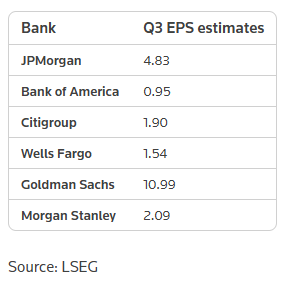
Core Viewpoint - The upcoming earnings season for major U.S. banks is expected to show strong performance driven by a recovery in investment banking and resilient economic conditions supporting consumer and commercial lending [1][2]. Group 1: Earnings Expectations - JPMorgan is projected to see a more than 10% increase in earnings per share (EPS) for Q3, with investment banking revenues expected to grow in the low double digits [1]. - Bank of America anticipates nearly a 17% year-over-year increase in EPS, with investment banking revenues expected to rise by 10% to 15% [2]. - Citigroup's EPS is expected to surge by 26%, primarily driven by capital markets activities [2]. - Goldman Sachs forecasts a 31% increase in EPS, benefiting from a rebound in investment banking and trading [2]. - Morgan Stanley expects over an 11% increase in EPS, supported by its strengths in capital markets and wealth management [2]. - Wells Fargo's EPS is projected at 1.54, while other banks have specific EPS estimates as well [3]. Group 2: Investment Banking Activity - Investment banking activities have rebounded due to regulatory easing and expectations of further interest rate cuts, with JPMorgan describing the summer as one of its busiest merger seasons [4]. - As of mid-September, 49 merger deals were announced in Q3, up from 39 in Q2 and 32 in the same period last year, with a total global merger volume reaching $2.6 trillion, the highest since the pandemic peak in 2021 [4]. Group 3: Trading and Interest Income Outlook - Trading revenues are expected to grow, with analysts noting that Q3 typically sees lower trading activity, but 2025 appears to break this trend [6]. - Net interest income (NII) is anticipated to remain robust due to the resilient U.S. economy, with banks reporting that consumer financial conditions are stable [6]. - Concerns are emerging regarding potential increases in default rates among small businesses, despite the overall positive outlook for investment and commercial banking [6].


[Earnings]Earnings Outlook: Financials Dominate the Week Ahead
Stock Market News· 2025-10-10 13:13
Financial Reporting Schedule - Next week will see significant financial reporting from major companies including JPMorgan Chase & Co., Wells Fargo & Company, and Goldman Sachs Group Inc., which will report pre-market on Tuesday [1] - Johnson & Johnson will also report alongside the financial institutions on Tuesday, indicating a blend of financial and healthcare sector updates [1] - The financial reporting theme continues with Bank of America Corporation and Morgan Stanley on Wednesday, along with ASML Holding N.V. and Abbott Laboratories, highlighting a diverse range of sectors [1] - Thursday will feature Taiwan Semiconductor Manufacturing Company Ltd. reporting pre-market, emphasizing the importance of the tech sector in the financial landscape [1] - American Express Company will lead the final wave of financial reports on Friday, rounding out a week heavy with financial disclosures [1]


数据模糊不清之际,华尔街将目光转向银行财报寻求方向
Hua Er Jie Jian Wen· 2025-10-10 12:32
Group 1 - The upcoming quarterly earnings reports from major banks like JPMorgan and Goldman Sachs are crucial for assessing the health of the U.S. economy, especially in light of the government shutdown affecting economic data releases [1][4] - Analysts expect an overall year-on-year earnings growth of 8.8% for S&P 500 companies in the third quarter, which is vital for maintaining the upward momentum of the stock market [1][3] - The current high market valuations and investor enthusiasm for technology and AI sectors make the performance of the third-quarter earnings season particularly significant [1][3] Group 2 - The earnings reports from banks will provide insights into consumer spending and credit demand, which are essential for understanding economic trends amid concerns over a weakening labor market [2][4] - The government shutdown has delayed the release of key economic data, including the non-farm payroll report and consumer price index, which heightens the importance of bank earnings as an economic indicator [3][4] - Market sentiment is heavily reliant on expected earnings growth, and any signs of weakness could negatively impact overall market conditions [3]
Consumer spending is continuing steadily upward, says BofA's Liz Everett Krisberg
Youtube· 2025-10-10 11:57
Core Insights - Bank of America Institute's consumer checkpoint for October indicates a 2% year-over-year increase in debit and credit card spending, marking the largest increase since December 2024 [1] - The data reveals a divergence in spending growth between higher and lower income households, with lower income households increasing spending by 6.1% and higher income households by 2.6% [5][6] Spending Trends - Overall consumer spending is on an upward trend, driven primarily by services and gas, while retail spending has decreased slightly by 0.2% [2][4] - The analysis is based on actual spending data from nearly 70 million consumers, rather than survey responses, providing a close to real-time view of consumer behavior [4] Income Disparities - Spending growth is significantly higher among higher income households compared to lower income households, highlighting a "tale of two cities" in consumer spending [5][6] - Higher income households experienced a wage growth of 4% in September, the highest in four years, while lower income households saw a modest increase of 1.4% [10][11][12] Labor Market Insights - The labor market shows signs of fatigue, with payroll growth in September at just 0.5%, down from 1.7% at the beginning of the year and nearly 4% two years ago [9][10] - Despite the slowdown in employment growth, wages for employed households are increasing, particularly among higher income groups, which supports their spending [10][12] Market Influence - Higher income consumers are benefiting from wealth effects due to rising stock and housing markets, which in turn supports discretionary spending [12] - The data suggests that while the labor market is growing, it is doing so at a slower pace, yet higher income consumers continue to drive spending [14]

Bank of America fires up generative AI payments assistant
Yahoo Finance· 2025-10-10 07:00
This story was originally published on CIO Dive. To receive daily news and insights, subscribe to our free daily CIO Dive newsletter. As the financial sector harnesses generative AI’s capacity to speed and simplify processes, Bank of America has leaned on sustained research and technology investments to rapidly scale multiple use cases. The firm unveiled a generative AI-powered knowledge management assistant called AskGPS for its Global Payments Solutions division last week. In-house engineers fed the mo ...
Bank of America Corporation (BAC): A Reliable Player in the World of Promising Dividend Stocks
Insider Monkey· 2025-10-10 03:51
Core Insights - Artificial intelligence (AI) is identified as the greatest investment opportunity of the current era, with a strong emphasis on the urgent need for energy to support its growth [1][2][3] - A specific company is highlighted as a key player in the AI energy sector, owning critical energy infrastructure assets that are essential for meeting the increasing energy demands of AI technologies [3][7] Investment Landscape - Wall Street is investing hundreds of billions into AI, but there is a looming question regarding the energy supply needed to sustain this growth [2] - AI data centers consume vast amounts of energy, comparable to that of small cities, leading to concerns about power grid strain and rising electricity prices [2][3] Company Profile - The company in focus is not a chipmaker or cloud platform but is positioned as a crucial player in the energy sector, particularly in nuclear energy infrastructure [7][8] - It is capable of executing large-scale engineering, procurement, and construction (EPC) projects across various energy sectors, including oil, gas, and renewables [7] Financial Position - The company is noted for being completely debt-free and holding a significant cash reserve, amounting to nearly one-third of its market capitalization [8] - It is trading at less than 7 times earnings, indicating a potentially undervalued position in the market [10] Market Trends - The company is poised to benefit from the onshoring trend driven by tariffs, as well as the surge in U.S. LNG exports under the current administration's energy policies [5][14] - There is a growing recognition on Wall Street of this company's potential, as it quietly capitalizes on multiple favorable market trends without the high valuations seen in other sectors [8][9] Future Outlook - The influx of talent into the AI sector is expected to drive continuous innovation and advancements, making investments in AI a strategic move for future growth [12] - The company is positioned to play a pivotal role in the upcoming AI infrastructure supercycle, which is anticipated to yield significant returns for investors [14][15]

全球系统重要性银行的机遇与挑战
Sou Hu Cai Jing· 2025-10-10 02:31
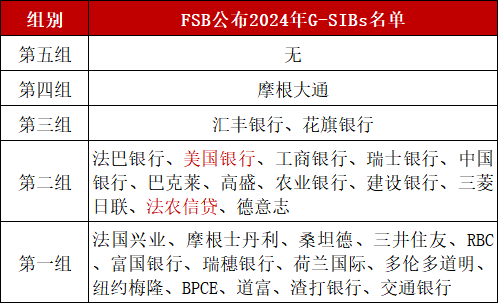
Core Insights - Global systemically important banks (G-SIBs) are undergoing a critical transformation, driven by industrialization and middle-class expansion in emerging markets, which present new opportunities in retail, corporate, and cross-border businesses. Financial technology is enhancing digital risk control and customer acquisition. However, challenges such as stagflation risks, geopolitical conflicts, and interest rate differentiation are intensifying pressure on interest margins and asset quality. The application of artificial intelligence also brings challenges related to model interpretability and compliance. Capturing the emerging market dividend and completing digital upgrades will be key to determining the future competitive advantage of G-SIBs [1]. Background - The 2008 global financial crisis highlighted the "too big to fail" issue of large international financial institutions. In 2011, the Financial Stability Board (FSB) released regulatory measures for G-SIBs, publishing the first list of G-SIBs, which included most global systemically important banks. According to the FSB's 2024 G-SIBs list, there are 29 banks globally [2][3]. Current Operations - In the current interest rate cut cycle, financial services have become the main revenue driver for banks. Since the Federal Reserve began lowering rates, traditional lending has faced pressure, leading to significant revenue growth in investment banking, financial markets, and wealth management. In Q1 2025, revenues from financial services for JPMorgan, Citigroup, and Bank of America grew by 12.0%, 10.0%, and 7.1%, respectively, with contributions exceeding 50% of total revenues, an increase of 3-6 percentage points from pre-rate cut levels [5]. - Investment banking has cooled down, with uncertainty in the market due to aggressive policy changes under the Trump administration. In Q1 2025, the growth rate of investment banking revenues for the four major U.S. banks dropped from an average of around 40% to less than 10%. Bank of America saw a year-on-year decline of -0.35% in investment banking revenue, while JPMorgan's growth slowed to 2.4% [5]. - Trading business has emerged as a new revenue driver, with significant increases in trading revenues for major U.S. banks in Q1 2025, attributed to heightened market volatility and geopolitical tensions. Trading revenues for JPMorgan, Citigroup, and Bank of America grew by 21%, 12%, and 11%, respectively, with stock trading revenues increasing by 48%, 23%, and 17% [6]. - Payment and settlement services have shown weak performance, with revenues for JPMorgan, Citigroup, Bank of America, and Wells Fargo growing by only 2.2%, 3.6%, 0.5%, and -10.9%, respectively, contrasting sharply with the growth in investment banking and trading revenues [6]. Opportunities - Expansion in emerging markets presents significant opportunities, particularly in retail banking, as the growing middle class demands diverse financial services. G-SIBs can meet these needs by offering various savings products and consumer loans. Additionally, the rising high-net-worth population increases demand for wealth management services [7]. - The demand for cross-border financial services is increasing, driven by globalization. G-SIBs can provide efficient cross-border payment solutions, financing, and risk management services to support businesses in their international activities [7]. - Regulatory changes may create potential opportunities, as the new U.S. administration's policies could support the cryptocurrency and digital asset markets, allowing G-SIBs to explore new business areas [8]. - Financial technology is enabling digital transformation, allowing G-SIBs to innovate in cross-border services and enhance customer experiences through personalized financial products [8]. Challenges - The uncertain macroeconomic environment in 2025 poses risks, with geopolitical tensions and trade protectionism affecting global economic activity. The U.S. government's tariff policies may lead to a new round of global trade disputes, increasing external risks for G-SIBs [9]. - The potential return of laissez-faire financial policies under the Trump administration could elevate systemic financial risks, as regulatory changes may reduce banks' liquidity requirements, impacting their ability to absorb potential losses [10]. - The application of AI in banking faces challenges, including the reliability and accuracy of AI outputs, which may conflict with the low tolerance for error in banking services [11]. Strategies and Recommendations - To address the challenges posed by low interest rates and regulatory costs, G-SIBs should build a multi-layered governance framework. This includes meeting total loss-absorbing capacity (TLAC) requirements and optimizing capital structures through asset securitization and diversifying capital tools [15][16]. - Business transformation and revenue diversification are crucial for balancing regulatory costs and profitability. G-SIBs should focus on expanding light-capital businesses and enhancing non-interest income through wealth management and advisory services [16]. - Governance and technology should work in tandem to improve risk management and operational resilience, including the implementation of real-time monitoring platforms for cross-border risks [16][17].