
CITIC Securities Co., Ltd.(CIIHY)

Search documents
和顺科技:接受中信证券等投资者调研

Mei Ri Jing Ji Xin Wen· 2026-02-05 02:47
Group 1 - Heshun Technology announced that on February 4, 2026, it will accept an investor survey conducted by CITIC Securities, with participation from the company's board secretary and CFO, Wu Xueyou, who will address investor inquiries [1] - The article highlights the significant number of elderly individuals living alone in China, estimated to be in the tens of millions, and discusses the challenges of providing adequate support for their aging process [1] - The concept of intended guardianship has been present in China for 14 years, but there are still barriers to its full implementation, referred to as the "last mile" issue [1]
中信证券:上游涨价对汽车影响几何?
智通财经网· 2026-02-05 02:07
Core Viewpoint - The report from CITIC Securities highlights the challenges faced by automotive manufacturers due to unexpected price increases in upstream storage, power batteries, and copper-aluminum resources, alongside a pressured domestic automotive consumption environment. The average cost per vehicle is projected to rise by approximately 3,000 yuan due to lithium carbonate price increases, while copper and aluminum price hikes are expected to add around 2,000 yuan per vehicle. The report suggests focusing on automakers with strong cost transfer capabilities and optimized product structures to navigate these challenges [1][2][3]. Storage - The automotive industry is entering an AI supercycle driven by surging demand for AI data centers, leading to a structural shortage in storage. Price increases for mainstream storage modules are expected to range from 53% to 340% by the end of 2025, with the price per Gb reaching historical highs. Despite the significant price increases, storage costs currently account for less than 1% of total vehicle costs, resulting in a manageable impact of approximately 200 to 3,000 yuan per vehicle [1]. Battery - The global demand for lithium batteries is projected to grow by over 45% year-on-year in 2025. The prices of lithium carbonate and lithium hexafluorophosphate have surged, with increases of 61.3% and 195% respectively by the end of Q4 2025. The average battery cost per vehicle is expected to rise by about 3,434 yuan, corresponding to a 14% increase. However, the impact is not rigid due to the buffering effect of price transmission and the ability of manufacturers to adjust battery configurations [2]. Resource Prices - Copper and aluminum prices are anticipated to rise significantly starting in 2025, with aluminum prices expected to increase by 22.3% and copper prices by 36.3% by January 2026. The average cost increase for electric vehicles is estimated at 2,624 yuan, while non-electric vehicles will see an increase of 1,717 yuan. Manufacturers may partially hedge against these cost pressures through hedging strategies [3].
中信证券:低轨通信卫星链是商业航天产业中最先有基本面逻辑和订单支持的细分领域
Di Yi Cai Jing· 2026-02-05 00:45
Core Insights - The commercial aerospace industry is expected to transition from "technology validation" to "scale industrialization" around 2026, marking a critical turning point [1] Industry Developments - The mass launch of China StarNet and the G60 Qianfan constellation, along with the operational use of Hainan commercial launch vehicles, will lead to a trend of high capacity and low cost, ushering in a new era for the industry [1] - Advancements in lunar exploration, deep space exploration, and space tourism will continue to expand the industry's potential [1] Investment Opportunities - High-potential investment areas include reusable rockets, the SpaceX supply chain, and space computing, while low Earth orbit communication satellite chains are the first segments with fundamental logic and order support [1] - Investment focus should be on core assets, identifying "inflation segments" and "marginal new growth" directions, with optimism towards 3D printing of rockets, satellite RF antennas, satellite carbon fiber composites, solar wings, and inter-satellite laser communication [1]
中信证券:若沃什担任美联储主席,美联储会重启缩表吗?
Sou Hu Cai Jing· 2026-02-05 00:39
Group 1 - The core viewpoint of the article indicates that despite multiple mentions of interest rate cuts and balance sheet reduction by Waller for 2025, the current liquidity pressure in the U.S. funding market has only recently eased, suggesting that the financial market environment does not support balance sheet reduction at this time [1] - The current reserve ratio to GDP is approximately 10%, while the Federal Reserve's asset holdings account for about 20% of GDP, nearing pre-pandemic levels from 2018, indicating limited overall reserve adequacy [1] - If Waller were to become the next Federal Reserve Chair and quickly initiate balance sheet reduction, the U.S. funding market could face renewed liquidity pressure, reinforcing the notion that the conditions for balance sheet reduction are not present [1]
中信证券:预计美股软件板块当下痛苦状态仍可能持续一段时间
Di Yi Cai Jing· 2026-02-05 00:36
Group 1 - The core viewpoint of the article is that the U.S. software sector is currently facing severe selling pressure, and the best response to skepticism about the tech wave is through corporate performance, similar to past tech cycles [1] - Traditional software companies have significant advantages over AI startups in terms of customer resources, delivery services, domain knowledge, and data accumulation, and they are actively responding to potential AI disruptions and opportunities through M&A and adjustments in products and business models [1] - The current "risk-off" sentiment in the U.S. market and the slow improvement in the performance of software companies suggest that the painful state of the software sector may persist for some time [1] Group 2 - In the medium to long term, considering the underlying logic of AI and corporate valuation levels, it is an optimal time to invest in companies with robust balance sheets, platform-based application software, information security firms, and foundational software vendors that benefit from computing infrastructure [1]
中信证券:2026年7628电子布供需有望维持偏紧
Di Yi Cai Jing· 2026-02-05 00:36
中信证券研报表示,从窑炉、织布机、需求拆分、特种布等多维度分析传统电子布的供需情况,认为 2026年7628电子布供需有望维持偏紧,价格上涨有望明显超出市场预期,高点或达到6元/米以上。 (文章来源:第一财经) ...
调研速递|安达维尔接待中信证券等26家机构 详解低空经济布局及毛利率回升预期
Xin Lang Cai Jing· 2026-02-04 14:12
Core Viewpoint - The company, Andavil Technology Co., Ltd., is actively engaging with institutional investors to discuss its strategic plans, including low-altitude economy development, gross margin improvement, and international market expansion [1]. Group 1: Investor Activity - The investor activity was a roadshow and site visit held on February 4, 2026, organized by CITIC Securities, with participation from 26 institutional investors [2]. - The company’s management team included key executives such as the Chairman, General Manager, and financial leaders, indicating a strong reception for investor inquiries [2]. Group 2: Business Expansion and Operational Improvement - The event featured a site tour where the management presented the company's strategic planning and the details of a planned private placement [3]. - In the low-altitude economy sector, the company has signed multiple research and development contracts or cooperation intentions with eVTOL manufacturers, indicating substantial progress in business expansion [4]. - The company is currently in technical discussions with commercial aerospace firms, although no revenue has been generated from this sector yet [4]. - The SIPDM industrial software is targeted at "specialized and innovative" small and medium enterprises, with a significant demand expected in this market [4]. Group 3: Financial Outlook - The company anticipates revenue growth in 2025, but a decline in gross margin due to product mix differences; however, gross margin is expected to stabilize and improve in 2026 through enhanced cost control and product optimization [4]. - The overall cash flow situation is secure, with good receivables from civil aviation business, and is expected to improve further in 2026 due to project settlements and supportive national policies [4]. Group 4: International Market Development - The company’s application for EASA (European Union Aviation Safety Agency) certification has been accepted, which will facilitate the development of Airbus supplier relationships and support international market entry [4]. - The Tianjin fundraising project is expected to benefit from the local aviation industry cluster and favorable talent policies, enhancing cost efficiency [4].

中广核电力(01816.HK)获中信证券-开元单一资产管理计划增持1146万股
Ge Long Hui· 2026-02-04 13:01
| 表格序號 | 大股東/董事/最高行政人員名 作出披露的 買入 / 賣出或涉及的 每股的平均價 | | 持有權益的股份數目 佔已發行的 有關事件的日期 | | | --- | --- | --- | --- | --- | | | 股份數目 | | ( 請參閱上述 * 註 | 有投票權股(日/月/年) 有 | | | | | | 份自分比 | | | | | | 30/0 3 | | CS20260204E00061 | 中信证券-开元单一资产管理计1101(L) | 11,460,000(L) | HKD 3.1835 1,790,129,000(L) | 16.04(L)03/02/2026 | 格隆汇2月4日丨根据联交所最新权益披露资料显示,2026年2月3日,中广核电力(01816.HK)获中信证券-开元单一资产管理计划在场内以每股均价3.1835港元 增持1146万股,涉资约3648.29万港元。 增持后,中信证券-开元单一资产管理计划最新持股数目为1,790,129,000股,持股比例由15.93%上升至16.04%。 | 股份代號: | 01816 | | --- | --- | | 上市法國 ...

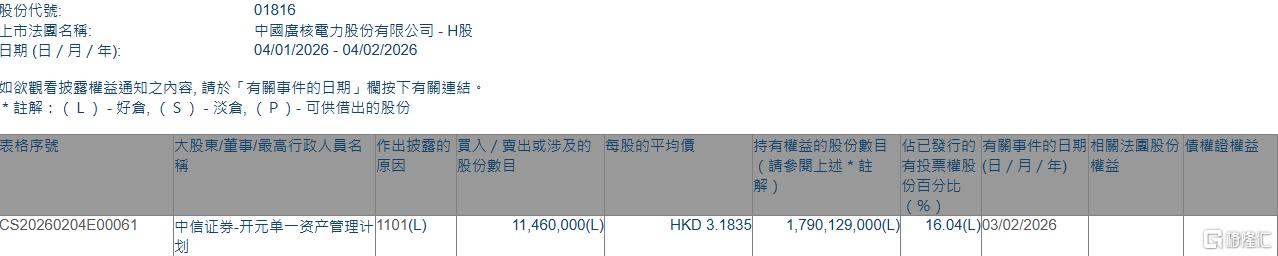
连续23年分红,中信证券拟分红42.98亿元,2025年净利增长近40%
3 6 Ke· 2026-02-04 12:40
"券商一哥"中信证券再发公告。 2月2日晚间,中信证券发布"提质增效重回报"行动方案2025年落实情况报告(简称"落实报告"),其中包含公司2025年业绩快报数据、对于"五篇大文 章"的落实举措、落实"看门人"职责的情况以及分红情况等。 据落实报告,2025年中信证券全年实现营业收入748.30亿元,同比增长28.75%;公司实现归母净利润300.51亿元,同比增长38.46%。对于稳健增长的业 绩,公司派发2025年中期现金分红42.98亿元,让投资者切实收获益处。 截至2025年12月31日,中信证券资产总额为20835.34亿元,较年初增长21.79%;公司归属于母公司股东权益为3199.05亿元,较年初增长 9.14%,经营业绩持续稳健增长。 针对公司业绩水平及分红情况,时代周报记者向中信证券发送了采访提纲,截至发稿公司未作回复。 2025年营收增长近30% 2023年,中信证券业绩水平延续下行状态。全年,中信证券实现营业收入600.68亿元,同比下降7.74%;公司实现归母净利润197.21亿元,同比下降 7.49%。公司上述两项重要指标下降幅度相比2022年有所收窄,但多项主营业务收入均下降。 2 ...
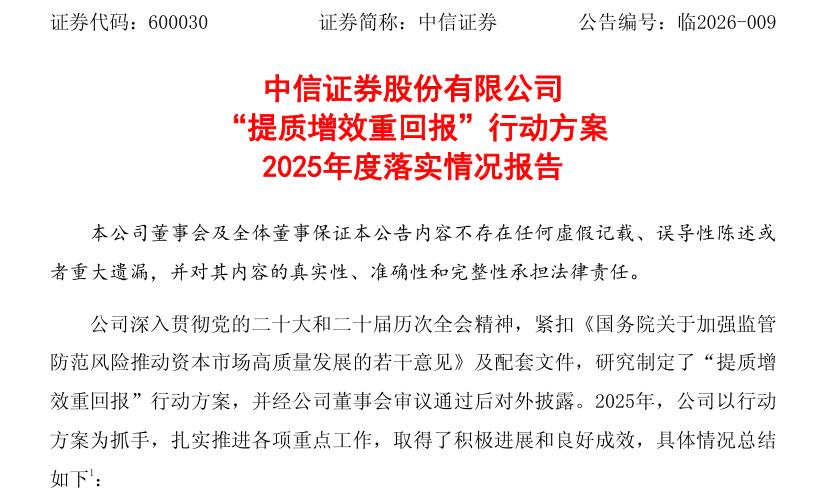
中信证券-开元单一资管计划增持中广核电力1146万股 每股作价约3.18港元
Zhi Tong Cai Jing· 2026-02-04 11:21
联交所最新资料显示,2月3日,中信证券-开元单一资产管理计划增持中广核电力(01816)1146万股,每 股作价3.1835港元,总金额约为3648.29万港元。增持后最新持股数目约为17.90亿股,最新持股比例为 16.04%。 ...