流动性缺口

Search documents
中信证券:4月存在一定的流动性缺口
Xin Lang Cai Jing· 2026-03-24 00:00
Group 1 - The core viewpoint of the report indicates that there is a liquidity gap in April due to factors such as government bond financing, seasonal fluctuations in M0, and an expanded base for reserve requirements [1] - The report emphasizes that the impact of large-scale foreign exchange settlements on liquidity is a more critical concern [1] - If commercial banks continue to settle foreign exchange without the central bank purchasing foreign currency, the funding environment may face friction, necessitating the central bank to use other monetary policy tools to counteract this [1]

2月24日投资避雷针:这两家上市公司实控人因犯罪被判刑
Xin Lang Cai Jing· 2026-02-24 00:33
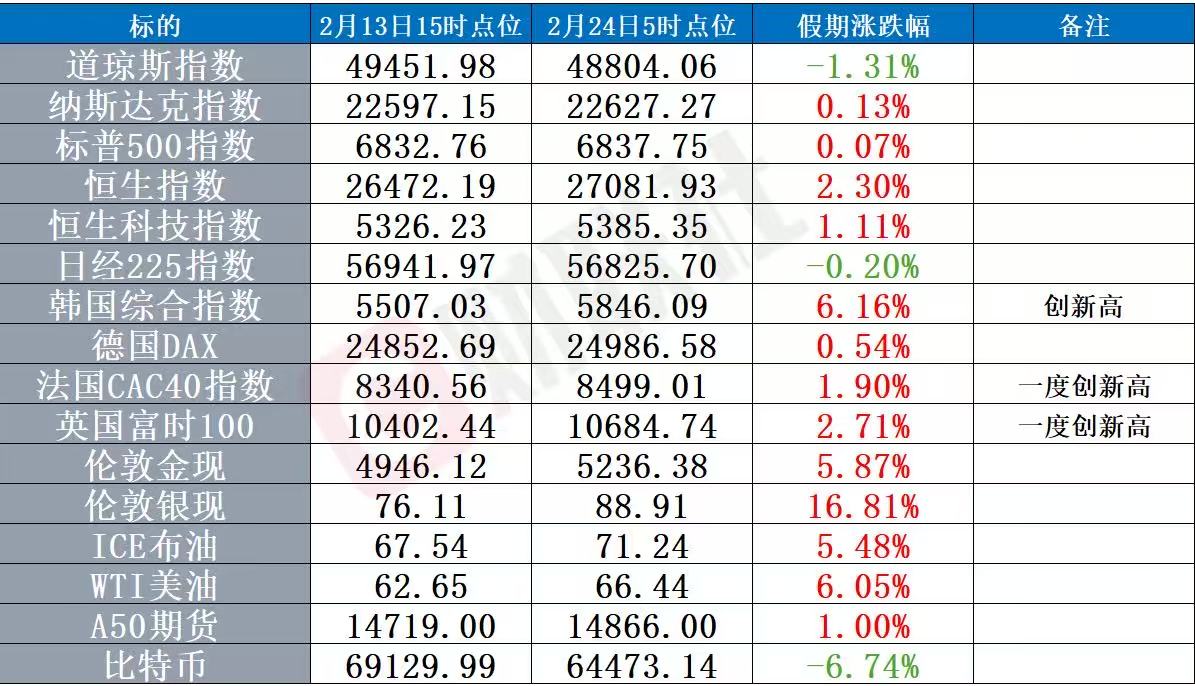
Economic Information - The liquidity gap in the first week after the Spring Festival is significantly expanding, with over 22,000 billion yuan in reverse repos maturing and a substantial pressure from government debt payments and tax periods [2] - The total box office for the 2026 Spring Festival has surpassed 5.7 billion yuan, compared to 9.51 billion yuan for the 2025 Spring Festival [2] - The restaurant revenue growth is slowing down in 2025, with commercial streets facing operational pressure and rental declines, as indicated by a rental index showing a 0.47% decrease in average rent for major commercial streets [2] Company Alerts - The actual controller of Zhengyuan Wisdom, Chen Jian, was sentenced to three years in prison for manipulating the securities market [6] - The controlling shareholder of Chuangshi Technology, Zhang Gengsheng, was sentenced to two years in prison for bribery [6] - Several companies, including Gaoce Co., and Guanghuan New Network, are planning to reduce their shareholdings by up to 3.19% and 3% respectively [10] Overseas Alerts - The U.S. stock market indices closed down over 1%, with IBM experiencing its largest drop since 2000, falling over 13% [7] - Federal Reserve Governor Waller indicated a potential pause in interest rate cuts if February employment data is strong, suggesting inflation is nearing the target level [8] - The EU is preparing to suspend the approval process for trade agreements with the U.S. amid uncertainties regarding new tariffs proposed by the Trump administration [8]




固收点评20260112:2026年一季度会否出现降准降息?
Soochow Securities· 2026-01-12 06:32
Group 1: Investment Rating - No information provided about the industry investment rating Group 2: Core Viewpoints - There is a possibility of RRR cuts and interest rate cuts in Q1 2026, but the likelihood of a rate cut is lower than that of an RRR cut [3] - The bond market is in a headwind period, and the downward space for interest rates driven by loose policies is limited [3] Group 3: Summary by Related Catalogs Event - The Central Economic Work Conference held from December 10th to 11th, 2025, set the tone for policies in 2026. The implementation timing of RRR cuts and interest rate cuts has become a point of contention in Q1 [1] Factors for RRR Cuts - To supplement the seasonal liquidity gap, the liquidity gap in January 2026 is about 190 billion yuan after considering fiscal deposits, cash flow, and bank reserve requirements [3] - The local government bond issuance plan in Q1 2026 is front - loaded compared to the previous year, with the total quarterly issuance decreasing but a need to hedge the high issuance in January [3] - To reduce bank liability costs, RRR cuts have the lowest capital cost for banks, and can help stabilize the net interest margin and create conditions for subsequent interest rate cuts [3] Factors for Interest Rate Cuts - From the fundamental perspective, the economy in 2025 showed a "high - first - then - low" trend, and an interest rate cut can help achieve a good start in 2026 [3] - If an RRR cut is implemented, it can reduce bank liability costs and open up space for interest rate cuts [3]
央行投放“精耕细作” 资金面料延续宽松态势
Zhong Guo Zheng Quan Bao· 2026-01-08 22:14
Core Viewpoint - The People's Bank of China (PBOC) is expected to maintain liquidity through various monetary policy tools, indicating a continued loose monetary stance in January 2026 [1][3][4] Group 1: Liquidity Operations - On January 8, the PBOC conducted a 99 billion yuan reverse repo operation with a fixed rate of 1.4%, resulting in a net injection of 99 billion yuan due to the maturity of other repos [1] - The PBOC is likely to continue using tools such as government bond transactions and Medium-term Lending Facility (MLF) to ensure ample liquidity in the market [1][3] Group 2: Factors Affecting Liquidity - Multiple factors are expected to disturb liquidity in January, including fiscal deposits and credit issuance, with a projected net increase in fiscal deposits of approximately 620 billion yuan [2] - The liquidity gap for January 2026 is estimated to be around 1.9 trillion yuan, influenced by cash withdrawals and bank reserve requirements [2] Group 3: Policy Tool Utilization - The market anticipates that the PBOC will intensify the use of policy tools to stabilize the funding environment, with expectations of a more proactive approach [3] - The PBOC is expected to employ a combination of reverse repos, MLF, and government bond transactions to inject medium-term liquidity, reflecting a continued "moderately loose" monetary policy [3][4] Group 4: Long-term Monetary Policy Signals - The PBOC's recent work meeting emphasized the importance of maintaining ample liquidity to support high-quality economic development and reasonable price recovery [4] - The overall monetary policy for 2026 is expected to exhibit characteristics of "quantity expansion and price stability," with a cautious approach towards tools like reserve requirement ratio (RRR) cuts and interest rate reductions [4][5]
1月流动性月报:高息存款到期,关注负债压力边际变化-20260108
Huachuang Securities· 2026-01-08 15:31
Report Industry Investment Rating There is no information provided in the content about the report industry investment rating. Core Viewpoints of the Report The report analyzes the liquidity situation in December 2025 and makes a forecast for January 2026. In December, the central bank actively injected liquidity, and the funds across the year were stable. The monetary policy emphasizes cross - cycle balance and flexible and efficient use of reserve requirement ratio cuts and interest rate cuts. In January, the liquidity gap pressure is relatively large, and the potential disturbances on the bank's liability side may increase in the middle and late months, but the funds fluctuation may be relatively mild, and attention should be paid to the marginal changes in the bank's liability pressure after the increase in fiscal factor disturbances [1][3][4]. Summary According to the Directory 1. December 2025 Funds and Liquidity Review: Active Injection, Stable across the Year (1) Funds Review: Narrow - range Fluctuation Continued In December 2025, the overnight fluctuation range narrowed compared with the previous month, and the 7D funds fluctuation range widened. The overnight funds basically ran stably around 1.28%, and the 7D funds were stable around 1.45% from the beginning of the month to the 23rd, then rose continuously until reaching 1.9821% on the 31st. The overnight and 7D funds did not show an inversion. The funds were loose at the beginning of the month, the central bank carried out 100 billion yuan of 3M repurchase on the 5th, and 60 billion yuan of 6M repurchase in the middle of the month, continuing the "short - term contraction and long - term expansion" operation. At the end of the year, affected by seasonal factors, the 7D funds price fluctuated slightly. The funds across the year were relatively stable [11][12]. (2) Liquidity Review: The Central Bank Actively Injected in December, Continuing the "Short - term Contraction and Long - term Expansion" - **Liquidity Aggregate**: In December, the base money may have increased by 1.7 trillion yuan, with government deposits supplementing about 1 trillion yuan, the central bank's net injection totaling 752.8 billion yuan, and foreign exchange funds continuing to withdraw slightly by 7 billion yuan. After deducting the consumption of excess reserves, the excess reserves at the end of the month may have increased by about 1 trillion yuan, and the excess reserve ratio may be around 1.5%, at a seasonal level. The narrow - sense excess reserve level after deducting reverse repurchases may be around 0.8%, close to the seasonal level [36]. - **Open - market Operations**: In December, the central bank's open - market reverse repurchases slightly increased, with a net injection of 28.19 billion yuan. The MLF was injected with 40 billion yuan and 30 billion yuan matured, with a balance of 6.25 trillion yuan. The net injection of the outright reverse repurchase was 20 billion yuan, with a balance of 6.5 trillion yuan. The central bank also net - bought 5 billion yuan of national debt, carried out 26 billion yuan of treasury time deposits, and 15.94 billion yuan of PSL and other structural tools [46][51][54]. 2. December 2025 Monetary Policy Tracking: Focus on Cross - cycle Balance, Flexibly and Efficiently Use Reserve Requirement Ratio Cuts and Interest Rate Cuts In December 2025, important meetings emphasized "flexibly and efficiently using reserve requirement ratio cuts and interest rate cuts." The overall loosening may be relatively prudent, but the idea of liquidity protection continues. The central bank emphasizes cross - cycle balance to avoid large - scale policy expansion and contraction. The central economic work conference takes promoting stable economic growth and reasonable price recovery as important considerations. The fourth - quarter monetary policy meeting first proposed to "give play to the integrated effect of incremental and existing policies." In a neutral scenario next year, the policy interest rate is likely to be cut once, with a range of 10bp [3][57][63]. 3. January 2026 Gap Prediction: Disturbances May Increase in the Middle and Late Months (1) Rigid Gap: Reserve Requirement Slightly Consumes Excess Reserves, and MLF Maturities Decrease Marginally In January, the increase in general deposits may consume about 32.96 billion yuan of excess reserves. The MLF matures at 20 billion yuan, and the outright reverse repurchase matures at 1.7 trillion yuan (1.1 trillion yuan for 3M and 600 billion yuan for 6M), of which 1.1 trillion yuan of the 3M outright reverse repurchase was renewed on the 7th [69]. (2) Exogenous Shocks: Cash Withdrawal and Non - financial Institution Deposits Consume Liquidity at the End of the Year In January, cash withdrawal and non - financial institution deposits slightly consume excess reserves. Cash withdrawal may consume about 67.87 billion yuan of excess reserves, and non - financial institution deposits may consume about 16.36 billion yuan [71]. (3) Fiscal Factors: A Big Month for Taxation, Coupled with Government Bond Issuance, May Partially Consume Reserves In January, government bond issuance pressure increases. Considering factors such as payment and refund, taxation, and fiscal expenditure, government deposits may consume about 1.2 trillion yuan of liquidity [4][75][76]. (4) Comprehensive Judgment: Stable at the Beginning of the Month, Disturbances May Increase in the Middle and Late Months In January, the liquidity gap pressure is relatively large, but the bank's liquidity level at the beginning of the month may be relatively abundant. Affected by factors such as the maturity of high - interest deposits and the renewal of large - scale certificates of deposit, the potential disturbances on the bank's liability side may increase in the middle and late months. However, considering the current relatively low excess reserve level, the central bank has no intention of large - scale withdrawal, and the Spring Festival is later, so the funds fluctuation may be relatively mild. Attention should be paid to the marginal changes in the bank's liability pressure after the increase in fiscal factor disturbances [4][80].
A50突发 三大变数来袭
Xin Lang Cai Jing· 2026-01-07 23:42
Core Viewpoint - The performance of the Asia-Pacific markets is weak, particularly in Hong Kong and Japan, leading to a decline in the A50 index and a negative trend in the cryptocurrency market [1] Group 1: Market Performance - The Hong Kong stock market experienced a collective decline, while the Japanese stock market showed weakness throughout the day [1] - The A50 index dropped nearly 1% due to the negative performance in these markets [1] Group 2: Influencing Factors - A downgrade of Alibaba's rating by foreign institutions negatively impacted the Hang Seng Technology stocks [1] - The decline in non-ferrous metal stocks, especially precious metals, contributed to the overall market downturn [1] - According to CITIC Securities, there is a liquidity gap in January due to government bond financing, seasonal fluctuations in M0, and an expanded base for reserve requirements [1] - The significant amount of currency settlement is also a point of concern regarding its impact on liquidity [1]
A50突发!三大变数来袭!
天天基金网· 2026-01-07 08:54
Core Viewpoint - The article discusses recent fluctuations in the equity markets, particularly focusing on the performance of the Hong Kong and Japanese stock markets, and highlights three main variables affecting market sentiment, including Alibaba's rating downgrade, the decline in precious metals, and liquidity concerns [2][4][6]. Group 1: Market Performance - The Asia-Pacific markets showed weakness, with Hong Kong stocks collectively declining and the Japanese market also underperforming, leading to a drop in the A50 index by nearly 1% [2]. - The Nikkei 225 index closed down 1.06% at 51,961.98 points, with significant declines in major stocks such as Nintendo (-4.65%) and Sony (-3.28%) [3]. - The Hang Seng Index fell significantly, losing over 355 points and dropping below 26,400 points, while the Hang Seng Tech Index declined by over 2% [3]. Group 2: Alibaba's Rating Downgrade - Freedom Capital Markets downgraded Alibaba's rating from "Buy" to "Hold," reducing the target price from $180 to $140 per share [4]. - This downgrade occurred despite Alibaba reporting quarterly earnings that exceeded expectations, with cloud services being a key growth driver [5]. - Concerns were raised regarding the rapid increase in capital expenditures related to the cloud business and the relatively moderate growth of its retail business compared to competitors [5]. Group 3: Precious Metals Decline - Precious metals prices fell as investors took profits, compounded by a strengthening dollar ahead of key employment data releases [5]. - The market sentiment for precious metals was pressured, with expectations that the Federal Reserve may cut interest rates at least twice this year [5]. - The adjustment in the stock of Zijin Mining, which had previously surged, contributed to pressure on the Shanghai Composite Index [5]. Group 4: Liquidity Concerns - According to CITIC Securities, there is a liquidity gap due to seasonal fluctuations and increased government debt financing, which could tighten liquidity in the banking system [6]. - The central bank's actions, including reverse repos and medium-term lending facilities, will determine whether the liquidity situation will trend towards tightening [6]. - The ongoing foreign exchange settlement by commercial banks may consume excess reserves in the banking system, leading to structural liquidity pressures [6].


A50,突发!三大变数,来袭!
券商中国· 2026-01-07 08:22
Core Viewpoint - The article discusses recent fluctuations in the equity markets, particularly focusing on the performance of the Hong Kong and Japanese markets, and highlights three main variables affecting market sentiment, including Alibaba's rating downgrade, the decline in precious metals, and liquidity concerns [1][3][4]. Group 1: Market Performance - The Asia-Pacific markets showed weakness, with Hong Kong stocks collectively declining and the Japanese market also underperforming, leading to a nearly 1% drop in the A50 index [1][2]. - The Nikkei 225 index closed down 1.06% at 51,961.98 points, with significant declines in major stocks such as Nintendo (-4.65%) and Sony (-3.28%) [2]. - The Hang Seng Index fell significantly, losing over 355 points and dropping below 26,400 points, while the Hang Seng Tech Index saw a decline of over 2% [2]. Group 2: Alibaba's Rating Downgrade - Freedom Capital Markets downgraded Alibaba's rating from "Buy" to "Hold," reducing the target price from $180 to $140 per share, despite the company reporting better-than-expected quarterly earnings [3]. - Concerns were raised regarding the rapid increase in capital expenditures related to Alibaba's cloud business, with uncertain return prospects [3]. - The company's ability to expand its retail and cloud businesses without significantly increasing costs will be a key factor influencing its performance in the coming quarters [3]. Group 3: Precious Metals Market - Precious metals experienced a decline as investors took profits, compounded by a strengthening dollar ahead of key employment data releases [3]. - The market sentiment for precious metals was pressured, with expectations that the Federal Reserve may cut interest rates at least twice this year [3]. - The adjustment in the stock of Zijin Mining, which had previously surged, contributed to some pressure on the Shanghai Composite Index [3]. Group 4: Liquidity Concerns - According to CITIC Securities, there is a liquidity gap due to seasonal fluctuations in M0 and increased government debt financing, which could lead to structural tightening in the banking system [4]. - The central bank's actions, including reverse repos and medium-term lending facilities (MLF), will determine whether the liquidity situation trends towards tightening [4]. - Continuous foreign exchange settlements by commercial banks may consume excess reserves in the banking system, impacting overall liquidity [4].

中信证券:1月存在一定的流动性缺口 关注大量结汇对流动性的影响
Zheng Quan Shi Bao Wang· 2026-01-07 00:33
Group 1 - The core viewpoint of the article is that there is a liquidity gap in January due to factors such as government bond financing, seasonal fluctuations in M0, and an expanded base for reserve requirements [1] - CITIC Securities emphasizes the significant impact of large-scale foreign exchange settlements on liquidity [1] - If commercial banks continue to settle foreign exchange without the central bank purchasing foreign currency, the funding environment may face friction, necessitating the central bank to use other monetary policy tools to counteract this [1]
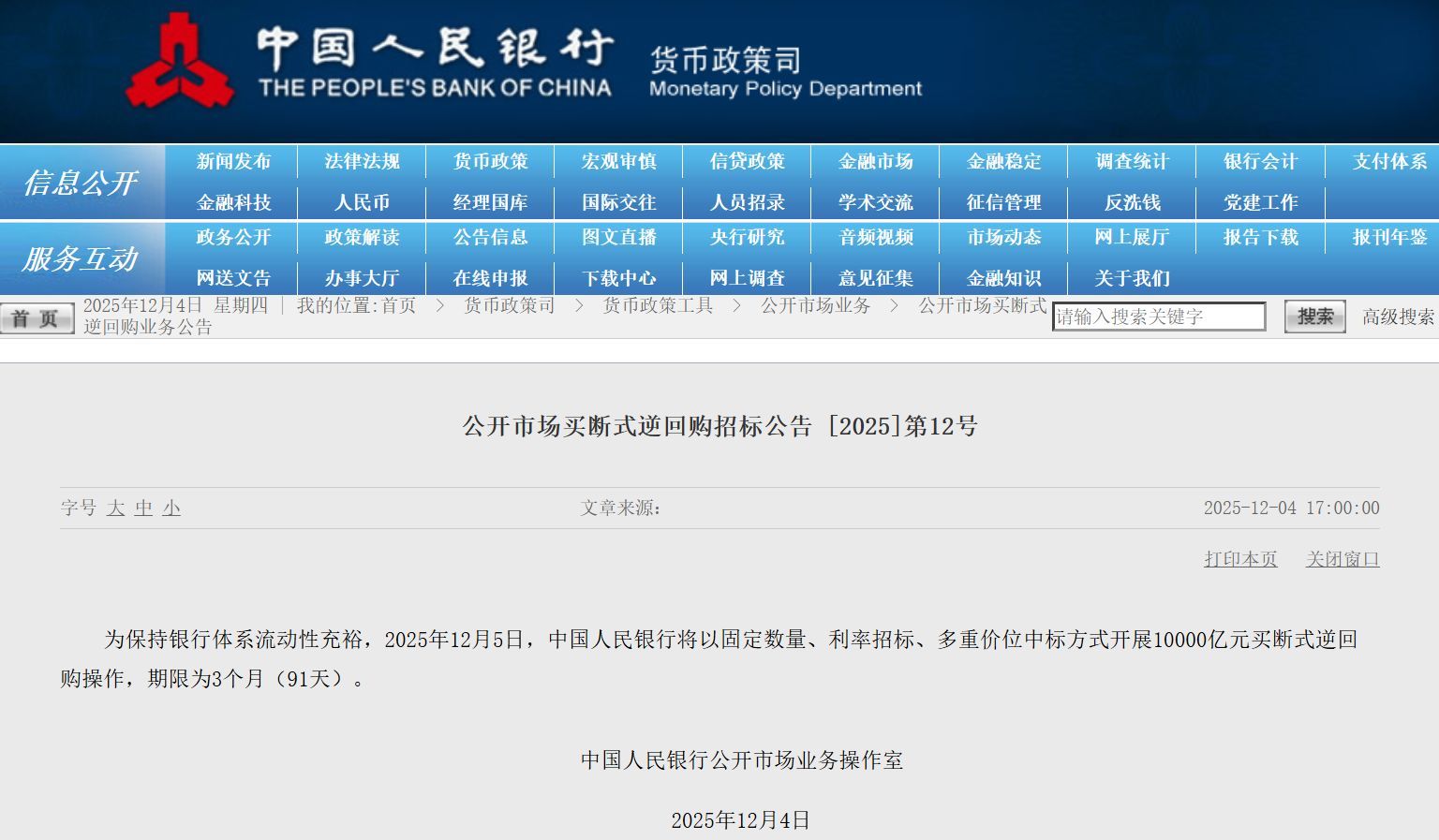
10000亿元!央行出手
Mei Ri Jing Ji Xin Wen· 2025-12-04 09:52
Core Viewpoint - The People's Bank of China (PBOC) announced measures to maintain ample liquidity in the banking system, including a significant reverse repurchase operation of 1 trillion yuan scheduled for December 5, 2025 [1] Group 1: Reverse Repo Operations - PBOC will conduct a fixed quantity, interest rate tender, multi-price bidding reverse repo operation amounting to 1 trillion yuan with a term of 3 months (91 days) [1] - On the same day, PBOC also conducted a 7-day reverse repo operation amounting to 180.8 billion yuan at an interest rate of 1.4% [4][5] Group 2: Market Interest Rates - Recent data indicates a decline in funding rates, with the overnight Shanghai Interbank Offered Rate (Shibor) down by 0.1 basis points to 1.301%, and the 7-day Shibor down by 0.8 basis points to 1.426% [6] - The weighted average rate of DR007 decreased to 1.4409%, while the 1-day government bond reverse repo rate (GC001) fell to 1.407% [6] Group 3: Liquidity Assessment - According to a report from CITIC Securities, there is essentially no liquidity gap in December when excluding the factors of MLF and reverse repo maturities, indicating limited risk to the bond market [6] - However, it is noted that fiscal spending may be delayed, which could lead to disturbances at certain points in the middle of the month [6]