
CITIC Securities Co., Ltd.(CIIHY)

Search documents
中信证券-开元单一资管计划增持中广核电力(01816)1146万股 每股作价约3.18港元
智通财经网· 2026-02-04 11:20
智通财经APP获悉,联交所最新资料显示,2月3日,中信证券-开元单一资产管理计划增持中广核电力 (01816)1146万股,每股作价3.1835港元,总金额约为3648.29万港元。增持后最新持股数目约为17.90亿 股,最新持股比例为16.04%。 ...
中信证券:多重利好共振 餐饮行业迎积极复苏周期 龙头企业率先凸显配置价值
Xin Lang Cai Jing· 2026-02-04 09:32
Core Viewpoint - The restaurant industry is currently in a phase of "marginal improvement in fundamentals - continuous policy support - price mechanism recovery - potential valuation uplift," with positive signals across operational, policy, pricing, and valuation dimensions, indicating a favorable recovery outlook for the industry [1][6]. Operational Improvement - The operational marginal improvement is the core support for the industry's recovery, with restaurant revenue showing significant year-on-year growth of 3.8%, 3.2%, and 2.2% in October to December 2025, outpacing overall retail levels [1][6]. - Supply-side optimization has created favorable conditions for operational recovery, with a noticeable slowdown in the growth rate of food service outlets in the second half of 2025, leading to reduced competitive intensity and a more favorable environment for existing businesses [1][6]. - Key segments such as fast food, tea drinks, coffee, and Western cuisine have shown positive same-store sales growth, demonstrating the resilience of leading enterprises with supply chain advantages and strong brand power [1][6]. Policy Support - Continuous policy support has injected strong momentum into the industry's recovery, with the restaurant sector benefiting from various consumption stimulus policies, particularly consumption vouchers [2][7]. - For instance, after the issuance of restaurant consumption vouchers in Shanghai in Q4 2024, the year-on-year decline in accommodation and catering revenue significantly narrowed, outperforming Beijing, which did not issue such vouchers [2][7]. - The increasing emphasis on policies to boost restaurant consumption is expected to yield positive short-term operational data improvements for the industry [2][7]. Price Mechanism Recovery - The recovery of the price mechanism has opened up space for profit improvement, with signs of improvement in the Consumer Price Index (CPI) since Q4 2025, and a national goal to "promote reasonable price recovery" in 2026 [3][8]. - Leading enterprises have begun to optimize menu structures and adjust pricing strategies, validating consumer demand resilience and showcasing their pricing power [3][8]. - Historical data indicates that rising raw material prices have a more temporary impact on restaurant gross margins, with top companies capable of navigating through price transmission and supply chain efficiency improvements [3][8]. Valuation Outlook - The valuation of the restaurant sector is expected to recover as inflation expectations improve, with CPI being a significant variable influencing restaurant valuations [3][8]. - Experiences from markets like Japan and the U.S. show that during periods of CPI recovery, market expectations for the long-term development of restaurant companies improve, leading to a valuation expansion phase [3][8]. - Leading restaurant companies, with their strong supply chain capabilities and management levels, are positioned to benefit from this valuation uplift as the pricing environment stabilizes [3][8]. Investment Themes - The report outlines three core investment themes: 1. Companies with strong growth potential that align with consumer trends and have robust same-store performance [4][9]. 2. Industry leaders with stable core businesses and promising new brand developments that can provide high returns to shareholders [4][9]. 3. Companies in specific segments that are actively pursuing operational changes and have shown signs of recovery [4][9].
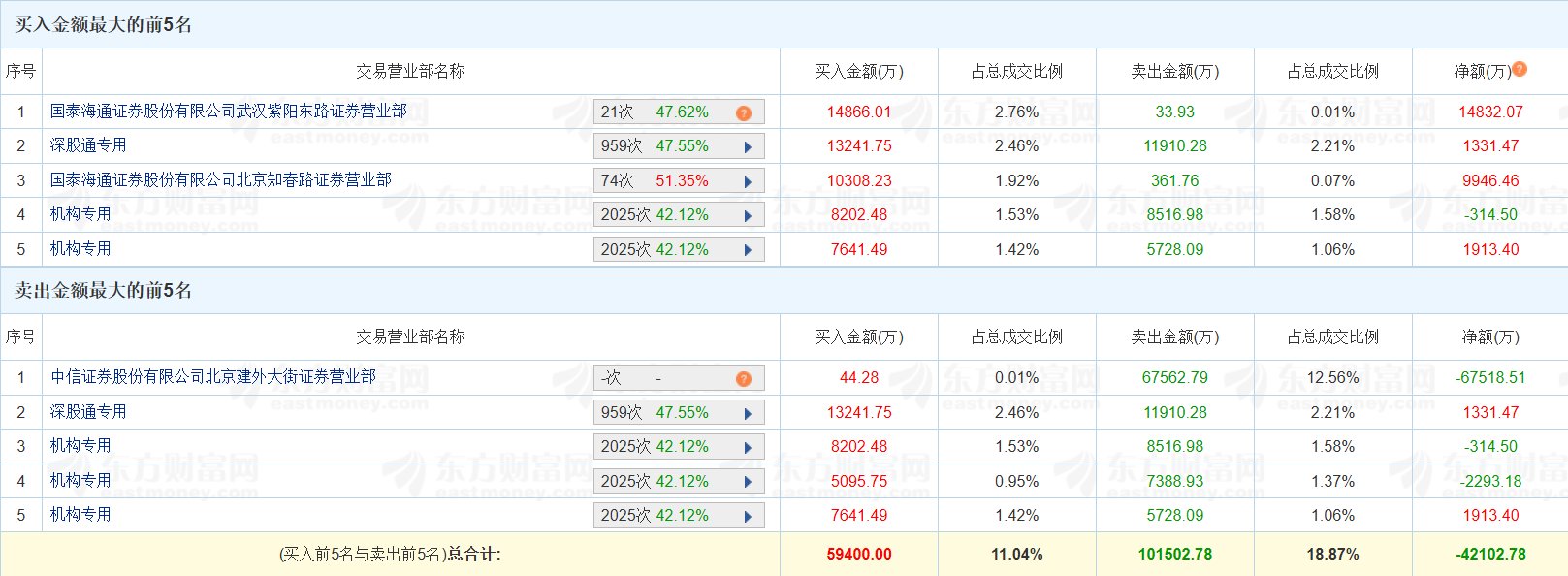
龙虎榜丨协鑫集成涨停,中信证券北京建外大街营业部净卖出6.75亿元

Ge Long Hui A P P· 2026-02-04 08:54
Group 1 - GCL-Poly Energy (002506.SZ) experienced a trading limit increase today, with a turnover rate of 25.1% and a transaction volume of 5.379 billion yuan [1] - The net buying from the Shenzhen Stock Connect amounted to 133.1 million yuan, with total purchases of 1.32 billion yuan and sales of 1.19 billion yuan [1] - CITIC Securities' Beijing Jianwai Street branch was the largest seller, with a net sell of 675 million yuan, while the top buying seat had a net sell of 421 million yuan after buying 594 million yuan and selling 1.015 billion yuan [1] Group 2 - The top five buying trading desks accounted for a total of 11.04% of the overall transaction volume, with the largest being Guotai Junan Securities' Wuhan Ziyang East Road branch, contributing 148.66 million yuan, or 2.76% of the total [2] - The second largest buyer was the Shenzhen Stock Connect dedicated account from easimoney.com, with a purchase amount of 132.42 million yuan, representing 2.46% of the total [2] - Institutional accounts also played a significant role, with multiple entries contributing to the buying activity, including 82.02 million yuan and 76.41 million yuan from different institutional desks [2]

中信证券:餐饮行业逐步进入修复阶段 板块中期展望积极
智通财经网· 2026-02-04 07:41
Industry Overview - The restaurant industry is transitioning into a recovery phase primarily driven by fundamental improvements, with a positive mid-term outlook [1] - Since the second half of 2025, there has been a clear trend of marginal improvement in restaurant operations, with a notable increase in same-store sales across various segments such as fast food, tea drinks, coffee, and Western cuisine [1][5] - The competition within the industry is easing, creating favorable conditions for existing businesses to recover and improve profitability [1][5] Policy Impact - The restaurant sector is a key beneficiary of consumer stimulus policies due to its characteristics of high frequency, low single transaction amounts, and short decision-making chains [2] - Recent policies aimed at boosting restaurant consumption have shown effective results, as evidenced by the significant improvement in Shanghai's restaurant revenue following the issuance of consumption vouchers [2] Pricing Dynamics - Since the fourth quarter of 2025, there have been signs of improvement in the Consumer Price Index (CPI), with expectations for a reasonable recovery in prices in 2026 [3] - Major restaurant chains like KFC and McDonald's have begun to adjust their pricing strategies, indicating resilience in consumer demand and their own pricing power [3] Valuation Insights - The valuation of the restaurant sector is significantly influenced by CPI trends, with a recovery in inflation expectations likely to enhance long-term growth prospects and drive valuation expansion [4] - Leading restaurant companies possess stronger supply chain capabilities and pricing power, which positions them well to navigate through economic cycles and achieve systematic valuation uplift [4] Recovery Factors - The restaurant industry is gradually entering a recovery phase driven by multiple factors, including improved consumer spending, supportive policies, and strategic pricing adjustments [5] - The historical impact of raw material cost fluctuations on profitability is expected to be more of a temporary disturbance rather than a long-term constraint, providing a foundation for margin recovery [5]
杰华特连亏3年 2022年上市募22亿元中信证券保荐
Zhong Guo Jing Ji Wang· 2026-02-04 06:58
Core Viewpoint - Jiewate (688141.SH) has disclosed its 2025 annual performance forecast, indicating expected revenue between 2.6 billion to 2.75 billion yuan, but projecting a net loss attributable to shareholders of 730 million to 630 million yuan [1] Group 1: Financial Performance Forecast - For 2025, Jiewate anticipates operating revenue of 260,000.00 thousand yuan to 275,000.00 thousand yuan [1] - The projected net profit attributable to shareholders is expected to be a loss of 730,000.00 thousand yuan to 630,000.00 thousand yuan [1] - The forecasted net profit excluding non-recurring gains and losses is estimated to be a loss of 820,000.00 thousand yuan to 720,000.00 thousand yuan [1] Group 2: Historical Financial Performance - In 2023, Jiewate reported a net profit attributable to shareholders of -531.4 million yuan, and in 2024, it was -603.4 million yuan [1] - The net profit excluding non-recurring gains and losses for 2023 was -554.1 million yuan, and for 2024, it was -643.8 million yuan [1] Group 3: IPO and Fundraising - Jiewate raised a total of 222,214.08 thousand yuan from its initial public offering, with a net amount of 205,468.49 thousand yuan, exceeding the original fundraising target by 48,373.76 thousand yuan [2] - The company initially planned to raise 157,094.73 thousand yuan for various projects, including high-performance power management chips and automotive electronic chips [2] - The total issuance costs for the IPO amounted to 16,745.59 thousand yuan, with underwriting fees of 13,332.84 thousand yuan [2] Group 4: Company Control - The actual controllers of Jiewate are Zhou Xunwei, a U.S. national, and Huang Biliang, a resident of Macau, China [2]

新富科技过会:今年IPO过关第16家 中信证券过3单
Zhong Guo Jing Ji Wang· 2026-02-04 02:44
Group 1 - The core viewpoint of the article is that Anhui Xinfu New Energy Technology Co., Ltd. has been approved for listing on the Beijing Stock Exchange, marking it as the 16th company to pass the review in 2026 [1][2] - Xinfu Technology focuses on the research, production, and sales of thermal management components for new energy vehicles, with key products including battery liquid cooling pipes and battery liquid cooling plates [1][2] - The company aims to raise approximately 409.31 million yuan for the expansion of its core components in the thermal management system for new energy vehicles [3] Group 2 - The largest shareholder of Xinfu Technology is Anqing Innovation No. 1 Enterprise Management Partnership, holding 14,817,302 shares, which accounts for 42.72% of the total shares [2] - The actual controller of Xinfu Technology is Pan Yixin, who indirectly controls 61.83% of the shares through various partnerships [2] - Xinfu Technology plans to issue up to 11.56 million shares, or up to 13.30 million shares if the overallotment option is fully exercised, with a maximum of 15% of the total issuance being subject to the overallotment option [2] Group 3 - The review meeting raised inquiries regarding the authenticity and sustainability of the company's performance, particularly concerning the significant increase in procurement despite stable revenue from major clients [4] - Questions were also raised about related party transactions, specifically regarding the acquisition of Dalian Huanxin's equity and the rationale behind it, as well as the decision-making mechanism for related transactions [4]
中信证券:互联网企业增值税无忧 关注高新企业认定
Di Yi Cai Jing· 2026-02-04 01:08
Core Viewpoint - The implementation of the new Value-Added Tax Law and its regulations in China will officially begin on January 1, 2026, with no current adjustments to tax rates for internet companies [1] Group 1: Tax Policy Changes - The new Value-Added Tax Law and its implementation regulations will take effect on January 1, 2026 [1] - Current tax policies continue to focus on supporting technological innovation [1] Group 2: High-Tech Enterprise Certification - The management measures for high-tech enterprise certification may be updated, potentially leading to stricter standards [1] - If the certification standards become more stringent, some non-leading internet companies may struggle to benefit from preferential income tax rates [1]
中信证券:多重因素共振 餐饮行业上行拐点可期
智通财经网· 2026-02-04 00:33
Core Viewpoint - The current restaurant industry is experiencing a phase of "marginal improvement in fundamentals—continuous policy support—price mechanism recovery—valuation uplift" driven by multiple factors [1] Industry - Since the second half of 2025, the restaurant industry has shown a trend of marginal improvement, with retail dining revenue increasing by 3.8%, 3.2%, and 2.2% year-on-year in October to December 2025, significantly outpacing overall retail growth [1] - The growth rate of the total number of food outlets nationwide has decreased compared to the first half of 2025, indicating a reduction in industry competition, which creates a more favorable environment for existing businesses to recover and improve profitability [1] - Major segments such as fast food, tea drinks, coffee, and Western cuisine have shown positive same-store sales growth, with leading companies demonstrating stronger operational resilience due to supply chain advantages, brand strength, and management capabilities [1] Policy - The restaurant sector is a key beneficiary of consumption stimulus policies due to its characteristics of high frequency, daily consumption, low single transaction amounts, and short decision-making chains [2] - Historical data shows that after the issuance of dining consumption vouchers in Shanghai, the year-on-year decline in retail dining revenue significantly narrowed, indicating effective policy execution [2] - If more consumption policies are introduced, the restaurant industry is expected to be a high-probability beneficiary, with improvements likely reflected in short-term operational data [2] Price - Since the fourth quarter of 2025, there have been signs of improvement in the Consumer Price Index (CPI), with the government aiming to "promote a reasonable recovery of prices" as a key macroeconomic goal [3] - Leading companies have begun to implement price adjustments through menu optimization and selective price increases, demonstrating their pricing power and the resilience of end-demand [3] - Historical experience suggests that fluctuations in raw material prices primarily have a short-term impact on restaurant companies' gross margins rather than long-term suppression [3] Valuation - Drawing from overseas experiences in Japan and the United States, CPI is a significant variable affecting restaurant sector valuations [4] - During periods of declining CPI or deflation, increased price competition and weak demand expectations tend to suppress restaurant valuations, while a recovery in CPI and improved inflation expectations can enhance long-term growth prospects and drive valuation recovery [4] - Leading restaurant companies, with stronger supply chains and management capabilities, are expected to see systematic valuation uplifts as the pricing environment improves [4] Investment Strategy - The restaurant industry is gradually entering a recovery phase driven by multiple factors [5] - Since the second half of 2025, retail dining revenue and same-store performance across major restaurant formats have improved, while the pace of new supply has slowed, reducing competitive intensity [5] - The importance of service consumption in the growth stabilization framework continues to rise, with the restaurant sector being a direct beneficiary of consumption stimulus policies [6] - As the government promotes a reasonable recovery of prices, restaurant companies are gradually implementing price adjustments, with historical data indicating that raw material cost fluctuations have a more temporary impact on profitability [6] - Overall, the industry is transitioning to a recovery phase primarily driven by fundamental improvements, with a positive mid-term outlook [6]
中信证券:电子元件涨价浪潮有望不断蔓延 推荐关注存储等在涨价趋势中受益确定性最高的环节
智通财经网· 2026-02-04 00:33
Core Viewpoint - The electronic components industry is experiencing a price increase across various segments, driven by strong downstream demand and rising upstream metal prices, with a recommendation to focus on segments like storage, CCL, BT substrates, wafer foundry, and packaging that are likely to benefit from this trend [1][2]. Downstream Demand - Downstream customer inventory replenishment is stronger than expected, with AI and automotive sectors driving demand despite pressures on automotive sales. The localization of upstream components is accelerating, and low inventory levels among downstream customers are contributing to strong replenishment motivation [2][3]. - Advanced packaging and storage expansions are occupying mature process capacities, leading to increased demand for replenishment from downstream customers [2]. Upstream Costs - Key raw materials for electronic manufacturing, including gold, silver, and copper, are experiencing significant price increases, with futures prices expected to rise by over 50% for gold, 150% for silver, and 50% for copper by 2025 [2]. Midstream Components - Since the downturn in 2022, many segments within the electronic components industry have maintained relatively low profit margins, creating a strong demand for price increases amid tight supply and rising costs [3]. - Price increase notices have been observed across various segments, including storage, CCL, BT substrates, wafer foundry, packaging testing, LED, power devices, analog chips, and passive components, with some segments experiencing multiple rounds of price hikes [3]. Specific Segment Insights - **Storage**: The AI supercycle is causing ongoing shortages, with TrendForce predicting a 55%-60% increase in traditional DRAM contract prices and a 33%-38% increase in NAND Flash contract prices by Q1 2026, with some NAND modules already increasing by over 40% this year [4]. - **CCL**: The latest round of price increases is expected to take effect by December 2025, supported by low industry inventory levels [4]. - **Wafer Foundry**: High utilization rates are reported, with some categories already seeing price increases, and the trend of advanced packaging and storage expansions affecting mature process capacities is beneficial for domestic supply-demand dynamics [4]. - **Packaging Testing**: High utilization rates (80%-90%) are noted among major companies, with some clients actively requesting price increases to secure capacity [4]. - **Analog Chips**: Strong demand from automotive and industrial sectors is driving price increases, with domestic design companies also showing willingness to raise prices [5]. - **Power Devices**: Strong price increase momentum is observed for mid-low voltage products, with extended delivery times reported [5]. - **SoC**: Initial price increases for internal storage SoC products are expected to enhance market share and profitability for leading manufacturers [5]. - **MCU**: A price increase of 15%-50% for MCU and Nor Flash products is set to take effect on January 27, 2026 [5].
中信证券:多重因素共振,餐饮行业上行拐点可期
Xin Lang Cai Jing· 2026-02-04 00:31
Core Viewpoint - The current restaurant industry is in a phase of "marginal improvement in fundamentals - continuous policy support - price mechanism recovery - potential valuation uplift" driven by multiple factors [1] Group 1: Operational Aspects - Since the second half of 2025, the retail dining revenue and same-store performance in major restaurant segments have shown continuous recovery [1] - The pace of supply expansion has slowed down, leading to a marginal decrease in industry competition intensity, which provides a more favorable external environment for business recovery and profit improvement [1] Group 2: Policy Environment - The direction of service consumption continues to strengthen, with the restaurant sector benefiting significantly from consumption stimulus policies due to its high frequency, strong scenarios, and short decision-making chains [1] Group 3: Pricing Dynamics - In the context of the government's clear push for reasonable price recovery, restaurant companies have begun to implement price adjustments [1] - Historical experience indicates that cost disturbances tend to have a more pronounced short-term impact, while medium to long-term gross margins are expected to recover and improve [1] Group 4: Valuation Trends - Drawing from overseas experiences, improvements in inflation expectations often lead to a rebound in the valuation center of the restaurant sector [1] - The restaurant industry is developing towards a more positive recovery direction under the influence of fundamentals, policies, prices, and valuations [1]