
CITIC Securities Co., Ltd.(CIIHY)

Search documents
伯镭科技,递交IPO招股书,拟赴香港上市,中信证券、中信建投国际联席保荐
Sou Hu Cai Jing· 2026-01-30 08:13
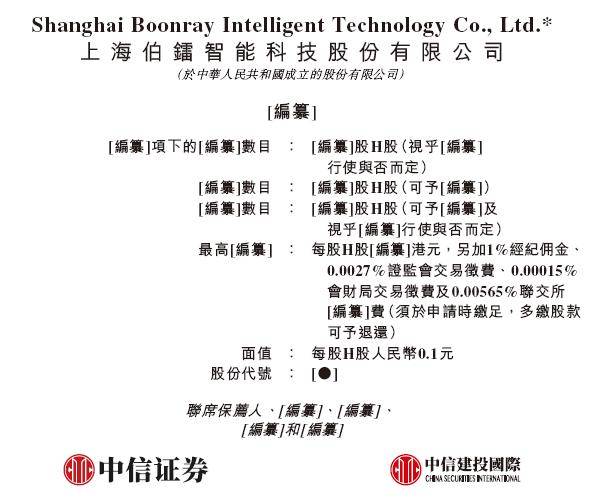
Core Viewpoint - Shanghai Boonray Intelligent Technology Co., Ltd. (Boonray Technology) is preparing for an IPO on the Hong Kong Stock Exchange, focusing on autonomous mining truck solutions and aiming to transform the industry through an integrated strategy of "automation + electrification" [1][2]. Business Overview - Boonray Technology, established in 2015, is a leading provider of autonomous mining truck solutions, emphasizing a strategy that integrates automation and electrification to drive industry transformation [2]. - The company has developed three synergistic business segments: Intelligent Vehicles, Intelligent Mining, and Intelligent Transportation [4]. Intelligent Vehicles - The Intelligent Vehicles segment focuses on the sales of fully electric autonomous mining trucks used in enclosed environments, which has been the largest revenue source for the company [5]. - Boonray Technology is the only supplier in the industry with its own production facilities and is the exclusive provider of integrated charging and swapping solutions for mining trucks [5]. - The company has achieved mass production of autonomous mining trucks and has secured orders for over a thousand units from leading mining service companies [5]. - By 2024, Boonray Technology is projected to be the largest global provider of electric autonomous mining trucks by shipment volume and revenue [5]. Intelligent Mining - The Intelligent Mining segment positions the company as a total contractor for smart mining solutions, offering an integrated solution covering the entire mining operation process from loading to transportation and energy replenishment [8]. - The company provides a comprehensive smart mining management platform, remote control systems for mining equipment, and intelligent charging and swapping systems [8]. Intelligent Transportation - The Intelligent Transportation segment offers unmanned transportation services for mining operations, relying on a self-invested and operated integrated system [9]. - Boonray Technology has established the first fully automated mining project in the industry, which has been operating safely 24/7 for nearly four years and has achieved unit-level profitability [9]. Financial Performance - For the fiscal years 2023, 2024, and the first nine months of 2025, Boonray Technology reported revenues of RMB 69.57 million, RMB 170.84 million, and RMB 315.21 million, respectively, with corresponding net losses of RMB 32.48 million, RMB 60.99 million, and RMB 58.67 million [15][16]. Shareholder Structure - Prior to the IPO, the largest shareholder group, led by Mr. Hu Xinyi and Dr. Yang Yang, collectively holds approximately 34.07% of the shares [11][12]. Management Team - The board of directors consists of 8 members, including 3 executive directors: Mr. Hu Xinyi (Chairman and CEO), Dr. Yang Yang (CTO), and Mr. Zhan Zhiyong (Vice President) [14].


港股IPO消息|新能源云母复合材料供应商浙江荣泰递表港交所,2025年前三季度利润2.05亿,中信证券为独家保荐人
Sou Hu Cai Jing· 2026-01-30 05:59
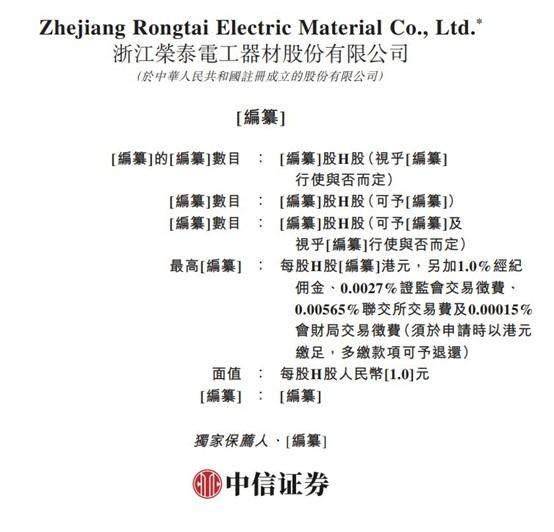
Core Viewpoint - Zhejiang Rongtai Electric Equipment Co., Ltd. has submitted an application for listing on the Hong Kong Stock Exchange, with CITIC Securities as the sole sponsor [1]. Company Overview - Zhejiang Rongtai is a pioneer and leader in the global new energy mica composite materials and related products, having expanded its business from mica products to key precision structural components for robots [4]. - The company holds a dominant position in the new energy mica product market in China, with a projected market share of 14.1% in 2024, significantly ahead of its competitors [4]. Market Position - According to Frost & Sullivan, Zhejiang Rongtai ranks first in the revenue of the new energy mica product market in China for 2024, with the following market share distribution: - 1st: Zhejiang Rongtai - 14.1% - 2nd: Company A - 6.4% - 3rd: Company B - 5.2% - 4th: Company E - 3.4% - 5th: Others - 1.6% [4]. Financial Performance - The revenue figures for Zhejiang Rongtai are as follows: - 2023: Approximately 800 million RMB - 2024: Approximately 1.135 billion RMB - Nine months ending September 30, 2024: Approximately 809 million RMB - Nine months ending September 30, 2025: Approximately 960 million RMB [4][6]. - The profit figures for the same periods are: - 2023: Approximately 172 million RMB - 2024: Approximately 230 million RMB - Nine months ending September 30, 2024: Approximately 167 million RMB - Nine months ending September 30, 2025: Approximately 205 million RMB [5][6]. Governance Structure - The board of directors of Zhejiang Rongtai consists of nine members, including two executive directors, three non-executive directors, and four independent non-executive directors. The chairman and CEO is Ms. Cao Meisheng, while Mr. Zheng Minmin serves as the executive director and general manager [7].

中信证券:待结汇规模估6500亿美元,无需过度担忧结汇对流动性消耗
Ge Long Hui A P P· 2026-01-30 05:19
格隆汇1月30日|中信证券研报测算显示,中国目前积累的待结汇规模或在6500亿美元左右,假设50% 在2026年结汇,只需要占用约1400亿元存款准备金,绝对金额并不大,无需过度担忧结汇对流动性的消 耗。 炒股就看金麒麟分析师研报,权威,专业,及时,全面,助您挖掘潜力主题机会! ...
中信证券:复盘新能源汽车,掘金人形机器人
Xin Lang Cai Jing· 2026-01-30 01:35
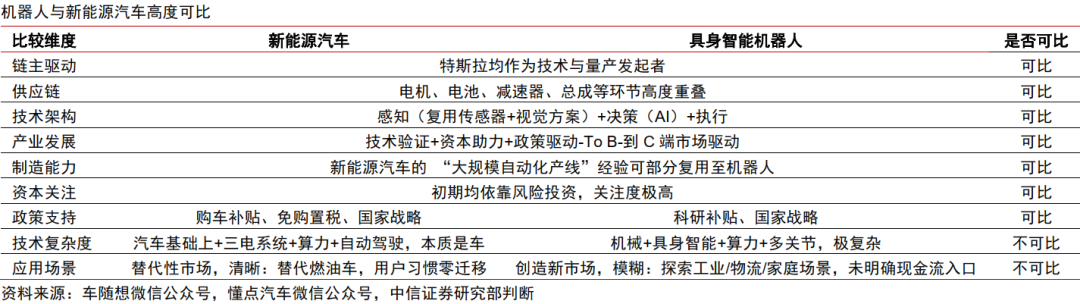
Core Insights - The report analyzes the development and investment cycles of the electric vehicle (EV) industry and draws parallels to the humanoid robot industry, suggesting that humanoid robots are currently in a technology validation phase, but their commercialization timeline will be shorter than that of EVs [3][27][28] - The report emphasizes the importance of focusing on high-value, clear-structure, and high-certainty segments within the robot industry, as these segments exhibit the greatest performance elasticity [17][22][41] Industry Comparison - Both the EV and humanoid robot industries are considered global strategic industries, initiated by Tesla, and follow similar patterns of technological validation, capital support, and policy-driven market dynamics [4][28] - The complexity of intelligent robotics is higher than that of EVs, with more fragmented application scenarios, leading to greater uncertainty in industry development [4][28] Investment Strategy - The report recommends actively seeking leading companies in the humanoid robot sector that have high barriers to entry in terms of non-standardization, technology, cost, and production expansion, as these companies are likely to navigate through industry cycles successfully [22][41] - The humanoid robot industry is expected to follow a path from closed to open systems, from standardization to complexity, and from production to everyday life applications [23][30] Technological Development - Current technological challenges in humanoid robots include improving autonomous decision-making capabilities, enhancing motion flexibility and stability, and reducing overall costs [31][34] - The report notes that while the cost structure of humanoid robots is similar to that of EVs, the industry is still in its infancy, and no dominant players have emerged yet, akin to CATL in the battery sector [41] Market Dynamics - The EV industry has experienced four major market cycles driven by macroeconomic factors, policy changes, and technological advancements, which may serve as a reference for the humanoid robot industry as it develops [10][11][39] - The report highlights that the investment landscape for humanoid robots is currently characterized by thematic investments, similar to earlier stages of the EV market [39][41]


中信证券:复盘新能源汽车 掘金人形机器人
智通财经网· 2026-01-30 00:49
Core Viewpoint - The humanoid robot industry is currently in a technology validation phase, but the timeline for commercialization is expected to be shorter than that of the electric vehicle industry. The focus should be on segments with high value, clear structure, and high certainty, as these will have the greatest performance elasticity [1][22]. Industry Comparison - The humanoid robot industry is highly comparable to the electric vehicle industry, both being global strategic industries initiated by Tesla. They follow similar development patterns driven by technology validation, capital support, and policy incentives, although the complexity and fragmentation of robot intelligence present unique challenges [2][3]. Key Segments - High-value and high-barrier segments in the humanoid robot industry include platform companies (integrating hardware and software), high-performance SOC chips (driving the brain side), dexterous hands (integrated hardware and software small robots), actuators, and precision sensors [1][19][22]. Investment Strategy - The investment strategy should focus on identifying leading companies in the humanoid robot sector that have high non-standard, technical, cost, and production expansion barriers, as these companies are likely to navigate through industry cycles successfully [1][22]. Market Dynamics - The humanoid robot industry is expected to experience a more stable performance trajectory compared to the electric vehicle industry, which has faced significant volatility due to cyclical material performance. The industry is still in its early stages, with no dominant players yet emerging like CATL in the lithium battery sector [19][22]. Policy and Capital Support - Policy and capital support are crucial for the development of both the electric vehicle and humanoid robot industries. The approach for robots should follow a "plan first, market later" strategy, similar to the early days of electric vehicles [5][6].
中信证券:海外AI模型与应用密集催化推动下 算力产业链或迎来新一轮上涨
智通财经网· 2026-01-30 00:49
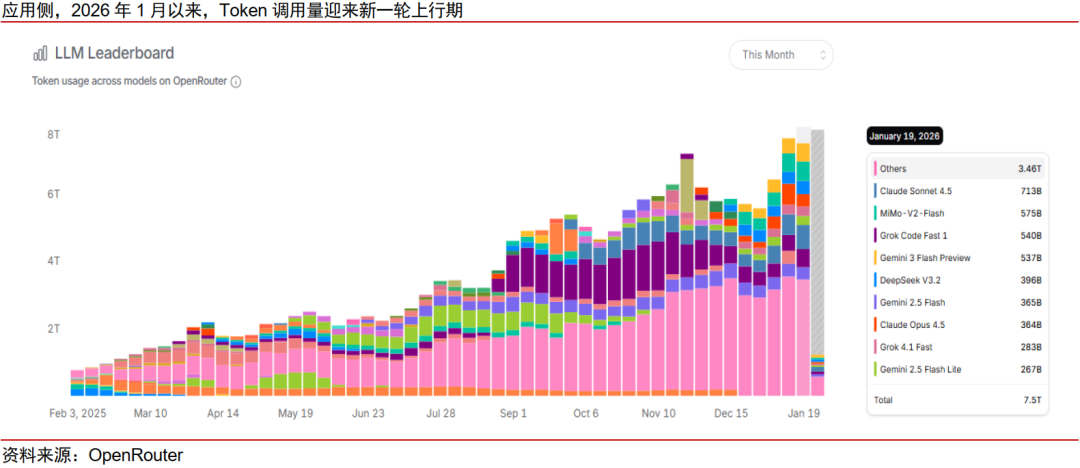
Core Viewpoint - Recent demand for inference and training computing power is strong, leading to price increases from both Amazon Web Services (AWS) and Google Cloud [1][2] Group 1: Demand for Computing Power - The demand for computing resources for inference and training has significantly increased, supporting the need for training computing power [1] - AWS raised prices by approximately 15% for EC2 machine learning capacity blocks on January 23, 2026, followed by Google Cloud announcing price hikes for its cloud network transmission services, with North America seeing a doubling of prices [2] Group 2: Inference Side - The rapid emergence of AI agents, such as MoltBot, is expected to support the demand for inference computing power, as these agents can perform more complex tasks and require more computing resources [3] - Anthropic has raised its revenue expectations for 2026 and 2027 to $18 billion and $55 billion, respectively, indicating a strong upward trend in inference demand [3] Group 3: Training Side - The industrial sector is continuously exploring scaling limits, which supports the demand for training computing power, with new models expected to be released in Q1 2026 [8] - Models like Grok-5 and GPT-6 are anticipated to utilize larger datasets and parameter scales, increasing the demand for training computing power [8] Group 4: Financial Reporting Catalyst - The upcoming earnings reports from major cloud service providers (CSPs) will be critical in confirming the demand for computing power and capital expenditure continuity [9] - Key earnings dates include Microsoft and Meta on January 29, 2026, followed by Google on February 5 and Amazon on February 6, with NVIDIA's report on February 26 expected to further influence market sentiment [9][10]
中信证券:新版《药品管理法实施条例》颁布,以人为本+创新加速助行业高质量发展
Xin Lang Cai Jing· 2026-01-30 00:29
Core Viewpoint - The revised Implementation Regulations of the Drug Administration Law of the People's Republic of China have been officially released, emphasizing a legal framework for drug activities that prioritizes public welfare and innovation [1] Industry Summary - The new regulations serve as a tool to refine and implement the Drug Administration Law, indicating a shift towards high-quality development in the pharmaceutical industry, driven by innovation and compliance [1] - The pharmaceutical industry is expected to maintain an overweight position, with investment strategies focusing on three main lines for 2026: 1. Innovation-driven and internationalization, highlighting the importance of companies that focus on innovation and international expansion in a domestic policy environment that discourages excessive competition [1] 2. Self-sufficiency, with an emphasis on core components, reagents, and upstream research that can replace imports, especially in light of potential geopolitical risks [1] 3. New policies and new opportunities, benefiting from optimized centralized procurement, three-payment systems in medical insurance, consumption stimulus policies, and state-owned enterprise reforms [1]
中信证券:人形机器人处于技术验证期,商业化落地时间相比新能源汽车将缩短
Xin Lang Cai Jing· 2026-01-30 00:24
Core Viewpoint - The humanoid robot industry is currently in a technology validation phase, but the timeline for commercialization is expected to be shorter compared to that of the electric vehicle sector [1] Group 1: Industry Insights - It is recommended to focus on segments of the robotics industry that have the highest value, clearest structure, and greatest certainty, as these segments exhibit the most significant performance elasticity [1] - Leading companies in the industry trend investment phase are deemed crucial, and there is a suggestion to actively seek out leading enterprises in niche segments of robotics that have high barriers related to non-standardization, technology, cost, and capacity expansion [1] Group 2: High-Value Segments - The report identifies high-value and high-barrier segments within the humanoid robot industry, including integrated platform companies (both hardware and software), high-performance SOC chips (driving the brain-side), dexterous hands (small robots with integrated hardware and software), actuators, and precision sensors (also integrated hardware and software) [1]
中信证券:新版《药品管理法实施条例》颁布 以人为本+创新加速助行业高质量发展
Di Yi Cai Jing· 2026-01-30 00:21
Core Viewpoint - The revised Implementation Regulations of the Drug Administration Law of the People's Republic of China have been officially released, emphasizing a legal framework for drug activities that prioritizes public welfare and innovation [1] Industry Summary - The new regulations serve as a tool to refine and implement the Drug Administration Law, indicating a shift towards high-quality development in the pharmaceutical industry, driven by innovation and compliance [1] - The pharmaceutical industry is expected to maintain an overweight position, with investment strategies focusing on three main lines for 2026: 1. Innovation-driven and internationalization, particularly in the context of domestic policies that discourage excessive competition [1] 2. Self-sufficiency, with an emphasis on core components, reagents, and upstream research areas that can replace imports due to geopolitical risks [1] 3. New policies and opportunities, benefiting from optimized centralized procurement, three-payment systems in medical insurance, consumption stimulus policies, and state-owned enterprise reforms [1]
中信证券:人形机器人处于技术验证期 商业化落地时间相比新能源汽车将缩短
Di Yi Cai Jing· 2026-01-30 00:21
Core Insights - The humanoid robot industry is currently in a technology validation phase, but the timeline for commercialization is expected to be shorter compared to the electric vehicle sector [1] - It is recommended to focus on segments within the robotics industry that have the highest value, clearest structure, and greatest certainty, as these segments exhibit the most significant performance elasticity [1] - Leading companies in the industry trend investment phase are deemed crucial, and there is an emphasis on identifying leading enterprises in niche segments that have high barriers related to customization, technology, cost, and capacity expansion [1] Industry Segments - Key high-value and high-barrier segments within the humanoid robot industry include integrated platform companies (both hardware and software), high-performance SOC chips (driving the brain-side), dexterous hands (small robots with integrated hardware and software), actuators, and precision sensors (also integrated hardware and software) [1]