Deutsche Bank AG(DB)

Search documents
地缘政治+财政赤字攀升,黄金将在2026上半年冲到5000美元?
Hua Er Jie Jian Wen· 2026-01-09 10:41
Core Viewpoint - HSBC predicts that gold prices may surpass $5,000 per ounce in the first half of 2026, driven by a combination of geopolitical risks and deteriorating fiscal conditions [1][2] Group 1: Factors Influencing Gold Prices - HSBC's report highlights that the rising fiscal deficits in the Western world, particularly the projected $2.05 trillion federal deficit in the U.S. for the 2026 fiscal year, are becoming a hidden driver for gold price increases [2] - The increasing fiscal deficits are eroding the credibility of fiat currencies, thereby amplifying the appeal of gold as a non-debt asset [2] - Deutsche Bank notes a fundamental shift in market structure, where the pricing power of gold is moving from price-sensitive consumers to less price-sensitive official buyers, such as central banks [3] Group 2: Market Dynamics and Investor Behavior - Institutional investors are currently experiencing "FOMO" (Fear of Missing Out), which is driving short-term volatility in the gold market [4] - The report warns that if anticipated interest rate cuts do not materialize, the rebound in gold prices may face suppression and potential corrections [4] - The gold market in 2026 is expected to exhibit characteristics of "high volatility and high prices," reflecting a broader distrust in the existing credit system [4]


德银深度:美国盯上委内瑞拉,不只是为了油,更是为了“拯救美元”
Xin Lang Cai Jing· 2026-01-09 05:18
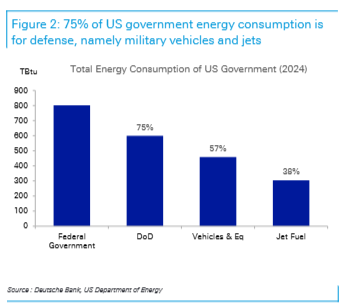
Core Viewpoint - Deutsche Bank indicates that the U.S. involvement in Venezuela's oil is not merely about energy but is fundamentally a covert war for dollar hegemony [1][10]. Group 1: Energy and Economic Control - Controlling the world's largest oil reserves enhances the U.S.'s influence over global oil prices, but the deeper strategic goal is to maintain the dollar's status as the global reserve currency [1][10]. - The U.S. relies on oil and gas for over 70% of its energy consumption, necessitating a stable and low-cost supply to maintain global competitiveness [12]. - Venezuela's oil reserves are six times larger than those of the U.S., creating a "perfect complement" despite Venezuela's low production capacity [12]. Group 2: Military and Dollar Dominance - The military's reliance on oil is crucial, as the U.S. Department of Defense is the largest oil consumer, with 75% of federal energy consumption coming from defense [13][15]. - Historical evidence suggests that a country's probability of winning conflicts influences its currency's stability, making military dominance a key factor in the dollar's reserve status [15]. - The U.S. aims to secure control over oil reserves to enhance its military success probability, thereby supporting the dollar's position [15]. Group 3: Shift from Demand to Supply Control - The traditional leverage of maintaining dollar pricing through demand is weakened as the U.S. is no longer the largest oil importer [17]. - The new strategy involves becoming one of the largest oil suppliers to enforce dollar settlements from the supply side, particularly by controlling Venezuelan oil reserves [17][19]. - If the U.S. can control Venezuela's oil sales channels, it can ensure that trade remains dollar-denominated, thus maintaining global demand for the dollar [19].

德银深度:美国盯上委内瑞拉,不只是为了油,更是为了“拯救美元“
Hua Er Jie Jian Wen· 2026-01-09 03:59
Core Viewpoint - The involvement of the United States in Venezuela's oil sector is not merely about energy but is fundamentally a covert war for maintaining the dollar's hegemony in the global financial system [1][2]. Group 1: U.S. Strategic Interests - Controlling Venezuela's vast oil reserves, which are six times larger than those of the U.S., is seen as a strategic move to enhance U.S. influence over global oil prices and maintain the dollar's status as the world's reserve currency [2][6]. - The U.S. aims to transition from being the largest oil importer to a dominant oil supplier, thereby ensuring that oil continues to be priced in dollars [1][6]. Group 2: Historical Context of Energy Dominance - Historical analysis indicates that nations controlling key energy resources gain significant economic, industrial, and military advantages, which solidify their global dominance [2]. - The U.S. has relied heavily on oil and gas, with over 70% of its energy consumption coming from these sources, making access to low-cost oil essential for maintaining global competitiveness [2]. Group 3: Military and Economic Interdependence - The military's reliance on oil underscores its critical role in maintaining the dollar's status; the U.S. Department of Defense is the largest consumer of oil, with 75% of government energy consumption attributed to military use [3][5]. - Historical precedents show that control over oil supplies has been pivotal in military conflicts, influencing the stability and value of currencies [5]. Group 4: Shift in Pricing Power - The traditional leverage of the U.S. as the largest oil buyer to enforce dollar-denominated transactions is diminishing, necessitating a shift to controlling oil supply to maintain pricing power [6][8]. - By controlling Venezuela's oil sales, the U.S. could ensure that transactions remain dollar-based, even if the oil does not flow directly to the U.S., thereby reinforcing the dollar's position in global trade [8].
Deutsche Bank (NYSE:DB) Maintains Strong Position in Global Banking Sector
Financial Modeling Prep· 2026-01-08 23:08
Core Viewpoint - Deutsche Bank is a significant player in the global banking sector, providing a variety of financial services and competing with other major banks like National Australia Bank [1] Group 1: Stock Performance - Morgan Stanley maintained an "Overweight" rating for Deutsche Bank, raising its price target from EUR 39 to EUR 40, indicating a positive outlook for the bank's stock [2][5] - Deutsche Bank's stock is currently priced at $38.81, reflecting a slight increase of 0.53% or $0.21, with trading stability observed [3][5] - Over the past year, Deutsche Bank's stock has seen a high of $39.82 and a low of $17.17, indicating significant volatility [3] Group 2: Market Capitalization and Trading Activity - Deutsche Bank's market capitalization is approximately $74.16 billion, representing the total market value of its outstanding shares [4][5] - The trading volume for Deutsche Bank's stock is 1,192,035 shares, indicating active investor interest and close monitoring of the bank's performance [4][5]
重要商品指数再平衡周五开启,两大投行预言“白银两周内调整”,高盛“关键还是伦敦”
Hua Er Jie Jian Wen· 2026-01-08 00:26
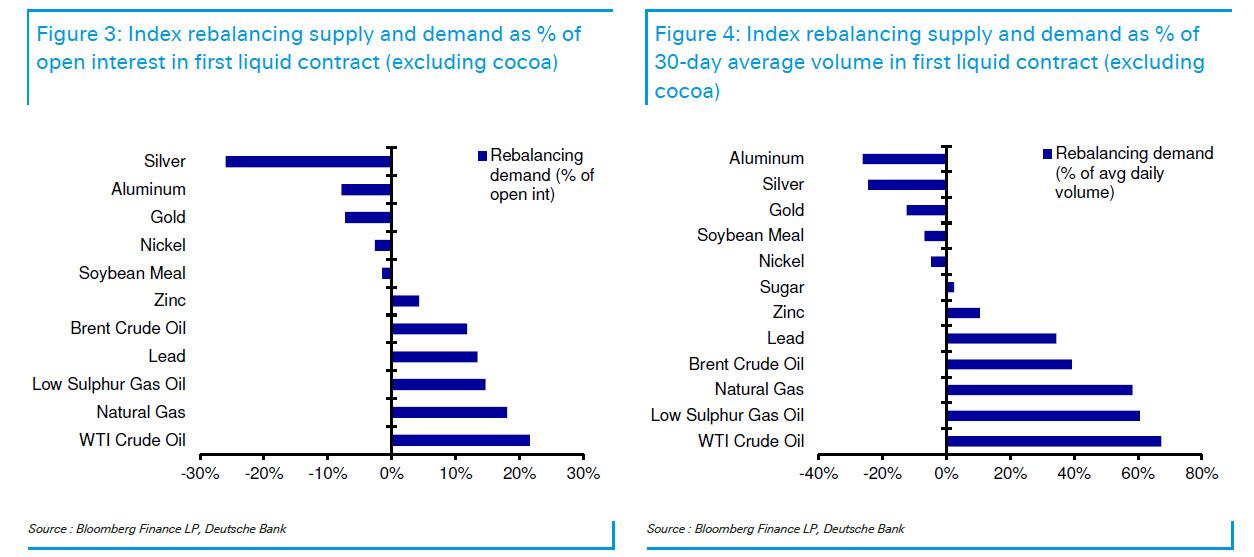
Core Viewpoint - The Bloomberg Commodity Index (BCOM) is set to undergo annual rebalancing, leading to significant selling pressure on silver, with an estimated $7.7 billion in silver sell orders expected to enter the market over the next two weeks, equating to 13% of the total open interest in the COMEX silver market [1][6][7]. Group 1: Rebalancing Impact - The rebalancing will reduce the weight of gold from 20.4% to 14.9%, with silver also facing a weight reduction [1][2]. - Deutsche Bank's analysis indicates that silver will experience the largest selling pressure during the rebalancing period, followed by aluminum and gold [2]. - The rebalancing period is scheduled from January 9 to January 15 [1]. Group 2: Market Dynamics - TD Securities highlights that the trading volume of the largest silver ETF has reached extreme levels, typically seen only at market peaks, indicating speculative fervor among retail investors [1][6]. - The report suggests that the recent surge in silver prices is not reflective of demand or supply fundamentals, but rather a speculative bubble that may lead to significant price corrections [6]. Group 3: Supply and Demand Factors - Goldman Sachs presents a contrasting view, emphasizing that liquidity in the London market is crucial for determining silver price movements. They predict that extreme price volatility will persist as long as the tight inventory situation in London remains unresolved [1][8]. - The tight inventory in London has led to increased borrowing costs for physical silver, indicating a supply squeeze [9][11]. Group 4: Future Price Projections - Goldman Sachs notes that lower inventory levels have created conditions for price squeezes, with sensitivity to demand changes significantly heightened during tight supply situations [11]. - If liquidity in London improves, there could be a notable downside risk for silver prices, especially if silver currently held in the U.S. returns to London, alleviating the tightness [12].

委内瑞拉政变,对全球市场的启示
Hua Er Jie Jian Wen· 2026-01-06 08:55
德意志银行认为,1945年后的国际体系正在解体,国际法和既定规范在军事和经济硬实力面前已变得无 关紧要。对于投资者而言,这意味着地缘政治风险不再是尾部风险,而是核心定价因素。 据追风交易台,美国外交政策呈现新的调整态势。近期委内瑞拉政局变化引发国际关注,这一局势发展 可能对美国在西半球的影响力产生深远影响。 报告指出,2026年全球市场可能面临较多不确定性因素。无论是能源市场的结构调整,还是国际关系格 局的演变,都可能对资产价格产生重要影响。 权力真空与过渡期的极大不确定性 据新华社和央视新闻报道,2026年1月3日美军发起的行动导致委内瑞拉总统马杜罗及其妻子被捕,并面 临毒品恐怖主义指控。德银指出,尽管行动迅速,但随之而来的是极度的政治真空。 石油机遇:1000亿美元的赌注与价格双刃剑 委内瑞拉拥有世界上最大的探明石油储量,控制这一资源将给予华盛顿巨大的经济杠杆。然而,德银分 析认为,这一机遇并非唾手可得,且伴随着复杂的市场后果: 基建废墟: 委内瑞拉的石油基础设施、道路和港口已摇摇欲坠。据估算,要将其石油出口 恢复至历史峰值,需要在十年内投入高达1000亿美元的资金。 价格冲击: 委内瑞拉出口的实质性增加 ...
Deutsche Bank's Chris Woronka favors Six Flags — here's why
Youtube· 2025-12-30 19:52
Core Viewpoint - The travel industry, particularly hotels and cruises, is experiencing fluctuations, but overall spending remains strong, especially among high-end customers [1][2]. Cruise Industry - Cruise lines are focusing on enhancing out-of-cabin spending through experiences like private island destinations and upscale dining options [2][5]. - There is a noticeable bifurcation in customer segments, with high-end customers continuing to spend, while budget-conscious travelers opt for lower-cost options like interior cabins [4][6]. Theme Parks - Theme parks, particularly Six Flags and SeaWorld Entertainment, are expected to evolve their offerings, incorporating more live entertainment and diverse dining experiences to attract a wider audience [7][9]. - The market may not fully appreciate the potential growth and evolution of these theme parks, which are primarily seasonal businesses [10]. Ski Industry - The ski industry, particularly in areas like Vail, is facing challenges due to high pass prices and insufficient snowfall, impacting customer turnout [11][12].

AI to drive growth and volatility in 2026, Deutsche Bank says
Proactiveinvestors NA· 2025-12-30 18:35
Company Overview - Proactive is a financial news publisher that provides fast, accessible, informative, and actionable business and finance news content to a global investment audience [2] - The company operates with a team of experienced and qualified news journalists, ensuring independent content production [2] Market Focus - Proactive specializes in medium and small-cap markets while also covering blue-chip companies, commodities, and broader investment stories [3] - The news team delivers insights across various sectors, including biotech and pharma, mining and natural resources, battery metals, oil and gas, crypto, and emerging digital and EV technologies [3] Technology Adoption - Proactive is recognized for its forward-looking approach and enthusiastic adoption of technology to enhance workflows [4] - The company utilizes automation and software tools, including generative AI, while ensuring that all content is edited and authored by humans [5]

德国银行业协会主席呼吁政府加快经济改革步伐
Zhong Guo Xin Wen Wang· 2025-12-30 13:27
Core Viewpoint - The President of the German Banking Association, Christian Sewing, emphasizes the need for the German government to accelerate economic reforms to maintain long-term competitiveness, suggesting that the public must also increase work intensity [1] Group 1: Economic Reforms - The new German federal government, which took office in May, has introduced several reform measures aimed at boosting the economy, including corporate tax cuts, reduced regulation, and increased infrastructure investment [1] - Despite these measures, Sewing believes they are insufficient to significantly drive long-term economic growth [1] Group 2: Economic Growth Projections - The German Banking Association forecasts that Germany's economic growth rate could reach 1.5% by 2026, indicating an improvement from previous sluggish growth [1] - The employment market is expected to recover, with unemployment projected to decrease by 100,000, bringing the total below 3 million [1] Group 3: Monetary Policy Outlook - Sewing anticipates that the European Central Bank will maintain a relatively stable benchmark interest rate through 2026, with inflation in the Eurozone expected to remain around 2% [1] - The ECB has set a medium-term inflation target of 2%, while recent overall price levels in Germany have slightly exceeded this target [1]
How Deutsche Bank Plans to Achieve RoTE Above 13% by 2028
ZACKS· 2025-12-29 18:21
Core Viewpoint - Deutsche Bank AG has outlined a structured plan to increase its return on tangible equity (RoTE) above 13% by 2028 through revenue growth, cost discipline, capital optimization, and higher shareholder payouts [1] Revenue Growth - The bank aims to achieve an additional €5 billion ($5.8 billion) in revenues by expanding its Global Hausbank across asset gathering, payments servicing, and advisory [2] - Deutsche Bank plans to generate €2 billion ($2.3 billion) of this growth in Germany by leveraging its home-market leadership and capitalizing on fiscal stimulus, structural reforms, private-sector investment, and long-term transformation spending [2] Cost Control and Efficiency - Deutsche Bank targets a cost-income ratio of below 60% by 2028, an improvement from previous goals [3] - This improvement is expected to be driven by €2 billion in gross cost efficiencies through process simplification, automation, and increased use of digital and AI-enabled platforms [3] Capital Management - The bank intends to maintain its Common Equity Tier 1 (CET1) ratio at 13.5-14%, balancing resilience with return optimization [4] - Starting in 2026, Deutsche Bank plans to increase its payout ratio to 60% of net profit attributable to shareholders, up from the current 50% target for 2025 [4] - Higher dividends and share buybacks are aimed at enhancing shareholder returns and reinforcing management's confidence in sustainable earnings [4] Market Performance - Over the past six months, Deutsche Bank shares have increased by 35.5% on the NYSE, outperforming the industry growth of 24.8% [9]