Alphabet(GOOGL)

Search documents
观察 | AI行业真相:传统行业没崩,OpenAI红利见顶,真正机会在这
未可知人工智能研究院· 2026-01-05 04:02
Core Insights - The article emphasizes that traditional industries are not as vulnerable to AI disruption as commonly perceived, with only minor declines in sectors like search engines and education technology [4][5][6] - AI is described as a gradual force of change rather than an immediate threat, suggesting that traditional industries have a window of five to ten years to adapt [7][21] - The report highlights the importance of integrating AI into workflows to gain a competitive edge, rather than relying solely on AI technology itself [7][21] Industry Performance - Traditional search engines experienced a year-over-year decline of only 3%, while traditional education technology platforms saw a 7% drop, indicating stability in these sectors [5][8] - Digital freelance work declined by 8%, but the overall trend remains steady, suggesting resilience in the market [8] - The report categorizes various sectors as "Steady," indicating that while AI is encroaching on market share, the protective barriers of these industries are stronger than anticipated [5][8] AI Market Dynamics - ChatGPT's growth rate turned negative at -4% in December, while competitors like Google's Gemini and Meta's AI products saw significant growth rates of 82% and 109%, respectively [9][10] - The market share of ChatGPT decreased by 3 percentage points over four months, indicating a shift in competitive dynamics where latecomers are gaining ground [9][10] - The fastest-growing AI sector is music generation, with an overall growth rate of 36%, highlighting opportunities in niche markets [16][20] Investment Opportunities - Companies like Zhiyu and MiniMax are entering a critical phase for capitalizing on AI, with MiniMax projected to achieve a 780% revenue growth in 2024 [24][26] - The differing business models of these companies present varied risk-reward profiles for investors, with Zhiyu focusing on B2B and MiniMax on a global C2C approach [24][26] - The successful IPOs of these companies could stimulate further investment in the AI sector, encouraging new startups to emerge [26][28] Actionable Insights - Individuals in traditional industries are encouraged to explore how AI tools can enhance efficiency, as the integration of AI will become a fundamental skill in the workplace [28][29] - Establishing a diverse AI toolset for different applications is recommended, as relying on a single tool may limit effectiveness [29] - Focusing on vertical market opportunities where AI can address specific pain points is advised, as these areas are likely to yield significant returns [29][21]




谷歌工程师:Claude Code仅用一小时就完成了其团队一年才能完成的工作
Huan Qiu Wang Zi Xun· 2026-01-05 03:39
Core Insights - Google's chief engineer Jaana Dogan highlighted the rapid development of AI-assisted coding capabilities, as demonstrated by Anthropic's Claude Code, which generated a distributed agent orchestration system in just one hour, a task that Google's team had been working on for a year [1] Group 1: AI Development - Claude Code produced results that aligned with functionalities Google had been developing, showcasing the swift advancements in AI coding assistance [1] - Dogan acknowledged that while the output from Claude Code is not perfect and requires improvements, it still reflects significant progress in the field [1] Group 2: Industry Perspective - Dogan emphasized the importance of recognizing competitors in the industry, stating that the field is not a zero-sum game and that acknowledging the achievements of others is reasonable [1] - The impressive output from Claude Code has inspired Dogan and her team to continue pushing forward in their own developments [1]
AI巨头们开抢实习生,月薪12.8万
3 6 Ke· 2026-01-05 03:08
Group 1 - The competition for AI talent has intensified, with major companies offering high salaries to attract interns, with some reaching up to $128,000 annually [1] - Companies like OpenAI, Anthropic, Meta, and Google DeepMind are now offering competitive salaries for entry-level roles, indicating a shift from traditional low-paying internships [1] - The trend reflects a broader strategy to not only recruit but also cultivate AI talent within the industry [1] Group 2 - Anthropic is offering a 4-month full-time research fellowship focused on AI safety, with a weekly stipend of $3,850, totaling approximately $15,400 monthly [2][3] - The fellowship aims to produce publicly publishable AI safety research, with over 80% of past participants successfully publishing papers [2] - OpenAI's residency program allows participants to work full-time on cutting-edge AI projects for 6 months, with a monthly salary of $18,300 [4][6] Group 3 - Google is running a rolling recruitment program for PhD students in computer science, offering positions in various research teams with salaries ranging from $113,000 to $150,000 annually [9][10] - Meta has multiple research internship positions available, with monthly salaries between $7,650 and $12,000, focusing on areas like neural rendering and natural language processing [10][12] - The industry is increasingly valuing practical skills and tangible achievements over traditional academic credentials, emphasizing the importance of real-world experience [13]
国信证券:模型架构继续演化 多模态+长文本为Agent爆发提供基础
Zhi Tong Cai Jing· 2026-01-05 02:15
Group 1 - The core viewpoint of the report emphasizes the evolution of model architecture, with multimodal and long-text capabilities laying the foundation for the explosion of Agents in the AI sector [1] - The report highlights that the commercial paths of large model vendors are diverging, with a significant increase in demand for reasoning expected by 2026, which will reshape the SaaS market landscape [1] - The analysis of the stock price trends of major US tech giants over the past three years shows a continuous progression of the AI narrative, with OpenAI leading the acceleration in 2023 and Microsoft benefiting from its exclusive partnership [1] Group 2 - The report discusses the ongoing evolution of model architecture, noting that the next generation of models must address two core pain points: the computational and memory consumption bottlenecks during the training phase, and the limited memory capacity during inference [2] - It is projected that the Scaling Law will continue to be relevant, with advancements in pre-training, post-training, and reasoning scenarios, while reinforcement learning is expected to become a key breakthrough area [2] - The report indicates that the gap between Chinese and US models is currently around 3-6 months, with computational power and algorithms being critical for catching up [2] Group 3 - The report identifies that no clear winner has emerged in the general large model capabilities, with different vendors pursuing distinct commercialization paths [3] - OpenAI is noted for its strong consumer base of 800 million users, while Gemini is recognized as the current state-of-the-art (SOTA) benchmark due to its commitment to a native multimodal approach [3] - Anthropic is highlighted for its focus on the B2B market, achieving a valuation of $350 billion, while Grok is expected to leverage Tesla's unique data advantages for its next-generation models [3] Group 4 - The report anticipates that the demand for AI applications will continue to grow, with the software development landscape being reshaped by large models, which are expected to open up new ceilings for software demand [4] - It cites IDC data projecting the global SaaS market to reach nearly $1 trillion by 2029, a significant increase from $580 billion in 2025, although it notes that the competitive landscape among players will be reshuffled [4] - The report observes that large model vendors are beginning to collaborate with B2B software service providers to develop more industry-specific demands [4] Group 5 - The report predicts an explosion in demand for reasoning capabilities by 2026, with AI programming, AI Agents, and AI content creation being the primary application areas driving growth [5] - It highlights the rapid growth of several AI applications, including AI programming software Cursor, which has reached an ARR of $1 billion, and AI agent Manus, which achieved $100 million in ARR within eight months [5] - The report suggests that as model capabilities mature, there will be noticeable growth in AI applications in consumer devices and enterprise distribution channels [5]


美股牛市迈入第四年:以史为鉴,“AI泡沫将破裂”还是“这次真的不一样”?
Zhi Tong Cai Jing· 2026-01-05 00:12
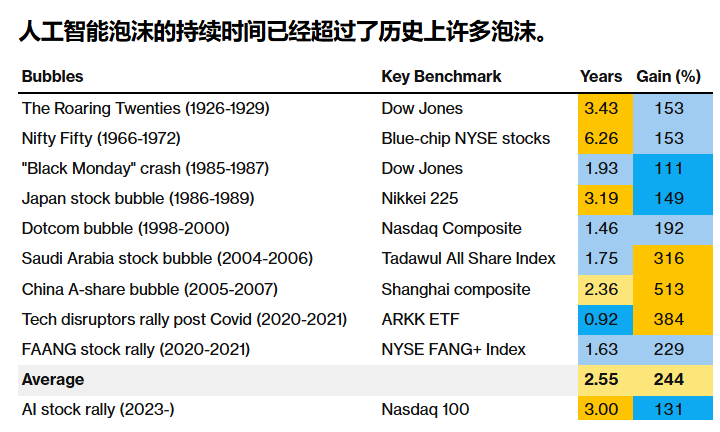
Core Viewpoint - The ongoing rise of AI-driven trading has led to new highs in the U.S. stock market, raising concerns about a potential financial bubble, but historical context suggests the situation is more complex than it appears [1][2]. Group 1: Market Performance - The S&P 500 index rose by 16% in 2025, with significant contributions from AI leaders like Nvidia, Alphabet, Broadcom, and Microsoft [1]. - Since the end of 2022, the S&P 500 index has increased by 79%, while the Nasdaq 100 index has surged by 130% [3]. Group 2: Investment and Spending - Major tech companies, including Microsoft, Alphabet, Amazon, and Meta Platforms, are projected to increase capital expenditures by 34% to approximately $440 billion over the next year [1]. - OpenAI has committed to investing over $1 trillion in AI infrastructure, a staggering amount for a non-public company that has yet to turn a profit [1]. Group 3: Historical Context and Comparisons - Historical analysis shows that past market bubbles have lasted an average of just over two and a half years, with peak gains averaging 244% [2]. - The current AI-driven market rally has already entered its third year, raising questions about its sustainability compared to previous market bubbles [3]. Group 4: Concentration of Stocks - The top 10 stocks in the S&P 500 now account for about 40% of the index, a level of concentration not seen since the 1960s [5]. - Historical precedents exist for high concentration levels, as seen in the 1930s and 1960s, but current levels are still a cause for concern among investors [5]. Group 5: Fundamentals and Valuation - Current AI giants have lower debt-to-earnings ratios compared to companies during the internet bubble, indicating stronger fundamentals [8]. - The S&P 500 index's valuation is at its highest level since the early 2000s, based on the cyclically adjusted price-to-earnings ratio [12]. - Despite rising valuations, some investors argue that the growth rates of tech stocks are not as inflated as during the internet bubble, with Nvidia's P/E ratio below 50 compared to Cisco's over 200 at its peak [15]. Group 6: Investor Sentiment and Risks - A recent survey indicated that investors view the AI bubble as the largest "tail risk" event, with over half of respondents considering the "seven major tech stocks" as the most crowded trade on Wall Street [18]. - Concerns are growing regarding whether the investments in AI will yield adequate returns, especially in light of increasing debt issuance [18].




2 AI Stocks to Buy in January and Hold for 20 Years
The Motley Fool· 2026-01-04 17:45
Core Insights - Artificial intelligence (AI) is identified as the next major technological shift, comparable to the internet, presenting a generational investment opportunity with potential operating efficiencies worth up to $40 trillion for the global economy [1][2]. Nvidia - Nvidia has emerged as a leading stock for capitalizing on the AI trend, with its high-end graphics processing units (GPUs) being essential for cloud infrastructure providers [4]. - The company's data center revenue increased by 66% year over year, reaching $51 billion, reflecting a shift from traditional computing to accelerated computing reliant on GPUs [5]. - Capital spending on AI infrastructure is projected to grow from $600 billion in 2026 to at least $3 trillion by 2030, indicating significant growth potential for Nvidia [6]. - Nvidia's innovation pace has accelerated, with plans to launch new GPU architectures annually, including the Vera Rubin chips in 2026, which promise substantial performance improvements [8]. - The company reported net profits of $99 billion on $187 billion in revenue over the last four quarters, showcasing its financial strength [9]. - Analysts forecast a 37% annualized earnings growth for Nvidia over the next few years, suggesting strong returns for shareholders [10]. Alphabet - Alphabet has delivered strong market-beating returns over the past decade, primarily driven by growth in advertising through Google Search and YouTube, with a stock increase of 700% [11]. - The company is expected to see further returns as demand for AI and cloud computing rises, with its cloud segment revenue increasing by 34% year over year [15]. - Alphabet's Gemini AI model is integrated into its services, contributing to a significant increase in Google Search usage and achieving over 650 million monthly active users [15][16]. - The company surpassed $100 billion in quarterly revenue for the first time, supported by diverse revenue streams from online advertising, subscription services, and cloud services [16]. - Alphabet plans to spend over $91 billion on capital expenditures in 2025, with a significant increase expected in 2026, funded by an operating cash flow of $151 billion over the last four quarters [17].

巴菲特价值投资的“科技适配”
Zheng Quan Ri Bao· 2026-01-04 16:44
Core Insights - Warren Buffett officially retired on December 31, 2025, marking the end of his career and drawing attention to his investment strategies at Berkshire Hathaway [1] - In November 2025, Berkshire released its last 13F report under Buffett, revealing that Apple constituted 22.69% of its portfolio, while Berkshire made its first investment in Alphabet, ranking it as the tenth largest holding [1] - Buffett's shift towards investing in technology stocks, particularly Alphabet, challenges the notion that value investing is incompatible with tech investments [1][2] Group 1 - Buffett's historical avoidance of technology stocks was due to concerns over their uncertain profit models and unclear competitive advantages, which initially aligned with his value investing principles [2] - Over the past 20 years, Berkshire's investment portfolio has evolved, with significant investments in technology companies like IBM, Apple, and now Alphabet, indicating a shift in Buffett's strategy [2][3] - The characteristics of Apple, such as brand loyalty and predictable earnings, align with value investing standards, which also apply to Alphabet's diverse revenue streams and strong competitive position [3] Group 2 - Buffett's adjustments in holdings before retirement set a precedent for value investing in the AI era, redefining the concept of competitive advantages in technology [3][4] - The focus for global investors should shift from whether a stock is a tech company to evaluating predictable cash flows, strong competitive moats, and effective management in the context of ongoing technological advancements [4]

Weekend Round-Up: Tesla Loses EV Crown, BYD's Overseas Sales Surge And Stellantis-Backed Leapmotor Bags $530 Million Funding
Benzinga· 2026-01-04 14:01
Core Insights - Tesla has lost its position as the world's leading electric vehicle (EV) maker to BYD after experiencing a second consecutive year of declining sales [1][2] - BYD reported a significant increase in overseas deliveries despite a decline in domestic sales [1][3] Tesla's Performance - Tesla's fully electric vehicle deliveries fell by 9% in 2025, totaling 1.64 million units compared to 1.79 million in 2024 [2] - The decline is attributed to increased competition, particularly from Chinese manufacturers, and the expiration of U.S. federal EV tax credits [2] BYD's Sales Figures - BYD experienced an 18.34% year-over-year decline in December sales, with total sales of over 420,398 units [3] - However, the company saw a remarkable 133.01% year-over-year increase in overseas deliveries, selling over 133,172 units abroad [3] Rivian's Delivery Results - Rivian reported a 26.2% drop in fourth-quarter deliveries, with only 9,745 vehicles delivered compared to 13,201 in the previous quarter [4] - For the full year 2025, Rivian produced 42,284 vehicles and delivered 42,247, marking an approximately 18% year-over-year decrease from 51,579 deliveries in 2024 [4] Leapmotor's Funding - Leapmotor, backed by Stellantis, secured over $530 million in funding from the state-owned automaker FAW [5] - The CEO of Leapmotor, Zhu Jiangming, set an ambitious target of achieving 4 million annual sales by the next decade [5] Waymo's Expansion - Waymo, supported by Alphabet, has begun testing its Robotaxi service in London as part of its expansion plans into international markets [6] Nio's Record Deliveries - Nio reported a record 48,135 vehicle deliveries in December 2025, reflecting a 54.6% year-over-year increase [7] - The deliveries included 31,897 units from the NIO brand, 9,154 from the ONVO brand, and 7,084 from the FIREFLY brand [7]

欧盟公布 2024 年全球研发投入百强企业:亚马逊第一,华为成唯一进前十的中国企业
Xin Lang Cai Jing· 2026-01-04 12:25
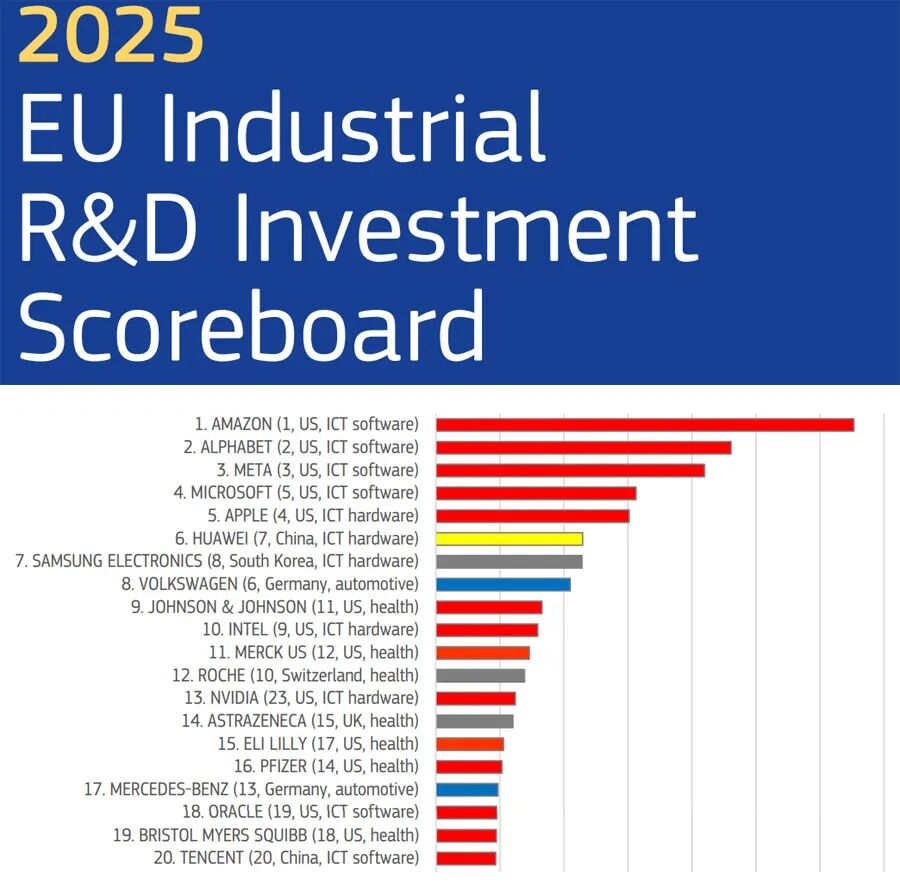
IT之家 1 月 4 日消息,欧盟委员会于 2025 年 12 月底公布了 2025 全球研发投入百强企业榜单,追踪并比较 2024 年欧盟领先的 工业研发投资者与其全球同行的表现。自 2004 年以来,该榜单为公司、研究人员和政策制定者提供见解和数据。 作为一项新举措,2025 年排名榜首次纳入了亚马逊,其预计的研发投资使其成为全球最大的研发投资者(650 亿欧元)。 2024 年,全球研发投资增长了 6.3%(按通胀调整为 4.0%),略高于 2023 年的增长,但低于过去十年的平均增长率 7.5%。欧盟 企业名义上的研发投资仅增长了 2.9%,落后于其他地区:世界其他地区(8.1%)、美国(7.8%)、日本(7.1%)和中国 (3.9%)。美国的科技大公司,尤其是在 ICT 软件和硬件领域,推动了大部分增长。 674 家美国企业(占总研发投资的 47.1%) 525 家中国企业(16.1%) 318 家欧盟企业(16.2%) 192 家日本企业(7.8%) 291 家其他地区企业(12.9%) ICT 软件行业占全球研发投资的 24.9%,其中美国企业贡献了 77%。这种集中程度是自 20 多年前首次发 ...
全球十大富豪,去年财富增近6000亿美元
财联社· 2026-01-04 12:07
Core Insights - The total wealth of the world's top 10 billionaires has surpassed the market value of Amazon, reaching over $2.5 trillion, with an increase of $579 billion in 2025 [1] Group 1: Billionaire Wealth Growth - Elon Musk experienced the largest wealth increase last year, adding $187 billion to reach a net worth of $619 billion, solidifying his position as the world's richest person [3] - Musk's wealth surge is attributed to the significant rise in the value of his holdings in Tesla and SpaceX, with Tesla's stock increasing by 11% last year [4] - SpaceX's valuation doubled to $800 billion by the end of 2025, compared to $400 billion in August [5] Group 2: Notable Billionaire Rankings - Larry Page and Sergey Brin, co-founders of Google, ranked second and fourth respectively, with wealth increases of $101 billion and $92 billion, driven by a 65% rise in Google's stock [5] - Jeff Bezos saw a wealth increase of $15 billion but dropped from second to third place due to Page's rise [6] - Larry Ellison's wealth grew by $55 billion, but he fell from fourth to fifth place on the billionaire list [7] Group 3: Other Billionaire Wealth Changes - Mark Zuckerberg's wealth increased by $26 billion, but he dropped from third to sixth place [8] - Bernard Arnault, head of LVMH, saw a wealth increase of $31.6 billion, ranking seventh [9] - Steve Ballmer's wealth grew by $22 billion, moving him from ninth to eighth place [10] - Jensen Huang, CEO of Nvidia, increased his wealth by $40 billion, rising from twelfth to ninth place [11] - Warren Buffett's wealth increased by $9 billion, maintaining his position at tenth [12] Group 4: Centibillionaires Club - The number of centibillionaires remains at 18, with a total wealth increase of $708 billion in 2025, surpassing Visa's market value of approximately $677 billion [13][14] - The total wealth of this group is close to $3.6 trillion, equivalent to the size of Microsoft [14] - Elon Musk alone accounts for 17% of the total wealth of the centibillionaires, contributing 26% of the group's overall wealth increase [14]