Coca-Cola(KO)

Search documents
可口可乐第二季度可比每股收益高于预估
news flash· 2025-07-22 11:00
Group 1 - The core revenue for Coca-Cola in the second quarter reached $12.5 billion [1] - The comparable earnings per share for the second quarter were $0.87, exceeding the forecast of $0.83 [2] - Coca-Cola expects a full-year comparable earnings per share growth of approximately 3%, an increase from the previous estimate of 2% to 3% [2] Group 2 - The company forecasts full-year capital expenditures to be around $2.2 billion, slightly above the market estimate of $2.15 billion [2] - Following the earnings report, Coca-Cola's stock rose over 1% in pre-market trading [2]

7月22日电,可口可乐第二季度净营收125亿美元;可比每股收益0.87美元,预估0.83美元。
news flash· 2025-07-22 10:59
智通财经7月22日电,可口可乐第二季度净营收125亿美元;可比每股收益0.87美元,预估0.83美元。 ...
特朗普想让可乐改回蔗糖,之前的配方已经用了41年
3 6 Ke· 2025-07-22 02:37
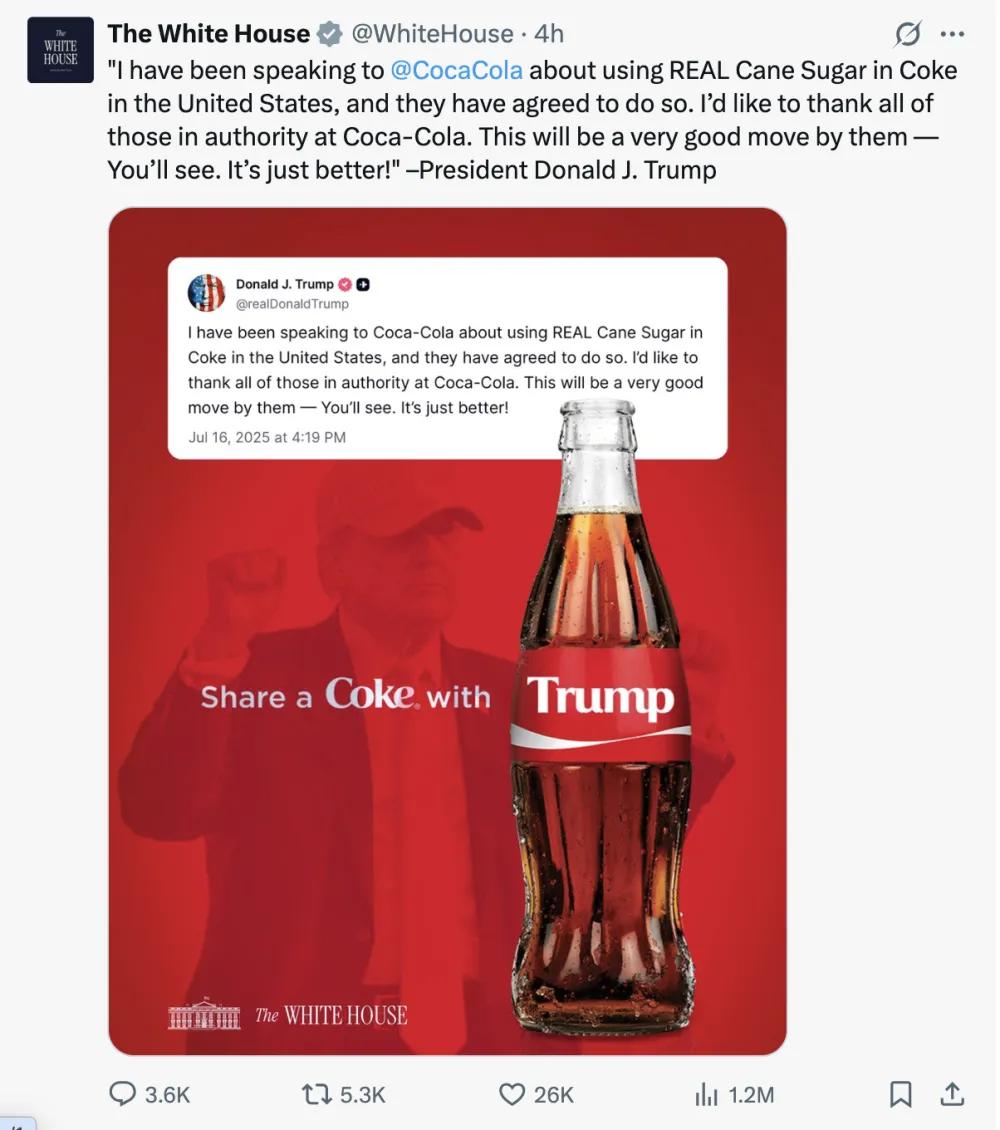
Core Viewpoint - The discussion around Coca-Cola's sweetener source has intensified following former President Trump's comments advocating for the use of real cane sugar instead of high fructose corn syrup (HFCS) in Coca-Cola products sold in the U.S. [1][3][5] Group 1: Trump's Comments and Company Responses - Trump expressed gratitude towards Coca-Cola's management for agreeing to consider using cane sugar in their products, labeling it a positive move [1][3] - Coca-Cola acknowledged Trump's enthusiasm for their brand and indicated that they would soon share more information about innovative products in their lineup [3] - PepsiCo's CEO stated that they would cater to consumer preferences for sugar and natural ingredients if there is a clear demand [3][5] Group 2: Historical Context of Sweetener Use - The switch from cane sugar to HFCS in Coca-Cola began in 1984, driven by cost considerations and the availability of cheap corn in the U.S. [5][19] - HFCS became popular due to government subsidies for corn production, which lowered its production costs compared to cane sugar [5][19] - Consumer calls for a return to cane sugar have persisted since the initial switch, reflecting a growing awareness and concern over ingredient sourcing [5][19] Group 3: Economic Implications of Sweetener Choices - The cost of HFCS is significantly lower than that of cane sugar, with estimates suggesting that switching to cane sugar could increase product costs by 10% to 15% [19][26] - In 1985, Coca-Cola and PepsiCo anticipated substantial savings from using HFCS, with Coca-Cola estimating a savings of approximately $30 million annually [26] - The market for HFCS surged, with its usage in the U.S. expected to increase by 500,000 tons annually following the switch [26] Group 4: Consumer Sentiment and Advocacy - Consumer backlash against the use of HFCS has been notable, with some advocating for a return to cane sugar due to health concerns associated with HFCS [31] - The discussion around sweeteners has gained traction, with political figures also voicing opposition to HFCS, linking it to health issues like childhood obesity [31] - Over the past two decades, the usage of HFCS in the U.S. has been gradually declining, while the consumption of cane sugar has been on the rise [31]


可口可乐改配方风波揭开40年甜味剂暗战
Qi Lu Wan Bao· 2025-07-22 00:24
Core Viewpoint - The ongoing debate over sweeteners in Coca-Cola products has been reignited by President Trump's announcement advocating for the use of real cane sugar in Coca-Cola sold in the U.S., which has led to speculation about potential changes in the company's formulation [2][3]. Sweetener Transition - Coca-Cola originally used cane sugar as the sole sweetener in its classic formula until the 1980s when high fructose corn syrup (HFCS) began to replace it due to lower production costs influenced by U.S. corn subsidy policies [3][4]. - By the 1980s, nearly 40% of added sugars in the U.S. market were HFCS, leading Coca-Cola to switch its U.S. product formulation from cane sugar to HFCS in 1984 [3][4]. Market Variations - In international markets such as Mexico, the UK, and Australia, Coca-Cola continues to use cane sugar, creating a distinct consumer preference for these products among American "cola enthusiasts" who often seek out Mexican cane sugar Coca-Cola [5][6]. - In contrast, domestic sugary beverages in China still predominantly use cane sugar, with brands like Kang Shifu maintaining cane sugar as the primary sweetener [4]. Flavor Differences - The flavor profiles of cane sugar and HFCS differ significantly; HFCS provides a quick burst of sweetness, while cane sugar offers a more prolonged and rounded sweetness experience [6]. - The chemical structures of the two sweeteners are distinct, with cane sugar being a disaccharide and HFCS being a mixture of monosaccharides [6]. Challenges of Reformulation - The likelihood of Coca-Cola fully reverting to cane sugar is low due to several challenges, including higher costs associated with cane sugar, the need to overhaul existing supply chains, and the influence of agricultural subsidy structures that favor corn production [7]. - Consumer taste preferences pose another hurdle, as many have become accustomed to the HFCS version of Coca-Cola, raising concerns about potential customer loss if the formulation changes [7].
Coca-Cola Q2 Preview: Will Warren Buffett Favorite Acknowledge Donald Trump's Sugar Push?
Benzinga· 2025-07-21 15:17
Core Viewpoint - Coca-Cola is set to report its second-quarter financial results, with analysts expecting a revenue increase to $12.54 billion, up from $12.36 billion in the same quarter last year [1] Earnings Estimates - Analysts predict Coca-Cola will report quarterly earnings of 83 cents per share, a slight decrease from 84 cents in the previous year [3] - The company has consistently beaten earnings estimates, achieving this in five consecutive quarters and eight out of the last ten [3][2] Market Context - Coca-Cola's results come after PepsiCo's recent earnings report, which exceeded analyst expectations and raised full-year guidance [4][5] - The weak dollar is anticipated to positively impact Coca-Cola's earnings in key foreign markets, such as Latin America and Asia [6] Analyst Insights - Bank of America Securities analyst Bryan D. Spillane remains bullish on Coca-Cola, citing resilient growth and improving fundamentals [6] - Spillane has reiterated a Buy rating with a price target of $66, suggesting that Coca-Cola's strength is not fully reflected in its stock price [7] Key Items to Watch - Analysts will be focused on the potential impact of tariffs and the company's response to President Trump's comments about using real cane sugar in its beverages [10][8] - Coca-Cola may consider offering a version of its product with real cane sugar while maintaining its regular formula due to cost and logistics concerns [9] Stock Performance - Coca-Cola stock is currently trading at $70.08, reflecting a year-to-date increase of 13.3% [13] - The stock's performance is significant as it is a key holding in Warren Buffett's Berkshire Hathaway, which owns over 400 million shares [11][12]

标普500指数、纳指齐创盘中新高,欧股小幅下跌,日元、黄金涨幅扩大至1%
Sou Hu Cai Jing· 2025-07-21 14:16
Market Overview - Investors are focused on a busy week of earnings reports, including major companies like Tesla and Google A, leading to a collective rise in the three major U.S. stock indices [1] - European stocks experienced a slight decline amid unclear U.S.-EU tariff negotiations, while Japanese markets showed short-term recovery [1][3] U.S. Stock Performance - The Nasdaq Composite Index rose by 0.7%, and the S&P 500 Index increased by 0.4%, both reaching intraday all-time highs [2] - Tesla's stock increased by over 2% following Elon Musk's announcement of significant advancements in the company's autonomous driving capabilities [2] - Trump's Media Technology Group saw a rise of over 7% after announcing a total Bitcoin reserve purchase of $2 billion [2] European Stock Performance - European stocks opened slightly lower, with the pan-European index down nearly 0.2% and German stocks declining over 0.1% [3] - The automotive manufacturer Stellantis reported a loss of €2.3 billion (approximately $2.7 billion) in the first half of the year due to restructuring costs and sales slowdown, leading to a significant drop in its stock price [10] Currency and Commodity Movements - The Japanese yen appreciated by about 1% against the U.S. dollar, while the U.S. dollar index fell nearly 0.5% [4][16] - Gold prices rose by over 1%, and silver prices increased by nearly 0.9% [6][24] - Crude oil prices saw a slight decline, with U.S. oil down over 0.1% and Brent oil down over 0.3% [7][24] Bond Market - U.S. Treasury yields fell for the fourth consecutive day, with the benchmark 10-year Treasury yield decreasing by about 4 basis points [5][14] - The decline in yields reflects investor sentiment amid tariff threats and concerns regarding potential changes in Federal Reserve leadership [14]





Coca Cola Earning Tomorrow, Alphabet And Tesla Earnings Later This Week
Forbes· 2025-07-21 13:20
Market Performance - Most major averages posted gains for the week, with the S&P 500 up 0.6% and the Nasdaq Composite gaining 1.5% [2] - Small cap stocks were the second-best performing group, up 0.8% [2] Earnings Season - Earnings are on pace to be up 5.6%, marking the eighth consecutive positive quarter, but this would be the lowest growth since Q4 2023 [3] - A total of 100 companies are scheduled to report earnings, with major tech names like Google and Tesla reporting on Wednesday [3] Tariff Developments - The deadline for tariffs is approaching, with the Trump administration considering blanket tariffs on the EU of 15% or more [4] - European Union envoys are planning to meet to discuss retaliatory measures if no deal is reached before the August 1st deadline [4] Consumer Sentiment - Recent reports on consumer sentiment showed better-than-expected results, indicating consumers feel more positive about the economy [5] - However, there are underlying concerns regarding the types of jobs being created, primarily in healthcare, government, and education, which may not stimulate economic growth [8] Housing Market - New home sales are at their lowest level since the housing crisis, which could be a concerning sign for wealth building in the country [9] - The Federal Reserve's influence on mortgage rates is limited, as these rates are determined by the market [9] Federal Reserve - Jerome Powell is scheduled to speak, and there is significant attention on his future as Fed Chair, with markets seeking reassurance that he will remain until his term ends in 2026 [10] Company Focus - Coca-Cola is set to report earnings, with an expected move of $1.58 for the week [11] - Netflix's response to its recent stock pullback will be closely monitored, along with the upcoming earnings announcements for Google and Tesla [11]

Should You Buy Coca-Cola Stock Ahead Of Its Upcoming Earnings?
Forbes· 2025-07-21 13:15
Core Insights - Coca-Cola is scheduled to release its earnings on July 22, 2025, with analysts predicting earnings of $0.84 per share on revenues of $12.55 billion, compared to $0.84 per share on revenues of $12.31 billion in the same quarter last year [3] - Historically, Coca-Cola stock has shown a 72% rate of positive one-day returns following earnings announcements over the past five years, with a median positive return of 1.4% and a maximum of 4.7% [2][7] Financial Performance - Coca-Cola currently has a market capitalization of $298 billion and generated $47 billion in revenue over the past twelve months, with operating profits of $14 billion and net income of $11 billion [4] - The company has recorded 18 earnings data points in the last five years, yielding 13 positive and 5 negative one-day returns, with a median of -0.6% for negative returns [7] Trading Strategies - Traders can utilize historical trends to inform their strategies, focusing on pre-earnings positioning and post-earnings analysis to optimize trading choices [6] - The correlation between one-day and subsequent five-day returns can provide insights for traders, suggesting a "long" position if the one-day post-earnings return is positive [8] Peer Performance - The performance of peers can influence Coca-Cola's stock reaction following earnings, with historical data indicating that peer stock returns may affect the pricing in prior to Coca-Cola's earnings announcement [9]
未来一周财报:TSLA、GOOGL、INTC、NOW等
美股研究社· 2025-07-21 12:33
Core Viewpoint - The upcoming earnings reports from major companies in technology, energy, industrial, and consumer sectors will provide significant insights into corporate health and macroeconomic conditions [1]. Group 1: Technology Sector - Tesla (NASDAQ: TSLA) and Google (NASDAQ: GOOGL) are the focal points among the "Seven Giants" in the technology sector, with other notable companies including Intel (NASDAQ: INTC), ServiceNow (NYSE: NOW), IBM (NYSE: IBM), and NXP Semiconductors (NASDAQ: NXPI) [1]. - Tesla is expected to report a 22% decline in profit and a 12% drop in revenue, with a 14% decrease in vehicle deliveries to 384,122 units [11][13]. - Google is anticipated to show strong double-digit growth in both revenue and profit, with a consensus revenue expectation of $22.36 billion and earnings per share forecasted at $0.40 [14][19]. Group 2: Telecommunications Sector - Verizon (NYSE: VZ) is set to report a 3% year-over-year increase in revenue and profit, with a consensus revenue expectation of $33.71 billion and earnings per share forecasted at $1.19 [4][5]. - Analysts maintain a cautious outlook on Verizon, with some suggesting a "hold" rating due to growth concerns, while others highlight its attractive valuation and stable dividend yield of 6.5% [4]. Group 3: Consumer Sector - Coca-Cola (NYSE: KO) is expected to report earnings with a consensus revenue of $12.56 billion and earnings per share of $0.84, having exceeded earnings expectations in the past eight quarters [7][9]. - Analysts are divided on Coca-Cola's outlook, with some expressing concerns over its reliance on price increases rather than sustainable volume growth, while others emphasize its strong fundamentals and dividend stability [7]. Group 4: Energy Sector - Phillips 66 (NYSE: PSX) is projected to see a 27% decline in profit and a 17% drop in revenue, with earnings per share expected at $0.01 and revenue forecasted at $11.88 billion [23][25]. - Analysts maintain a "buy" rating for Phillips 66, citing its diversified business strength and shareholder returns through dividends and buybacks, despite concerns over high valuations relative to peers [23].



How To Earn $500 A Month From Coca-Cola Stock Ahead Of Q2 Earnings
Benzinga· 2025-07-21 11:41
Group 1 - The Coca-Cola Company is set to release its second-quarter earnings results on July 22, with analysts expecting earnings of 84 cents per share and revenue of $12.55 billion, an increase from $12.31 billion a year earlier [1] - Luisa Ortega has been appointed as the president of the Europe operating unit, effective September 1, succeeding Nikos Koumettis, who is set to retire in 2026 [2] - Coca-Cola currently offers an annual dividend yield of 2.92%, translating to a semi-annual dividend of 51 cents per share, or $2.04 annually [2] Group 2 - To generate $500 monthly or $6,000 annually from Coca-Cola's dividends, an investment of approximately $205,429 or around 2,941 shares is required [3] - For a more modest income of $100 monthly or $1,200 annually, an investment of $41,072 or around 588 shares is necessary [3] - The dividend yield is calculated by dividing the annual dividend payment by the stock's current price, which can fluctuate based on stock price changes [4] Group 3 - Changes in the dividend payment can affect the yield; an increase in dividends raises the yield if the stock price remains constant, while a decrease lowers it [5] - Coca-Cola's stock price fell by 1.1% to close at $69.85 on the previous Friday [5]