
LENOVO GROUP(LNVGY)

Search documents
联想控股(03396)近期在公开市场由Honorific收购合共1.15亿股联想集团股份
智通财经网· 2025-12-09 23:45
Core Viewpoint - Lenovo Holdings announced a series of acquisitions to buy back 115 million shares of Lenovo Group, representing approximately 0.9285% of its issued share capital, for a total cash consideration of about HKD 1.125 billion, with an average price per share of approximately HKD 9.7653 [1][2]. Group 1: Acquisition Details - The acquisition period is set from November 21, 2025, to December 9, 2025, inclusive of both start and end dates [1]. - The total cash consideration for the acquisition is approximately HKD 1.125 billion, excluding related transaction costs [1]. - The average price per share for the acquisition is approximately HKD 9.7653, excluding related transaction costs [1]. Group 2: Company Performance and Strategy - Lenovo Group is a significant subsidiary of Lenovo Holdings and has maintained its position as a global leader in the PC market for several consecutive years [2]. - The company has achieved historical highs in revenue and net profit for multiple quarters in the fiscal year 2025/26, demonstrating strong operational resilience and growth potential [2]. - Lenovo Group's focus on AI and technological innovation aligns with Lenovo Holdings' strategic direction of leading through technological innovation and focusing on the real economy, making the acquisition beneficial for long-term development and shareholder value [2].
联想集团(0992.HK):AI驱动业绩较快增长 PC龙头地位稳固
Ge Long Hui· 2025-12-09 21:20
Core Viewpoint - Lenovo Group reported a strong growth in the first half of the 2025/26 fiscal year, with revenue and net profit (under non-Hong Kong financial reporting standards) increasing by 18% and 24% respectively. All three major business groups achieved double-digit year-on-year growth, demonstrating the effectiveness of the hybrid AI strategy [1][5]. Group Summaries IDG Group - The Intelligent Devices Group (IDG) saw a revenue increase of 15% year-on-year, with the global market share of personal computers reaching a historic high of 25.6%, up by 1.8 percentage points. The AI PC penetration rate rose to 33% of total PC shipments, maintaining a leading position in the global Windows AI PC market with a share of 31.1% [2][5]. ISG Group - The Infrastructure Solutions Group (ISG) experienced a significant revenue growth of 30% year-on-year, driven by strong demand for AI servers. The proprietary Neptune liquid cooling technology saw revenue more than double year-on-year, supported by over a hundred patents developed over the past decade, creating competitive advantages in the liquid cooling sector. However, the group reported an operating loss of $118 million, which widened due to increased strategic investments in product development and business expansion [3][5]. SSG Group - The Solutions and Services Group (SSG) achieved a revenue growth of 19% year-on-year, reaching a historic high with an operating profit margin of 22%. Support services, operational services, and project solutions all showed steady growth, with operational and project solutions services accounting for 58.9% of total revenue. The order volume for TruScale doubled year-on-year, reflecting the successful promotion of Device as a Service (DaaS) and Infrastructure as a Service (IaaS) [4][5]. Investment Forecast - The company maintains its profit forecast, expecting revenues for the fiscal years 2026-2028 to be $76.911 billion, $84.379 billion, and $92.349 billion respectively, with net profits of $1.694 billion, $1.913 billion, and $2.196 billion, corresponding to current P/E ratios of 9, 8, and 7 times. The "Buy" rating is upheld [1][5].
Lenovo: Undervalued, But Surging Memory Prices Threaten Margins And End-User Demand
Seeking Alpha· 2025-12-09 00:14
Core Viewpoint - Lenovo is frequently impacted by various macroeconomic concerns, which affects its stock performance [1] Group 1 - Lenovo is categorized as a stock that is often hindered by ongoing macroeconomic issues [1]



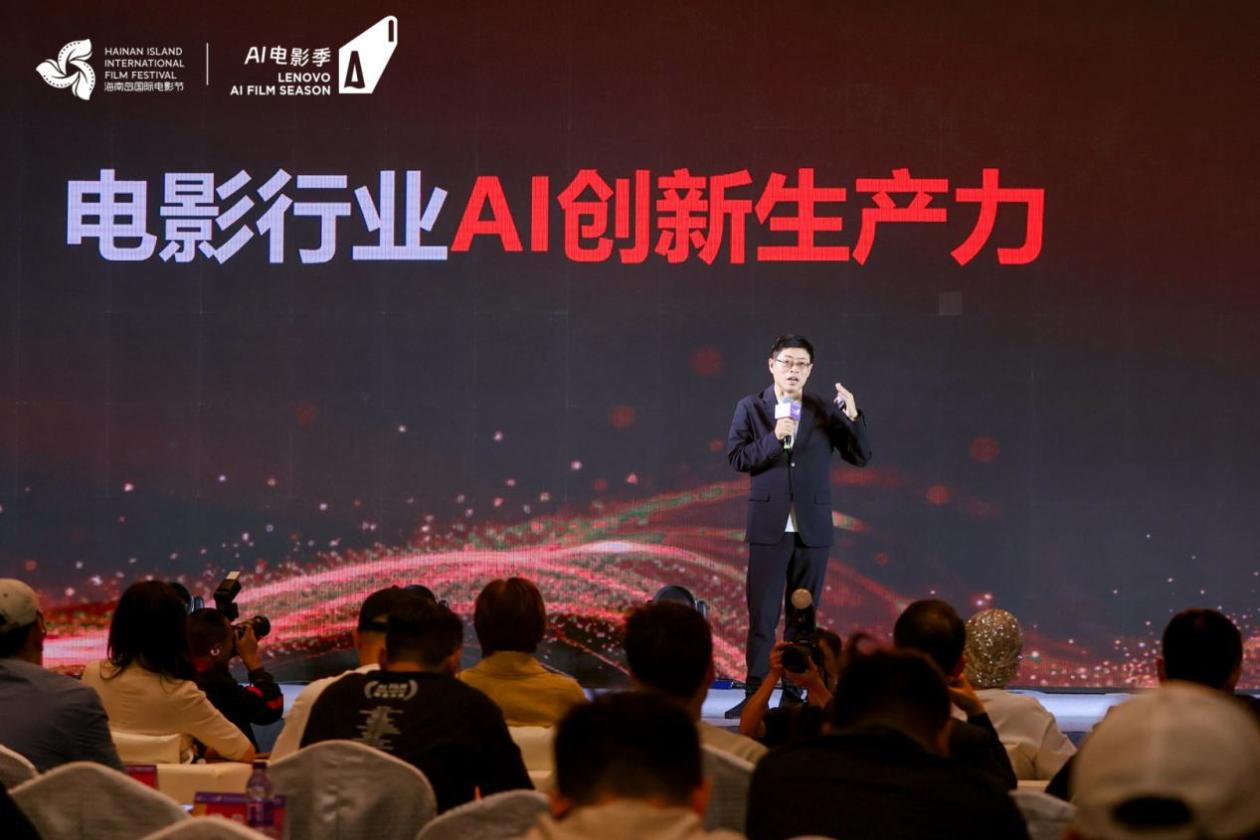
联想集团副总裁王传东:AI电影正走向“全民共创”
Huan Qiu Wang· 2025-12-08 06:27
Core Viewpoint - The era of "human-machine co-creation" has arrived, with Lenovo aiming to empower AI creators to surpass their imagination through AI tools and services [1]. Group 1: AI in Film Creation - Over the past two years, AI has become an indispensable force in film creation, marking a significant trend in the evolution of the film industry [4]. - The establishment of the AI Film Season at the Hainan Island International Film Festival represents a strategic move to embrace the multi-modal transition of AIGC (AI-Generated Content) and to lay the groundwork for future imaging [4]. - The rapid evolution of AIGC is reconstructing the paradigm of film production, transitioning from the film era to the digital era, and now to the AI film era [4]. Group 2: Characteristics of AI Film Creation - The creation in the AI film era exhibits three characteristics: integrated end-cloud architecture, multi-modal fusion, and collaboration among multiple intelligent agents [4]. - AI has broken down creative barriers, allowing individual creators to possess large-scale production capabilities, significantly reducing the creation time from months to mere hours [4]. Group 3: Lenovo's AI Tools and Services - Lenovo offers a comprehensive suite of AI tools and services to empower creators, enabling them to have their own "dream factory" [4]. - The Tianxi AI, Lenovo's personal AI, is designed to assist creators in various aspects of film production, including script writing and storyboard design, achieving the effect of "one person as the entire crew" [5]. - Lenovo's AI workstations support local deployment of powerful models, serving top film post-production teams globally, exemplified by their work on the critically acclaimed film series "Dune" [5]. Group 4: Future Initiatives - Lenovo has launched the "Parallel Universe" creative concept, aiming to collaborate with pioneering creators through co-creation of worldviews, characters, scenes, and music, enriching traditional film production models [5]. - The AI Film Season is expected to inspire filmmakers to expand their imagination and foster a thriving ecosystem in the AI era [5].
涨幅最高20%!戴尔(DELL.US)、联想(00992)等PC厂计划涨价 存储成本压力“扛不住了”
智通财经网· 2025-12-07 02:57
Group 1 - The core issue is the rising memory prices impacting PC and laptop manufacturers, leading to planned price increases of up to 20% by companies like Lenovo, Dell, and HP [1][2] - Lenovo has already notified customers of upcoming price adjustments, with new pricing set to take effect on January 1, 2026, due to increased memory costs and heightened demand for AI applications [1] - Dell is also considering price hikes of at least 15%-20%, with potential implementation as early as mid-December, citing unprecedented increases in memory chip costs [1][2] Group 2 - HP's CEO has indicated that the second half of 2026 may be particularly challenging, with plans to raise prices if necessary, noting that memory chips account for 15%-18% of a PC's cost [1][2] - The rising memory prices are exerting profit pressure on PC manufacturers, prompting a reevaluation of product plans for 2026, including AI PCs and tablets [2] - TrendForce has revised its 2026 laptop shipment forecast from a 1.7% year-on-year growth to a 2.4% year-on-year decline due to increased material costs [2] Group 3 - The ongoing memory shortage is evolving from a component-level issue to a macroeconomic risk, potentially hindering productivity growth based on AI and delaying significant digital infrastructure investments [2] - The storage price increases may lead to a decline in shipment volumes for Android phones and PCs, affecting competition dynamics among brands [3] - There is a suggestion to monitor production activity rates and the potential for price wars within the supply chain as profit margins are squeezed [3]


从硬件到服务!联想(00992)发布首款高端大模型训练AI服务器及AI工厂解决方案等四项关键成果
智通财经网· 2025-12-06 08:40
Core Insights - Lenovo has transitioned from a traditional hardware manufacturer to a leader in AI services, marking a strategic shift in its core value from hardware production to standardized AI service capabilities and scalability potential [12] Group 1: AI Solutions and Innovations - Lenovo's "AI Factory" is a strategic solution that transforms complex AI development tasks into a standardized, efficient "AI production line," utilizing customer data as raw materials [3] - The launch of the Lenovo Wanquan Heterogeneous Computing Platform 4.0 enhances AI service efficiency and industry adaptability, achieving a 35% reduction in model training time through long-sequence parallel optimization [4] - The DeepSeek R1 model has achieved a record-breaking throughput of 12,000 Tokens/s, providing Lenovo with a differentiated advantage in AI services [5] Group 2: Market Position and Growth - Lenovo ISG China has experienced a remarkable 175% revenue growth over the past two and a half years, establishing itself as one of the fastest-growing AI infrastructure providers in China [2][11] - The AI server market in China is projected to reach $16 billion in the first half of 2025, doubling year-on-year, with expectations to exceed $140 billion by 2029 [10] Group 3: Strategic Partnerships and Standards - Lenovo has collaborated with industry partners to release the first model training and inference service standard, which fills a gap in the industry and supports the standardized implementation of AI factories [8] - The new service model allows enterprises to access AI capabilities without building complete AI teams, leading to stable recurring revenue for Lenovo [10] Group 4: Valuation Shift - Lenovo is shifting its valuation logic from traditional PE (Price-to-Earnings) metrics focused on hardware sales to PS (Price-to-Sales) metrics that emphasize service revenue growth and customer lifetime value [9][10] - As service revenue increases in proportion to total revenue, Lenovo's profitability is expected to transition from low-margin manufacturing to high-margin technology services, potentially increasing market valuation multiples [11][12]
联想集团(00992) - 变更申请表格
2025-12-05 09:00
(HKD Counter Stock Code 港幣櫃台股份代號: 992 / RMB Counter Stock Code 人民幣櫃台股份代號: 80992) Change Request Form 變更申請表格 To: Lenovo Group Limited (the "Company") 致: 聯想集團有限公司(「本公司」) c/o Tricor Investor Services Limited 卓佳證券登記有限公司轉交 17/F, Far East Finance Centre 香港夏愨道 16 號 16 Harcourt Road, Hong Kong 遠東金融中心 17 樓 Part B (乙部) - I/We would like to change the choice of means of receipt and language of all future Corporate Communications* of the Company as indicate below: 本人/吾等要求更改 貴公司日後之所有公司通訊* 的收取途徑及語言版本如下﹕ (Please "" only o ...
联想集团(00992) - 致非登记证券持有人之函件 - 刊发二零二五╱二六年中期报告的通知
2025-12-05 08:57
Lenovo Group Limited 聯想集團有限公司 (於香港註冊成立的有限公司) (港幣櫃台股份代號:992 / 人民幣櫃台股份代號:80992) 此致 敬啟者: 刊發二零二五╱二零二六年中期報告(「本次公司通訊文件」)的通知 本次公司通訊文件 之 中英文版本 現 已 登 載 於本公司網站 https://investor.lenovo.com/tc/publications/news.php 及香港交易及結算所有限公司的披露易網站 https://www.hkexnews.hk/index_c.htm (「網上版本」)。 就日後刊發之公司通訊 ( 附 註 2 ) 文件而言,本公司將於公司通訊文件刊發日期通過電子郵件或郵寄方 式向非登記股東發送公司通訊文件之網上版本的登載通知,該通知將同時提供英文和中文版本。為 支援通過電子郵件方式進行公司通訊,本公司建議 閣下日後隨時向其代理人,例如經紀、託管 商、代名人或其他為中央結算系統的參與者提供電郵地址。 倘 閣下擬收取本次公司通訊文件之印刷本及/或欲更改選擇收取本公司日後發布之公司通訊文件 (附註 2 ) 的語言版本及收取方式,請填妥隨附的變更申請表格或於 ...
拉美成中国AI基建“后院”:联想(00992)、阿里、字节三企割据
智通财经网· 2025-12-05 08:53
Core Insights - A number of Chinese internet companies are expanding their investments in Latin America, with TikTok announcing a $37.7 billion investment in a data center complex in Northeast Brazil, marking its first major project in the region [1] - The Latin American market is experiencing a significant boom in data center investments, expected to nearly double from approximately $5 billion in 2023 to nearly $10 billion by 2029, driven by demand for cloud computing and AI [4] Group 1: Company Investments - TikTok plans to invest approximately $37.7 billion in a large data center complex in Northeast Brazil, utilizing local wind energy and strategically located as a submarine cable hub [1] - Alibaba Cloud is also expanding its presence in Latin America, with new data centers in Brazil and Mexico, focusing on digital transformation needs of local businesses [1] - Lenovo has established a strong foothold in Latin America, leading the PC market and experiencing significant growth in its server business, with a 25% annual growth rate [1] Group 2: Competitive Landscape - Major international tech giants like Amazon, Google, and Microsoft are also heavily investing in Latin America, with Google investing $850 million in a new data center in Uruguay and Microsoft investing $2.7 billion in Brazil for cloud and AI infrastructure [3] - The top three global cloud providers (Amazon AWS, Microsoft Azure, Google GCP) hold approximately 60%-70% market share in Latin America, indicating a highly concentrated market [5] Group 3: Market Dynamics - Latin America is becoming a hotspot for data center investments due to its cheap and sustainable energy sources, with countries like Chile and Brazil offering over 90% carbon-free energy [4] - The region's digital economy is rapidly growing, with increasing demand for AI and cloud computing services, making it an attractive market for tech giants [4] - Approximately 30 new data centers have been constructed or are under construction in the region since last year, highlighting the ongoing expansion [4] Group 4: Strategic Initiatives - Lenovo's mixed AI strategy focuses on both personal and enterprise AI, with expectations that AI PCs will account for over 80% of global PC sales by 2028 [7] - Lenovo supports local businesses in Latin America, such as RGK 4 IT, by providing infrastructure solutions that help reduce costs and enhance service flexibility [6] - The company emphasizes a "global resources + local delivery" model to effectively penetrate the Latin American market, ensuring efficient cost control and product customization [6]
联想集团(00992) - 致现时登记股东之函件 - 刊发二零二五╱二六年中期报告的通知
2025-12-05 08:52
凡選擇(或被視作已同意)瀏覽在本公司網站登載之本公司公司通訊 (附註 1) 以代替收取印刷本之 股東,均可要求索取本次公司通訊文件及 / 或收取本公司日後發布之公司通訊的印刷本。 倘 閣下擬收取本次公司通訊文件之印刷本及 / 或欲更改選擇收取本公司日後發布之公司通訊的 語言版本及收取方式,請填妥隨附的變更申請表格或於本公司網站下載,利用郵寄標籤寄回本公司 之股份過戶登記處–卓佳證券登記有限公司或將變更申請表格電郵至 lenovo-ecom@vistra.com 。當 收到 閣下之要求,本次公司通訊文件及 / 或日後公司通訊的印刷本將免費發送予 閣下。 Lenovo Group Limited 聯想集團有限公司 (於香港註冊成立的有限公司) (港幣櫃台股份代號:992 / 人民幣櫃台股份代號:80992) 敬啟者: 刊發二零二五 / 二零二六年中期報告(「本次公司通訊文件」)的通知 本次公司通訊文件之中英文版本現已登載於本公司網站 https://investor.lenovo.com/tc/publications/news.php 及香港交易及結算所有限公司的披露易網站 https://www.hkexne ...