
Morgan Stanley(MS)

Search documents
美联储降息窗口临近,美债、美元下半年将迎关键转折?
Zhi Tong Cai Jing· 2025-08-27 12:38
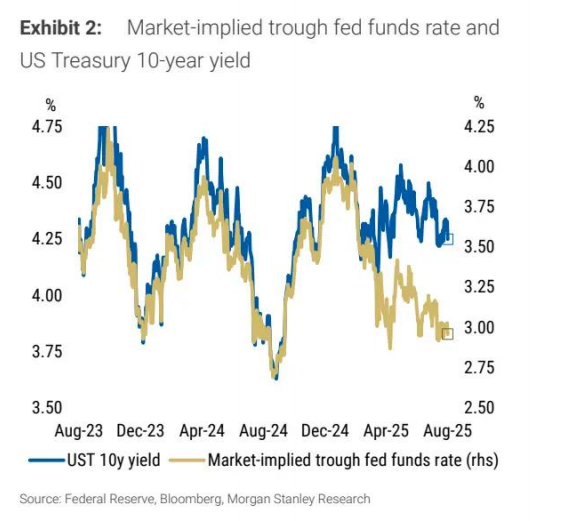
Group 1 - The core viewpoint of the article is that the Federal Reserve's potential interest rate cuts are the main driving force for global asset pricing in the second half of the year, with expectations that U.S. Treasury yields and the dollar index may reach new lows [2][26] - The Federal Reserve's policy shift is highlighted as the central logic for global asset pricing, with indications that the federal funds rate may drop below 3%, and ultimately to 2.625% due to factors such as tightening immigration policies affecting labor market growth [2][4] - The relationship between U.S. Treasury yields and the federal funds rate is expected to dominate the bond market, with projections that if the federal funds rate falls below 2.69%, the 10-year Treasury yield could drop below 4% [4][6] Group 2 - Morgan Stanley recommends two core investment strategies: going long on U.S. Treasury durations and shorting the dollar, focusing on opportunities in both the bond and foreign exchange markets [10][11] - For U.S. Treasuries, the strategy includes going long on 5-year Treasury durations, which are expected to benefit from price increases during a yield decline cycle, and taking advantage of the steepening yield curve between 3-year and 30-year Treasuries [10][11] - In the foreign exchange market, the recommendation is to short the dollar while going long on the euro and yen, driven by the expectation that the Fed's rate cuts will exceed those of the European Central Bank [11][12] Group 3 - The report provides differentiated strategies for major economies, including focusing on yield curve flattening in the Eurozone and tactical strategies in the UK and Japan, reflecting the varying monetary policies and economic conditions [21][22][23] - In the Eurozone, the strategy involves entering into yield curve flattening trades and adjusting asset allocations based on updated yield targets for German bonds [21] - For the UK, the recommendation is to go long on short-term rates as the Bank of England approaches the end of its rate hike cycle, while in Japan, the strategy suggests buying 10-year Japanese bonds amid expectations of U.S. Treasury yield declines [22][23]


Is Morgan Stanley (MS) Outperforming Other Finance Stocks This Year?
ZACKS· 2025-08-26 14:40
Company Performance - Morgan Stanley (MS) has returned 17.4% year-to-date, outperforming the average return of 11.8% for Finance companies [4] - The Zacks Consensus Estimate for Morgan Stanley's full-year earnings has increased by 2.8% over the past three months, indicating improved analyst sentiment and earnings outlook [3] Industry Comparison - Morgan Stanley is part of the Financial - Investment Bank industry, which has an average year-to-date return of 23.1%, suggesting that MS is slightly underperforming its industry [5] - In contrast, Aviva (AVVIY) has significantly outperformed both the Finance sector and its own industry, returning 57.1% year-to-date [4][6] Sector Ranking - The Finance sector, which includes 869 individual stocks, currently holds a Zacks Sector Rank of 2, indicating strong performance relative to other sectors [2] - Morgan Stanley has a Zacks Rank of 2 (Buy), reflecting its favorable position within the Finance sector [3]

X @Ash Crypto
Ash Crypto· 2025-08-26 12:17
BREAKING:🇺🇸 MORGAN STANLEY SAYS THATFED WILL CUT RATES IN SEPTEMBER.BULLISH FOR MARKETS 🚀 ...
摩根士丹利:预计9月起降息,目标利率降至2.75%-3.0%
Sou Hu Cai Jing· 2025-08-26 10:18
Core Viewpoint - Federal Reserve Chairman Jerome Powell's unexpected dovish stance at the Jackson Hole central bank conference has led Wall Street investment banks to adjust their expectations for the Fed's interest rate cuts [1] Group 1: Federal Reserve's Interest Rate Predictions - Morgan Stanley now predicts that the Federal Reserve will begin cutting rates in September, a shift from their previous forecast of no changes until March 2026 [1] - Morgan Stanley expects a 25 basis point cut in September, followed by another 25 basis point cut in December, and quarterly cuts of 25 basis points until the target rate reaches 2.75%-3.0% [1] - Barclays, BNP Paribas, and Deutsche Bank have also revised their forecasts, anticipating a 25 basis point cut in September and two cuts within the year, interpreting Powell's comments as signs of potential easing [1] Group 2: Labor Market and Inflation Insights - Powell's remarks indicated a change in tone regarding labor market risks, suggesting that the Fed may proactively respond to downside risks in the labor market [1] - Powell emphasized that tariffs would cause a one-time increase in prices, but the effects would take time to manifest [1] - The probability of a rate cut in September increased from 75% to 87% following Powell's speech, according to the Chicago Mercantile Exchange's FedWatch tool [1]
大摩调整预期:美联储9月降息25基点 到明年底共降6次!
Sou Hu Cai Jing· 2025-08-26 09:33
Group 1 - The core viewpoint is that following Fed Chair Powell's dovish remarks at the Jackson Hole conference, Wall Street banks are adjusting their expectations for interest rate cuts by the Federal Reserve, with Morgan Stanley now predicting rate cuts starting in September [1][2] - Morgan Stanley forecasts a 25 basis point rate cut in September and another in December, with quarterly cuts of 25 basis points in 2026 until the target rate reaches 2.75%-3.0% [1] - Powell's shift in tone regarding labor market risks indicates a potential preemptive adjustment in monetary policy to address downside risks in the labor market [1] Group 2 - Following Powell's comments, several international banks, including Barclays and Deutsche Bank, have revised their forecasts to predict a 25 basis point cut in September and two cuts within the year [2] - The likelihood of a September rate cut has increased from 75% to 87% according to CME Group's FedWatch tool after Powell's speech [2] - American Bank remains the only major Wall Street firm predicting that the Fed will not cut rates this year [2]
大摩改变立场:从“不信今年降息”到“预期9月降息”
Hua Er Jie Jian Wen· 2025-08-26 09:01
Group 1 - Morgan Stanley has shifted its stance, now predicting the Federal Reserve will cut interest rates by 25 basis points in September and December, contrasting its previous view of maintaining rates until March 2026 [1][2] - The catalyst for this change was Fed Chair Jerome Powell's speech at the Jackson Hole global central banking conference, where he expressed increased concern over potential risks in the labor market [1][2] - Market expectations have rapidly adjusted, with traders now estimating an 81.9% probability of a 25 basis point rate cut in September according to LSEG data [1] Group 2 - Morgan Stanley noted a significant shift in the Fed's policy focus from inflation and low unemployment to potential risks in the labor market [2] - The bank anticipates two rate cuts this year, followed by quarterly cuts of 25 basis points starting next year until the benchmark rate reaches a range of 2.75%-3.0% by 2026 [2] - Analysts highlighted that a substantial decline in employment data would be necessary for the Fed to consider larger cuts beyond 25 basis points [2] Group 3 - Political pressure is increasing from Washington, with former President Trump announcing plans to replace Fed Governor Lisa Cook over alleged mortgage fraud, which could create vacancies and alter the power balance within the FOMC [3]
大摩:预计美联储2025年降息2次 2026年降息4次
Ge Long Hui A P P· 2025-08-26 06:24
Core Viewpoint - Morgan Stanley predicts that the Federal Reserve will cut interest rates by 25 basis points in September and December, previously expecting no rate cuts until 2025 [1] Group 1 - The Federal Reserve is expected to lower rates in March, June, September, and December of 2026, with each cut being 25 basis points [1] - The final target range for interest rates is projected to be between 2.75% and 3.0% [1]
美股集体收跌!芯片巨头警告风险
Guo Ji Jin Rong Bao· 2025-08-26 00:48
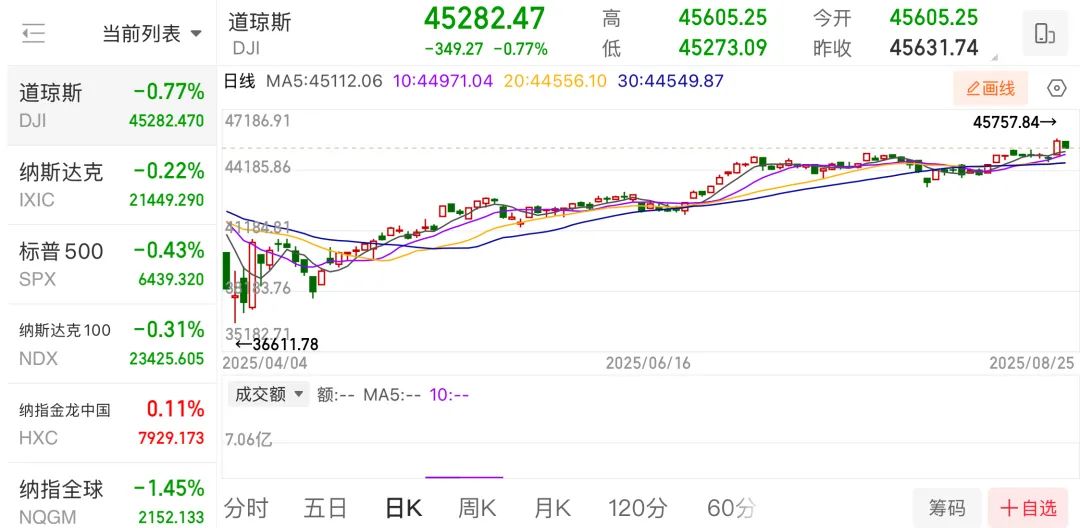
Market Overview - On August 25, US stock indices collectively declined, with the Dow Jones falling by 349.27 points to close at 45,282.47, a decrease of 0.77% [1] - The Nasdaq dropped by 47.24 points to 21,449.29, down 0.22%, while the S&P 500 fell by 27.59 points to 6,439.32, a decline of 0.43% [1] Technology Sector - Major tech stocks showed mixed performance; Tesla rose by 1.94%, Google increased by over 1%, and Nvidia also gained over 1%. In contrast, Microsoft fell by 0.59%, Amazon by 0.39%, Apple by 0.26%, and Facebook by 0.2% [3] - Nvidia announced the launch of the Drive AGX Thor development kit, available for pre-order immediately and set to ship in September, aimed at accelerating the design, testing, and deployment of autonomous vehicles and smart transportation solutions [3] - Nvidia also launched the Jetson AGX Thor developer kit, specifically designed for robotics applications, with a starting price of $3,499, now available for global customers including those in China [3] - Intel stated that Trump's US stockholding plan poses business risks, and on August 22, Intel announced an agreement with the US federal government for an $8.9 billion investment to acquire 433.3 million shares of Intel common stock at $20.47 per share, representing 9.9% of the company [3] Banking Sector - Most bank stocks declined, with JPMorgan down 0.49%, Goldman Sachs down 0.45%, Citigroup down 0.31%, and Morgan Stanley down 0.25%. However, Bank of America rose by 0.04%, and Wells Fargo increased by over 1% [4] Chinese Stocks - The Nasdaq Golden Dragon China Index saw a slight increase of 0.11%. Among popular Chinese stocks, Daqo New Energy rose by over 4%, Melco Resorts increased by over 3%, and NetEase gained over 2%. Conversely, Newegg fell by over 15%, DaJiang Cloud Warehouse dropped by over 9%, and Semtech declined by over 5% [4] Economic Indicators - According to the CME Group's FedWatch tool, traders currently estimate an 84% probability of a Federal Reserve interest rate cut in September [5] - The London Stock Exchange was closed, while the other two major European indices reported declines, with the CAC40 index in Paris closing at 7,843.04, down 126.65 points or 1.59%, and the DAX index in Frankfurt closing at 24,273.12, down 89.97 points or 0.37% [5]


华尔街:全球牛市有望延续,美联储降息将给亚洲市场注入动能
Sou Hu Cai Jing· 2025-08-25 09:41
Core Viewpoint - The global market appears resilient to economic data and policy uncertainties, driven by liquidity, with expectations of continued bullish trends in Asia due to potential interest rate cuts by the Federal Reserve [1] Group 1: Market Dynamics - A major Wall Street bank's chief economist noted a "water buffalo" sign indicating liquidity-driven market behavior [1] - In the U.S., there is a frenzy around AI themes, while the Eurozone benefits from low interest rates and increased defense spending, attracting funds into defense and cyclical stocks [1] Group 2: China Market Insights - In China, a stable economic foundation and policy expectations have led to a flow of household savings into the stock market, with insurance funds investing nearly 1 trillion yuan [1] - The recent trading volume in A-shares has reached over 30 trillion yuan for the second time in history, indicating strong market activity [1] Group 3: Federal Reserve and Interest Rates - Federal Reserve Chairman Jerome Powell indicated potential adjustments to policy stance based on changes in baseline outlook and risk balance [1] - Goldman Sachs predicts a high probability of a 25 basis point rate cut in the September meeting, which is expected to inject momentum into Asian markets [1]


摩根士丹利对美图公司的多头持仓比例增至6.29%
Jin Rong Jie· 2025-08-25 09:31
Group 1 - Morgan Stanley's long position in Meitu increased from 5.72% to 6.29% as of August 20, 2025 [1]