
美债收益率下行

Search documents
中国固定收益研究:中资美元债券2025年市场回顾
Bank of China Securities· 2026-01-09 07:18
Report Industry Investment Rating No relevant content provided. Core Viewpoints - In 2025, Chinese USD corporate bonds delivered high - single - digit returns (6.87%), showing overall resilience but slightly underperforming the broader Asia ex - Japan USD corporate bond universe (7.47%) due to the Vanke onshore debt maturity extension talks at year - end [4][5][6]. - Chinese IG bonds performed marginally stronger than HY bonds. The decline in sub - 10 - year US Treasury yields supported Chinese IG bonds, and their spread tightening outpaced that of HY bonds [4][15][24]. - The issuance volume in the Chinese USD bond primary market rebounded in 2025, but the net issuance was still deeply negative due to large - scale maturities, redemptions, and buybacks [4][39][40]. Summaries by Related Catalogs Performance Analysis - Chinese corporate bonds had a total return of 6.87% in 2025, lower than the 7.47% of the Asia ex - Japan corporate bond index and 7.75% of the iBoxx Global USD Corporate Bond Index [5][6]. - The iBoxx USD China IG Index posted a 6.87% total return, outperforming Chinese HY bonds but trailing the 7.51% return of the Asia ex - Japan IG index. Chinese HY bonds had a 6.70% return, significantly below the 9.38% of the Asia ex - Japan USD HY index [7][10][14]. Market Analysis - In 2025, the decline in sub - 10 - year US Treasury yields supported Chinese IG bonds. The Fed cut rates in September, October, and December and restarted balance - sheet expansion in December [15][19]. - By year - end, 2 - year, 5 - year, and 10 - year Treasury yields declined by 77bps, 66bps, and 40bps respectively, while the 30 - year yield edged up 6bps, steepening the yield curve [16][19]. - In 2026, the actual number of Fed rate cuts may exceed expectations due to a potentially more dovish voting committee [17][19]. Spread Analysis - Chinese IG bond spreads tightened by 24bps to 47bps in 2025, driven by negative net issuance and strong investor demand. Chinese HY bond spreads tightened by 16bps [24][25][28]. High - Yield Financing Environment - Some HY industrial and property developers returned to the primary market in 2025 with over - subscriptions, but Vanke's onshore bond extension affected other HY property developers' offshore refinancing [30][33]. - The government focused on stabilizing the property market. Developers' operations continued to diverge, and the sector was in a bottoming - out phase. Quality SOE and central SOE property bonds are preferred [31][33]. - Chinese developers' default resolution and restructuring deepened, and creditors shifted focus to more sophisticated claims protection [32][33]. Sector Performance - In IG, tech, property, and AMC bonds had returns over 8% as spreads narrowed. Central SOE perpetual and bank senior bonds had lower returns. In non - defaulting HY, HY industrial bonds had 15.9% returns, and HY property bonds had 8.8% returns despite the Vanke incident. Bank AT1 bonds underperformed with 5.5% returns [37][41]. - In the broader Asia ex - Japan credit market, bank, basic materials, and consumer services sectors had total returns above 8% [38][41]. Issuance Review - In 2025, the Chinese USD bond primary market issuance volume rebounded to US$101.7bn (+23% YoY). Excluding restructuring issuances, new issuance rose 6% YoY to US$81.1bn. Net issuance was deeply negative due to US$155.5bn of maturities, redemptions, and buybacks [4][39][42]. - Chinese issuers' activity in the Asia ex - Japan USD bond market increased slightly, accounting for 47% of total issuance volume compared to 43% in 2024. Non - Chinese Asia ex - Japan issuers' issuance volume grew 7.6% to US$116.4bn [40][42]. - Monthly issuance peaks were in February, May, September, and November, supported by financial and sovereign issuers. IG non - financial corporates' issuance was sensitive to USD interest rates. Rated HY bond volume increased, with non - property issuers dominant. Unrated bonds mainly came from LGFVs, small - scale leasing companies, and property restructuring [44][46]. - In 2025, issuance was mainly under 4 years (76.3%), but demand for longer - term funding emerged. The industrial sector became the largest issuer group (41%), overtaking the financial sector (32.7%). Property sector issuance was 22.4%, mainly for debt restructuring. LGFV issuance decreased to 29.8%. SOEs dominated new issuance (72%), and non - SOE issuers' proportion rose to 28% [45][47].

金价屡创历史新高 “疯牛”行情能走多远
Jin Tou Wang· 2025-12-27 04:45
Group 1 - The core viewpoint of the news highlights the significant rise in gold prices driven by geopolitical tensions, with spot gold nearing $4550 per ounce, marking a historical high and a weekly increase of 4.49% [1] - The market is closely monitoring the Federal Reserve's monetary policy direction as 2026 approaches, with an 82.3% probability that the Fed will maintain interest rates in January 2026, while expectations for a potential rate cut have increased significantly [2] - The decline in U.S. Treasury yields, which have fallen from 4.2% to around 4.1%, is reducing the attractiveness of dollar-denominated fixed-income assets, potentially driving investors towards gold as a safer asset [2][3] Group 2 - Gold has shown remarkable performance in 2025, with over a 100% increase since breaking long-term lows in 2024, and a year-to-date rise exceeding 65%, outperforming most asset classes [4] - Technical indicators suggest that while gold prices are currently in a strong upward trend, there is a risk of a significant profit-taking sell-off in early 2026 due to overbought conditions [4] - The current price action indicates that gold is likely to continue its upward trajectory, with key resistance at $4550 and support around $4500, suggesting a potential for further price movements within these ranges [4]
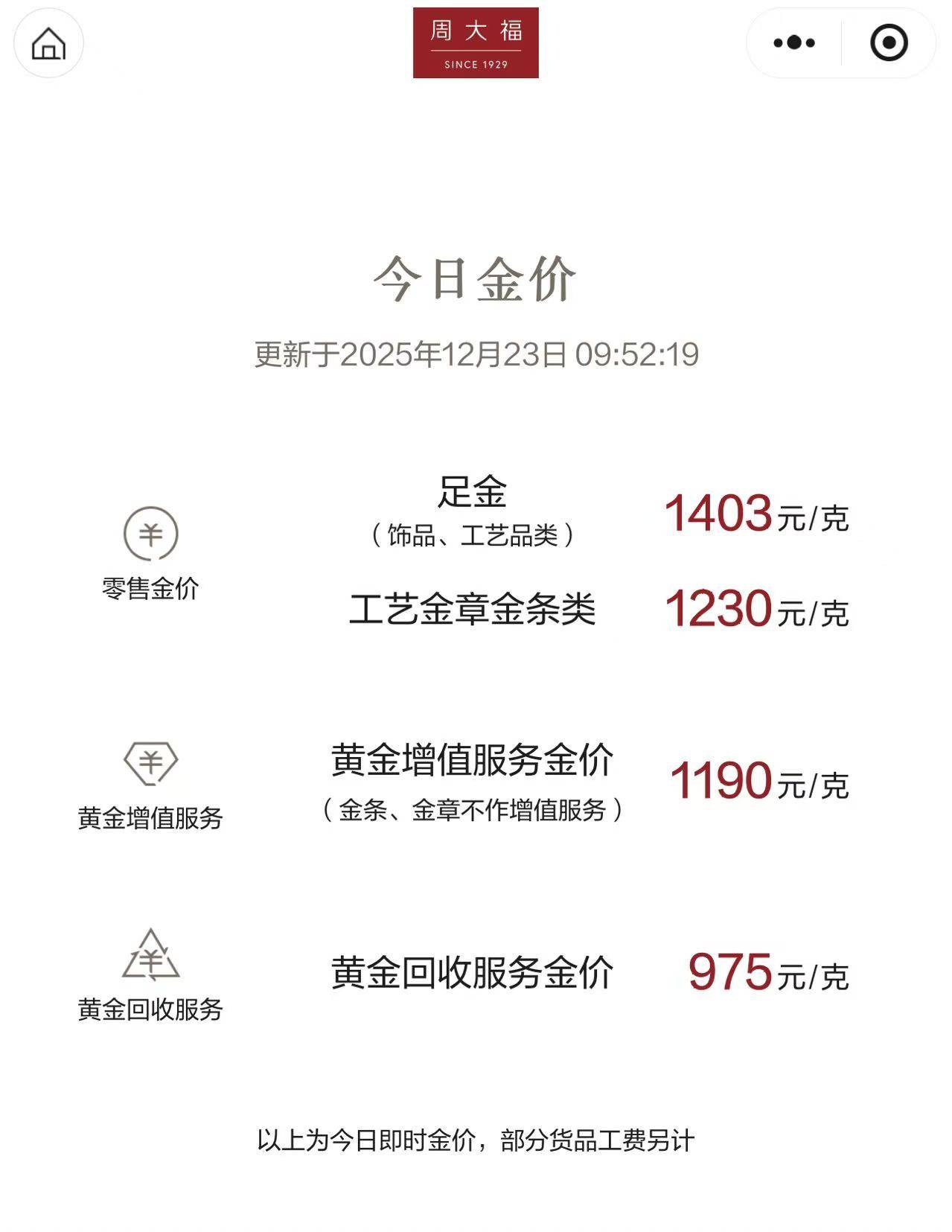
【实探】首饰金价突破1400元/克,消费者购金热情退却
Sou Hu Cai Jing· 2025-12-23 13:46
Group 1 - The core viewpoint of the articles highlights that gold prices have reached historical highs, with several jewelry brands increasing their gold prices above 1400 yuan per gram [1][4][7] - Major brands such as Chow Tai Fook and Chow Sang Sang have set their gold prices at 1403 yuan per gram, while Lao Miao Gold is at 1402 yuan per gram, and other brands like Liufuk Jewelry and King Precious are at 1401 yuan per gram [1][2] - The price of platinum has also risen, with 950 platinum jewelry priced at 861 yuan per gram as of December 23 [4] Group 2 - The surge in gold prices is attributed to rising market expectations for the Federal Reserve to lower interest rates by 2026, along with continuous net inflows into global physical gold ETFs [7] - A report from GF Securities indicates that weakening U.S. real interest rates and dollar index expectations are driving gold prices higher, with a potential for gold companies' performance to improve significantly in 2026 [7] - The World Gold Council's December report forecasts that gold prices may increase by 15% to 30% next year due to factors such as declining U.S. Treasury yields, escalating geopolitical tensions, and heightened risk aversion [7]




金荣中国:白银亚盘小幅走低,关注支撑位多单布局
Sou Hu Cai Jing· 2025-11-24 06:27
Fundamental Analysis - The spot silver price slightly declined to around 49.90, with market focus on support levels for long positions [1] - The Federal Reserve's policy stance is a key indicator for the gold and silver markets, with a notable shift this week as New York Fed President John Williams released dovish signals, suggesting potential rate cuts without jeopardizing inflation targets [1] - Following Williams' remarks, market sentiment shifted dramatically, increasing the probability of a December rate cut to 70%-74%, a recent high, reversing previous expectations that had dropped to around 40% [1] - The geopolitical landscape is creating mixed signals for gold prices, with peace prospects in the Russia-Ukraine conflict slightly reducing safe-haven demand, while tensions in the Middle East introduce new uncertainties [1] Gold Market Dynamics - The surge in bets on rate cuts provided strong support for gold prices, which initially fell over 1% to around 4023 USD/oz but rebounded to touch 4100 USD/oz after Williams' comments, closing near 4065 USD/oz [3] - Diverging opinions among global brokerages exist regarding the likelihood of a December rate cut, with some optimistic and others betting on maintaining the current status [3] - The sensitivity of gold prices to monetary policy changes is highlighted by this rebound from recent lows [3] U.S. Treasury Yield Curve - The expectation of Fed rate cuts has also impacted the U.S. Treasury market, with a collective decline in bond yields, including a drop of 3.8 basis points in the two-year yield to 3.52% and a 3.7 basis point drop in the ten-year yield to 4.067% [4] - The narrowing of the yield spread between two-year and ten-year bonds to 55.5 basis points indicates a further flattening of the yield curve, driven by investor bets on rate cuts due to a weak labor market [4] - Lower yields diminish the attractiveness of bonds, leading to a shift of funds towards non-yielding assets like gold, providing price support [4] Economic Data Impact - The lagging effects of U.S. economic data are amplifying these trends, with a strong September jobs report overshadowed by a revised negative growth in August and rising unemployment rates, revealing underlying labor market concerns [5] - The recent government shutdown has delayed data collection, resulting in the cancellation of the October consumer price index report and postponement of the November CPI report to December 18, creating a data vacuum that heightens speculation about the Fed's path [5] - Weak factory activity data for November, attributed to increased import tariffs suppressing demand, may further drag on overall economic growth, reinforcing gold's role as a buffer against economic uncertainty [5] Silver Market Outlook - The current trend for silver indicates a price uptrend, with support levels identified around 49.30 [9] - Technical indicators show a bullish outlook with MACD patterns suggesting upward momentum, although market activity appears to be decreasing, warranting cautious trading strategies [9] - Suggested trading strategies include long positions near 49.30 with stop-loss at 49.00 and profit targets in the 50.60-51.30 range [9]
资金涌入避风港!时隔半年,美债收益率跌破4%
Sou Hu Cai Jing· 2025-10-20 01:36
Core Viewpoint - The U.S. Treasury market is experiencing a classic flight-to-safety trend due to credit concerns and trade tensions, with the 10-year Treasury yield falling below 4% for the first time since April, and the 2-year yield reaching its lowest level since 2022 [1][3]. Group 1: Market Reactions - The regional bank credit risks have led to significant market volatility, prompting investors to flock to Treasuries for safety, resulting in the regional bank stock index experiencing its largest drop since April [1]. - The 2-year Treasury yield fell below 3.4%, while the 10-year yield touched a low of 3.93%, marking a significant decline in yields [1][3]. - The current market has fully priced in a 25 basis point rate cut by the Federal Reserve on October 29, with investors viewing the 10-year yield of 4% as a safe allocation amidst high valuations in the stock and credit markets [1][4]. Group 2: Future Expectations - The future trajectory of Treasury yields largely depends on traders' expectations regarding the Federal Reserve's rate cuts over the next 12 months, with a consensus anticipating further cuts in December and potentially two more by mid-2026 [4][6]. - The upcoming release of the September CPI report is expected to temporarily halt further declines in Treasury yields, with economists predicting a year-over-year CPI of 3.1%, significantly above the Fed's 2% inflation target [6]. - Analysts suggest that the 10-year Treasury yield may have room to fall below 4%, but this would require a significant worsening of current conditions [4][5][6].
每日债券市场要闻速递(2025-10-17)
Sou Hu Cai Jing· 2025-10-17 08:31
Group 1 - The market is increasing bets on the Federal Reserve cutting interest rates three times this year [1] - The U.S. Treasury will continue to advance the new local government debt limit for 2026 [1] - Jefferies states that there is limited room for a decline in U.S. Treasury yields [1] Group 2 - Federal Reserve researchers indicate that hedge fund holdings of U.S. Treasuries in the Cayman Islands exceed U.S. official data by $1.4 trillion [1] - Institutions suggest that the beginning of a decline in U.S. Treasury yields may signal a significant shift in market sentiment [1] - The Shanghai Stock Exchange has cumulatively issued over 950 billion yuan in green bonds and low-carbon transition bonds [1] Group 3 - The Guangdong provincial government plans to issue bonds with a ceiling of 7.5 billion yuan [1] - Fitch Ratings warns that developed economies face increasing risks of shocks in the bond market [1] - Credit Agricole faces rating risks that may trigger passive selling by institutions [1] Group 4 - Vanke A reports that its production, operations, and debt repayment are progressing smoothly, with all due public bonds being repaid on time [1] - China International Capital Corporation has received approval from the China Securities Regulatory Commission to publicly issue up to 10 billion yuan in technology innovation corporate bonds [1] - Kewen Technology has terminated its application to issue convertible bonds to unspecified objects and has withdrawn its application documents [1] - Guosen Securities has received registration approval from the China Securities Regulatory Commission for the public issuance of short-term corporate bonds to professional investors [1]
贺博生:9.16黄金强势上涨空单如何解套,原油晚间行情最新操作建议
Sou Hu Cai Jing· 2025-09-16 09:23
Group 1: Gold Market Analysis - The current spot gold price closed at $3678.73 per ounce, with a rise of approximately 1%, reaching a record high of $3685.47 during the session [2] - Multiple factors contributing to the gold price surge include a weak US dollar, declining US Treasury yields, and investor anticipation of the Federal Reserve's policy meeting [2][4] - The market expects the Federal Reserve to announce its first interest rate cut since December, which is driving the bullish sentiment in gold [2] Group 2: Technical Analysis of Gold - The gold market remains in a strong bullish trend, with key support at the historical high of $3674 and a critical support level at $3660 [4] - If gold breaks below $3660, it may continue to adjust, with further attention on the 3640-3635 region [4] - Short-term trading strategy suggests focusing on buying on dips and selling on rebounds, with resistance levels at 3715-3725 and support at 3680-3670 [4] Group 3: Oil Market Analysis - International oil prices are experiencing high volatility, with Brent crude at $67.48 per barrel and WTI at $63.32 per barrel [5] - Concerns over Russian oil supply due to increased attacks on its refineries are driving market sentiment [5] - The oil market is influenced by three main factors: supply concerns from Russia, expectations of a rate cut from the Federal Reserve, and mixed signals from Middle Eastern geopolitical tensions [5] Group 4: Technical Analysis of Oil - The oil market is currently in a weak consolidation phase, with prices fluctuating within a narrow range [6] - Short-term trading strategy suggests focusing on selling on rebounds and buying on dips, with resistance levels at 64.5-65.5 and support at 62.0-61.0 [6]

瑞银:10年期美债仍处高位,有进一步下行空间
Sou Hu Cai Jing· 2025-09-12 08:32
Core Viewpoint - UBS strategists indicate that the 10-year U.S. Treasury yield remains at the high end of its range since 2008, suggesting further downward potential [1] Group 1: Market Sentiment - Recent declines in U.S. Treasury yields are attributed to increasing market confidence that the Federal Reserve will begin to cut interest rates [1] - If U.S. economic growth disappoints and data weakens, high-quality bonds are expected to experience an upward trend, potentially leading to significant capital gains [1]
美联储降息窗口临近,美债、美元下半年将迎关键转折?
美股研究社· 2025-08-28 12:07
Core Viewpoint - Global asset prices are undergoing significant adjustments, with a notable decline in the 10-year US Treasury yield and the US dollar index. The Federal Reserve's policy shift is identified as the central logic for global asset pricing in the second half of the year [4][5]. Group 1: Macroeconomic Insights - The 10-year US Treasury yield has dropped over 50 basis points from its peak this year, while the US dollar index has fallen more than 10% from its high [4]. - Morgan Stanley's report indicates that the Federal Reserve's dovish signals at the Jackson Hole meeting suggest a potential decline in the federal funds rate, which could lead to new lows for both Treasury yields and the dollar index in the fall [4][5]. - The expected decline in the federal funds rate is supported by projections that it may fall to 2.625%, influenced by tighter immigration policies affecting labor market growth [5]. Group 2: Investment Strategies - Morgan Stanley recommends a long position in 5-year US Treasuries, which currently yield 3.75%, as they are expected to benefit from price increases during a yield decline cycle [15]. - The report suggests a steepening of the yield curve between 3-year and 30-year Treasuries, with the short end benefiting more from Fed rate cuts [15]. - For foreign exchange, Morgan Stanley advocates for shorting the US dollar while going long on the euro and yen, citing unfavorable interest rate differentials for the dollar [15][27]. Group 3: Economic Forecasts - The US Congressional Budget Office predicts a reduction in the federal deficit by $4 trillion from 2025 to 2035 due to tariff adjustments, which will lower the demand for government bonds and suppress long-term yields [10]. - The report highlights that if the federal funds rate dips below 2.69%, the 10-year Treasury yield could potentially fall below 4% [8]. Group 4: Regional Strategies - In the Eurozone, the focus is on yield curve flattening strategies and tactical opportunities in September, anticipating a rate cut by the European Central Bank [28]. - For the UK, the strategy involves going long on short-term rates as the Bank of England approaches the end of its rate hike cycle [30]. - In Japan, the recommendation is to buy 10-year Japanese government bonds while being cautious of yen volatility [31].


偏偏这类理财频现提前终止,为什么?
Sou Hu Cai Jing· 2025-08-28 07:13
Core Viewpoint - The recent increase in expectations for a Federal Reserve interest rate cut has led to a notable rise in the early termination of dollar-denominated wealth management products in the domestic market, with six products terminating early in July compared to only two in the same month last year [1][2]. Group 1: Reasons for Early Termination of Dollar Wealth Management Products - The frequent early termination of dollar wealth management products can be attributed to two main factors: product design and market environment changes. Many of the terminated products are "target return" type, which include stop-profit clauses aimed at helping investors lock in gains [2]. - The market environment has shifted, particularly affecting products primarily invested in U.S. Treasury bonds. Recent influences such as policy expectations, tariff conflicts, and geopolitical factors have led to a decline in U.S. Treasury yields, accelerating the net asset value growth and causing annualized returns to exceed stop-profit thresholds [2]. Group 2: Considerations for Investors Holding Dollar Wealth Management Products - Investors holding dollar wealth management products should assess whether to redeem based on various factors. If holding a "target return" product close to the stop-profit threshold, it may be prudent to wait for natural termination to secure gains. However, if the product has not reached the stop-profit threshold and has a longer remaining term (e.g., over one year), investors should be cautious of potential yield declines due to anticipated Federal Reserve rate cuts [3]. - In the event of redemption, investors might consider allocating to short-term dollar assets to mitigate long-term currency risk while benefiting from higher interest spreads. Additionally, focusing on equity dollar assets through QDII funds that track major U.S. tech stocks, such as those in the Nasdaq 100 index, could be beneficial. Another strategy could involve converting 30%-50% of dollar assets into non-dollar currency assets or investing in emerging market stocks in countries like Vietnam and South Korea to diversify currency risk [3]. Group 3: General Investment Considerations for Dollar Assets - When investing in dollar assets, it is essential to consider personal circumstances, product characteristics, and market conditions. Investors should match their actual needs with the risk levels of the products they choose. It is also crucial to pay attention to product design and underlying assets to lock in gains and avoid market volatility [4]. - Continuous monitoring of market changes, such as the Federal Reserve's September meeting and the U.S.-China interest rate differential, is necessary for timely adjustments to asset allocations [4].