
Micron Technology(MU)

Search documents
Micron (MU)’s Quarter Was a Thing of Beauty, Says Jim Cramer
Yahoo Finance· 2025-12-27 09:23
Core Insights - Micron Technology, Inc. (NASDAQ:MU) is a key player in the AI ecosystem, manufacturing memory chips essential for AI GPUs, including those from NVIDIA [2] - The company reported fiscal Q1 earnings of $13.64 billion in revenue and $4.78 in earnings per share, surpassing analyst expectations of $12.84 billion and $3.95 respectively [2] - Micron's stock has surged by 227% year-to-date and increased by 26.90% following the earnings report [2] - Analysts, including Morgan Stanley, have raised the price target for Micron's shares to $350 from $338, maintaining an Overweight rating and identifying it as a top AI stock pick [2] - Jim Cramer expressed enthusiasm about Micron's earnings, highlighting its high bandwidth memory component as ideal for data centers [2][3] Financial Performance - Micron's fiscal Q1 revenue was $13.64 billion, exceeding expectations [2] - Earnings per share were reported at $4.78, also above analyst estimates [2] - The stock's year-to-date increase of 227% reflects strong market performance [2] Analyst Sentiment - Following the earnings report, several analysts expressed optimism, with Morgan Stanley increasing the price target significantly [2] - Cramer noted the impressive nature of Micron's earnings call, indicating strong confidence in the company's future [3]

一年两倍!千亿美金!
Ge Long Hui· 2025-12-27 06:17
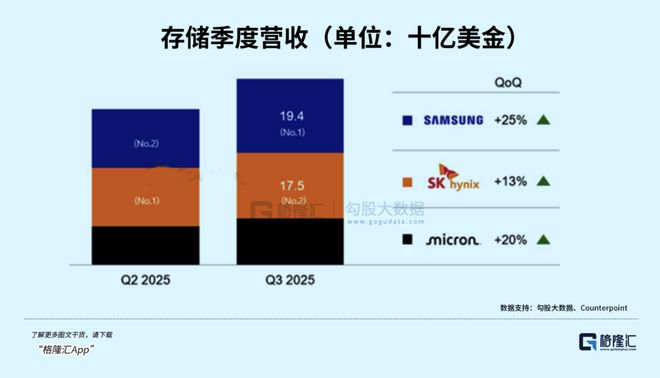
Core Viewpoint - Micron's FY26 Q1 financial report shows impressive results, with revenue of $13.64 billion, significantly exceeding the guidance range of $12.2-12.8 billion and market expectations by nearly $700 million. Adjusted EPS reached $4.78, far surpassing the market expectation of $3.95 [1][3][6] Group 1: Performance Breakdown - Revenue and Profit: Micron's FY26 Q1 performance exceeded expectations across the board, with revenue of $13.64 billion, a year-on-year increase of 57% and a quarter-on-quarter increase of 21%, marking the highest growth rate in nearly five years [3][6] - Adjusted EPS of $4.78 significantly exceeded the market expectation of $3.95, showing a substantial jump from the previous quarter. Non-GAAP gross margin soared to 56.8%, up 17.3 percentage points year-on-year and 11.1 percentage points quarter-on-quarter, far exceeding the guidance of 50.5%-52.5% [6][7] - Operating cash flow reached $8.41 billion, well above the expected $5.94 billion, while adjusted free cash flow hit a record $3.91 billion, with a free cash flow margin close to 30% [6] Group 2: Product Structure - DRAM remains the main revenue driver, generating $10.8 billion, accounting for 79% of total revenue, with a quarter-on-quarter growth of 20%. Average Selling Price (ASP) surged approximately 20%, reflecting the scarcity of supply [7] - NAND business generated $2.7 billion, representing 20% of total revenue, with a quarter-on-quarter growth of 22%. ASP also saw mid-single-digit growth, indicating a "volume and price increase" trend [7] - HBM, crucial for AI servers, has seen its production capacity sold out for 2026, with expectations for HBM4 to enter mass production in CY26Q2, further enhancing profitability. The HBM market is projected to grow from $35 billion in 2025 to $100 billion by 2028, with a compound annual growth rate of about 40% [7][8] Group 3: AI Storage Demand - The demand for storage driven by AI is not a short-term trend but signals a new five-year cycle. The current recovery is fundamentally different from previous cycles, focusing on enterprise-level AI capital expenditures rather than consumer demand [9][10] - AI data centers are driving a "voracious demand" for storage, leading to price increases across all product categories, with HBM prices soaring by 500% and DDR4 prices rising over 50% [10] Group 4: Supply Constraints - The storage industry faces significant supply constraints, with expected DRAM and NAND shipment growth limited to about 20% year-on-year, falling short of demand growth [12] - The production adjustment cycle for storage wafer fabs exceeds five months, making it difficult to respond quickly to market demand changes, exacerbating supply-demand imbalances [12] Group 5: Future Outlook - Micron's optimistic FY26 Q2 guidance suggests adjusted revenue of $18.3-19.1 billion, significantly above the market expectation of $14.38 billion, indicating strong resilience in AI storage demand [15] - The ability to release capacity and achieve technological advancements will be critical for growth, with the successful mass production of DRAM's 1-gamma node and NAND's 232-layer node directly impacting supply and profitability [16][17] - The balance of supply and demand, along with price trends, will be crucial in determining the sustainability of the recovery, with potential risks from geopolitical factors affecting the semiconductor supply chain [18]

一年两倍!千亿美金!
格隆汇APP· 2025-12-27 06:10
Core Viewpoint - Micron's FY26 Q1 financial report shows impressive results, with revenue of $13.64 billion, significantly exceeding the guidance range of $12.2-12.8 billion and market expectations by nearly $700 million. Adjusted EPS reached $4.78, far surpassing the market expectation of $3.95 [5][8][11] Group 1: Revenue and Profitability - Micron's revenue for the quarter increased by 57% year-over-year and 21% quarter-over-quarter, marking the highest growth rate in nearly five years [8] - The revenue growth was primarily driven by price increases rather than volume, with bit shipments showing only slight growth. The adjusted EPS of $4.78 represents a significant jump from the previous quarter [11] - Non-GAAP gross margin surged to 56.8%, a year-over-year increase of 17.3 percentage points, and a quarter-over-quarter increase of 11.1 percentage points, far exceeding the guidance of 50.5%-52.5% [11] - Operating cash flow reached $8.41 billion, well above the expected $5.94 billion, while adjusted free cash flow hit a record $3.91 billion, with a free cash flow margin close to 30% [11] Group 2: Product Structure - DRAM remains the dominant segment, generating $10.8 billion in revenue, accounting for 79% of total revenue, with a quarter-over-quarter growth of 20% [12] - The average selling price (ASP) for DRAM increased by approximately 20% quarter-over-quarter, reflecting the scarcity of supply [12] - NAND revenue reached $2.7 billion, representing 20% of total revenue, with a quarter-over-quarter growth of 22% [12] - HBM is highlighted as a key growth driver, with all of Micron's HBM capacity for 2026 already sold out, and HBM4 expected to enter mass production in Q2 2026 [12] Group 3: Demand and Supply Dynamics - The demand for storage is being driven by AI, with a "voracious" appetite for storage across all categories, leading to widespread price increases [15][16] - HBM prices have surged by 500% this year, while DDR4 prices have increased by over 50% [15] - The supply of DRAM and NAND is expected to grow by only about 20% year-over-year, significantly lagging behind demand growth, leading to a persistent supply-demand imbalance [19] - Micron's strategy involves balancing production between HBM and traditional DRAM while prioritizing strategic customers in data centers [20] Group 4: Future Outlook - The global storage market is projected to reach $193.2 billion by 2025, setting a historical record [22] - Key signals to watch for the sustainability of this recovery include whether Micron can maintain its strong performance in FY26 Q2, with guidance suggesting revenue of $18.3-19.1 billion and adjusted EPS of $8.42 [24] - The release of new production capacity and advancements in technology will be critical for growth, particularly in HBM [25][26] - The balance of supply and demand, along with price trends, will be crucial in determining the industry's profitability in the long term [27]
Micron: Exploiting The Overlooked Structural Alpha
Seeking Alpha· 2025-12-27 05:39
Core Insights - The article introduces Vega North as a new contributing analyst for Seeking Alpha, emphasizing a focus on investment processes rather than predictions [1] - Vega North's approach includes testing investment ideas using open data and reproducible methods, concentrating on position sizing, risk management, and investor psychology [2] Investment Approach - The methodology involves moving from base rates to a simple model that assesses returns, volatility, and correlations, concluding with a decision checklist for investors [2] - Coverage includes various aspects such as factor tilts, cash-flow durability, downside risk metrics, and scenario analysis, aiming for evidence-based investment strategies [2]
反转!SK海力士无锡厂提高DDR4产能
是说芯语· 2025-12-27 01:45
Core Viewpoint - The semiconductor industry is experiencing a phase adjustment in technology iteration due to the imbalance of supply and demand in the global memory market and soaring prices. Samsung and SK Hynix have postponed their plans to cease DDR4 memory production from the end of 2025 to 2026 [1]. Group 1: Strategy Adjustment - Samsung and SK Hynix's decision to delay DDR4 production is not a sudden move; they had previously signaled to customers about gradually reducing DDR4 capacity starting in early 2024, with a complete stop planned between late 2025 and early 2026 [3]. - This strategy aligns with the semiconductor industry's logic of "technology iteration driving capacity upgrades," especially as major chip manufacturers like AMD and Intel are phasing out support for DDR4 [3]. Group 2: Market Dynamics - The explosive growth of the AI industry has significantly increased the demand for HBM, with storage needs for AI servers exceeding traditional servers by more than three times. This shift has led manufacturers to allocate more capacity to HBM, severely constraining DDR4 production [4]. - The transition of Chinese DRAM suppliers to DDR5, driven by government subsidies, will result in a complete halt of DDR4 production by 2025, further exacerbating the global supply shortage [4]. Group 3: Price Movements - Since the beginning of 2025, the price of a 16GB DDR4 module has surged from 180-200 yuan to around 800 yuan by December, marking a cumulative increase of over 200%. There have been instances of older products surpassing the prices of newer DDR5, with some specifications showing price differences of up to 100% [4]. - Current inventory levels for DDR memory are critically low, with only 9 weeks of supply for PC and mobile devices and 11 weeks for server DDR memory, contributing to further price increases. It is projected that DDR contract prices will rise by 35% in Q4 2025 and continue to increase by 30% in Q1 2026 [4]. Group 4: Manufacturer Responses - In response to market conditions, SK Hynix has officially notified customers of the extension of DDR4 production until 2026 and plans to increase DDR4 capacity at its Wuxi factory to meet rising orders. Samsung will maintain stable DDR4 supply while focusing on advanced DRAM products [5]. - Unlike Samsung and SK Hynix, Micron is sticking to its original plan, with its DDR4 and LPDDR4 products entering the end-of-life phase and expected to cease shipments in the next 2-3 months [5]. Group 5: Long-term Outlook - In the short term, the maintenance of DDR4 production by Samsung and SK Hynix is expected to alleviate supply tightness and somewhat curb price surges, but prices are likely to remain high due to significant supply gaps [6]. - Long-term, this adjustment does not alter the industry's trend towards advanced technologies like DDR5 and HBM; rather, it provides a buffer period for market transition. The continued focus on DDR4 by leading manufacturers may compress market space for domestic storage companies while allowing them time to mature their DDR5 technology and capacity [6].

芯片的十字路口
半导体行业观察· 2025-12-27 01:33
Core Viewpoint - The global semiconductor industry is at a historic crossroads, with Q3 2025 revenue projected to reach $216.3 billion, marking the first time it surpasses $200 billion in a single quarter. The annual revenue for 2025 is expected to exceed $800 billion, representing nearly a 20% increase from 2024. However, this growth is characterized by a "K-shaped recovery," indicating a structural shift in the industry rather than uniform growth across all sectors [1][4]. Group 1: Revenue and Growth Dynamics - The $200 billion quarterly revenue figure is misleading, as it masks the profound "K-shaped recovery" within the industry. The core contradiction of this cycle is the fundamental shift in demand focus from "consumer electronics-driven volume growth" to "data center-driven price increases" [4]. - Omdia attributes the unexpected performance in Q3 2025 to accelerated industry growth, with AI and storage as the main engines. Specifically, the combination of "computing power stacking + HBM premium" has driven revenue growth, with high-end GPUs and accelerators being in high demand due to AI training and inference [4][5]. - The semiconductor equipment sales are projected to reach approximately $133 billion in 2025, with expectations of continued growth in subsequent years, indicating a long-term bet on AI demand rather than a short-term spike [5]. Group 2: Profit Distribution and Market Structure - The top four semiconductor companies, including NVIDIA and major memory firms like Samsung and SK Hynix, account for over 40% of total industry revenue, highlighting a significant profit concentration among a few players [7]. - The industry is experiencing a "profit black hole," where a small number of companies capture the majority of profits, leading to a stark divide in profit structures and creating a scenario where capital expenditures from leading firms are essential for maintaining overall industry health [7][8]. - The demand for mature processes is weak, with traditional applications struggling to recover, leading to a price war in the market. This misalignment between supply and demand is expected to result in low visibility for orders in the latter half of 2025 [10]. Group 3: AI and Market Sentiment - The semiconductor industry's true nature, excluding AI and storage, resembles a "stock game," with companies grappling with inventory reduction and price stabilization challenges [9]. - The automotive semiconductor market is projected to grow by approximately 16.5% year-on-year for 2025-2026, driven by advancements in smart driving technology, while traditional components face pricing pressures [11]. - The smartphone market is showing signs of a "moderate recovery," with a 2.6% year-on-year increase in global shipments in Q3 2025, influenced by promotions and AI feature upgrades [11]. Group 4: Concerns Over AI and Investment - The discussion around an "AI bubble" is prevalent, with concerns about whether the demand for computing power will lead to over-investment in data centers and whether the returns on these investments will materialize in a reasonable timeframe [13][15]. - Major tech companies are projected to spend around $320 billion on capital expenditures in 2025, reshaping their valuation narratives. The focus is on whether these expenditures can translate into sustainable cash flows [15]. - The financial presentation of returns is under scrutiny, as significant investments may not yield immediate returns, prompting a closer examination of profit quality and accounting practices [16].


Micron: Valuation Of This AI Winner Defies Logic (NASDAQ:MU)
Seeking Alpha· 2025-12-26 23:13
Core Viewpoint - The investment in Micron Technology, Inc. (MU) has proven successful, with the stock appreciating by 75% since late September, driven by strong earnings in FQ1 2026 [1] Group 1: Company Performance - Micron Technology, Inc. reported stellar earnings for FQ1 2026, contributing to the significant stock price increase [1] Group 2: Investment Insights - The decision to invest in Micron Technology in late September has yielded substantial returns, highlighting the potential for growth in the semiconductor sector [1]
Micron Technology, Inc. 2026 Q1 - Results - Earnings Call Presentation (NASDAQ:MU) 2025-12-26
Seeking Alpha· 2025-12-26 23:01
Group 1 - The article does not provide any relevant content regarding the company or industry [1]

2026 market risks and profit growth, best-positioned software stocks, the Oscars head to YouTube
Youtube· 2025-12-26 22:10
Market Overview - The S&P 500 is nearing a new record, contributing to a strong market performance in 2025, with investors hoping to maintain the Santa Claus rally [1][2] - Major averages are on track for solid weekly gains, with a focus on cyclical sectors like financials and industrials leading the market [5][6] Economic Outlook for 2026 - The consumer sector is crucial for economic growth in 2026, with potential risks stemming from a weakening job market and consumer confidence [3] - Profit growth is expected to be broad, particularly in industrials and materials, indicating a healthy economic expansion [6][8] Sector Performance - Financials and industrials have shown significant growth, with earnings growth projected at 10% in Europe and Japan, and high teens in emerging markets [9] - The healthcare sector is viewed as both offensive and defensive, benefiting from AI advancements to improve profitability [15][16] Interest Rates and Federal Reserve - The Federal Reserve is anticipated to implement two rate cuts in 2026, aiming for a neutral rate between 3% and 3.5% [10][11] - Stable inflation and interest rates are expected to support market valuations, allowing for continued earnings growth [8][9] AI and Technology Trends - Companies investing in AI are expected to focus on the return on investment rather than just having an AI strategy, with tech firms maintaining strong profit margins [12][13] - The software sector has underperformed compared to the broader market, with concerns about AI's impact on established applications [31][32] Credit Market Concerns - The private credit market is facing scrutiny, with potential risks of a credit cycle emerging as lenders become more selective [88][89] - Investors are advised to monitor high-yield bonds, regional bank stocks, and consumer credit delinquencies as indicators of credit market health [94][95] Streaming and Entertainment Industry - The Oscars will move to YouTube starting in 2029, marking a significant shift in how major award shows are broadcast, aiming to reach a broader audience [98][99] - This transition reflects the growing influence of tech companies in Hollywood and the need for traditional media to adapt to changing viewer habits [100][101]


韦德布什:服务器与存储芯片需求尚未出现放缓迹象
Xin Lang Cai Jing· 2025-12-26 20:49
Core Viewpoint - Micron Technology (MU) experienced a 0.4% decline in stock price on Friday, but Wedbush analysts noted that there are no signs of a slowdown in demand for the company's server and storage chips [1][2] Group 1 - Micron Technology's stock price fell by 0.4% at the end of trading on Friday [1][2] - Wedbush analysts reported that the demand for Micron's server and storage chips remains strong and has not shown any signs of slowing down [1][2]