
Nissan Motor(NSANY)

Search documents
A股指数即将上新;央行连续8个月增持黄金……盘前重要消息一览
Zheng Quan Shi Bao· 2025-07-08 00:38
Group 1 - The People's Bank of China has increased its gold reserves for eight consecutive months, with the latest figures showing a rise of 70,000 ounces to a total of 73.9 million ounces as of the end of June [2] - By the end of 2027, China aims to have over 100,000 high-power charging facilities nationwide, focusing on local economic development and the promotion of new energy vehicles [2] - The Shanghai Stock Exchange and the China Securities Index Company will launch several specialized indices on July 21, including the Shanghai Stock Exchange Specialized New Index and the China Securities Specialized New 100 Index [3] Group 2 - A new mandatory national standard for passenger car braking systems will take effect on January 1, 2026, introducing requirements for electric transmission braking systems and emergency braking signals [3] - An international standard for testing scenarios of autonomous vehicle systems has been officially released, detailing evaluation processes and testing methods [4] - The U.S. President has signed an executive order extending the delay for "reciprocal tariffs" until August 1, affecting imports from 14 countries with varying tariff rates [8][5] Group 3 - The U.S. stock market saw declines across major indices, with the Dow Jones down 0.94%, the Nasdaq down 0.92%, and the S&P 500 down 0.79%, impacting stocks of Japanese and Korean companies listed in the U.S. [5] - Companies such as Nissan and Toyota experienced significant stock drops, with Nissan down over 7% and Toyota down nearly 4% [5] - The market sentiment is shifting towards a balanced approach, with a focus on large-cap stocks and potential inflows of incremental capital in July [8][9]




特朗普贸易战担忧重燃,美国股债遭抛售,新兴市场货币创4月以来最大跌幅
Hua Er Jie Jian Wen· 2025-07-08 00:29
Core Viewpoint - The announcement of new tariffs by Trump on Japan, South Korea, South Africa, and four other countries has reignited concerns over trade tensions, leading to declines in both U.S. stocks and bonds, as well as significant depreciation in emerging market currencies [1][2]. Market Reactions - U.S. stock indices experienced significant declines, with the S&P 500 dropping by 49.37 points (0.79%) to close at 6229.98 points, and the Dow Jones Industrial Average falling by 422.17 points (0.94%) to 44406.36 points [3][8]. - The Nasdaq Composite Index also saw a decline, closing down 188.59 points (0.92%) at 20412.52 points [4]. - The Russell 2000 Index fell by 1.55% to 2214.23 points [5]. - The VIX, a measure of market volatility, increased by 1.77% to 17.79 [6]. Sector Performance - The biotechnology ETF dropped by 1.45%, while the semiconductor ETF fell by 1.36%. Other sectors such as global airlines and banking also saw declines of around 1.29% [7]. - The "Magnificent 7" tech stocks index decreased by 1.03%, with Tesla experiencing a notable drop of 6.79% [10]. Currency and Commodity Movements - Emerging market currencies faced their largest decline since April, with the Colombian, Brazilian, and Chilean currencies each dropping over 1.2% [1]. - The U.S. dollar strengthened, with the ICE dollar index rising by 0.31% to 97.479 points [20]. - Gold prices experienced a V-shaped reversal, initially dropping below $3300 before stabilizing [26]. International Market Impact - The European stock indices showed mixed results, with the Eurozone STOXX 50 index rising by 1.00% to 5341.54 points, while the UK FTSE 100 index fell by 0.19% [12][13]. - Oil prices fluctuated, with WTI crude oil futures closing up nearly 1.4% at $67.93 per barrel [25].







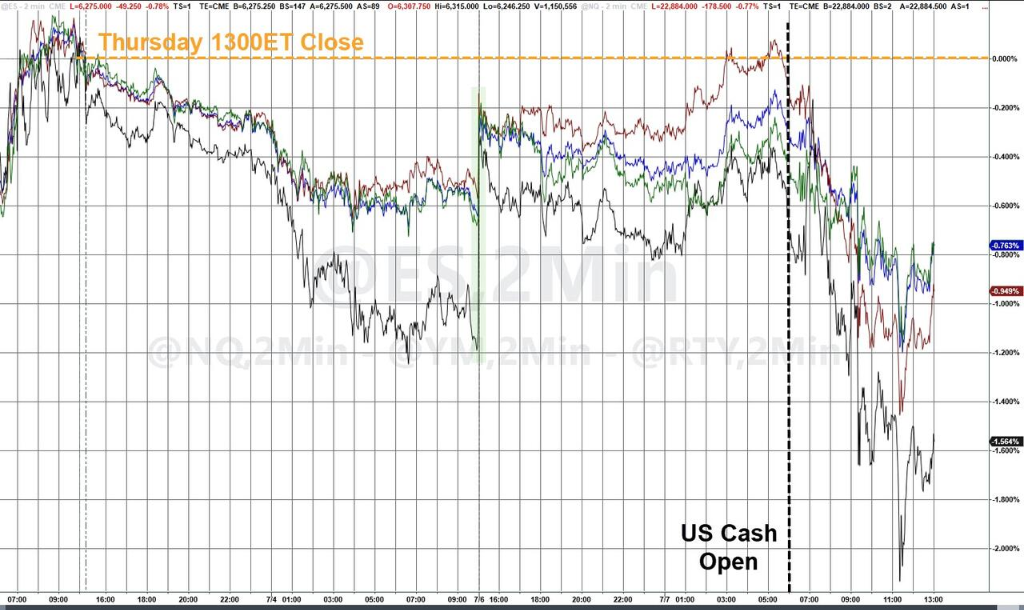
丰田汽车ADR下跌4.3%,日产汽车ADR跌7.6%,创2月12日以来最差盘中表现。此前特朗普宣布将对日本加征25%的关税。
news flash· 2025-07-07 16:39
丰田汽车ADR下跌4.3%,日产汽车ADR跌7.6%,创2月12日以来最差盘中表现。此前特朗普宣布将对日 本加征25%的关税。 ...
今日新闻丨奇瑞组织架构重大调整!日产计划借助中国工厂出口电动汽车!
电动车公社· 2025-07-07 15:53
奇瑞组织架构重大调整 近日据媒体报道称,奇瑞组织架构进行重大调整,公司成立奇瑞品牌国内业务事业群,将星途事业部、艾 虎事业部(艾瑞泽和瑞虎)、风云事业部以及QQ四大事业部归于旗下统一管理,四者分别聚焦高端、经 典、新能源和小车。此外, 奇瑞与华为合作的智界、 奇瑞与智米联手打造的iCAR 和捷途将维持独立运 营。此次组织架构调整不涉及品牌定位变更,主要目的是实现 战略聚焦、资源整合、强化协同、品牌向 上。 奇瑞作为"多生儿子好打架"的典 型代表,也开始进行资源整合了。一方面,这说明了集中力量办大事的 重要性,能够切实带来降本增效的好处;另一方面,也说明国内汽车市场的竞争环境空前激烈,留给大企 业的容错空间也很小。未来几年,汽车行业中很有可能会看到更多的"合纵连横",从春秋步入战国。 2、 关注 「电动车公社」 和我们一起重新思考汽车 《今日新闻》将会每天给大家带来几条当日重磅新闻,并附上社长的简单评论。关注「电动车公社」,新能源 圈大事小事 看我们就够啦~ 今日新闻要点: 1、 日产计划借助中国工厂出口电动汽车 奇瑞组织架构重大调整 ; 日产计划借助中国工厂出口电动汽车; 据外媒报道,日产汽车计划于2026年 ...

日产汽车将发行1500亿日元可转换债券。
news flash· 2025-07-07 03:31
Group 1 - Nissan Motor will issue 150 billion yen convertible bonds [1]
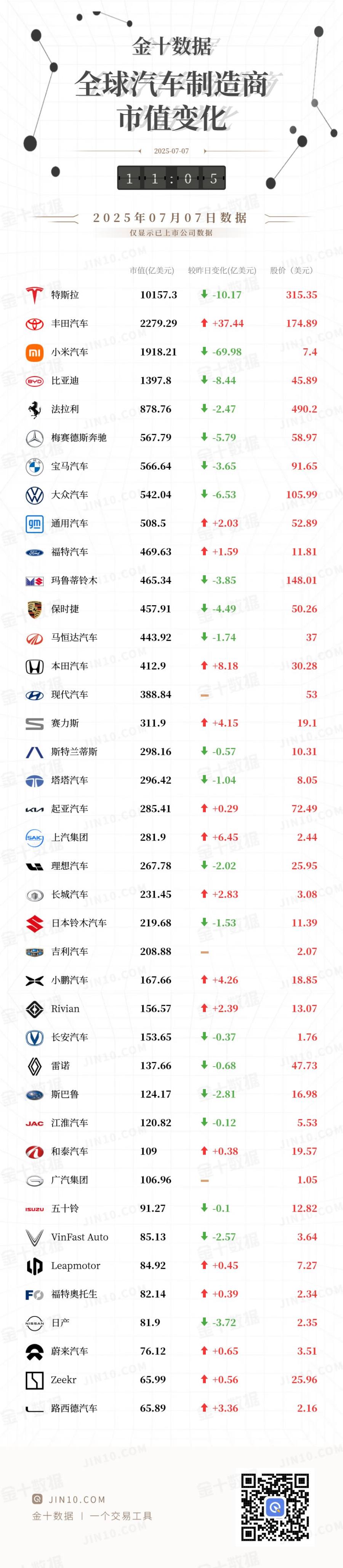
金十图示:2025年07月07日(周一)全球汽车制造商市值变化
news flash· 2025-07-07 03:07
Group 1 - The automotive industry shows varied performance among major companies, with Volkswagen leading at 542.04 million, followed closely by General Motors at 508.5 million, and Ford at 469.63 million [2] - Honda experienced a significant increase of 8.18% in its performance, reaching 412.9 million, while Tata Motors saw a decline of 1.04%, totaling 296.42 million [2] - New entrants like Li Auto and Xpeng are also making their mark, with Li Auto at 267.78 million and Xpeng at 167.66 million, both showing positive growth [2] Group 2 - The data indicates that traditional automakers like Nissan and Subaru are facing challenges, with Nissan reporting a decrease of 3.72% to 81.9 million and Subaru down by 2.81% to 124.17 million [3] - Emerging companies such as VinFast Auto and Leapmotor are also in the mix, with VinFast at 85.13 million, down by 2.57%, while Leapmotor shows a slight increase to 84.92 million [3] - The overall market dynamics suggest a competitive landscape where established brands must adapt to the rising presence of new players [3]





增程式汽车再加速
Zhong Guo Qi Che Bao Wang· 2025-07-07 01:57
Group 1 - BMW plans to reintroduce range-extended technology with the iX5 in 2026, expecting a combined range of 1000 km, and will apply this technology to the sixth generation iX3 and seventh generation iX7 models [2][4] - GAC Toyota announced plans to produce range-extended models, including versions of the Highlander and Sienna, while SAIC Volkswagen has introduced the ID.ERA concept car as its first range-extended model [2][5] - The market for range-extended vehicles is experiencing significant growth, with a nearly 50% year-on-year increase in sales, while plug-in hybrid vehicles are showing signs of slowing growth [3][4] Group 2 - The sales of range-extended vehicles have surged, with a reported 111% year-on-year growth in 2023 and an expected 167% increase in 2024, contrasting with the single-digit growth of pure electric and plug-in hybrid vehicles [12][18] - The shift towards range-extended technology is driven by changing consumer preferences, with buyers favoring vehicles that offer both electric and fuel options for flexibility [10][14] - Range-extended vehicles are perceived to have better performance and user experience compared to plug-in hybrids, as they are fully driven by electric motors and alleviate concerns about range anxiety [8][9] Group 3 - The automotive industry is witnessing a strategic pivot towards range-extended technology, with companies like Ideal, Leap Motor, and Aito achieving significant sales growth in this segment [5][13] - The simplicity of range-extended vehicle structures helps reduce manufacturing costs and vehicle weight, enhancing their appeal in the market [9][14] - The introduction of solid-state batteries is anticipated to further enhance the performance and appeal of range-extended vehicles, potentially revolutionizing the market [17][18]



日产汽车回应日经新闻关于Oppama工厂的报道,称:该报道并非基于公司的官方公告。
news flash· 2025-07-06 10:06
日产汽车回应日经新闻关于Oppama工厂的报道,称:该报道并非基于公司的官方公告。 ...
奇骏·荣誉打响东风日产“油电并进”第一枪
Zhong Guo Jing Ying Bao· 2025-07-05 04:19
Group 1 - Dongfeng Nissan launched the new X-Trail Honor model with two variants priced at 160,800 and 166,800 yuan, with promotional prices dropping to 119,800 and 125,800 yuan, significantly enhancing cost-performance [1] - The new model incorporates extensive user feedback, optimizing technology configuration, interior space, and exterior design, and features the Nissan Connect Super Intelligent 2.0+ system for enhanced smart functionalities [1] - Dongfeng Nissan's strategy includes maintaining a strong presence in the fuel vehicle market while accelerating the transition to electric vehicles, aligning with Nissan's global strategy [1] Group 2 - Nissan's financial situation has improved, with sufficient current assets and a positive cash flow achieved in Q1 2025, indicating stabilization [2] - The company plans to significantly shorten the development cycle for new models, targeting 37 months for the first model and 24 months specifically for the Chinese market, while ensuring quality and safety [2] - In May 2025, Nissan's sales in China reached 57,998 units, with cumulative sales for the year at 225,560 units, highlighting the market's vitality [2]