
Nissan Motor(NSANY)

Search documents
日产与东风成立新合资公司 日产中国:中国市场是日产全球复兴计划重要力量
Zhong Guo Jing Ying Bao· 2025-07-10 02:32
Group 1 - Nissan has formed a new joint venture with Dongfeng Motor Group, with a registered capital of 1 billion RMB, where Nissan (China) Investment Co., Ltd. holds 60% and Dongfeng holds 40% [2] - The joint venture aims to expand Nissan's automobile export business, positioning China as a key export base for the company [2][5] - Nissan plans to leverage resources from its joint ventures in China to enhance its global revival strategy, with a focus on exports, product development, and brand enhancement by 2025 [2][5] Group 2 - Nissan's electric vehicle model N7, developed locally in China, has shown strong sales performance, with 6,189 units sold by June 2025 and over 10,000 units delivered since mid-May [3] - The company aims to accelerate its electric vehicle development in China, with plans to invest over 10 billion RMB by the end of 2026 to enhance R&D capabilities [4] - The "Re:Nissan" revival plan includes cost optimization strategies, targeting a total cost reduction of 500 billion JPY by the fiscal year 2024 [5]




广汽菲克宣告破产;余承东回应“开车睡觉” | 汽车早参
Mei Ri Jing Ji Xin Wen· 2025-07-09 23:14
Group 1: Bankruptcy of GAC Fiat - GAC Fiat Chrysler Automobiles has been declared bankrupt by the Changsha Intermediate People's Court due to its debt and asset situation [1] - Established in 2010 with an investment of approximately 17 billion, GAC Fiat entered bankruptcy proceedings in October 2022 due to poor management [1] - The bankruptcy highlights the immense pressure faced by some joint ventures in the current market environment, prompting a reflection on the joint venture model and market strategies in the automotive industry [1] Group 2: Nissan's Sales Growth in China - Nissan reported a sales increase in China for June, marking the first year-on-year growth in 15 months, with total sales of 53,843 vehicles [2] - The sales for Dongfeng Nissan, which includes Nissan, Venucia, and Infiniti brands, were 49,033 vehicles, while the light commercial vehicle segment (Zhengzhou Nissan) sold 4,810 vehicles [2] - Cumulatively, Nissan's sales in China for the first half of 2025 reached 279,546 vehicles, indicating a positive trend that may enhance its competitive position in the growing electric vehicle market [2] Group 3: Passenger Car Market Performance - The China Passenger Car Association reported that retail sales of passenger cars in June reached 2.084 million units, representing a year-on-year increase of 18.1% and a month-on-month increase of 7.6% [3] - Cumulatively, retail sales for the year reached 10.901 million units, up 10.8% year-on-year [3] - Passenger car exports in June totaled 480,000 units, showing a year-on-year growth of 23.8%, reflecting the increasing international competitiveness of domestic automobiles [3] Group 4: Huawei's Developments in Smart Vehicles - Huawei's executive Yu Chengdong addressed the "sleeping while driving" incident, clarifying that he was looking at his phone and has since paid a fine [4] - At the "Enjoy Brand Night" event, Huawei announced the upcoming launch of its second travel vehicle under the HarmonyOS brand this fall [4] - Huawei's strategy in the smart vehicle sector is evolving, with plans for independent product launches and a more flexible partnership approach, which may enhance market collaboration and resource integration [4]
汽车关税成“拦路虎” 据悉日产两家美国工厂暂停生产加拿大特供车型
news flash· 2025-07-09 08:23
Core Viewpoint - The imposition of tariffs on imported vehicles between the United States and Canada has led Nissan to suspend production of certain models intended for the Canadian market at its U.S. factories [1] Group 1: Production Impact - Nissan has halted production of three models destined for Canada, specifically the Pathfinder and Murano SUVs from the Tennessee plant, and the Frontier pickup from the Mississippi plant [1] - The suspension of production began in May, indicating a significant operational adjustment due to tariff-related challenges [1]
汽车关税成“拦路虎” 传日产(NSANY.US)两家美国工厂暂停生产加拿大特供车型
智通财经网· 2025-07-09 08:18
Group 1 - Nissan has suspended production of three car models destined for Canada at its factories in Tennessee and Mississippi due to tariffs imposed by the U.S. and Canada on imported vehicles [1] - The suspension began in May and affects the production of the Pathfinder and Murano SUVs in Tennessee, as well as the Frontier pickup in Mississippi [1] - The tariffs were initiated by the Trump administration in April, which imposed a 25% tariff on imported cars, prompting Canada to retaliate with its own tariffs [1] Group 2 - Despite Canada being a relatively small market for Nissan, the suspension of exports highlights the challenges faced by global automakers due to tariffs [1] - Nissan reported a net loss of $4.5 billion for the fiscal year ending in March and has approximately ¥700 billion ($4.8 billion) in maturing debt [1] - All three major credit rating agencies have downgraded Nissan's debt rating to "junk" status, and the company has requested some suppliers to allow deferred payments to free up short-term cash [1] Group 3 - Nissan does not have any factories in Canada, and its car sales in Canada for the last fiscal year were approximately 104,000 units, which is less than half of its sales in Mexico and slightly above 10% of its sales in the U.S. [2] - Overall, Canada accounted for only 3% of Nissan's global sales in the last fiscal year [2] Group 4 - On Wednesday, Nissan's stock fell by 3% in the Tokyo stock market, underperforming compared to the Nikkei index [3]
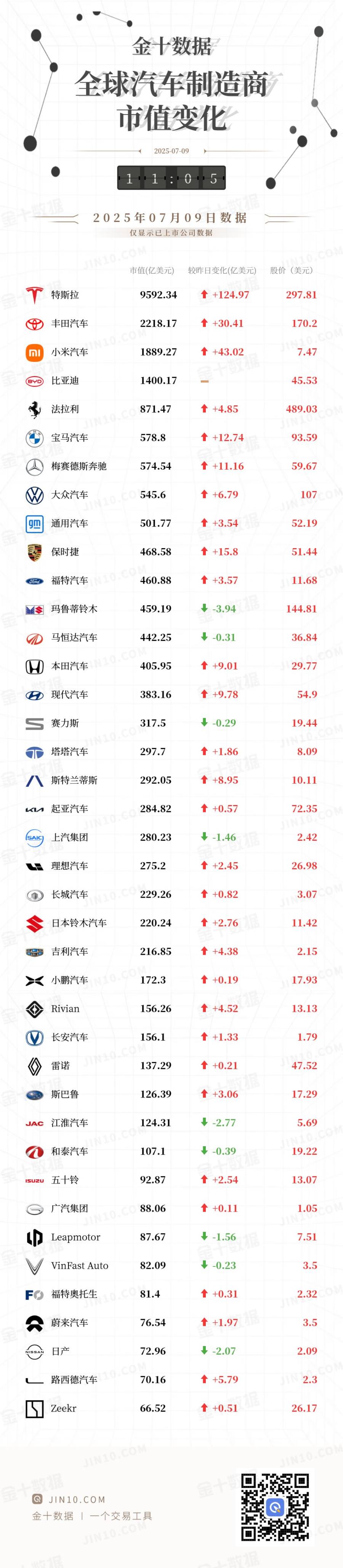
金十图示:2025年07月09日(周三)全球汽车制造商市值变化
news flash· 2025-07-09 03:13
Group 1 - Volkswagen leads the automotive industry with a market value of 545.6 billion, showing a 6.79% increase [2] - General Motors follows with a market value of 501.77 billion, reflecting a 3.54% increase [2] - Porsche has a significant growth of 15.8%, reaching a market value of 468.58 billion [2] Group 2 - Ford's market value stands at 460.88 billion, with a 3.57% increase [2] - Maruti Suzuki shows a decline of 3.94%, with a market value of 459.19 billion [2] - Mahindra & Mahindra's market value is 442.25 billion, with a slight decrease of 0.31% [2] Group 3 - Honda's market value is 405.95 billion, increasing by 9.01% [2] - Hyundai's market value is 383.16 billion, with a growth of 9.78% [2] - Geely's market value is 216.85 billion, reflecting a 4.38% increase [2] Group 4 - Changan Automobile has a market value of 156.1 billion, with a 1.33% increase [3] - Subaru's market value is 126.39 billion, showing a 3.06% increase [3] - NIO's market value is 76.54 billion, with a growth of 1.97% [3]




1~6月丰田在华新车销量增6.8%,本田日产苦战
日经中文网· 2025-07-09 02:44
Group 1 - Toyota's new car sales in China from January to June increased by 6.8% year-on-year, reaching 837,700 units, marking the first time in four years that it surpassed the previous year's performance in the same period [1] - The combined new car sales of Honda and Nissan in China decreased by double digits, with a total decline of 7% to 1.43 million units compared to the same period [1] - Japanese automakers are lagging in the EV and PHV sectors in China, with sales down 40% compared to the recent peak in 2021 [1] Group 2 - FAW Toyota, a joint venture with China's First Automobile Group, saw a sales increase of 16.3% to 377,800 units, while GAC Toyota, in partnership with Guangzhou Automobile Group, grew by 0.6% to 364,200 units [2] - Lexus, the luxury brand, experienced a 1.3% increase in sales, reaching 85,600 units [2] - Honda's new car sales in China from January to June fell by 24.2% to 315,152 units, with the Accord and CR-V remaining strong but other models underperforming [2] Group 3 - Nissan's sales decreased by 17.6% to 279,546 units, with both Honda and Nissan losing market share to Chinese manufacturers [3] - In June alone, Toyota's sales grew by 3.7% to 157,700 units, while Honda's sales dropped by 15.2% to 58,468 units, and Nissan's sales increased by 1.9% to 53,843 units [3]


日产在美国的两家工厂已经停止了销往加拿大市场的三款车型的生产。
news flash· 2025-07-08 23:46
Group 1 - Nissan has halted production of three models destined for the Canadian market at its two factories in the United States [1]
据日本共同社:日产汽车缩减了新款Leaf电动车的计划。
news flash· 2025-07-08 12:17
Group 1 - Nissan has reduced its plans for the new Leaf electric vehicle [1]
7月8日电,日产汽车决定将2031年到期债券的总金额从1500亿日元提高至2000亿日元。
news flash· 2025-07-08 03:44
Core Viewpoint - Nissan Motor has decided to increase the total amount of its bonds maturing in 2031 from 150 billion yen to 200 billion yen [1] Group 1 - The total amount of bonds maturing in 2031 has been raised by Nissan Motor from 150 billion yen to 200 billion yen [1]