PDD(PDD)

Search documents
美股遭遇“黑色星期五”
财联社· 2025-10-10 23:35
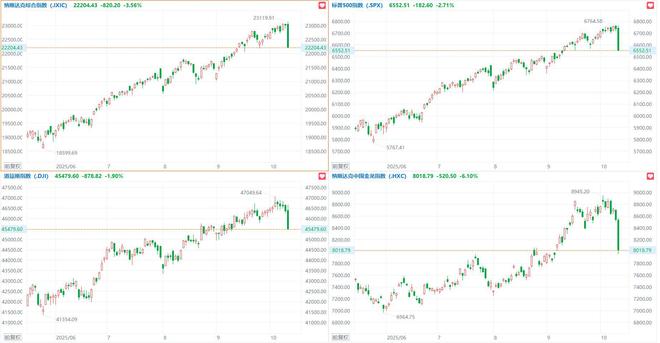
Market Overview - The U.S. stock market experienced a significant drop, with the S&P 500 index falling by 2.71% to 6552.51 points, marking the largest single-day decline since April [1] - The Nasdaq Composite index decreased by 3.56% to 22204.43 points, also the largest drop since April [1] - The Dow Jones Industrial Average fell by 1.9% to 45479.6 points [1] Commodity and Asset Performance - Crude oil and metals faced severe losses, with WTI crude oil dropping over 4%, nearing its lowest point of the year [4] - Copper prices fell by 4.5%, while spot gold rose above $4000 per ounce [4] - The yield on the 10-year U.S. Treasury bond decreased by nearly 8 basis points [4] Cryptocurrency Market - Bitcoin experienced significant volatility, with intraday losses exceeding 10% [5] Investor Sentiment and Market Risks - Analysts noted that the recent market downturn was anticipated due to prior gains since April, indicating a risk of substantial adjustments in the U.S. stock market [5] - The sentiment was further dampened by comments from the U.S. Office of Management and Budget regarding the government shutdown and employee layoffs [5] Stock Performance of Major Companies - Major tech stocks saw declines, including Nvidia down 4.89%, Microsoft down 2.19%, and Apple down 3.45% [6] - Post-market trading also reflected declines for tech giants, with Nvidia, Tesla, and Oracle all dropping over 2% [7] Chinese Stocks Impact - The Nasdaq Golden Dragon China Index fell by 6.10%, with Alibaba down 8.45% and JD down 6.24% [9] Company-Specific News - Tesla launched a lower-priced version of the Model Y in Europe, priced at €39,990 (approximately $46,304), aimed at boosting demand in a sluggish market [10] - U.S. fertilizer producer Mosaic's stock dropped by 9.24% due to operational disruptions at its phosphate plant, resulting in lower-than-expected production and sales [11] - A coalition of global banks, including Goldman Sachs and Bank of America, announced plans to explore the issuance of a stablecoin backed by reserves [12]





深夜!全线暴跌,发生了什么?
券商中国· 2025-10-10 23:27
Core Viewpoint - The U.S. stock market experienced a significant downturn, referred to as "Black Friday," with major indices suffering substantial losses due to rising uncertainties and macroeconomic concerns [2][4][10]. Market Performance - On October 10, U.S. stock indices fell sharply, with the Dow Jones dropping by 1.9%, the Nasdaq plunging by 3.56%, and the S&P 500 declining by 2.71% [4]. - Major tech stocks also faced heavy losses, with TSMC ADR down over 6%, Broadcom and Tesla down over 5%, and Nvidia and Amazon down over 4% [6]. - Chinese stocks listed in the U.S. were affected as well, with the Nasdaq Golden Dragon China Index falling over 6% [6]. Global Market Impact - European markets also saw declines, with the Euro Stoxx 50 index down 1.75% and major indices in Germany, France, and Italy dropping over 1% [7]. - Commodities like WTI crude oil fell over 4%, nearing yearly lows, while Bitcoin experienced a drop of over 13% [7]. Investor Behavior - The uncertainty in the market led to a surge in demand for protective derivatives, with investors flocking to safe-haven assets like gold and U.S. Treasury bonds [8]. - Gold prices rose over 1%, surpassing $4000 per ounce, while the yield on the U.S. 10-year Treasury note fell to 4.034% [8]. Macroeconomic Indicators - The preliminary consumer confidence index from the University of Michigan for October was reported at 55, the lowest since May, indicating stagnant consumer sentiment [12]. - Approximately 63% of respondents expect unemployment to rise next year, and over two-thirds anticipate inflation to exceed income growth [12]. Government Actions - The U.S. government shutdown has escalated, with the Trump administration initiating large-scale permanent layoffs of federal employees, marking a departure from previous practices during shutdowns [10][11].



美股大跌!纳指、道指均跌逾800点,特斯拉跌超5%,中概指数暴跌6.1%
Ge Long Hui A P P· 2025-10-10 22:22
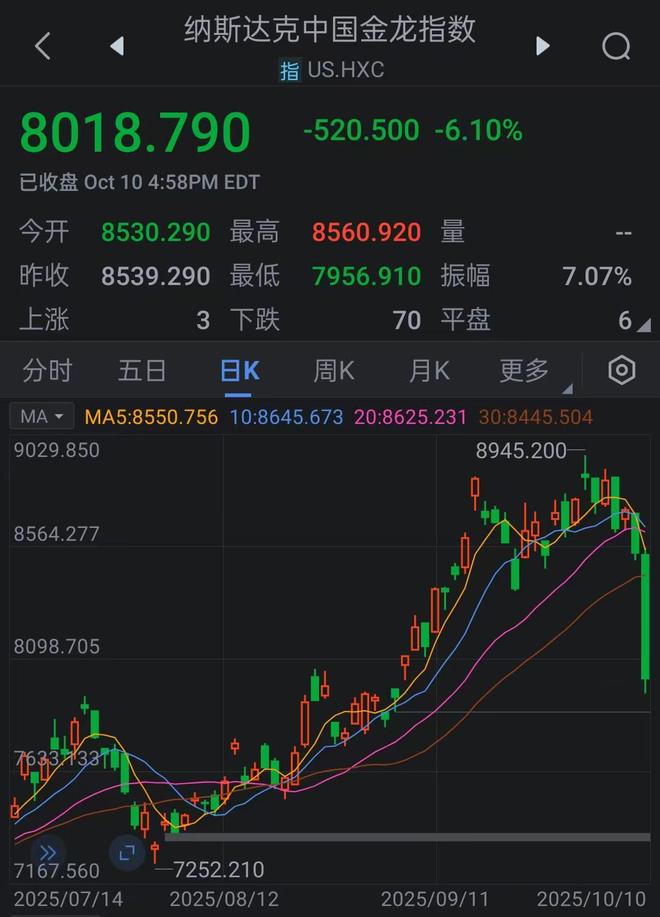
Market Overview - The three major U.S. stock indices experienced significant declines, with the Dow Jones falling by 1.9%, the Nasdaq dropping by 3.56%, and the S&P 500 decreasing by 2.71%. The Nasdaq and S&P 500 recorded their largest single-day declines since April [1] Sector Performance - Large-cap technology stocks saw widespread losses, with Broadcom down nearly 6%, Tesla falling over 5%, Amazon decreasing close to 5%, Nvidia dropping over 4%, and Apple, Meta, Microsoft, and Google all declining by more than 2% [1] - The semiconductor and cryptocurrency sectors faced the steepest declines, as evidenced by the Philadelphia Semiconductor Index plummeting by 6.32%. Notable declines included Circle down over 11%, Arm down over 9%, and AMD, Qualcomm, and Coinbase each down over 7% [1] Chinese Stocks - The Nasdaq Golden Dragon China Index fell by 6.1%, accumulating a weekly decline of 8.37%. Popular Chinese stocks also suffered, with NIO and Kingsoft Cloud both down over 10%, and Bilibili down over 9%. Other significant declines included Baidu, Alibaba, and Xpeng each down over 8%, and JD.com down over 6% [1]


热门中概股多数收跌 阿里跌超8%


Xin Lang Cai Jing· 2025-10-10 21:32
来源:滚动播报 周五热门中概股多数收跌,纳斯达克中国金龙指数跌6.1%。阿里跌超8%,拼多多跌超5%,网易跌超 3%,京东跌超6%,携程跌超1%,百度跌超8%,腾讯音乐跌超4%,富途跌超11%,小鹏跌超8%,蔚来 跌超10%,理想跌超3%,哔哩哔哩跌超9%。 ...
同样是电商,拼多多为什么比淘宝还要便宜?内行人道出了猫腻
Sou Hu Cai Jing· 2025-10-10 18:06
Core Insights - The article discusses the significant price differences between e-commerce platforms, particularly focusing on Pinduoduo's low pricing strategy compared to Taobao and JD.com. It explores the underlying factors contributing to these price disparities and consumer perceptions regarding them. Group 1: Price Discrepancies - A survey indicated that 78.3% of consumers compare prices across multiple e-commerce platforms before making a purchase, with over 65% expressing confusion about the reasons for price differences [1] - Pinduoduo's average prices are reported to be 15.5% lower than Taobao, with some products priced up to 50% less than competitors [1] Group 2: Supply Chain and Business Models - The difference in supply chain structures and business models is a key factor; Pinduoduo employs a "factory direct" model, reducing intermediaries and costs, while Taobao follows a "platform merchant" model with higher costs due to multiple intermediaries [3] - Data from the Supply Chain Management Association in 2025 shows that traditional e-commerce models involve an average of 2.8 intermediaries, each adding about 15% to the price, whereas Pinduoduo's model averages only 1.3 intermediaries, cutting the markup by nearly half [3] Group 3: Customer Acquisition Costs - Taobao's average customer acquisition cost ranges from 25 to 40 yuan, while Pinduoduo's is significantly lower at 8 to 15 yuan, allowing merchants to maintain profitability even with lower prices [4] - Pinduoduo's social sharing and group buying model has led to 62% of new users coming from referrals, saving approximately 70% on marketing costs compared to traditional advertising [4] Group 4: Target Demographics and Positioning - Taobao caters to a broader demographic, including higher-income consumers, while Pinduoduo primarily targets lower-income consumers in third and fourth-tier cities, focusing on basic necessities and low-priced goods [6] - Market research indicates that 63% of Pinduoduo's users are from lower-tier cities, with an average transaction value of 92 yuan, compared to Taobao's 238 yuan for urban consumers [6] Group 5: Quality and Service Standards - There is a noted difference in product quality and service levels, with Taobao achieving a product compliance rate of 93.2% compared to Pinduoduo's 88.7% [7] - Consumers have reported better experiences with higher-priced products on Taobao, reinforcing the notion that lower prices may correlate with lower quality [7] Group 6: Commission Structures - Taobao typically charges merchants a comprehensive fee rate of around 5-5%, while Pinduoduo's rate is approximately 2%, allowing for greater pricing flexibility [8] Group 7: Subsidy Strategies - Pinduoduo often employs subsidy strategies, sometimes selling products below cost to attract users, with reported spending of 8.7 billion yuan on subsidies in Q1 2025, accounting for 12.3% of its revenue [9] Group 8: Consumer Decision-Making - Consumers are advised to recognize the principle of "you get what you pay for," as lower prices may indicate differences in specifications, materials, or service [10] - It is recommended that consumers choose platforms based on their specific needs and the nature of the products, with a focus on quality for high-stakes purchases [10] - The importance of distinguishing between genuine low prices and misleading offers is emphasized, as well as considering total costs beyond just the product price [11] - Utilizing price comparison tools can help consumers save an average of 12.8% on shopping expenses [12]

US stock market down today: Nvidia, Apple, Tesla, Amazon, AMD, Levi Strauss among top losers as Trump targets China
The Economic Times· 2025-10-10 17:51
Market Overview - US stocks experienced a significant decline, with the Dow Jones Industrial Average falling 604 points (1.3%), the S&P 500 losing 1.9%, and the Nasdaq Composite dropping 2.7% following President Trump's tariff threat on Chinese imports [12][13]. Tariff Threat and Trade Relations - President Trump announced a potential "massive" increase in tariffs on Chinese products, citing China's recent restrictions on rare earth metals as a reason for the heightened tensions [2][3][13]. - The tightening of export controls by Beijing, requiring licenses for goods containing 0.1% or more of rare earth materials, has raised concerns about China's control over this critical resource [3][13]. Impact on Technology Sector - Technology stocks, heavily reliant on China for manufacturing and sales, were among the hardest hit, with AMD plunging over 6%, Tesla dropping more than 4%, and Nvidia losing more than 2% [6][12][13]. - The "Magnificent Seven" stocks, including Amazon and Apple, also saw declines, with Amazon tumbling more than 3% and Apple slipping 2% [6][12][13]. Performance of Other Companies - Mosaic and Levi Strauss were noted as top losers in the S&P 500, with Mosaic facing production issues at its plants and Levi Strauss warning that tariffs would negatively impact its current-quarter results [8][13]. - Chinese companies listed in the US, such as Alibaba and Baidu, experienced significant drops of about 8%, while JD.com and PDD Holdings fell 6.6% and 5.2%, respectively [9][13]. Broader Economic Context - The market sell-off coincided with the ongoing US government shutdown, which has entered its 10th day, contributing to negative investor sentiment [10][13].


Chinese stocks slide as Trump threatens tariffs, accuses Beijing of holding world ‘captive’
CNBC· 2025-10-10 16:59
Market Reaction - Chinese stocks listed in the U.S. experienced significant declines, with Alibaba and Baidu each falling approximately 8%, JD.com down 6.6%, and PDD Holdings decreasing by 5.2% [1] - The iShares MSCI China ETF, which tracks major Chinese companies in the U.S., dropped by 5.2% [1] Political Context - Former President Donald Trump threatened to increase tariffs on Chinese imports if he returns to office, citing China's "very hostile" stance [1] - Trump accused China of dominating the rare earth metals market, claiming it holds the world "captive" [2] - Beijing has recently tightened regulations on rare earth exports, requiring foreign companies to obtain government licenses for products containing 0.1% or more of rare earth elements [2] Investor Sentiment - The market reaction reflects heightened investor anxiety regarding escalating U.S.-China tensions, which have been characterized by disputes over trade, technology, and national security [1] - Mark Hackett, chief market strategist at Nationwide, noted that the market is currently driven by emotion and uncertainty, with investors adopting a wait-and-see approach [3] - Despite the recent pullback, the iShares MSCI China ETF remains up 32% for the year, indicating a strong rebound in Chinese stocks driven by signs of economic stabilization and renewed investor optimism [3]
深夜突发!全球资产暴跌!
证券时报· 2025-10-10 15:52
Market Overview - On October 10, U.S. stock markets experienced a significant drop, with the Dow Jones down 1.03%, S&P 500 down 1.53%, and Nasdaq down 2.24% [1][2] - The Nasdaq China Golden Dragon Index fell sharply by 4.28%, with major Chinese stocks like Kingsoft Cloud down over 9%, NIO, Bilibili, Alibaba, and Xpeng down over 7%, and Baidu, Futu Holdings, and JD down over 6% [2][3] Consumer Confidence and Inflation - The preliminary consumer confidence index from the University of Michigan for October is reported at 55, the lowest since May, slightly above the forecast of 54.2 and down from the previous value of 55.1 [2] - Current personal financial conditions and future business environment perceptions improved, but expectations for future personal finances and evaluations of current durable goods purchasing conditions declined, leading to a net neutral effect [2] - Short-term inflation expectations decreased from 4.7% to 4.6%, while long-term inflation expectations remained stable at 3.7% [3] International Markets - The FTSE A50 index futures dropped over 3%, and the Hang Seng Index futures fell nearly 4% [4][6] - European stock markets also declined, with the UK FTSE 100 down nearly 1%, and both the French CAC40 and Italian MIB indices down over 1% [8] Commodity Prices - International oil prices saw a significant decline, with WTI crude oil down over 3% and Brent crude oil down nearly 3% [9] - Conversely, international gold prices rebounded, with London gold and COMEX gold rising over 1% [9] Trade Relations - In response to U.S. restrictions on Chinese shipping and shipbuilding industries, China announced countermeasures, including special port fees for U.S.-flagged vessels, effective October 14 [7]


热门中概股中,阿里巴巴、百度、京东跌超6%
Mei Ri Jing Ji Xin Wen· 2025-10-10 15:44
Core Viewpoint - Major Chinese concept stocks experienced significant declines on October 10, with Alibaba, Baidu, and JD.com dropping over 6%, Pinduoduo falling by 4%, and Xpeng, NIO, and Bilibili decreasing by over 7% [1] Company Performance - Alibaba's stock declined by over 6% [1] - Baidu's stock also fell by over 6% [1] - JD.com experienced a drop exceeding 6% [1] - Pinduoduo's stock decreased by 4% [1] - Xpeng's stock fell by over 7% [1] - NIO's stock saw a decline of over 7% [1] - Bilibili's stock dropped by over 7% [1]
2025年全网十大小程序平台深度分析报告
Sou Hu Cai Jing· 2025-10-10 15:37
Market Overview - By 2025, China's mini-program market is expected to show significant head concentration and parallel development in vertical segmentation, with user scale and ecological maturity reaching historical highs [1] - The industry landscape has evolved from the early "WeChat, Alipay, Baidu" trio to a new "big three" of "WeChat, Alipay, Douyin," with leading platforms controlling core traffic entry while vertical fields and long-tail markets release structural growth opportunities [1][3] Leading Platforms and Competitive Barriers - The current mini-program market exhibits an "one super, two strong" oligopoly structure, with WeChat dominating due to its social ecosystem, while Douyin achieves rapid growth through content scenarios [3][4] - The combined market concentration of the top three platforms (CR3) reaches 71.6%, forming a diverse traffic matrix of "social entry (WeChat) + content entry (Douyin) + service entry (Alipay)" [3] Evolution of the Landscape: Marginalization of Baidu's Search Entry Model - The early dominance of "WeChat, Alipay, Baidu" has weakened due to the replacement of search-based interaction with scenario-based interaction [4] - WeChat mini-programs have over 1 billion monthly active users, accounting for over 85% of the domestic market share, with an average daily usage frequency of nearly 70 times [4] - Douyin mini-programs have 283 million monthly active users, with an annual growth rate of 65%, capturing a market share of 22% by 2024 [4] - Alipay mini-programs maintain 890 million monthly active users, focusing on payment scenarios and commercial services, but with relatively slow growth [4] Core Conclusions - The mini-program market in 2025 will exhibit a dual-track feature of "strengthened head concentration and active long-tail innovation" [5] - Leading platforms are building competitive barriers through traffic ecosystems, while low-code technology and vertical scene innovation provide breakout paths for smaller players [5] Ranking and Core Analysis of Major Mini-Program Platforms - WeChat mini-programs lead the ecosystem with over 1 billion monthly active users, capturing over 85% of the market share, and achieving a daily active user count of 600 million [6] - Douyin mini-programs have 283 million monthly active users, with a daily usage time of 2.3 hours, benefiting from the integration of content and commerce [18] - Alipay mini-programs have 890 million monthly active users, focusing on life service scenarios and maintaining a high trust level [14] User Behavior and Scene Penetration - WeChat mini-programs cover over 200 industries, with a user behavior pattern showing a balance among entertainment, consumption, and service [13] - Douyin mini-programs leverage short video content to drive high conversion rates, with an average conversion rate of 8.2% [24] Vertical Platform Rise - Platforms like Kuaishou, Xiaohongshu, and Pinduoduo are building differentiated ecosystems based on specific scenarios, with Pinduoduo's mini-programs focusing on the lower-tier market and achieving a 210% year-on-year growth in Q1 2025 [12] - The low-code technology market is expected to exceed 10 billion by 2025, significantly lowering the entry barrier for small and medium enterprises [12] Government Services and Digital Transformation - The government service mini-programs have achieved nationwide coverage, integrating over 300 high-frequency services, and significantly improving service efficiency [50][51] - The average processing time for government services has been reduced by 75%, with a 90% reduction in the number of visits required [51] Industry Trends and Challenges - The industry is undergoing a technological transformation driven by AI and immersive experiences, with 30% of mini-programs adopting intelligent customer service [53] - Regulatory pressures are increasing, with compliance costs rising as the industry enters a "strong compliance era" [54]