Workflow
POP MART(PMRTY)
icon
Search documents
泡泡玛特年初至今股价涨约186%!买LABUBU比买黄金还赚钱,哪些 “投资猎手” 提前抓住这波新消费风口?基金狂买"塑料茅台",21家机构给出“买入”评级
Sou Hu Cai Jing· 2025-06-11 06:59
Core Viewpoint - The surge in popularity of LABUBU has led to significant price increases in the secondary market, with some items being sold for thousands of yuan, resulting in high premiums for Pop Mart's stock, which has been humorously referred to as "plastic Moutai" [1][16] - Pop Mart's stock price reached a historical high of 262 HKD, with a market capitalization exceeding 336.8 billion HKD, reflecting a more than 23-fold increase since its low in 2022 and a 186% rise year-to-date [1][3] Market Performance - Deutsche Bank raised its target price for Pop Mart from 200 HKD to 303 HKD, citing a potential market size larger than previously estimated [3] - As of June 10, 2023, Pop Mart's stock price has increased over 23 times from its 2022 low, with a year-to-date increase of approximately 186% [1] Institutional Ratings - In the past month, 21 institutions have given Pop Mart a "buy" rating, indicating strong institutional interest [3] - The latest ratings show 26 institutions with a "buy" rating, 21 with "hold," and 3 with "neutral" [4] Fund Holdings - As of Q1 2025, 270 funds held a total of 68.75 million shares of Pop Mart, with a total market value of 9.93 billion CNY [5] - The top fund holding Pop Mart shares is Invesco Great Wall Quality Evergreen Mixed Fund, with 3.22 million shares valued at 465 million CNY [5][7] Fund Activity - The number of funds holding Pop Mart shares increased by 78.45% compared to the previous period, with a significant rise in the number of funds increasing their holdings [6] - The total market value of fund holdings in Pop Mart reached approximately 992.91 million CNY, reflecting a 107.27% increase [6] Investment Trends - The current investment trend shows a growing number of public funds investing in Pop Mart, with 116 funds holding shares by the end of 2024, compared to only 36 at the beginning of that year [7] - The analysis indicates that funds that have consistently held Pop Mart shares since 2021 have benefited significantly from the stock's performance [8] Future Outlook - Analysts predict that Pop Mart's strong IP supply, particularly with LABUBU, will drive significant growth, with overseas sales expected to increase by 152% in 2025 [17] - The shift in consumer behavior towards personalized and rational consumption is expected to support the growth of new consumption trends, benefiting companies like Pop Mart [17]
大摩:泡泡玛特更长期的规模潜力还未被市场挖掘,北美有望超过中国市场
Hua Er Jie Jian Wen· 2025-06-11 06:32
Core Insights - The report by Morgan Stanley highlights the exponential growth of Pop Mart in North America and Europe, driven by viral marketing and social media, with sales expected to rise from $3.6 billion in 2025 to $6 billion by 2027, making it one of the fastest-growing consumer brands globally [1][3]. Group 1: Market Performance - Morgan Stanley raised Pop Mart's target price from HKD 224 to HKD 302, reflecting a 35% increase while maintaining an "Overweight" rating [3]. - The overseas growth of Pop Mart is significantly attributed to the "social media tailwind effect," with products like Labubu becoming viral sensations after being showcased by celebrities [4][6]. Group 2: Product Strategy - The Labubu series, launched at the end of 2023, ignited market enthusiasm and is expected to contribute 28% of revenue in 2024, with a fourth generation of products anticipated by late 2025 or early 2026 [7]. - Other IPs like Molly and Dimoo are also performing well, indicating that Pop Mart's diverse IP matrix provides broader growth opportunities [9]. Group 3: New Business Ventures - Pop Mart is expanding beyond toys with new ventures like Pop Land (an IP-themed amusement park) and POPOP (fashion jewelry), which are seen as significant long-term value drivers [10]. - The Pop Land project in Beijing has already turned a profit, with annual revenue projected between RMB 300 million to 500 million, and plans for expansion are underway [10][11]. Group 4: Future Growth Potential - The North American and European markets are expected to be key growth engines for Pop Mart, with North American sales projected to reach levels comparable to the Chinese market by 2028-2029 [12]. - Starting from mid-April 2024, Pop Mart will increase the pricing of new products in North America by 80-100%, with an expected gross margin of 75%, showcasing its global potential despite potential tariff pressures [14].
全球唯一薄荷色Labubu拍出124.2万元天价 ,泡泡玛特市值突破3476亿港元
Sou Hu Cai Jing· 2025-06-11 06:02
Group 1 - The first auction of the original collectible Labubu art pieces took place, with a unique mint green Labubu selling for 1.242 million yuan, setting a new record for trendy toy auctions [1][3] - The auction featured a total of 48 lots, achieving a 100% sell-through rate and a total transaction amount of 3.7254 million yuan [3] - The buyer of the mint green Labubu expressed confidence in the future appreciation of this non-standard art piece [3] Group 2 - Labubu's popularity has significantly increased the wealth of its creator, Wang Ning, who became the richest person in Henan with a net worth of 20.3 billion USD, largely due to the rising stock price of Pop Mart [4][7] - Pop Mart's stock price surged from 19.8 HKD to 258.8 HKD, representing a cumulative increase of over 10 times, with a market capitalization exceeding 347.6 billion HKD [4][5] - In 2024, Pop Mart reported revenue of 13.04 billion yuan, a year-on-year increase of 106.9%, with the THE MONSTERS series, including Labubu, generating 3.04 billion yuan, a staggering increase of 726.6% [7] Group 3 - Labubu's phenomenon extends beyond financial metrics, as it has successfully integrated modern trendy elements with traditional craftsmanship, exemplified by the "Zan Hua Labubu" project [8] - The LABUBU3.0 series has seen significant international demand, with sales in Europe and the US increasing by over 800% [8] - Concerns have been raised regarding the sustainability of the trendy toy IP lifecycle, with industry experts noting that new IP development is crucial before Labubu's popularity wanes [8] Group 4 - The current market valuation of Pop Mart, with a price-to-earnings ratio exceeding 98 times, raises questions about the sustainability of its valuation compared to international peers like Sanrio and Hasbro [8] - The Labubu phenomenon reflects a shift in consumer behavior among Generation Z, moving from material possession to emotional resonance and identity recognition [8] - Recent actions against counterfeit Labubu products highlight the commercial value of authentic IP, with Pop Mart actively building a robust intellectual property barrier [8]
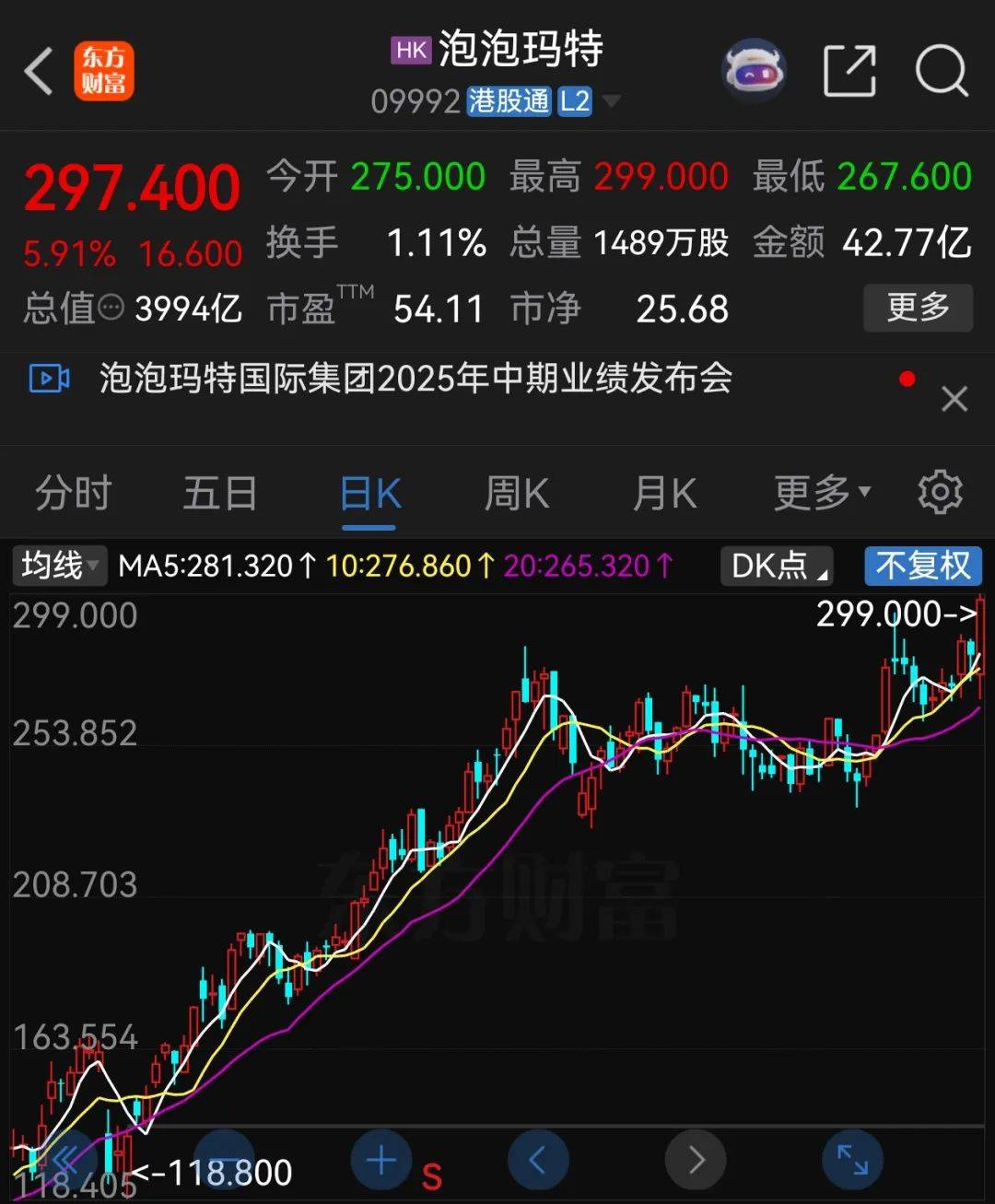
6月11日电,港股泡泡玛特午后涨超4%,股价续创历史新高,成交额超33亿港元。
news flash· 2025-06-11 05:49
智通财经6月11日电,港股泡泡玛特午后涨超4%,股价续创历史新高,成交额超33亿港元。 ...
泡泡玛特证明了,情绪价值到底多值钱丨小白商业观
Jing Ji Guan Cha Wang· 2025-06-11 04:08
Core Insights - Wang Ning and his company Pop Mart (09992.HK) have achieved remarkable success, with his wealth reaching $20.8 billion, ranking him 10th in China and 101st globally as of June 9 [2] - Pop Mart's stock price has surged 174% this year, and over 11 times since the beginning of 2024 [2] - The LABUBU toy has become a cultural phenomenon among young consumers, indicating the significant impact of trend culture [2][3] Market Performance - Pop Mart's sales in the U.S. reached $6-7 million in April, making it the top-selling brand in that region [3] - The company's app topped the shopping charts in the U.S. Apple Store, demonstrating strong consumer engagement [3] Consumer Behavior - Young consumers are increasingly valuing emotional connections and brand significance over mere functionality in products [3][4] - The blind box mechanism creates anticipation and excitement, while limited editions enhance desirability [4] Business Model - Pop Mart's competitive advantage lies in its deep exploration of IP value and emotional attachment, transforming toys into symbols of identity [4] - The company is expanding its product range beyond toys to include various categories like apparel and cultural content, aiming to create a comprehensive emotional economy [4] Industry Trends - The rise of Pop Mart reflects a shift towards a new consumption era, where understanding the needs of the younger generation is crucial for business sustainability [5]
鹏华基金重仓泡泡玛特的基金经理工位引热议: 潮玩投资OR资本套现?
Xin Lang Ji Jin· 2025-06-11 03:53
Core Viewpoint - The investment decision by Penghua Fund manager Xie Tianyuan to heavily invest in Pop Mart has sparked discussions, with mixed opinions on the necessity and potential of such an investment in a non-essential product [1][7]. Group 1: Manager Background and Investment Strategy - Xie Tianyuan, born in 1995 in Beijing, has a strong background in business, holding both undergraduate and master's degrees in the field. He has a deep interest in anime, video games, and IP culture, which reflects in his investment choices [1][5]. - The fund managed by Xie, "First Class," has a significant position in Pop Mart, which is its largest holding. His investment philosophy focuses on "long-term growth potential + short-term market conditions," targeting stocks with substantial growth even in a weak consumption environment [1][12]. Group 2: Performance Metrics - Xie Tianyuan's Penghua Optimal Return Fund has achieved a return rate of 42.53% since his tenure began, with an asset size of 0.51 billion yuan. This performance significantly outpaces the benchmark index [9][10]. - The fund's strategy includes identifying new consumption companies with low penetration rates and potential for market expansion, particularly in the trendy toy sector [12]. Group 3: Market Reactions and Opinions - The investment in Pop Mart has led to varied reactions from the public, with some questioning the rationale behind investing in a non-essential product, while others support the decision, emphasizing the importance of understanding the trendy toy market [7][8]. - Xie has articulated three key insights regarding new consumer investments, emphasizing that emotional value is not exclusive to Generation Z, the unpredictable nature of new trends, and the importance of sustained demand over perceived authenticity [6].
两种IP模型揭秘:形象IP泡泡玛特VS故事IP迪士尼漫威
3 6 Ke· 2025-06-11 00:43
Core Perspective - The article explores the dichotomy between "story-driven" IPs, exemplified by Disney, and "image-driven" IPs, represented by Pop Mart, highlighting their different approaches to emotional connection and consumer engagement [1][5][30] Group 1: Story-driven IPs - Story-driven IPs, like those from Disney and Marvel, create expansive narrative universes over decades, fostering deep emotional connections with characters and plots, which enhances consumer loyalty and engagement [3][6][8] - Disney's "Frozen" serves as a prime example, where the emotional arcs of characters like Elsa and Anna resonate deeply with audiences, transforming consumer purchases into support for the characters' journeys [8][20] - The business model for story-driven IPs involves a long-term cycle of content creation, merchandise, and immersive experiences, requiring significant investment and time to build a robust narrative ecosystem [6][20][23] Group 2: Image-driven IPs - Image-driven IPs, such as Pop Mart, focus on visual appeal and emotional projection rather than complex narratives, allowing consumers to project their feelings onto characters like Molly and LABUBU [10][12][13] - The success of image-driven IPs relies on operational agility, frequent design updates, and social media engagement, positioning them as trendy cultural symbols rather than traditional storytelling vehicles [12][13][25] - Pop Mart's evolution from reliance on a single IP to a diverse IP matrix demonstrates its operational capabilities, with projections indicating significant growth in the collectible toy market [15][16] Group 3: Comparative Analysis - A comparative analysis reveals that story-driven IPs offer long-term emotional engagement and high-value derivatives, while image-driven IPs provide quick market responses and social currency [18][19][28] - Story-driven IPs tend to have a longer lifecycle and deeper emotional barriers, while image-driven IPs face challenges of shallow emotional connections and shorter lifespans [20][28] - Both types of IPs are converging towards a common goal of emotional connection, with story-driven IPs adopting visual elements and image-driven IPs incorporating narrative aspects to enhance consumer engagement [30][32]
没有LABUBU的52TOYS,距离泡泡玛特还有多远?
Hu Xiu· 2025-06-10 23:58
Core Viewpoint - The article discusses the competitive landscape of the collectible toy industry, focusing on the contrasting positions of Pop Mart and 52TOYS, highlighting the challenges 52TOYS faces in replicating Pop Mart's success in terms of brand recognition, sales channels, and profitability [1][12][18]. Group 1: Market Position and Performance - Pop Mart has achieved significant market success with a market capitalization close to HKD 350 billion, driven by popular IPs like LABUBU [1]. - 52TOYS has submitted its prospectus for an IPO in Hong Kong and has secured new financing from notable investors, indicating strong market interest [2][3]. - In terms of GMV, 52TOYS ranks third among Chinese IP toy companies, with a market share of only 1.2%, compared to Pop Mart's 11.5% [3][4]. Group 2: IP Strategy and Revenue Structure - 52TOYS employs a dual strategy of developing its own IPs while also relying heavily on licensed IPs, with 64.5% of its revenue coming from licensed IPs in 2024 [4][14]. - The company has 35 proprietary IPs and 80 licensed IPs, but its reliance on licensed IPs has led to a decline in the contribution of proprietary IPs to revenue [4][5]. - The absence of blockbuster proprietary IPs has resulted in lower sales and market differentiation, as seen with the performance of its self-developed IPs compared to licensed ones like Crayon Shin-chan [5][14]. Group 3: Sales Channels and Distribution - 52TOYS has a limited number of direct retail stores, with only 8 locations across five cities, contrasting sharply with Pop Mart's 401 stores [9][10]. - The sales structure of 52TOYS is heavily reliant on distributors, with over 60% of sales coming from this channel, which limits direct consumer engagement [10][11]. - The company's slow expansion in direct retail stores hampers its ability to create a strong brand presence and customer loyalty compared to competitors [10][11]. Group 4: Financial Performance and Profitability - 52TOYS reported revenues of CNY 630 million in 2024, significantly lower than Pop Mart's CNY 13.038 billion, highlighting a stark revenue disparity [12][18]. - The gross margin for 52TOYS has fluctuated between 28.9% and 40.5%, while Pop Mart maintains a gross margin of 66.8%, indicating a significant profitability gap [13][14]. - The high cost structure of 52TOYS, driven by reliance on licensed IPs and a diverse product range, further erodes its profitability [14][15]. Group 5: Challenges and Industry Insights - The article emphasizes that the collectible toy industry has high barriers to entry, requiring a combination of proprietary blockbuster IPs, customer loyalty, and effective distribution channels for sustained growth [17]. - The challenges faced by 52TOYS in replicating Pop Mart's success are not just about product offerings but also involve fundamental differences in brand strategy and market approach [18].
泡泡玛特股价一年涨超11倍
Shen Zhen Shang Bao· 2025-06-10 22:33
Group 1 - The core point of the article highlights the explosive popularity of Labubu, a brand under Pop Mart, which has significantly boosted the company's stock price, increasing over 11 times since the beginning of 2024 [2] - Pop Mart's latest financial report shows a revenue of 13.04 billion yuan for 2024, representing a year-on-year growth of 106.9%, and an adjusted net profit of 3.4 billion yuan, up 185.9% year-on-year [2] - The overseas and Hong Kong-Macau business segment generated revenue of 5.07 billion yuan, marking a staggering growth of 375.2% [2] Group 2 - The article mentions that Labubu has become a social media phenomenon and that the release of its 3.0 products has led to long queues at global stores [2] - Banks in China have started offering Labubu figures as incentives for deposits, indicating a shift in strategies to attract younger customers [2] - Experts caution that while Pop Mart has shown significant growth, many new consumer stocks have become overheated, with some trading at price-to-earnings ratios around 100, suggesting potential risks for investors [3]
泡泡玛特王宁成河南新首富,坐拥203亿美元,透露什么财富密码?
Sou Hu Cai Jing· 2025-06-10 16:46
Group 1 - Wang Ning, the founder of Pop Mart, has become the new richest person in Henan, surpassing Qin Yinglin of Muyuan Foods, with a net worth of $20.3 billion compared to Qin's $16 billion [1] - The rise of Pop Mart indicates a shift in wealth from traditional industries, such as pig farming, to new retail sectors focused on trendy consumer products like collectible toys and blind boxes [1][3] - The changing consumption patterns among younger generations suggest that traditional necessities are no longer the primary focus of spending, with younger consumers prioritizing fun and novelty in their purchases [3][5] Group 2 - The wealth distribution in society is heavily skewed towards older generations, which has led to stagnation in overall consumer spending, as they tend to focus on traditional consumption categories [5] - The future of retail and consumer spending is expected to be driven by interesting and novel products that appeal to younger consumers, rather than traditional assets like real estate or automobiles [5][6] - Investing in innovative and engaging brands within the new retail concept is seen as a key opportunity for future wealth creation, as exemplified by Wang Ning's success with Pop Mart [8]