Qualcomm(QCOM)

Search documents
富国银行上调高通评级至“与大盘持平” 目标价升至150美元

Ge Long Hui A P P· 2026-02-24 13:00
Group 1 - Wells Fargo upgraded Qualcomm's rating from "Underperform" to "Market Perform" [1] - The target price for Qualcomm was raised from $135 to $150 [1]
Stock Index Futures Mixed With Focus on Trump’s SOTU Address and U.S. Economic Data
Yahoo Finance· 2026-02-24 11:29
Economic Indicators - U.S. rate futures indicate a 95.9% probability of no rate change and a 4.1% chance of a 25 basis point rate cut at the March FOMC meeting [1] - The U.S. Conference Board's Consumer Confidence Index is expected to rise to 87.4 in February from 84.5 in January [6] - The U.S. Richmond Fed Manufacturing Index is anticipated to come in at -8 for February, compared to -6 previously [7] Stock Market Performance - Wall Street's main stock indexes ended lower, with IBM dropping over 13% after AI startup Anthropic announced a tool that could modernize programming languages used on IBM systems [3] - Capital One Financial and JPMorgan Chase saw declines of more than 8% and 4% respectively, amid concerns about the economic impact of AI [3] - PayPal Holdings rose over 5% after reports of takeover interest from potential buyers [3] Corporate Earnings - Home Depot, Constellation Energy, and other notable companies are set to release quarterly results [9] - Keysight Technologies surged over 16% in pre-market trading after posting strong FQ1 results and guidance [14] - Vir Biotechnology jumped over 65% in pre-market trading following a licensing agreement with Astellas Pharma [15] Global Trade and Tariffs - President Trump's new 10% global tariffs took effect, with plans for a potential increase to 15% [5] - The European Union has paused the ratification of its trade deal with the U.S. due to uncertainties surrounding the new tariffs [11] - China has called for the U.S. to eliminate unilateral tariffs while expressing willingness for further trade talks [12]


Qualcomm–Tata tie-up for automotive module manufacturing
Yahoo Finance· 2026-02-23 11:47
Core Insights - Qualcomm Technologies and Tata Electronics have formed a partnership to manufacture Qualcomm Automotive Modules at Tata's semiconductor facility in India, enhancing the global network of module manufacturing partners [1][2] Group 1: Manufacturing and Investment - Production of Qualcomm Automotive Modules will take place at Tata Electronics' new semiconductor assembly and test facility in Assam, aligning with India's "Make in India" initiative and diversifying semiconductor supply chains [2][4] - Tata Electronics is investing $3 billion in its Jagiroad plant, which is touted as India's first indigenous OSAT facility, focusing on advanced packaging technologies for automotive and other applications [4][5] Group 2: Strategic Importance - The collaboration is a significant milestone in Qualcomm's automotive growth strategy, as the industry shifts towards integrated, module-based architectures, necessitating expanded manufacturing capacity in key regions [3][6] - Local manufacturing aims to serve both Indian and international automakers, enhancing supply-chain resilience and geographic diversification [4][5] Group 3: Technological Collaboration - Qualcomm's Automotive Modules integrate Snapdragon Digital Chassis system-on-chips with essential components for applications such as digital cockpits and intelligent vehicle functions [3][4] - Qualcomm has also announced a letter of intent with Volkswagen Group for a long-term supply arrangement focused on advanced infotainment and connectivity features powered by Snapdragon Digital Chassis solutions [6][7]
全球半导体TOP10,谁主沉浮
3 6 Ke· 2026-02-23 04:03
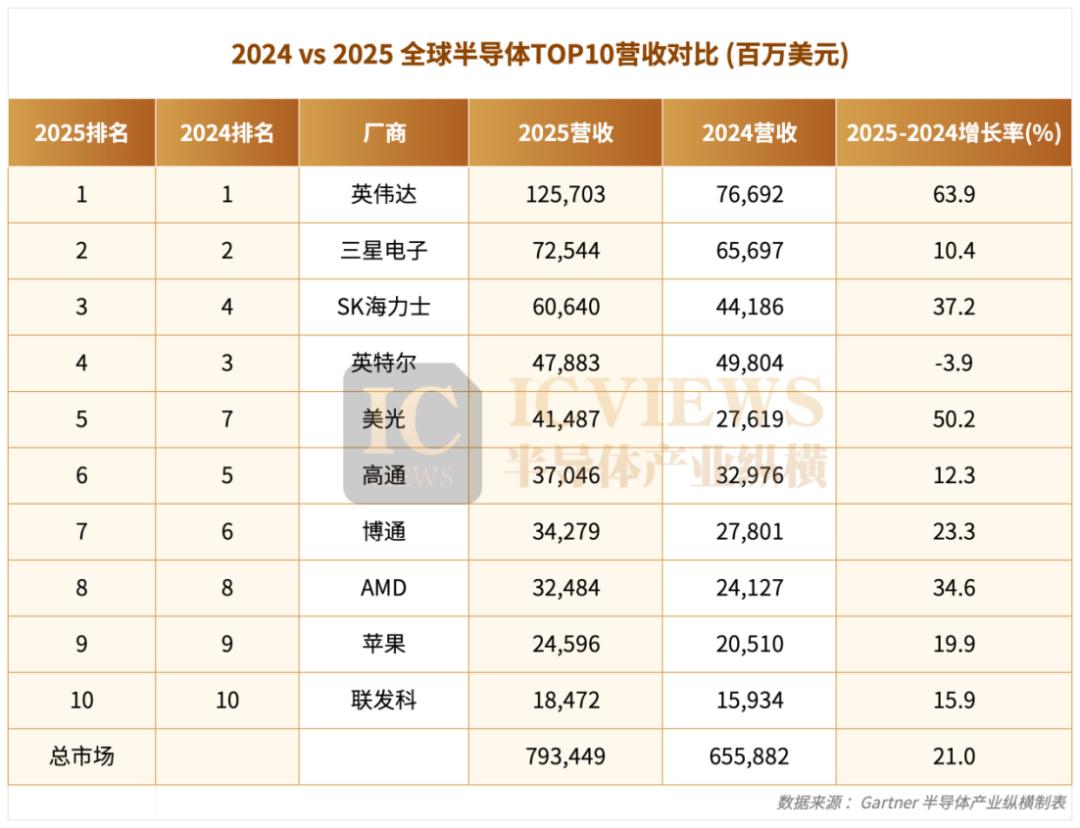
Core Insights - The global semiconductor industry is experiencing a historic turning point in 2025, with total revenue reaching $793 billion, a 21% year-on-year increase, signaling a fundamental shift in growth logic driven by AI infrastructure [1][6]. Group 1: Market Dynamics - Nvidia leads the semiconductor market with $125.7 billion in revenue, a 63.9% increase, marking the first time a company has surpassed $100 billion in annual revenue [6][4]. - Samsung Electronics and SK Hynix follow, with revenues of $72.5 billion and $60.6 billion, respectively, reflecting growth rates of 10.4% and 37.2% [4][6]. - Intel's revenue declined by 3.9%, dropping from third to fourth place, with a market share of only 6%, half of what it was in 2021 [7][8]. Group 2: Key Growth Drivers - The demand for High Bandwidth Memory (HBM) is driving growth, with HBM sales exceeding $30 billion and accounting for 23% of the DRAM market in 2025 [7][13]. - Companies like Nvidia, AMD, SK Hynix, and Micron are benefiting significantly from the data center and AI sectors, with Nvidia alone contributing over 35% to the industry's total growth [6][13]. - Broadcom reported a 28% revenue increase in Q4, driven by a 74% rise in AI semiconductor sales, indicating a strong correlation between AI and revenue growth [13]. Group 3: Strategic Shifts - Nvidia's success is attributed to its "software-defined hardware" approach, creating high entry barriers through its CUDA ecosystem, which integrates hardware, software, and developer communities [10]. - Vertical integration is making a comeback, with Apple and Samsung leveraging their strengths in chip design and manufacturing to create robust ecosystems [11]. - The semiconductor industry's value chain is shifting towards design and IP value, moving away from traditional manufacturing and scale advantages [19]. Group 4: Historical Comparison - Comparing 2015 to 2025, Intel's revenue has decreased from $51.4 billion to $47.9 billion, while Nvidia has risen from not being in the top 10 to $125.7 billion, highlighting a significant shift in market leadership [18][19]. - The top 10 semiconductor companies in 2025 include more fabless and design-driven firms, indicating a transition in the industry towards application and software-defined solutions [19]. Group 5: Future Outlook - The semiconductor landscape is expected to evolve further, with companies like Google and Amazon developing custom AI chips that may challenge Nvidia's dominance [20][21]. - The shift of AI from cloud to edge devices, such as smartphones and cars, presents new growth opportunities for mobile chip giants like Qualcomm and MediaTek [21].


玻璃,革命芯片?
Zhi Tong Cai Jing· 2026-02-22 02:17
Core Insights - The semiconductor industry is shifting focus from miniaturization of individual chips to the integration of multiple smaller units, known as Chiplets, due to physical limitations in chip size and yield issues [2][6][9] - The demand for larger AI models necessitates an increase in transistor count on chips, leading to a need for larger chip sizes, which is constrained by current lithography technology [5][6] - The industry is exploring new materials and architectures, particularly glass substrates, to overcome the limitations of organic substrates and silicon interconnects [24][28][33] Group 1: Chiplet Architecture - Chiplet architecture allows for the assembly of smaller chips, improving yield and reducing costs while enabling the use of different manufacturing processes for various components [9][10] - The communication between Chiplets must be efficient; otherwise, the benefits of separating chips could be negated [10][11] - Companies like NVIDIA and Intel are already implementing Chiplet designs in their products, such as NVIDIA's Blackwell and Intel's Ponte Vecchio [9] Group 2: Material Limitations - Organic substrates have dominated the market for 25 years but are now facing challenges in high-performance applications, particularly in AI chips [15][16][20] - Silicon interconnects provide superior performance but come with high costs and resource constraints, leading to a bottleneck in production capacity [21][22][49] - Glass substrates are being explored as a potential solution, offering advantages in thermal expansion matching and signal integrity [28][29][30] Group 3: Glass Substrate Development - Two main approaches for glass substrates are emerging: replacing the interconnect layer with glass and using glass as a substrate itself [26][27] - Glass has shown superior performance in thermal expansion and signal loss compared to organic materials, making it a promising alternative [28][29] - However, challenges such as fragility, thermal conductivity, and power noise must be addressed before glass can be widely adopted [31][32][33] Group 4: Competitive Landscape - Intel has invested heavily in glass substrate technology and holds a significant number of patents, but recent leadership changes raise questions about its future in this space [36][38] - Samsung is pursuing a vertically integrated approach to glass substrate production, but quality issues have been reported with their prototypes [39] - Other companies, such as Absolics, are also entering the market but face challenges in securing large customers for their products [40] Group 5: Industry Dynamics - The semiconductor industry is at a crossroads, with multiple technologies competing for dominance in the substrate and interconnect space [52][53] - The future will depend on the ability to achieve high production yields and meet the demands of AI chip growth, with no clear winner emerging yet [35][58] - The ongoing developments in both glass and organic materials will shape the competitive landscape, with significant implications for production capabilities and market dynamics [57][60]


Tech Corner: QCOM's AI Role & Post-Apple Outlook
Youtube· 2026-02-21 18:00
Core Viewpoint - Qualcomm is a leading technology company focused on developing and commercializing foundational technologies for the wireless industry, with a strong emphasis on integrated circuits and system software for various applications [2][3]. Company Overview - Qualcomm operates through three primary segments: QCT (Qualcomm Communications Technologies), QTL (Technology Licensing), and Strategic Initiatives [2]. - The QCT segment develops integrated circuits and software for mobile devices, automotive systems, and IoT devices, while the QTL segment focuses on licensing Qualcomm's extensive patent portfolio essential for wireless technologies like 5G [3]. Financial Performance - In its fiscal Q1 earnings, Qualcomm reported earnings of $3.50 per share, exceeding estimates by $0.10, and revenues of $12.25 billion, which is a 17% increase year-over-year [7][8]. - Despite beating expectations, the stock reacted negatively due to lowered Q2 guidance, with revenue estimates revised down by $600 million to $10.6 billion [8][9]. - The automotive segment achieved record revenue of over $1 billion, up 14.6% year-over-year, while IoT revenue grew 9% year-over-year [10][11]. Market Position and Competition - Qualcomm faces competition from companies like Broadcom, ARM Holdings, Nvidia, Intel, and AMD, which provide various semiconductor products [4][5]. - The company maintains a strong market share in Apple's iPhone lineup, expected to be around 70%, despite potential future losses from Apple's own modem technologies [12][16]. Strategic Focus - Qualcomm's strategic focus on artificial intelligence enhances its position in delivering high-performance, low-power solutions across various industries, including data centers [6][11]. - The acquisition of Alpha Wave aims to bolster Qualcomm's capabilities in data centers and AI infrastructure [12]. Valuation Metrics - Qualcomm's stock is trading below its historical 5-year PE ratio of approximately 14.55%, with a current PE of less than 13 times, indicating potential value for institutional investors [13][15]. - Forward revenue growth is projected at only 4.3%, below the historical average of over 11%, while EBITDA growth is expected to exceed 9% [14]. Risks and Challenges - The company faces challenges in the handset market, particularly due to reliance on the cyclical mobile phone market and potential revenue losses from Apple [15][16]. - Licensing revenue is projected to decline, with guidance for fiscal Q2 set between $1.2 billion and $1.4 billion, impacted by supply constraints [17][18]. Technical Analysis - Qualcomm's stock has shown a bearish trend, underperforming the S&P 500 and trading below its 200-day moving average [19][20]. - Despite the negative trend, there are signs of potential upside momentum as indicated by the weekly RSI and MACD [21][22]. Future Outlook - Qualcomm's diversification into automotive and IoT segments is expected to drive growth, offsetting potential losses from the handset market [23][24]. - The company's focus on energy-efficient AI chips and strategic acquisitions positions it well for future competitive advantages and shareholder returns [24].

Morgan Stanley Warns QUALCOMM Incorporated (QCOM) Upside Largely Priced In at Current Levels
Insider Monkey· 2026-02-20 18:20
Core Insights - Generative AI is viewed as a transformative technology by Amazon's CEO Andy Jassy, indicating its potential to significantly enhance customer experiences across the company [1] - Elon Musk predicts that by 2040, humanoid robots could create a market worth $250 trillion, representing a substantial shift in the global economy driven by AI innovation [2][3] - Major firms like PwC and McKinsey acknowledge the potential of AI to unlock multi-trillion-dollar opportunities, reinforcing the optimistic outlook on AI's economic impact [3] Company and Industry Analysis - A breakthrough in AI technology is believed to be redefining work, learning, and creativity, leading to increased interest from hedge funds and top investors [4] - There is speculation about an under-owned company that may play a crucial role in the AI revolution, suggesting that its technology could pose a threat to competitors [4][6] - Prominent figures in technology and investment, including Bill Gates and Warren Buffett, recognize AI as a significant advancement with the potential for broad societal benefits [8]

LPDDR 6时代来临!AI需求太猛 下一代DRAM将比预期更快进入市场
智通财经网· 2026-02-20 11:00
Core Insights - The next-generation low-power DRAM (LPDDR6) is entering the market at an accelerated pace, driven by the surging demand for high-performance and efficient DRAM in the server and AI sectors [1][2] - Major semiconductor design companies are discussing the simultaneous adoption of LPDDR5X and LPDDR6 IP, with companies like Samsung Electronics and Qualcomm planning to support LPDDR6 in their next-generation products [1] - The explosive growth of AI applications is the primary driver for the increased demand for LPDDR6, particularly in smartphones and AI data centers [1][2] Performance and Commercialization - LPDDR6 offers a significant performance upgrade, with bandwidth reaching 10.6Gbps to 14.4Gbps, representing an approximate 1.5 times improvement over the previous LPDDR5X, which had a bandwidth range of 8.5Gbps to 10.7Gbps [3] - Full commercialization of LPDDR6 is expected to take time, with necessary infrastructure like PHY, controllers, and interface IP not yet fully prepared, aiming for commercial availability by the second half of this year [3] - Current achievable performance for LPDDR6 is around 12.8Gbps, with expectations to reach 14.4Gbps by next year [3] Adoption Trends - LPDDR is a DRAM standard that emphasizes energy efficiency compared to general DDR, with the 7th generation LPDDR5X already in commercial use and LPDDR6 finalized in July of last year [3] - A significant number of AI and high-performance computing semiconductor design companies are advancing plans to adopt LPDDR6, initially integrating LPDDR5X and upgrading to LPDDR6 once mass production is achieved [3][4] - Over half of high-performance semiconductor design companies are considering parallel adoption of LPDDR5X and LPDDR6 IP, particularly in designs for advanced process chips at 4nm and below, with demand exceeding expectations [4]
LPDDR 6时代来临!AI需求太猛,下一代DRAM将比预期更快进入市场
Hua Er Jie Jian Wen· 2026-02-20 10:16
Core Insights - The next-generation low-power DRAM (LPDDR6) is entering the market at an accelerated pace, driven by the surging demand for high-performance and efficient DRAM in the server and AI sectors [1][2] - Major semiconductor design companies are discussing the simultaneous adoption of LPDDR5X and LPDDR6 IP, with companies like Samsung and Qualcomm planning to support LPDDR6 in their next-generation products [1][4] - The explosive growth of AI applications is the primary driver for this transition, as both AI-enabled smartphones and data centers require enhanced DRAM performance [1][2] Performance and Commercialization - LPDDR6 offers a significant performance upgrade, with bandwidth reaching 10.6Gbps to 14.4Gbps, compared to LPDDR5X's range of 8.5Gbps to 10.7Gbps, representing an approximate 1.5 times improvement [3] - Although the basic standards for LPDDR6 have been established, full commercialization will take time, with supporting infrastructure like PHY, controllers, and interface IP not yet fully ready; commercialization is expected by the second half of this year [3] - Currently, LPDDR6 can achieve around 12.8Gbps performance, with expectations to reach 14.4Gbps by next year as companies push for IP development [3] Adoption in Advanced Process Chips - LPDDR is a DRAM standard that emphasizes energy efficiency compared to general DDR; the seventh generation LPDDR5X is already commercialized, while LPDDR6 was finalized last July [4] - Despite the incomplete supporting infrastructure, many AI and high-performance computing semiconductor design companies are advancing their plans to adopt LPDDR6, initially using LPDDR5X until LPDDR6 is mass-produced [4] - Over half of high-performance semiconductor design companies are considering parallel adoption of LPDDR5X and LPDDR6 IP, especially in designs for chips at 4nm and below, with demand growing faster than expected [4]
8 Most Promising Metaverse Stocks to Buy According to Hedge Funds
Insider Monkey· 2026-02-19 22:40
Industry Overview - The global metaverse market was valued at $105.40 billion in 2024 and is projected to grow at a compound annual growth rate (CAGR) of 46.4% from 2025 to 2030, reaching $936.57 billion by 2030 [2] - North America leads the VR and AR technologies market with a 42.8% share, driven by significant expenditures and widespread adoption [2] - Software accounts for 41.6% of the market revenue, with desktop platforms being the most frequently used [2] - The demand for cloud infrastructure, real-time rendering, and immersive applications is facilitating the scalable creation of interactive digital environments [2] Company Developments - Organizations are increasingly creating digital replicas of physical locations, which is driving demand for virtual land and customized spaces, especially in education and business [3] - Meta has purchased 350,000 NVIDIA H100 GPUs to support AGI and metaverse services, while Ansys launched SimAI to enhance engineering processes [4] - Cryptocurrencies and NFTs are transforming virtual business by enabling secure transactions and verifying ownership of digital assets, contributing to the development of a networked, immersive metaverse [4] Notable Collaborations - Meta and VictoryXR launched 130 digital twin university campuses in Europe, showcasing significant collaboration in the metaverse space [3] - Unity has partnered with Apple for spatial computing, while Vagon is enabling cloud-based 3D content streaming [3] - Capgemini is expanding Unity's digital twin development, further enhancing the metaverse ecosystem [3] Investment Insights - The article identifies metaverse-related stocks from ETFs like the iShares Future Metaverse Tech and Communications ETF, focusing on those with positive analyst upside [7] - The methodology ranks stocks based on the number of hedge fund holders as of Q3 2025, including both pure-play metaverse companies and those with significant exposure to the space [7] - Research indicates that imitating top stock picks from hedge funds can lead to market outperformance, with a reported return of 427.7% since May 2014 [8] Company Highlights - Snap Inc. (NYSE:SNAP) has 50 hedge fund holders and a price target upside of 69.13%, with a shift towards higher-margin subscription revenue expected to improve financial standing [10][11] - QUALCOMM Incorporated (NASDAQ:QCOM) has 63 hedge fund holders and a price target upside of 5.17%, with plans to invest up to $150 million in Indian firms focusing on deep technology and AI [15][17]