Toyota(TM)

Search documents
选中国还是美国?石破茂刚直言“非常遗憾”,日本爆出重大丑闻
Sou Hu Cai Jing· 2025-05-13 10:38
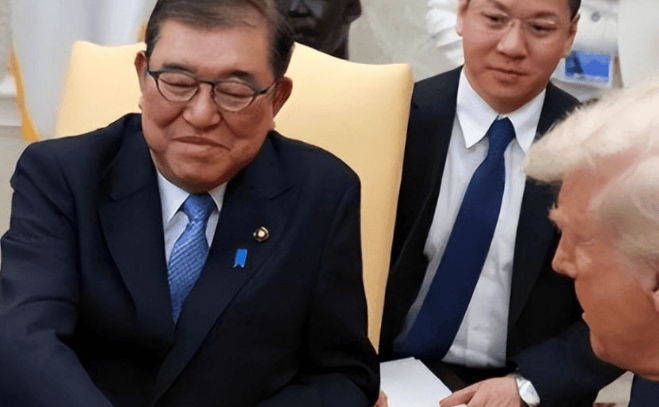
Group 1: Trade Negotiations and Tariffs - Japanese Prime Minister Kishida expressed regret over the US imposing a 25% tariff on key automotive parts and is urging the US to reconsider these measures [1] - The US is demanding Japan to "level the trade deficit," which includes conditions such as importing American cars, exempting tariffs, and increasing imports of beef, rice, and seafood [1][3] - Kishida emphasized that Japan will not comply with US demands that link security issues with tariff negotiations [1][3] Group 2: Impact on the Automotive Industry - The automotive industry is a crucial pillar of the Japanese economy, with significant exports to the US [3] - Toyota is expected to face a burden exceeding 1 trillion yen due to tariffs, while other companies like Honda and Nissan are also projected to incur impacts in the hundreds of billions of yen [3] - Kishida indicated that Japan will consider all options to respond to US tariff policies, hinting at a potential strong response to protect the domestic automotive industry [3] Group 3: Japan's Economic Position - Japan holds over 1 trillion USD in US Treasury bonds, raising questions about whether it might leverage this in trade negotiations [3] - Japan's Finance Minister stated that the country does not intend to use the sale of US Treasury bonds as a negotiating tool in trade discussions [3] Group 4: Political Context - Recent allegations of illegal political donations against Kishida could destabilize his position, especially in light of his strong stance in US tariff negotiations [8] - There are speculations that the US might influence Japanese domestic politics in response to Kishida's firm approach towards trade negotiations [8]


关税引发震荡!回暖有望?
Zhong Guo Qi Che Bao Wang· 2025-05-13 09:40
2025年4月《中国汽车报》汽车市值研究组继续对全球汽车类上市公司月度市值变化进行全面跟踪、梳理和比较分析。并基于2024年全年的数据积累基础 上,对全球汽车类上市公司的年度市值表现进行总结,并对2025年市值变化趋势进行预判。为读者提供更丰富、更详实、更客观、更多元、多维度的市值 变化数据分析。 2025年4月,全球汽车类上市公司的统计范围依然涵盖国际和国内上市的主流整车、零部件企业,以及主要新创公司和国内汽车经销商集团,统计在内的 上市企业数量共计130家。 全球汽车类上市公司市值TOP20 市值环比以涨为主 排位持续波动 | | | | 2025年4月全球汽车类上市公司市值TOP20 | | | | --- | --- | --- | --- | --- | --- | | 排序 | 公司名称 | 4月市值 (单位:亿元) | 环比 | 同比 | 较上月排位变化 | | 1 | 特斯拉 | 65327.50 | 4.04% | 57.83% | 持平 | | 2 | 丰田 | 22059.52 | 9.90% | -20.85% | 持平 | | 3 | 小米集团 | 12186.20 | 9.34% ...





为什么你以为的改善,其实根本没有降本?
3 6 Ke· 2025-05-13 02:52
Core Insights - The article emphasizes the distinction between "labor-saving" and "man-saving" in the context of Toyota Production System (TPS), highlighting that these terms have specific meanings and implications for operational efficiency [1][4][5] - It warns against common misconceptions that equate making work easier with improving efficiency, or reducing personnel with actual labor savings [3][6][8] Group 1: Misunderstandings in Improvement Terminology - A prevalent misunderstanding in corporate improvement initiatives is the belief that reducing the number of workers directly correlates with labor savings, which is not necessarily true [3][4] - The article illustrates that simply making work easier does not equate to increased productivity if the number of workers remains unchanged [7][8] - It stresses that true labor savings occur only when the number of workers required for a task is genuinely reduced, allowing for reallocation of human resources to more valuable tasks [7][9] Group 2: Transitioning from Labor-Saving to Man-Saving - The article outlines that "labor-saving" is merely the first step towards achieving true flexibility in production, which involves reducing the number of workers based on demand fluctuations [9][10] - It introduces the concept of Just-In-Time production, which aims to produce at a pace that matches sales demand, thereby optimizing labor usage [9][10] - The goal is to create a production line that can flexibly adjust the number of workers based on order volume, thus avoiding waste and ensuring efficiency [10][12] Group 3: Implementing Flexible Production Systems - To achieve "man-saving," companies must establish standardized operations, train multi-skilled employees, optimize equipment layout, and foster a culture of continuous improvement [12][13] - The article emphasizes that the objective of "man-saving" is not merely to cut labor costs but to create a responsive and efficient production system centered around customer demand [12][13] - Continuous improvement and adaptability are crucial for companies to avoid inefficiencies and remain competitive in a rapidly changing market [12][13]
净利润是中国7大车企总和的3倍,丰田汽车财报发布
Jin Rong Jie· 2025-05-12 03:58
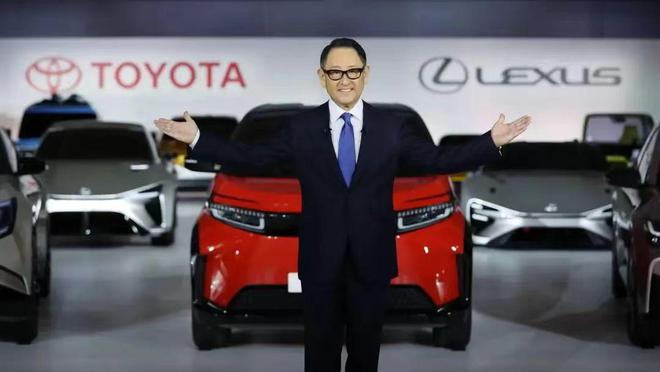
Core Insights - Toyota's sales for the fiscal year 2025 are projected to reach 10.111 million units, a slight decline of 0.7% year-on-year [1] - The company's operating revenue is expected to be 48.04 trillion yen (approximately 2.4 trillion RMB), reflecting a year-on-year growth of 6.5% from 45.1 trillion yen (approximately 2.3 trillion RMB) in the previous fiscal year [1] - Net profit is forecasted at 4.77 trillion yen (approximately 236.4 billion RMB), down 3.6% from 4.94 trillion yen (approximately 247 billion RMB) in the previous fiscal year [1] Revenue and Profit Comparison - Toyota's revenue for fiscal year 2025 is equivalent to the total revenue of seven major Chinese automakers combined, while its net profit is three times that of these companies [3] - The seven Chinese automakers include BYD, SAIC, GAC, Geely, Great Wall, BAIC, and Changan, with their respective revenues and net profits significantly lower than Toyota's [3] Future Outlook - For fiscal year 2026, Toyota's operating profit is expected to be 3.8 trillion yen (approximately 190 billion RMB), which is significantly lower than analysts' previous expectations of 4.7 trillion yen (approximately 235 billion RMB) [5] - The projected net profit for 2026 is 3.1 trillion yen (approximately 155 billion RMB), indicating a substantial decline of 34.9% compared to fiscal year 2025 [5] - The anticipated drop in net profit is primarily attributed to the impact of U.S. tariff policies and the appreciation of the yen against the dollar [5]
丰田在日本停售汽油版“卡罗拉”
日经中文网· 2025-05-12 03:05
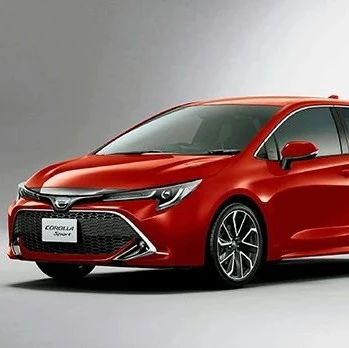
Core Viewpoint - Toyota is shifting its focus towards hybrid vehicles, discontinuing gasoline versions of the Corolla series in Japan, and will concentrate on hybrid models moving forward [1] Group 1: Product Strategy - Toyota announced the discontinuation of gasoline versions of the Corolla sedan in Japan, with three models including the "Wagon" and "Sport" set for partial improvements by May 19, focusing on hybrid sales [1] - The company is implementing a "group strategy" for the Corolla, unifying the three models to hybrid variants, leaving only the SUV "CROSS" and the sports car brand "GR Corolla" as gasoline options [1] - By the end of October, Toyota plans to cease production of the Corolla sedan "AXIO" and the wagon "Fielder," indicating a reduction in the number of models offered [1] Group 2: Market Trends - In recent years, Toyota has increasingly launched new models without gasoline options, as seen in the luxury "Crown" series introduced in 2022, which includes hybrid, plug-in hybrid (PHV), and fuel cell vehicles (FCV) [1]
每小时损失百万美元!关税战下丰田(TM.US)“流血”不止
智通财经网· 2025-05-12 01:36
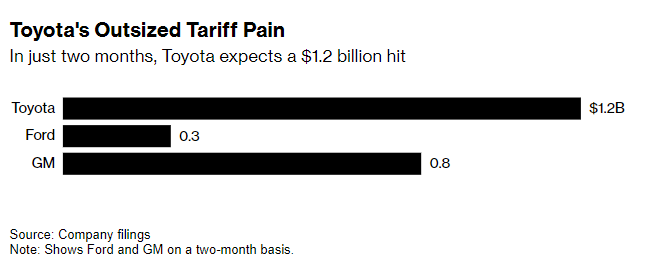
Core Viewpoint - Toyota is facing significant challenges due to Trump's trade policies, potentially becoming the biggest loser among global automakers as tariffs on imported vehicles and parts severely impact its profitability [1][2]. Group 1: Financial Impact - General Motors (GM) expects a profit reduction of up to $5 billion, while Ford anticipates a loss of $1.5 billion. In contrast, Toyota has already experienced a $1.2 billion profit decline within two months [1]. - Toyota's operating profit for the fiscal year ending March 2026 is projected to drop to ¥3.8 trillion ($26.1 billion), significantly below analysts' expectations of ¥4.7 trillion [1]. Group 2: Trade Negotiations and Tariffs - Despite over half of its sales in the U.S. being produced locally, Toyota still imports approximately 1.2 million critical parts and vehicles annually, drawing attention from the White House [2]. - The ongoing trade negotiations have not yielded results, and the timeline for a final agreement remains uncertain, with tariffs on most imported vehicles set at 25% and parts at the same rate [5]. - The Japanese government has indicated that a certain unnamed Japanese automaker is losing about $1 million per hour due to tariffs, aligning with Toyota's estimated monthly loss of $1.2 billion based on its operational hours [4]. Group 3: Production and Supply Chain - Toyota has committed to maintaining its production capacity in Japan, with plans to produce 3 million vehicles domestically by 2024, which will account for one-third of its global output [5][6]. - The company has invested $13.9 billion in a new battery plant in North Carolina while also emphasizing its commitment to its extensive domestic production base [5]. - Toyota's supply chain strategy, which includes importing vehicles like the RAV4 and Prius from Japan, makes it a target for U.S. tariffs, linking its fate closely to the outcomes of U.S.-Japan trade negotiations [6]. Group 4: Employment and Investment - Since 2016, Toyota's direct manufacturing employment in the U.S. has increased from 25,000 to 31,000, reflecting its commitment to local investment [6]. - The company has pledged $21 billion in investments in the U.S. since 2020, nearly double its commitments during Trump's first term [6].
聚焦电池回收,丰田汽车与中国五矿携手
Guan Cha Zhe Wang· 2025-05-10 11:02
Group 1 - The establishment of Hunan Yunchu Siweipu New Energy Technology Co., Ltd. is a joint investment by Toyota (China), China Minmetals, Hunan Yunchu Recycling New Energy Technology Co., Ltd., Minmetals New Energy Materials (Hunan) Co., Ltd., and Minghe Industry (Shanghai) Co., Ltd. with a registered capital of 100 million yuan [1][2] - The company aims to address the challenges of retired battery recycling and utilization, injecting new vitality into the power battery recycling market [1][2] - The partnership emphasizes sustainable development and corporate social responsibility, aligning with the goal of achieving carbon neutrality [1][2] Group 2 - The company will focus on building a Sino-Japanese technology cooperation model in the new energy sector, addressing key technical challenges in retired battery recycling [2] - The full industry chain advantage of China Minmetals will be leveraged to create a closed-loop industry for resource-materials-reuse-recycling [2] - The market for retired battery recycling in China is seen as having broad prospects and significant cooperation potential [2]
丰田(TM.US)拟收购子公司 或重塑日本企业治理结构
智通财经网· 2025-05-09 15:18
Group 1 - Toyota Motor Corporation expects a 21% decline in operating profit for the next fiscal year, attributing this to new tariffs on automobile imports imposed by the U.S. [1] - The company is reportedly planning to acquire its subsidiary, Toyota Industries, for over $40 billion, which could be one of the largest internal equity restructuring actions in Japan's history [1][2] - The complex cross-shareholding structure within the Toyota Group has raised concerns among investors regarding the independence of companies and capital flow [1][2] Group 2 - There is dissatisfaction among Toyota's independent shareholders, as evidenced by a majority vote against the re-election of Chairman Akio Toyoda, reflecting concerns over corporate governance [2] - If Toyota integrates Toyota Industries into the parent company, it would be seen as a significant improvement in corporate governance, but current rumors suggest a preference for a special purpose vehicle (SPV) structure that may reinforce family control [2] - The potential "century deal" could inspire other Japanese companies to follow suit, as approximately 30% of the Japanese market's value is tied up in cross-shareholding, significantly higher than in Western markets [2] Group 3 - Stock buybacks in Japan have tripled compared to last year, indicating a growing focus on capital efficiency among Japanese companies [3] - Despite challenges such as tariffs, global economic slowdown, and yen appreciation, there is potential for companies focused on the domestic market to benefit as Japan's long-standing deflation may be nearing an end [3] - The potential restructuring at Toyota may signal a shift in Japan towards reforming overcapitalized corporate groups, similar to the U.S. in 1982 [3]
Toyota: Roughly $7.4 Billion Tariff Headwind Is Material
Seeking Alpha· 2025-05-09 15:05
Core Insights - The article emphasizes the investment philosophy focused on small cap companies, highlighting the importance of identifying mispriced securities through understanding financial drivers and utilizing DCF model valuation [1] Investment Philosophy - The investment approach is not confined to traditional categories such as value, dividend, or growth investing, but rather considers all prospects of a stock to assess risk-to-reward [1]