TSMC(TSM)

Search documents
一周重磅日程:美国通胀、中国外贸数据,财报季正式开启,美高院关税裁决将出
华尔街见闻· 2026-01-11 12:21
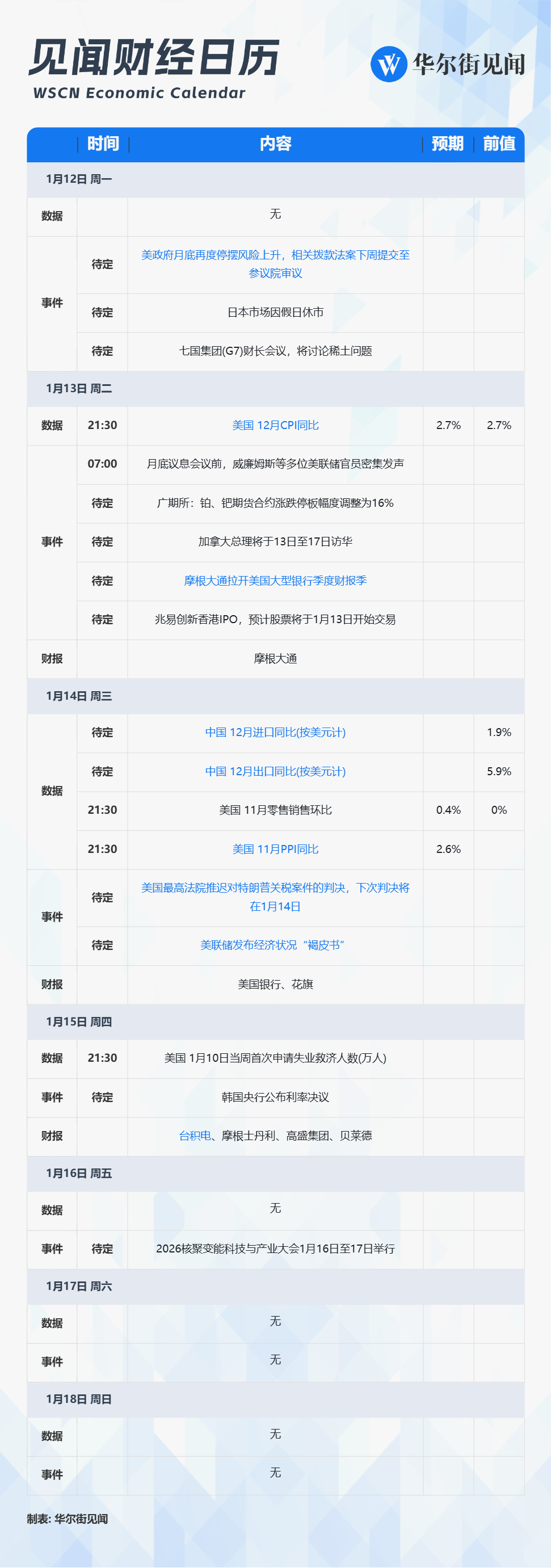
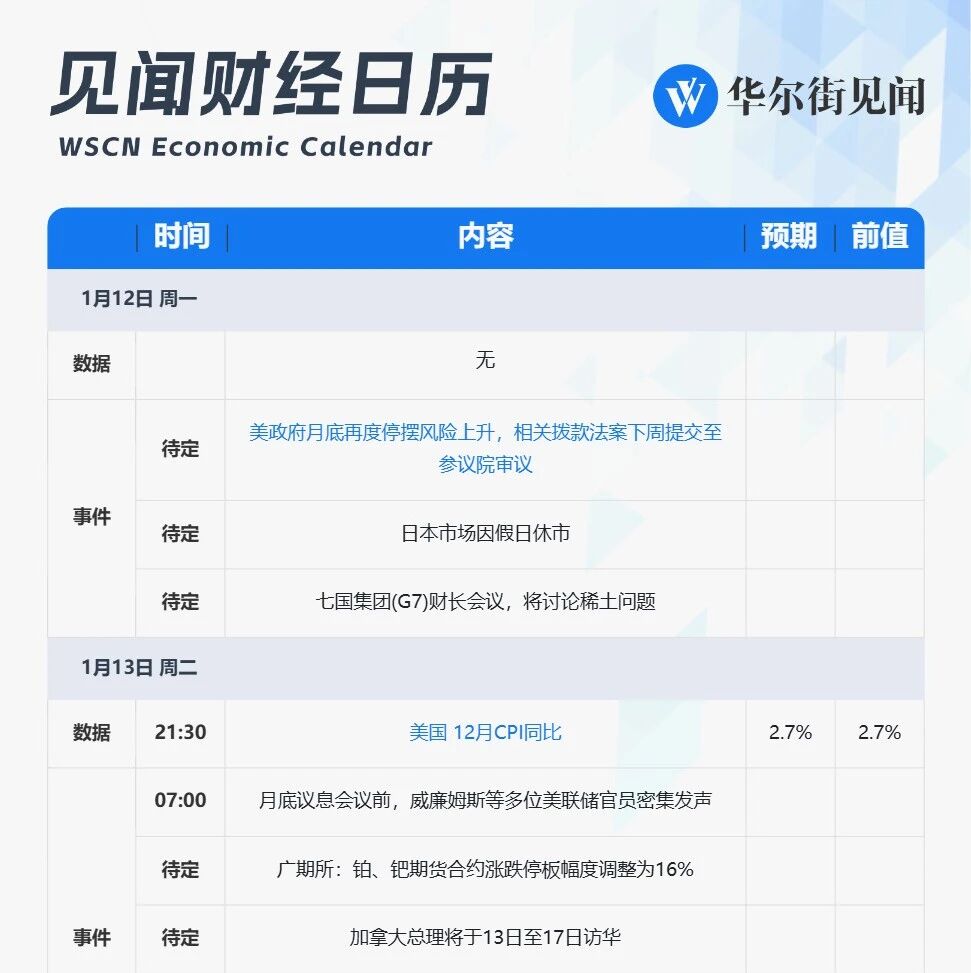
Core Viewpoint - The article highlights the upcoming significant economic events and data releases that could impact market dynamics, including U.S. inflation data, corporate earnings reports, and geopolitical developments, particularly concerning the U.S. government funding and G7 discussions on rare earth issues [3][16][20]. Economic Data - The U.S. is expected to release the December CPI data on January 13, with predictions of a significant rebound, influenced by government shutdown-related statistical distortions. Morgan Stanley forecasts a core CPI increase of 0.36% [5][6]. - China's December import and export data will be released on January 14, with expectations of a 3.0% year-on-year increase in exports and a 2.9% decline in imports [4]. Corporate Earnings - Major U.S. banks, including JPMorgan Chase, will kick off the earnings season, with a focus on the health of the financial system amid high interest rates. The earnings reports from these banks will be critical for assessing market sentiment [11]. - Taiwan Semiconductor Manufacturing Company (TSMC) is set to release its Q4 2025 earnings on January 15, with anticipated revenue of approximately NT$1.011 trillion and earnings per share of NT$2.72. The report will be crucial for understanding the demand for advanced chip manufacturing, particularly in AI [10]. Geopolitical and Industry Developments - The risk of a U.S. government shutdown is rising, with funding bills being expedited through Congress. The outcome of these discussions will significantly influence market sentiment [16]. - The G7 finance ministers will meet to discuss rare earth issues, which could have implications for global supply chains and technology sectors [20]. - The 2026 Nuclear Fusion Technology and Industry Conference will take place on January 16-17, indicating a growing focus on nuclear fusion as a future energy source, with significant investments expected in the coming years [21].


What to Expect in Markets This Week: Big Bank Earnings, December Inflation Data, Retail Sales, TSMC Earnings
Investopedia· 2026-01-11 10:55
Group 1: Earnings Reports - Major financial institutions including JPMorgan, Wells Fargo, Morgan Stanley, and Goldman Sachs are set to report earnings, marking the start of the earnings season for Q4 2025 [1][3] - JPMorgan Chase, the largest U.S. bank, will kick off the earnings season with its year-end report, having recently announced it will become the next issuer of the Apple Card [3] - Wells Fargo anticipates slower growth in net interest income for the year, while BNY Mellon and Goldman Sachs are also scheduled to report [4] Group 2: Economic Indicators - December's Consumer Price Index is expected to show inflation pressures slowing to 2.7%, with additional reports on wholesale inflation from October and November to provide further insights [6] - Retail sales data for November will offer insights into consumer activity during the holiday shopping season, which is crucial for the U.S. economy [8] - Reports on new and existing home sales are anticipated, as home sales have stalled due to ongoing affordability challenges [8] Group 3: Sector-Specific Insights - Taiwan Semiconductor's earnings will be closely watched to assess the chipmakers' ability to sustain revenue growth amid rising demand for AI chips [5] - Delta Air Lines' earnings will provide insights into the travel sector's recovery following disruptions caused by last year's government shutdown [5]


台积电2025年营收同比增长逾三成
Zheng Quan Shi Bao Wang· 2026-01-11 09:47
Core Insights - TSMC reported a consolidated revenue of approximately NT$335 billion for December 2025, reflecting a month-over-month decline of 2.5% but a year-over-year increase of 20.4%, marking a record high for the month [1] - The revenue for the entire year of 2025 is projected to be around NT$3.81 trillion, representing a year-over-year growth of 31.6%, setting a new historical record [1] - The strong performance is attributed to the booming demand in the artificial intelligence sector, which has significantly increased the demand for TSMC's products [1] Company Performance - TSMC's Q4 2025 revenue is estimated to reach NT$1.05 trillion, a year-over-year increase of approximately 20%, surpassing market expectations [1] - The revenue forecast provided in TSMC's October earnings call aligns closely with the actual figures, indicating a strong performance [1] - TSMC is set to release its complete Q4 earnings report on January 15, which will include updated guidance for the current quarter and the full year [1] Industry Outlook - TSMC maintains over 90% market share in the AI chip market, driving its revenue to new heights [2] - Projections indicate that TSMC's 2nm revenue may surpass the combined revenue of its 3nm and 5nm processes by Q3 2026, highlighting the rapid pace of technological transition [2] - J.P. Morgan forecasts a 30% year-over-year revenue growth for TSMC in 2026, while Aletheia predicts a 40%-50% growth rate in 2027, marking a significant year for capacity expansion [2] - Despite TSMC's advanced manufacturing capabilities, there are reports that Apple may consider using Intel's foundry services for some of its M-series chips, focusing on entry-level Mac models [2]
Should You Buy Taiwan Semiconductor Manufacturing Stock Before Jan. 15?
The Motley Fool· 2026-01-11 09:35
Core Insights - Taiwan Semiconductor Manufacturing Company (TSMC) is expected to report strong earnings, with a significant share price increase of 54% in 2025 and record revenue in Q3 2025 [1][2] - The upcoming fourth-quarter results will be announced on January 15, raising questions about whether to invest in TSMC stock before the report [1] Financial Performance - TSMC has shown robust earnings growth in the first three quarters of 2025, with substantial year-over-year increases in revenue, net income, and earnings per share (EPS) [2] - Despite strong earnings, TSMC's stock price did not see immediate increases post-earnings reports, remaining flat or declining after the second and third quarters [3] Market Data - TSMC's current stock price is $323.63, with a market capitalization of $1.7 trillion [4] - The stock has a gross margin of 57.75% and a dividend yield of 0.95% [5] Industry Context - TSMC manufactures semiconductors for major tech companies like Apple, Broadcom, and Nvidia, benefiting from the rapid growth in semiconductor demand driven by artificial intelligence technology [5][6] - The company is positioned as a long-term investment opportunity rather than a short-term earnings play, emphasizing the importance of a long-term perspective in investment decisions [7]

英伟达推出新一代Rubin/存储平台,台积电1月15日举行法说会
Guotou Securities· 2026-01-11 07:34
Investment Rating - The industry is rated as "Outperforming the Market - A" with a maintained rating [4] Core Insights - Nvidia has launched the next-generation Rubin AI platform, which is set to significantly enhance training performance by 3.5 times and improve AI software performance by 5 times compared to the previous Blackwell platform. The platform will reduce inference token generation costs by up to 10 times and decrease the number of GPUs required for training mixture of experts models by 4 times [1] - Nvidia's new AI-native storage infrastructure, driven by BlueField-4, aims to address the growing AI storage demand, which has surpassed existing infrastructure capacity. This new architecture is designed specifically for AI inference, enhancing efficiency and energy optimization [2] - TSMC has begun mass production of its 2nm process technology, with initial monthly capacity of 35,000 wafers, expected to increase to 140,000 wafers by the end of 2026, surpassing previous market estimates [3] Industry Performance - The electronic sector has shown a relative return increase of 4.8% over the past month and an absolute return of 8.3% [6] - The electronic index has risen by 7.74% in the past week, ranking 7th out of 31 industries [30] - The semiconductor sub-sector has seen a significant increase of 10.61% in the same period, indicating strong performance within the industry [35] Investment Recommendations - For the semiconductor sector, companies such as SMIC, Hua Hong Semiconductor, and Northern Huachuang are recommended for investment. In the consumer electronics sector, companies like Luxshare Precision, Lens Technology, and Goertek are highlighted as potential investment opportunities [10]

Taiwan Semiconductor Quietly Turns The AI Choke Point Into Pricing Power
Seeking Alpha· 2026-01-11 06:55
Core Insights - The article highlights the qualifications and experience of a finance professional with expertise in data analytics, financial modeling, and investment research, particularly in the property management sector in Istanbul [1]. Group 1: Professional Background - The individual is ACC-qualified and holds a Master's in Audit & Accounting from Istanbul University [1]. - Over two years of experience as a Data Scientist and Financial Analyst at a leading property management firm [1]. - Developed budgets, set targets, and utilized data-driven insights to enhance profitability [1]. Group 2: Skills and Expertise - Proficient in financial modeling, market analysis, and investment research [1]. - Hands-on experience in stocks and cryptocurrency [1]. - Focus on delivering concise and conversational writing to aid readers in making informed financial decisions [1].

6 Hypergrowth Tech Stocks to Buy in 2026
The Motley Fool· 2026-01-11 05:00
Core Insights - The article highlights six companies poised for significant growth in the tech sector, particularly in AI, data infrastructure, and cloud computing, with expectations of becoming global leaders by 2026 [1] Company Summaries 1. Palantir - Palantir is shifting from a government contract-focused business to a commercial AI software provider, achieving 121% growth in U.S. commercial revenue and 63% overall revenue growth year over year in Q3 2025 [2][3] - The growth is driven by its Artificial Intelligence Platform (AIP), with a shortened sales cycle due to intensive workshops, resulting in 204 deals worth at least $1 million, including 53 deals over $10 million last quarter [3] 2. Nvidia - Nvidia remains the leader in AI computing, valued at over $4.6 trillion, with a stock increase of over 1,350% in the past five years [6] - The company reported $57 billion in revenue for the latest quarter, marking a 22% increase from the previous quarter and a 62% increase year over year [6] 3. Advanced Micro Devices (AMD) - AMD is emerging as a strong competitor to Nvidia, with its MI300 series gaining traction among large customers [9] - Under CEO Lisa Su's leadership since 2014, AMD's market cap has surged from $2 billion to $350 billion [9] 4. MercadoLibre - MercadoLibre is positioned as the Amazon of Latin America, with a 39% year-over-year increase in net revenue in Q3 2025, marking 27 consecutive quarters of over 30% growth [10][11] - The company operates in e-commerce, financial services, fintech, and media, although it faces risks from geopolitical issues and regulatory challenges [11] 5. Taiwan Semiconductor (TSMC) - TSMC produces about 90% of the world's leading-edge chips, with increasing demand for its 3nm and 2nm nodes due to AI growth [12] - Goldman Sachs raised its price target for TSMC by 35%, predicting that AI computing demand will exceed supply into 2027 [12][13] 6. Micron - Micron's stock has risen over 17% since the start of the year, securing long-term supply contracts with AI chipmakers [14] - The company is expected to see DRAM prices increase by 55% to 60% quarter over quarter in 2026, benefiting from strong pricing power [14][16] Conclusion - The six companies are well-established players with solid growth prospects, expected to thrive in the AI revolution and provide sustainable returns [17]


三星晶圆厂,终于要翻身?
半导体行业观察· 2026-01-11 04:23
Core Viewpoint - Samsung's semiconductor foundry business is crucial for its overall strategy, facing challenges and opportunities as it transitions from 3nm to 2nm technology, aiming to regain market share against TSMC [1][2][21] Group 1: Historical Context and Challenges - Samsung entered the foundry market in 2005 with minimal revenue, initially overshadowed by TSMC's nearly $10 billion revenue [1] - The company achieved a significant milestone in 2014 by producing 14nm FinFET technology, surpassing TSMC at that time [1] - However, Samsung faced setbacks with its 5nm node due to yield issues and misrepresentation, leading to a loss of trust among fabless companies [1][2] Group 2: Transition to 2nm Technology - Starting in 2024, Samsung is focusing all resources on 2nm technology, shifting its strategy to prioritize stability and yield improvement [3] - The new 2nm process utilizes an upgraded MBCFET architecture, improving transistor performance by 11% to 46% and reducing leakage by approximately 50% [3][4] - Initial yield rates for the 2nm process were low, starting at 30% in February 2024, but improved to 40% by April 2024 [4] Group 3: Production Capacity and Market Strategy - By 2025, Samsung's 2nm yield stabilized between 50% and 60%, meeting commercial production requirements [5] - The company plans to establish a 2nm production line in its Taylor, Texas facility, aiming for a monthly output of 21,000 wafers by the end of 2026 [5] - Samsung is diversifying its 2nm product roadmap to cater to various markets, including high-performance computing and automotive electronics [5][6] Group 4: Strategic Shift to Physical AI Market - Samsung is pivoting towards the emerging physical AI market, where competition is less established compared to the data center AI market dominated by TSMC [7][8] - The company aims to leverage its flexible pricing and supply strategies to attract clients in the cost-sensitive physical AI sector [8] - Automotive semiconductors are identified as a key entry point for Samsung into the physical AI market, with significant partnerships already established [9][10] Group 5: Customer Ecosystem and Competitive Positioning - Samsung is restructuring its customer base to include a wider range of clients, moving away from reliance on a few large customers [12][13] - The company is enhancing its support systems and technical teams to improve responsiveness and service quality for diverse clients [15] - Samsung's vertical integration across semiconductor manufacturing, packaging, and memory production provides a competitive edge in total cost of ownership (TCO) [19][20] Group 6: Differentiation Strategy - Samsung is focusing on niche markets where TSMC has less presence, such as mature process technologies and advanced packaging solutions [17][18] - The company has established partnerships to enhance its capabilities in mature process nodes, particularly in automotive and aerospace applications [18] - Samsung's advanced packaging solutions, including the SAINT series, aim to improve performance and reduce power consumption, further solidifying its market position [19][20]
三大客户,抢爆台积电2nm
半导体行业观察· 2026-01-11 04:23
公众号记得加星标⭐️,第一时间看推送不会错过。 科技新闻网站《wccftech》报导,台积电2纳米投片(tape-out)量已达3纳米制程的1.5倍,苹果、 高通与联发科是主要客户。分析师指出,台积电2纳米制程的空前需求,使台积电在人工智能(AI) 加速器市场上维持95%市占率。 报导说,今年下半年,台积电2纳米制程的量产芯片将上市。联发科宣布,已于去年完成其首款2纳米 制程系统单芯片(SoC)的投片。如同这家台湾IC设计公司,一些其他客户也排队下单台积电新一代 制程,最新消息指出,台积电2纳米制程的投片量已是3纳米制程的1.5倍,显示其需求十分强劲。 知名半导体爆料人士@jukan05分享摩根大通的报告指出,台积电2纳米制程需求动能强劲,投片量是 3纳米制程的1.5倍。拜2纳米时代来临之赐,台积电预料在AI加速器市场,仍维持逾95%的市占率。 即使是英特尔,也在其自家产品中增加采用台积电2纳米制程。英特尔近期才在拉斯维加斯举行的消 费性电子展(CES)上,首度展示采用其18A技术的Panther Lake Core Ultra系列3芯片。 报导说,由于AI狂潮,预定今年底,台积电2纳米制程晶圆的月产量将达1 ...


下周重磅日程:美国通胀、中国外贸数据,财报季正式开启,美高院关税裁决将出
Hua Er Jie Jian Wen· 2026-01-11 03:49
Core Viewpoint - The upcoming week is characterized as a "super week" for global capital markets, with significant macroeconomic data and corporate earnings reports expected to heighten market volatility. Key focus areas include inflation dynamics, corporate earnings validation, and geopolitical developments [3]. Economic Indicators - The U.S. is set to release the December CPI data on January 13, with expectations of a notable rebound, attributed to statistical distortions from the government shutdown rather than genuine inflationary pressures [5][6]. - China's December import and export data will be released on January 14, with forecasts indicating a 3.0% year-on-year increase in exports (down from 5.9% in November) and a 2.9% decline in imports (down from a 1.9% decrease in November) [4]. Corporate Earnings - Major U.S. banks, including JPMorgan Chase, will kick off the earnings season, with a focus on the health of the financial system amid high interest rates. Additionally, TSMC's earnings report is anticipated to serve as a bellwether for the global AI supply chain [3][9]. - TSMC is expected to report revenues of approximately NT$1.011 trillion for Q4 2025, with earnings per share projected at NT$2.72, highlighting its role as a key player in AI chip manufacturing [8]. Geopolitical and Industry Developments - The U.S. government faces an increased risk of shutdown as funding runs low, with a critical funding bill set to be reviewed by the Senate. This situation could significantly impact market sentiment and economic stability [13]. - The G7 finance ministers will meet to discuss rare earth issues, reflecting ongoing geopolitical tensions and industry dynamics [13]. - Canadian Prime Minister is scheduled to visit China from January 13 to 17, marking a significant diplomatic engagement focused on trade and energy discussions [13].