TSMC(TSM)

Search documents
台积电不相信AI有泡沫
Xin Lang Cai Jing· 2026-01-20 13:20
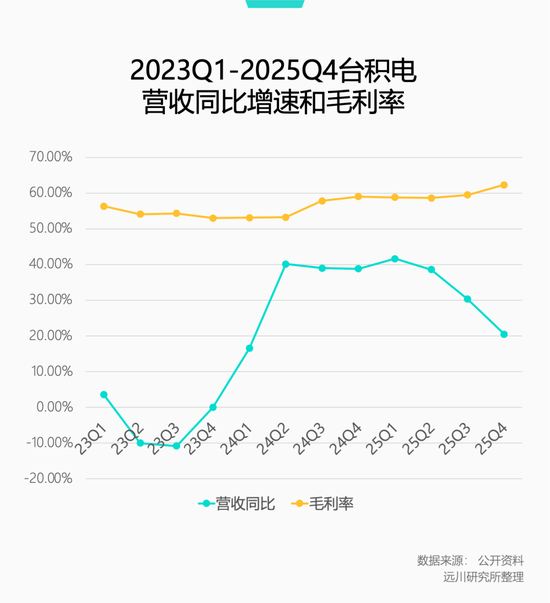
Core Viewpoint - TSMC's financial report serves as a strong endorsement for the AI industry, showcasing significant growth and profitability metrics that exceed expectations, with a gross margin surpassing 60% and continuous revenue growth over eight quarters [1][19]. Group 1: Financial Performance - TSMC's Q4 2025 financial results showed revenue growth for eight consecutive quarters, with a gross margin of 62.3%, rivaling software giants [1][24]. - The company reported a substantial increase in capital expenditure guidance for 2026, projecting between $52 billion and $56 billion, a significant rise from $40.9 billion in 2025, indicating strong future demand [3][21]. Group 2: Market Position and Technology - TSMC's dominance is attributed to its 3nm process technology and advanced packaging solutions, with 3nm revenue accounting for 28% of total revenue in Q4 2025, marking a record high [6][24]. - The company has maintained a high gross margin due to the unique demand for AI computing chips, with major clients like NVIDIA and AMD driving this demand [9][27]. Group 3: Competitive Landscape - TSMC's ability to maintain high margins is partly due to the lack of strong competition in advanced process nodes, as rivals like Samsung and Intel have struggled to keep pace [10][28]. - The advanced packaging technology, particularly CoWoS, has become critical for AI chips, with TSMC capturing a significant share of this market, further solidifying its competitive edge [11][31]. Group 4: Client Dynamics - NVIDIA has emerged as a key client, with expectations that it will surpass Apple as TSMC's largest customer by 2026, reflecting a shift in the client landscape [17][35]. - TSMC's collaboration with NVIDIA has evolved from process design to system-level integration, indicating a deepening partnership that could redefine the future of chip manufacturing [34][35]. Group 5: Future Outlook - TSMC's capital expenditure plans suggest a robust growth trajectory, with a projected compound annual growth rate of 25% from 2024 to 2029, driven by strong demand for advanced process technologies [19][37]. - The company has already secured significant orders for its upcoming 2nm process, indicating a healthy pipeline of demand that contrasts sharply with the challenges faced during the initial rollout of the 3nm process [37].


台积电不相信AI有泡沫
远川研究所· 2026-01-20 13:16
Core Viewpoint - TSMC's recent financial report has provided strong validation for the AI industry, showcasing significant growth and robust capital expenditure plans that signal future demand for chip manufacturing [5][8]. Financial Performance - TSMC's Q4 2025 financial results exceeded expectations, with revenue growth for eight consecutive quarters and a gross margin surpassing 60%, comparable to software giants [5][12]. - The company projected capital expenditures of $52 billion to $56 billion for 2026, a substantial increase from $40.9 billion in 2025, indicating confidence in future orders from clients like NVIDIA and AMD [8][27]. Market Dynamics - TSMC's dominance is attributed to its advanced 3nm process technology, which accounted for 28% of revenue in Q4, driving a 20% increase in average wafer prices over two years [12][16]. - The demand for AI computing chips has surged, leading to a shortage of 3nm capacity, with reports indicating that TSMC has stopped accepting new orders for this process due to full capacity bookings [16][24]. Competitive Landscape - TSMC's competitors, particularly Samsung and Intel, have struggled to keep pace with its advancements in process technology, allowing TSMC to maintain a significant competitive edge [16][19]. - The advanced packaging technology, CoWoS, has become critical for AI chips, with TSMC holding a dominant position in this area, further solidifying its market leadership [17][20]. Client Relationships - TSMC's collaboration with NVIDIA has evolved from design to system-level integration, with NVIDIA expected to surpass Apple as TSMC's largest client by 2026 [22][24]. - The company has successfully diversified its client base, reducing reliance on any single customer, which is crucial for sustaining growth in advanced process technologies [23][26]. Future Outlook - TSMC's capital expenditure plans reflect a strong forecast for the semiconductor industry, with anticipated revenue growth rates of 25% from 2024 to 2029, driven by increasing demand for advanced chips [27].


Taiwan Semiconductor: AI Value Stock Hiding In Plain Sight
Seeking Alpha· 2026-01-20 13:00
Core Viewpoint - Taiwan Semiconductor Manufacturing Company Limited (TSM) is experiencing a slowdown in stock momentum after a significant rally, indicating potential shifts in market dynamics [1]. Group 1: Company Performance - The stock of TSM was previously rated as a "buy" on October 23rd, 2025, suggesting a positive outlook prior to the observed slowdown [1].
Q4业绩超预期,但投资者更关心“为什么台积电这么激进”?
Hua Er Jie Jian Wen· 2026-01-20 12:48
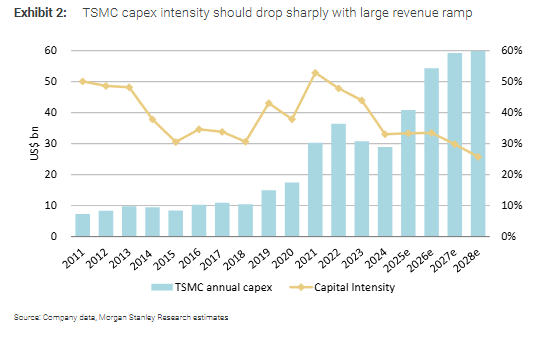
Core Viewpoint - TSMC's Q4 financial results and guidance exceeded market expectations, but investor focus has shifted from performance to strategic concerns regarding aggressive expansion plans and capital expenditure increases [1][2]. Group 1: Capital Expenditure and Market Share - TSMC's capital expenditure guidance for 2026 is set at $52 billion to $56 billion, significantly higher than market expectations by approximately $6 billion to $11 billion, raising discussions about the aggressive investment strategy [2]. - Analysts from Morgan Stanley suggest that strong AI semiconductor growth and potential equipment supply constraints necessitate TSMC's aggressive capacity expansion to avoid market share loss in the next 2-3 years [2][9]. - TSMC is accelerating infrastructure development, including advanced packaging plants AP9 and AP10 in the U.S., with potential prepayments for equipment to smooth capital expenditures in 2026 and 2027 [2][9]. Group 2: Revenue Growth and Production Efficiency - TSMC's revenue guidance for 2026 indicates nearly 30% year-over-year growth, attributed to improved production efficiency [3][5]. - The long-term gross margin target has been raised from 53% to 56% or higher, reflecting confidence in AI opportunities and sustainable production efficiency improvements [5][9]. - Analysts expect TSMC to achieve a gross margin target exceeding 56% despite increased capital expenditures, with a revised gross margin assumption of 63% for 2026 [5]. Group 3: AI Demand as a Growth Catalyst - The primary catalysts for TSMC's future growth are centered around the AI market, with global cloud service providers' capital expenditure guidance directly impacting TSMC's order visibility [6][8]. - The total addressable market (TAM) for AI semiconductors is projected to grow to $550 billion by 2029, with AI semiconductors expected to account for 20-25% of TSMC's total revenue by 2026 [6][9]. - TSMC has raised its AI semiconductor revenue growth forecast from 45% to a compound annual growth rate (CAGR) of 55-59% for 2024-2029, aligning closely with Morgan Stanley's 60% prediction [6]. Group 4: U.S. Investment and Strategic Partnerships - Following a tariff agreement with the U.S. requiring $250 billion in direct investments, TSMC is expected to contribute significantly, with plans for substantial investments in U.S. facilities [1][9]. - TSMC's previous announcement of a $165 billion investment in the U.S. by 2030 includes plans for 30% of its 2nm and below capacity to be located in the U.S., indicating a strategic push to meet customer demand [9]. Group 5: Stock Valuation and Analyst Recommendations - TSMC remains a preferred stock for analysts, with a target price of NT$2,088, reflecting strong AI capital expenditure guidance and a favorable valuation compared to historical price-to-earnings ratios [10][13]. - The stock is currently valued at 15 times the projected earnings per share for 2027, close to the average forward P/E ratio of 16.5 times since 2018, indicating an attractive investment opportunity [10][13].
This $2 Trillion Opportunity Could Send These Top Stocks Soaring
Yahoo Finance· 2026-01-20 12:35
Core Insights - Gartner forecasts AI spending to reach nearly $1.5 trillion in 2025 and over $2 trillion in 2026, driven by AI integration in devices and computing infrastructure [1][8] Company Analysis: Taiwan Semiconductor Manufacturing (TSMC) - TSMC, the world's leading chip manufacturer, is expected to see solid demand due to its production of chips for smartphones, smart devices, and high-performance computing [3] - TSMC's fourth-quarter earnings showed a 25% year-over-year revenue increase in U.S. dollars, attributed to advanced AI chip technologies [3] - Revenue from TSMC's smartphone segment increased by 11% year over year, while Internet of Things revenue grew by 3%, and automotive revenue declined by 1% [4] - TSMC forecasts AI chip revenue to grow by over 50% annually through 2029, indicating a strong focus on expanding manufacturing capacity [5] - Apple has secured about half of TSMC's production capacity for its advanced 2-nanometer process technology, which will be utilized for the A20 chip in upcoming iPhones [6] - TSMC's outlook for 2026 predicts a 30% revenue increase in U.S. dollars and a 25% growth in earnings per share to $13.26, suggesting potential for a higher earnings multiple [7]

Taiwan Semiconductor Manufacturing Company (TSM)’s Call Was Amazing, Says Jim Cramer
Yahoo Finance· 2026-01-20 11:00
We recently published 15 Fresh Stocks Jim Cramer Discussed. Taiwan Semiconductor Manufacturing Company Limited (NYSE:TSM) is one of the stocks Jim Cramer discussed. Taiwan Semiconductor Manufacturing Company Limited (NYSE:TSM) was the star of the show last week as it set the tone for AI investing in 2026. The firm is the largest contract chip manufacturer in the world, particularly when it comes to manufacturing leading-edge chips. Taiwan Semiconductor Manufacturing Company Limited (NYSE:TSM)’s shares are ...
It’s Funny SML Holding (ASML) Moved Faster Than TSMC, Says Jim Cramer
Yahoo Finance· 2026-01-20 11:00
Group 1 - ASML Holding N.V. is a Dutch semiconductor manufacturing equipment provider with a monopoly in the high-end market due to its unique capability to produce EUV lithography machines [2] - The company's shares have increased by 79% over the past year and are up 16.8% year-to-date [2] - Analyst focus on ASML has intensified following TSMC's strong earnings report, with Bernstein reiterating an Outperform rating and a €1,300 price target, while RBC Capital set a $1,550 price target and an Outperform rating [2] Group 2 - Jim Cramer noted that ASML's stock price moved faster than TSMC's, leading to upgrades in capital equipment stocks [3] - Despite the potential of ASML as an investment, there is a belief that some AI stocks may offer higher returns with limited downside risk [3]

Who Are the Biggest Winners from Taiwan Semiconductor Manufacturing's Blowout Quarterly Report?
Yahoo Finance· 2026-01-20 11:00
Group 1 - Taiwan Semiconductor Manufacturing (TSMC) reported a strong quarter, leading to a rise in its stock price and indicating broader benefits for related companies in the semiconductor industry [1] - TSMC plans to increase capital expenditures to between $52 billion and $56 billion in 2026, up from $41 billion in 2025, signaling sustained demand for AI chips [2] - Increased capex from TSMC is expected to benefit various companies, including Nvidia, Broadcom, AMD, and ASML, as they capitalize on the growing AI infrastructure and semiconductor manufacturing needs [4][6] Group 2 - Nvidia is positioned to gain significantly due to its GPUs being essential for training large language models, benefiting from TSMC's increased capacity [4] - Broadcom is anticipated to potentially increase its AI revenue fivefold over the next two years as it assists customers in designing custom AI chips [5] - ASML stands to benefit from TSMC's increased spending, as it is the sole manufacturer of the extreme ultraviolet lithography machines necessary for advanced semiconductor production [6] Group 3 - The memory market for DRAM is currently tight, with rising prices, and TSMC's investment in AI chip capacity is likely to keep demand high, benefiting companies like Micron Technology, SK Hynix, and Samsung [9]
——25年12月台股电子板块景气跟踪:先进制程满载,AI/HPC扩张带动结构升级
Shenwan Hongyuan Securities· 2026-01-20 10:44
Investment Rating - The report indicates a positive investment outlook for the semiconductor industry, particularly driven by AI and high-performance computing (HPC) demand [1]. Core Insights - TSMC's revenue for December and the entire year showed a year-on-year growth of 20% and 32% respectively, with Q4 exceeding market expectations due to strong demand from AI and HPC sectors [1][4]. - TSMC's gross margin for Q4 2025 was reported at 62.3%, surpassing previous guidance, attributed to better-than-expected cost improvements and favorable exchange rates [5]. - The report highlights a robust capital expenditure forecast for TSMC in 2026, estimated at $52-56 billion, with 70%-80% allocated to advanced processes, reflecting a commitment to meeting structural demand in AI and HPC [5]. Summary by Sections AI Sector - The AI sector continues to see strong spending, with TSMC's advanced process utilization remaining high due to demand from AI servers and HPC applications [1][4]. - The report notes that the growth in AI applications has mitigated declines in consumer electronics chip demand [4]. Advanced Process Manufacturing - TSMC's guidance for Q1 2026 includes revenue expectations of $34.6-35.8 billion and a gross margin of 63%-65%, indicating resilience in advanced process demand despite seasonal slowdowns [5]. - The report emphasizes that TSMC's advanced process capacity utilization remains robust, driven by AI and HPC applications [1][5]. Server Management Chips - The report highlights that the revenue for server management chips from the company Xinxin reached a new high in December, with a year-on-year growth of 18% [8]. - Xinxin's revenue for 2025 is projected to grow by 41%, driven by strong demand from AI servers and improved supply chain conditions [8]. PCB and EMS - PCB manufacturers such as XinXing and JingShuo reported year-on-year revenue growth of 27% and 25% respectively, attributed to increased shipments of high-end server and high-speed application boards [1]. - EMS companies like Hon Hai and Wistron experienced significant revenue growth, with year-on-year increases of 32% and 142% respectively, driven by AI server demand [1].
Stock Market Today: S&P 500, Nasdaq Futures Plunge As Trump Escalates Tariff Threats—Alibaba, United Airlines, Netflix In Focus
Benzinga· 2026-01-20 10:21
Market Overview - U.S. stock futures declined on Tuesday, continuing the negative momentum from Friday's declines, influenced by President Trump's tariff threats against Europe [1] - Major indices showed significant losses: Dow Jones down 1.66%, S&P 500 down 1.79%, Nasdaq 100 down 2.23%, and Russell 2000 down 2.17% [2] Company Performance - United Airlines Holdings Inc. (NASDAQ:UAL) fell 2.26%, with projected quarterly earnings of $2.94 per share on revenue of $15.40 billion [6] - BHP Group Ltd. (NYSE:BHP) decreased by 1.65% despite raising copper production guidance and setting operational records [7] - Alibaba Group Holding Ltd. (NYSE:BABA) dropped 2.35% as ByteDance challenges its dominance in China's cloud market [7] - Taiwan Semiconductor Manufacturing Co. Ltd. (NYSE:TSM) declined 1.21% despite plans for a significant U.S. manufacturing expansion [7] - Netflix Inc. (NASDAQ:NFLX) shares rose 0.15% ahead of earnings, with expectations of $0.55 per share on revenue of $11.97 billion [15] Economic Indicators - The 10-year Treasury bond yielded 4.28%, while the two-year bond was at 3.57%, with a 95% likelihood of the Federal Reserve maintaining current interest rates in January [2] - Upcoming economic data includes construction spending, pending home sales, jobless claims, GDP revisions, and consumer sentiment [16]