
XIAOMI(XIACY)

Search documents
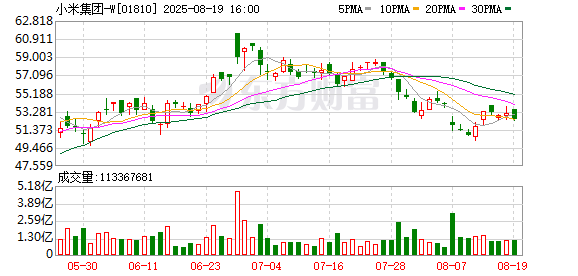
小米集团-W(01810)下跌2.0%,报51.35元/股
Jin Rong Jie· 2025-08-20 03:04
Group 1 - The core viewpoint of the article highlights that Xiaomi Group's stock experienced a decline of 2.0% on August 20, trading at 51.35 HKD per share with a transaction volume of 8.05 billion HKD [1] - Xiaomi Group is primarily an internet company focused on smartphones, smart hardware, and IoT platforms, with a business model built on innovative, high-quality hardware, efficient new retail, and a rich array of internet services [1] - As of the mid-year report for 2025, Xiaomi Group reported total revenue of 227.249 billion RMB and a net profit of 22.829 billion RMB [1] Group 2 - For the fiscal year 2025, Xiaomi Group's profit attributable to shareholders reached 22.83 billion RMB, representing a year-on-year growth of 146%, with basic earnings per share of 0.9 RMB [1]
小米集团公布最新财报 机构称汽车业务加速增长 毛利率喜人
Mei Ri Jing Ji Xin Wen· 2025-08-20 02:15
Group 1 - The core viewpoint of the news highlights the performance of Xiaomi Group, which reported a revenue of 227.25 billion RMB for the first half of the year, marking a year-on-year growth of 38.2%, and an adjusted net profit of 21.51 billion RMB, up 69.8% year-on-year [1] - In Q2, Xiaomi achieved a revenue of 115.96 billion RMB, reflecting a year-on-year increase of 30.5%, with an adjusted net profit of 10.83 billion RMB, which is a 75.4% year-on-year growth [1] - The Hong Kong stock market indices opened lower, with the Hang Seng Index down 0.61% and the Hang Seng Tech Index down 0.75%, while the performance of individual stocks in the Hang Seng Tech Index ETF was mixed, with only a few companies like Sunny Optical Technology and Xpeng Motors seeing gains [1] Group 2 - Guojin Securities noted that Xiaomi's overall performance in Q2 2025 showed steady progress, with total revenue exceeding 100 billion RMB for three consecutive quarters and adjusted net profit surpassing 10 billion RMB for two consecutive quarters, driven by growth in smartphones, home appliances, and automotive sectors [2] - In Q2, Xiaomi delivered a total of 81,300 new cars, with cumulative deliveries reaching 300,000, generating revenue of 21.3 billion RMB from the automotive segment, which had a gross margin of 26.4%, an increase of 3.2% quarter-on-quarter [2] - The southbound capital flow into Hong Kong has reached nearly 960 billion HKD this year, primarily directed towards AI and new consumption sectors, indicating a trend towards emerging industries and potential for further capital inflow [2]
小米集团公布最新财报,机构称汽车业务加速增长,毛利率喜人
Mei Ri Jing Ji Xin Wen· 2025-08-20 02:10
Group 1 - The core viewpoint of the news highlights the performance of Xiaomi Group, which reported a revenue of 227.25 billion RMB for the first half of the year, marking a year-on-year growth of 38.2% and an adjusted net profit of 21.51 billion RMB, up 69.8% [1] - In Q2, Xiaomi achieved a revenue of 115.96 billion RMB, reflecting a year-on-year increase of 30.5%, with an adjusted net profit of 10.83 billion RMB, which is a 75.4% increase compared to the previous year [1] - The automotive segment of Xiaomi delivered 81,300 new vehicles in Q2, with a cumulative delivery of 300,000 vehicles, generating revenue of 21.3 billion RMB and a gross margin of 26.4%, which improved by 3.2% quarter-on-quarter [2] Group 2 - The inflow of southbound funds into Hong Kong stocks has reached nearly 960 billion HKD this year, primarily directed towards artificial intelligence and new consumption sectors, indicating a trend towards emerging industries [2] - The Hang Seng Technology Index ETF (513180) includes 30 leading Hong Kong tech stocks, focusing on the AI industry chain, with major companies like Alibaba, Tencent, Xiaomi, Meituan, SMIC, and BYD potentially becoming the "seven giants" of Chinese tech stocks [2] - Investors without a Hong Kong Stock Connect account can access Chinese AI core assets through the Hang Seng Technology Index ETF (513180) for a simplified investment approach [2]
港股早参丨小米集团Q2营收同比增30.5%,创历史新高!机构称港股资金面情绪积极
Mei Ri Jing Ji Xin Wen· 2025-08-20 01:30
Market Overview - On August 19, Hong Kong's three major indices opened high but closed lower, with the Hang Seng Index down 0.21% at 25,122.9 points, the Hang Seng Tech Index down 0.67% at 5,542.03 points, and the National Enterprises Index down 0.3% at 9,006.23 points [1] - The technology sector saw more declines than gains, with notable movements in stocks such as Tencent and NIO rising nearly 1%, while NetEase and Xiaomi fell over 1% [1] Southbound Capital - On August 19, southbound capital recorded a net inflow of 18.573 billion HKD, bringing the total net inflow for the year to 958.881 billion HKD, significantly exceeding last year's total [2] Company Performance - Xiaomi Group reported its Q2 earnings on August 19, with revenue reaching 116 billion CNY, a year-on-year increase of 30.5%, and adjusted net profit of 10.8 billion CNY, up 75.4% [3] - Pop Mart disclosed that its revenue for the first half of the year was 13.876 billion CNY, a 204.4% increase year-on-year, with adjusted net profit of 4.71 billion CNY, up 362.8% [3] Foreign Investment Trends - As of August 18, over 70 listed companies had qualified foreign institutional investors (QFII) among their top ten shareholders, with a total market value of approximately 6.8 billion CNY, indicating increased foreign institutional investment in the Chinese stock market [3] Short Selling Data - On August 19, a total of 637 Hong Kong stocks were short-sold, with total short selling amounting to 31.137 billion HKD. The top three stocks by short selling amount were Tencent (2.243 billion HKD), Xiaomi (1.941 billion HKD), and Alibaba (1.288 billion HKD) [4] Institutional Insights - Zhongtai International noted that despite marginal economic slowdowns in July, market risk appetite remained intact, with A-shares reaching new highs and significant net inflows into Hong Kong stocks [5] - The institution suggested focusing on sectors such as technology innovation (AI/Semiconductors), biomedicine, and high-dividend assets (utilities, energy, and leading consumer stocks) due to favorable long-term capital allocation and market recovery [5][6]
小米集团Q2营收同比增30.5%,创历史新高!机构称港股资金面情绪积极
Mei Ri Jing Ji Xin Wen· 2025-08-20 01:26
Market Overview - On August 19, Hong Kong's three major indices opened high but closed lower, with the Hang Seng Index down 0.21% at 25,122.9 points, the Hang Seng Tech Index down 0.67% at 5,542.03 points, and the National Enterprises Index down 0.3% at 9,006.23 points [1] - Technology stocks generally declined, with notable movements in individual stocks such as Tencent Holdings and NIO rising nearly 1%, while NetEase and Xiaomi Group fell over 1% [1] Southbound Capital - On August 19, southbound capital recorded a net inflow of 18.573 billion HKD, bringing the total net inflow for the year to 958.881 billion HKD, significantly exceeding last year's total [2] U.S. Market Performance - U.S. stock indices showed mixed results, with the Dow Jones up 0.02% and reaching a historical high during the session, while the S&P 500 and Nasdaq fell by 0.59% and 1.46%, respectively [3] - Notable declines were observed in Chinese concept stocks, with Xunlei down over 10% and Weibo down over 6% [3] Company Earnings Reports - Xiaomi Group reported Q2 earnings on August 19, with revenue reaching 116 billion CNY, a year-on-year increase of 30.5%, and adjusted net profit of 10.8 billion CNY, up 75.4% year-on-year [4] - Pop Mart disclosed that its H1 revenue exceeded the total for the previous year, with earnings of 13.876 billion CNY, a 204.4% increase, and adjusted net profit of 4.71 billion CNY, up 362.8% [4] Foreign Investment Trends - As the Chinese stock market strengthens, foreign institutional investors are increasing their positions, with over 70 listed companies reporting QFII holdings totaling approximately 6.8 billion CNY [4] Short Selling Data - On August 19, a total of 637 Hong Kong stocks were short-sold, with total short selling amounting to 31.137 billion HKD. Tencent Holdings, Xiaomi Group, and Alibaba were the top three in short selling amounts [5] Institutional Insights - Zhongtai International noted that despite marginal economic slowdowns in China, market risk appetite remains intact, with A-shares reaching new highs and significant inflows into the Hong Kong market [6] - The expectation of an 85% probability of a Fed rate cut in September is likely to support Hong Kong stocks, with a focus on technology innovation and non-bank financial sectors [6] Hong Kong ETFs - The Hong Kong Consumption ETF (513230) focuses on e-commerce and new consumption sectors, while the Hang Seng Technology Index ETF (513180) includes key AI assets [7]

中金:维持小米集团-W跑赢行业评级 目标价70.0港元
Zhi Tong Cai Jing· 2025-08-20 01:20
Group 1 - The core viewpoint of the report indicates that due to weak smartphone demand and rising raw material costs, the adjusted net profit forecast for Xiaomi Group-W (01810) for 2025 has been lowered by 5.9% to 46.139 billion yuan, while the profit forecast for 2026 remains unchanged [1] - The current stock price corresponds to a price-to-earnings ratio of 27.0 times for 2025 and 18.5 times for 2026, with a target price of 70.0 HKD, implying a potential upside of 33.6% [1] Group 2 - In Q2 2025, the adjusted net profit exceeded expectations, with revenue reaching 1159.56 billion yuan, a year-on-year increase of 30.5%, slightly below expectations by 1.7%, while the adjusted net profit attributable to shareholders was 10.831 billion yuan, a year-on-year increase of 75.4%, exceeding expectations by 6.4% [2] - The growth in IoT business revenue was a key driver, alongside better-than-expected automotive gross margins [2] Group 3 - In Q2 2025, Xiaomi's smartphone shipments increased by 0.6% year-on-year to 42.4 million units, maintaining a global market share of 14.7%, ranking third [3] - Market share improvements were noted in Southeast Asia, Europe, Latin America, and Africa, with increases of 1.6 percentage points, 3.4 percentage points, 1.0 percentage point, and 2.7 percentage points respectively [3] - The ASP (average selling price) of smartphones decreased by 2.7% year-on-year to 1,073 yuan, while the smartphone gross margin fell by 0.7 percentage points to 11.5% due to a higher proportion of low-margin products [3] Group 4 - IoT revenue grew by 44.7% year-on-year to 38.712 billion yuan in Q2 2025, driven by significant growth in major appliances, wearables, and tablets, with air conditioner shipments exceeding 5 million units [4] - The IoT gross margin decreased by 2.7 percentage points to 22.5% due to the impact of the "618" promotional event, but it remained at a good level [4] - Internet business revenue increased by 10.1% year-on-year to 9.097 billion yuan, with a gross margin decline of 3.0 percentage points to 75.4%, attributed to changes in advertising revenue structure [4] Group 5 - In Q2 2025, the company delivered 81,300 vehicles, with an ASP of 253,700 yuan, and the gross margin increased by 3.27 percentage points to 26.4%, primarily due to economies of scale and increased deliveries of the Ultra model [5] - The company is optimistic about the profit elasticity from automotive order deliveries and the long-term ecological value of its "people, vehicles, and home" strategy [5]
小米(01810)电话会全文:坚决不打价格战,汽车业务有望在下半年实现单季盈利,2027年进军欧洲电车市场
智通财经网· 2025-08-19 22:40
Core Viewpoint - Xiaomi's Q2 financial report shows record high revenue and net profit, driven by strong performance in smartphones, IoT, and automotive sectors. Key investor concerns include the profitability of the automotive business, sustainability of high-end smartphone margins, and the potential of AI strategy to create new valuation narratives [1][5][12]. Financial Performance - Total revenue for Q2 reached 116 billion yuan, a year-on-year increase of 30.5%, marking the fifth consecutive quarter of record highs [5][12]. - Adjusted net profit for the quarter was 10.8 billion yuan, up 75% year-on-year, also a record high for three consecutive quarters [5][12]. - Gross margin improved to 22.5%, an increase of 1.8 percentage points year-on-year [5][12]. Automotive Business - Xiaomi's automotive business reported a reduced operating loss of 300 million yuan in Q2, with hopes of achieving monthly or quarterly profitability in the second half of the year [1][11]. - Vehicle deliveries reached 81,300 units in Q2, a 197.7% increase from the same period last year, contributing to a 233.9% surge in automotive revenue to 21.3 billion yuan [1][11]. - The company plans to enter the European electric vehicle market by 2027 [1][11]. Smartphone Business - Xiaomi aims to join the "200 million club" in global smartphone shipments within the next three to five years [1][11]. - Despite an increase in high-end smartphone sales, Q2 smartphone gross margin fell to 11.5% due to rising component costs and a slower new product release schedule [1][11][12]. - The company maintained a global smartphone market share of 14.7%, ranking third worldwide [12][13]. IoT and AI Strategy - The AI strategy is structured in three layers: large models, application layer, and transformation layer, aiming to create a closed-loop ecosystem of "people-vehicle-home" [2][12]. - IoT revenue reached 38.7 billion yuan in Q2, a 44.7% increase year-on-year, with a gross margin of 22.5% [12][13]. - The company emphasizes the importance of self-developed chips and AI technology as core competitive advantages [7][12]. Home Appliances - Revenue from smart home appliances reached a record high, growing 66.2% year-on-year, with air conditioning sales exceeding 5.4 million units, also showing over 60% growth [9][12]. - The company is focused on transforming traditional home appliances into smart products, leveraging user scenarios for innovation [9][10]. Market Position and Future Outlook - Xiaomi's strategy includes avoiding price wars and focusing on long-term market positioning rather than short-term rankings [3][11]. - The company is committed to continuous investment in core technologies and aims for sustainable growth across all business lines [11][15].
小米集团第二季度收入及净利润创历史新高
Zheng Quan Ri Bao· 2025-08-19 16:35
Core Insights - Xiaomi Group reported record high revenue and net profit for Q2, achieving revenue of 116 billion yuan, a year-on-year increase of 30.5%, and an adjusted net profit of 10.8 billion yuan, up 75.4% [2] Smartphone Business - Despite a challenging global smartphone market, Xiaomi's smartphone business saw significant growth, with 11.5 million new device activations in Q2, capturing a 16.8% market share in China, ranking first [2] - Xiaomi aims to maintain its annual smartphone shipment target at approximately 175 million units, focusing on increasing average selling price (ASP) and market share in China by 1 percentage point each year [2][3] Automotive Sector - Xiaomi's smart electric vehicle and AI innovation segment generated over 20 billion yuan in revenue, entering a phase of rapid growth, with Q2 vehicle deliveries reaching 81,302 units, totaling over 300,000 cumulative deliveries by July 10 [3] - The company is committed to avoiding price wars in the competitive electric vehicle market, prioritizing order fulfillment and aiming for profitability in the second half of the year [3] Home Appliances - In the home appliance sector, Xiaomi achieved "volume and price increase" amidst fierce competition, leveraging its advantages in smart home technology and user-centric innovation to transform the traditional appliance market [4]
港股公告掘金 小米集团-W二季度收入及盈利均再创历史新高 公司拥有人应占溢利119.04亿元 同比增长133.51%




Jin Rong Jie· 2025-08-19 16:03
Major Events - CSPC Pharmaceutical Group (01093) received clinical trial approval for Dupilumab injection in China [1] - Rongchang Biopharmaceutical (09995) was granted breakthrough therapy designation for RC148 for non-small cell lung cancer by the National Medical Products Administration [1] - China Biologic Products (01177) included LM-302 "CLDN18.2 ADC" in the breakthrough therapy program [1] - Sunshine Oilsands (02012) plans to acquire 51% stake in Noble Technology Limited for HKD 50.91945 million [1] - Galenica Pharmaceutical-B (01672) plans to issue shares at a discount of approximately 9.9%, raising HKD 468 million [1] Financial Performance - Xiaomi Group-W (01810) reported record high revenue and profit for Q2, with attributable profit of HKD 11.904 billion, up 133.51% year-on-year [1] - Pop Mart (09992) announced a mid-term profit of HKD 4.574 billion, a year-on-year increase of 396.5% [1] - Fuyao Glass (03606) reported a half-year net profit of approximately HKD 4.805 billion, up 37.33% year-on-year [1] - China Resources Beer (00291) announced a mid-term profit of HKD 5.789 billion, an increase of 23.04% year-on-year [1] - Kunlun Energy (00135) reported a mid-term profit of HKD 3.161 billion, down 4.36% year-on-year, with a dividend of HKD 0.166 per share [1] - WuXi Biologics (02269) reported a mid-term profit of approximately HKD 2.339 billion, up 56% year-on-year [1] - Sunny Optical Technology (02382) announced a mid-term profit of HKD 1.646 billion, an increase of 52.56% year-on-year [1] - Yixin Group (02858) reported an adjusted net profit of HKD 648 million, up 28% year-on-year [1] - Kangchen Pharmaceutical (01681) reported a mid-term profit of HKD 498 million, up 24.6% year-on-year, maintaining market leadership with its flagship product [1] - Ping An Good Doctor (01833) reported a mid-term profit of HKD 134 million, a year-on-year increase of 136.84% [1] - China Communication Services (02342) reported a mid-term profit of HKD 61.781 million, returning to profitability [1] - XPeng Motors-W (09868) achieved record levels in core business and financial metrics for Q2, with a net loss of HKD 480 million, narrowing by 62.8% year-on-year [1] - Guochuang Tongqiao (02190) reported a mid-term profit of HKD 121 million, up 76% year-on-year [1] - Yanda Pharmaceutical (00512) reported record revenue of HKD 6.107 billion [1] - Jinli Permanent Magnet (06680) reported a mid-term profit of approximately HKD 305 million, up 154.81% year-on-year [1] - Zhaogang Group-W (06676) issued a profit warning, expecting a mid-term profit of approximately HKD 140 million to HKD 180 million, returning to profitability [1] - Longyuan Power (00916) reported a mid-term profit of HKD 3.519 billion, down 14.4% year-on-year [1] - Yancoal Australia (03668) reported a mid-term profit of AUD 16.3 million, down 61.19% year-on-year [1] - SF Holding (06936) reported total revenue of HKD 24.847 billion for July in logistics, supply chain, and international business, up 9.95% year-on-year [1] - Chow Sang Sang (00116) expects a mid-term profit from continuing operations of approximately HKD 900 million to HKD 920 million [1]
格隆汇公告精选(港股)︱小米集团-W(01810.HK)二季度营收1160亿元、净利润108亿元,收入及盈利均再创历史新高
Ge Long Hui· 2025-08-19 15:37
Group 1 - Xiaomi Group-W (01810.HK) reported a record revenue of RMB 116 billion and a net profit of RMB 10.8 billion for Q2 2025, marking a year-on-year increase of 30.5% and 75.4% respectively [1] - The "Mobile × AIoT" segment generated RMB 94.7 billion in revenue, up 14.8% year-on-year, while the "Smart Electric Vehicles and AI Innovation" segment reached RMB 21.3 billion, both achieving historical highs [1] - The total smartphone shipments for Q2 2025 were 42.4 million units, reflecting a 0.6% year-on-year growth, maintaining a global market share of 14.7% and ranking among the top three for 20 consecutive quarters [2] Group 2 - Xiaomi's active user base reached a record high of 731.2 million globally by June 2025, representing an 8.2% year-on-year increase [2] - The number of connected IoT devices on Xiaomi's AIoT platform grew to 989.1 million, a 20.3% increase year-on-year [2] - Research and development expenditure for Q2 2025 was RMB 7.8 billion, up 41.2% year-on-year, with the number of R&D personnel reaching a historical high of 22,641 [2] Group 3 - Xiaomi's retail presence expanded significantly, with over 1,700 new Xiaomi Home stores opened in mainland China, bringing the total to over 17,000, while international retail stores reached approximately 200 [2]