
XPENG(XPEV)

Search documents
汽车行业周报:汽车反内卷新政出台,行业价格乱象有望纠正-20251215
CHINA DRAGON SECURITIES· 2025-12-15 09:34
Investment Rating - The report maintains an investment rating of "Recommended" for the automotive industry [2]. Core Viewpoints - The introduction of the automotive anti-involution policy is expected to correct price irregularities in the industry, with the potential for marginal recovery in profit margins across the supply chain [5][15]. - The National Market Supervision Administration released the "Guidelines for Compliance with Automotive Industry Pricing Behavior," which aims to regulate pricing practices from production to sales [5][15]. - Major automakers such as BYD, BAIC Group, and Xpeng Motors have expressed their support for the new guidelines, indicating a collective effort to address unreasonable competition [5][15]. Industry Dynamics - The automotive sector is witnessing a shift towards L3 and L4 autonomous driving technologies, with companies like Ideal Auto planning to launch their first L4 model within three years [5][24]. - The market is seeing new model launches, including the Geely Lynk 10 EM-P and Dongfeng Lantu Zhaiguang L, among others [5][31]. - The automotive sector's performance has outpaced the broader market, with the automotive index showing a gain of 0.16% compared to a decline of 0.08% in the CSI 300 index during the week of December 8 to December 12, 2025 [5][36]. Data Tracking - In November 2025, retail sales of passenger vehicles reached 2.225 million units, a year-on-year decrease of 8.22%, while retail sales of new energy vehicles increased by 4.03% to 1.321 million units [5][47]. - The penetration rate of new energy vehicles in retail sales reached 59.4%, up 6.99 percentage points year-on-year [5][57]. - The inventory coefficient for automotive dealers was reported at 1.57 in November 2025, indicating a significant increase compared to the previous year [5][70]. Investment Recommendations - The report suggests focusing on companies in a strong new product cycle, such as Great Wall Motors, Seres, SAIC Motor, and Xpeng Motors [5]. - It also highlights supply chain leaders and companies involved in humanoid robotics and intelligent driving as potential investment targets [5]. - For commercial vehicles, it recommends focusing on leading companies like Weichai Power and Yutong Bus, which are expected to benefit from the industry's recovery [5].





小鹏汽车启动其马来西亚本地化生产项目
Bei Jing Shang Bao· 2025-12-15 08:08
Core Insights - Xiaopeng Motors has signed an agreement with Malaysia's EPMB Group to officially launch its local production project in Malaysia, marking its third localized production initiative globally after Indonesia and Austria [1] - The project is planned to achieve mass production by next year [1] - In the first 11 months of this year, Xiaopeng Motors' overseas delivery volume reached 39,800 units, representing a year-on-year increase of 95% [1] - Currently, Xiaopeng Motors' sales and service network has expanded to cover 52 countries and regions globally, with the number of overseas sales and service outlets increasing to 321 [1]
小鹏汽车与马来西亚EPMB集团签署合作协议,项目将于2026年实现量产
Xin Lang Cai Jing· 2025-12-15 07:43
Core Viewpoint - Xpeng Motors has signed a cooperation agreement with EPMB Group to initiate a localized production project in Malaysia, marking its third such project globally after Indonesia and Austria, with plans for mass production by 2026 to serve the ASEAN right-hand drive vehicle market [1][3]. Group 1 - The project aims to establish a strategic hub for the ASEAN right-hand drive vehicle market [3]. - Xpeng Motors has entered the top six electric vehicle brands in Malaysia from January to October this year, surpassing numerous automotive brands [4]. - The Xpeng X9 model achieved the highest sales in the high-end electric MPV segment in Malaysia in September, demonstrating strong competitive performance in the local market [4]. Group 2 - Xpeng Motors plans to further promote its localization strategy in Southeast Asia to provide better products and services to regional consumers [4].

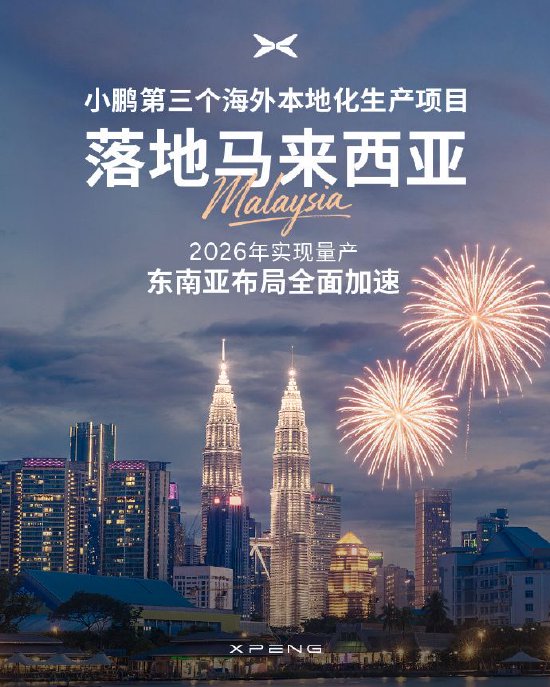
小鹏汽车正式启动马来西亚本地化生产项目 2026年实现量产
Feng Huang Wang· 2025-12-15 07:14
2025年1-11月,小鹏汽车海外交付量达39,773辆,同比增幅高达95%,显示出强劲的市场扩张势头。截 至目前,小鹏汽车销售服务网络已覆盖全球52个国家和地区,海外销售服务网点增至321个。此外,小 鹏汽车在全球已设立9大研发中心,为持续创新注入核心动力。 凤凰网科技讯12月15日,小鹏汽车官方宣布,小鹏汽车与马来西亚大型制造业上市公司EPMB集团签署 合作协议,正式启动马来西亚的本地化生产项目。这是继印尼、奥地利之后,小鹏在全球布局的第三个 本地化生产项目。按计划,项目将于2026年实现量产,旨在打造服务整个东盟右舵车市场的战略枢纽。 据官方介绍,今年1-10月,小鹏汽车成功跻身马来西亚当地纯电品牌销量前六。其中,小鹏X9在9月拿 下马来西亚高端电动MPV销量冠军。 ...

小鹏汽车第三个海外本地化生产项目将落地马来西亚
Mei Ri Jing Ji Xin Wen· 2025-12-15 07:02
每经AI快讯,据小鹏汽车微信公众号12月15日消息,近日,小鹏汽车与马来西亚大型制造业上市公司 EPMB集团签署合作协议,正式启动其在马来西亚的本地化生产项目。这是继印尼、奥地利之后,小鹏 在全球布局的第三个本地化生产项目。按计划,项目将于2026年实现量产,旨在打造服务整个东盟右舵 车市场的战略枢纽。 ...
小鹏汽车正式启动其在马来西亚的本地化生产项目
Zheng Quan Shi Bao Wang· 2025-12-15 06:55
人民财讯12月15日电,小鹏汽车15日宣布,与马来西亚大型制造业上市公司EPMB集团签署合作协议, 正式启动其在马来西亚的本地化生产项目。这是继印尼、奥地利之后,小鹏在全球布局的第三个本地化 生产项目。按计划,项目将于2026年实现量产,旨在打造服务整个东盟右舵车市场的战略枢纽。 ...
XPENG Kick-Starts Local EV Production in Malaysia, Marking Strategic Milestone in ASEAN Expansion
Prnewswire· 2025-12-15 06:10
Core Insights - XPENG has entered a strategic partnership with EP Manufacturing Berhad (EPMB) to establish localized production in Malacca, Malaysia, with mass production expected to start in 2026, marking XPENG's third such project globally and second in the Asia-Pacific region [1][2] Group 1: Partnership and Production - The collaboration aims to leverage EPMB's local manufacturing expertise and production capacity to produce advanced intelligent electric vehicles (EVs) tailored to Malaysian and ASEAN consumer needs [3] - Localized production will enhance XPENG's integration into the regional market, improve responsiveness, and strengthen its competitive edge [3] Group 2: Strategic Alignment - The partnership aligns with the Malaysian government's vision for a green economy and aims to upgrade Malaysia's new energy vehicle (NEV) industrial ecosystem while creating skilled employment opportunities locally [4] - XPENG's Vice President emphasized that this project is a significant milestone in the company's global strategy and reflects a long-term commitment to the ASEAN region [5] Group 3: Market Expansion - From January to November 2025, XPENG's overseas deliveries reached 39,773 units, a 95% year-on-year increase, with a sales and service network spanning 52 countries and regions [5] - The new facility in Malaysia is designed to synergize with XPENG's existing operations in Europe and other Asia-Pacific markets, forming an integrated ecosystem for localized production, sales, charging services, and user operations [2][5] Group 4: Company Background - XPENG, founded in 2014, is a leading AI-driven mobility company focused on designing, developing, and manufacturing smart EVs, with a mission to drive the Smart EV revolution through cutting-edge technology [7] - EPMB has over 40 years of experience in automotive manufacturing and is committed to advancing Malaysia's manufacturing landscape through strategic partnerships and innovation [6]

小鹏汽车与EPMB签署车辆组装协议
Xin Lang Cai Jing· 2025-12-15 06:07
12月15日,马来西亚汽车零部件制造商EPMB公告称,全资子公司与小鹏汽车已于12月12日签署协议, 将在马来西亚共同开展特定车辆项目的研发、制造、生产及组装合作,子公司将为小鹏汽车组装G6车 型及X9车型(含X9车型的增程电动汽车版本),G6车型计划于2026年3月31日前投产,X9车型计划于 2026年5月25日前投产。 ...
汽车行业反“内卷”卖车须明码标价
Xin Jing Bao· 2025-12-15 03:59
Core Viewpoint - The National Market Supervision Administration has released a draft guideline aimed at regulating price behaviors in the automotive industry, targeting false promotions and disguised price reductions, to promote price transparency and fair competition [1][4]. Group 1: Guidelines and Regulations - The guideline requires car manufacturers to establish a pricing strategy based on production costs and market demand, implementing full-chain price management across vehicle sales and financial services [2][4]. - It specifies that car sales must be clearly marked, prohibiting misleading pricing tactics such as false "manufacturer suggested retail prices" and "limited-time discounts" [3][4]. - The guideline aims to prevent price fraud, misleading pricing, and other unfair practices that disrupt market order and harm consumer rights [1][3][5]. Group 2: Industry Response - Major automotive companies like BYD, BAIC Group, and Xpeng Motors have expressed support for the guideline, committing to adhere to clear pricing and eliminate below-cost selling practices [8][9]. - BYD emphasized the guideline's role in maintaining fair competition and protecting consumer rights, pledging to optimize its pricing management and compliance systems [8][9]. - Xpeng Motors highlighted the importance of a healthy market environment for innovation, stating that the guideline will help refocus on value creation through technology, quality, and service [9]. Group 3: Market Context - The automotive industry has faced severe "involution" competition, leading to declining profitability and prompting regulatory bodies to signal a return to rational market development [6][7]. - The guideline is seen as a continuation of efforts to curb irrational price wars that have negatively impacted the health of the automotive supply chain [6][7]. - The China Automobile Dealers Association has noted that the guideline aims to stabilize retail market prices and enhance transparency in new car pricing [7].

十年后,蔚小理再次站在同一起跑线
Zhong Guo Qi Che Bao Wang· 2025-12-15 02:34
Group 1 - The new energy vehicle companies "Li Auto," "NIO," and "Xpeng" have reported their November sales figures, with NIO achieving a 76.3% year-on-year growth, delivering 36,275 vehicles, while Xpeng delivered 36,728 vehicles, showing a decline from the previous month [2][3] - NIO's multi-brand strategy is showing results, with its mainstream brand "Lido" contributing 11,794 vehicles and "Firefly" contributing 6,088 vehicles to the total sales, indicating a shift from high-end to mainstream market [3] - NIO's Q3 2025 financial report shows a revenue of 21.79 billion yuan, a 16.7% year-on-year increase, and a reduced net loss of 3.481 billion yuan, with a gross margin of 14.7%, the highest in three years [3] Group 2 - Xpeng reported a record Q3 2025 revenue of 20.38 billion yuan, a 101.8% increase year-on-year, with a net loss of 380 million yuan, down 78.9% [6] - Xpeng positions itself as an "AI car company," focusing on advanced autonomous driving capabilities and plans to launch a L4-level "Robo" car by 2026 [6][7] - Xpeng's service and technology R&D revenue gross margin reached 74.6%, contributing to an overall gross margin exceeding 20% [6] Group 3 - Li Auto faces challenges in its transition to pure electric vehicles, with Q3 revenue of 27.4 billion yuan, a 9.5% decline from the previous quarter, and a net loss of 624 million yuan due to recall costs [9] - Li Auto's new electric models, i8 and i6, have received over 100,000 orders, indicating progress in its transition strategy [10] - Li Auto plans to focus on user value and efficiency, with a new ten-year strategy emphasizing "organization, product, and technology" [10] Group 4 - The competition among "Li Auto," "NIO," and "Xpeng" has intensified as the market shifts from product-centric to a comprehensive competition involving strategy, efficiency, technology, and user engagement [12] - All three companies are navigating a challenging market environment, with Li Auto focusing on hybrid technology, NIO expanding its multi-brand strategy, and Xpeng maintaining its commitment to smart technology [13] - The automotive industry is undergoing significant transformation, requiring companies to balance strategic consistency with necessary adjustments to survive [14]


