
国博电子

Search documents
星网管理层正式调整,大规模招标近期或将开启,继续看好商业航天表现
Orient Securities· 2026-01-26 05:17
Investment Rating - The report maintains a "Positive" investment rating for the defense and military industry [4] Core Insights - The management adjustment at China Star Network is expected to accelerate the commercialization of satellite internet, with plans to deploy 13,000 low-orbit satellites between 2026 and 2030 [11][12] - The commercial space industry is projected to achieve 50 launches in 2025, marking a significant turning point in 2026, driven by policy support and advancements in reusable rocket technology [13][16] - The report emphasizes continued optimism for commercial aerospace, large aircraft, new combat capabilities, and military trade as key growth areas [16] Summary by Sections Industry Overview - The defense and military industry is experiencing a positive trend, with a 4.37% increase in the industry index, outperforming the Shanghai and Shenzhen 300 index [18][19] Commercial Aerospace - The management changes at China Star Network reflect a strategic focus on fulfilling satellite constellation deployment goals, with a critical period from 2027 to 2029 for compliance with ITU regulations [12] - The rapid growth in commercial space launches is highlighted, with 50 launches expected in 2025, representing 54% of total space launches in China [13][15] Investment Opportunities - The report identifies several investment targets within the commercial aerospace sector, including: - Aerospace Electronics (600879, Buy) - National Science and Technology Military Industry (688543, Not Rated) - Aerospace Power (600343, Not Rated) [16] - The report also highlights potential in the large aircraft and military trade sectors, suggesting a broad development space for military enterprises [16]


商业航天专题解读
2026-01-26 02:49
Summary of Key Points from Conference Call Records Industry Overview - The conference call focuses on the **commercial aerospace industry**, highlighting its rapid development and investment opportunities in related sectors such as technology stocks and materials [1][5][6]. Core Insights and Arguments - **Market Sentiment**: There is a notable outflow of long-term funds from broad-based ETF indices, indicating a mid-to-late market phase. Retail investor sentiment is recovering but remains cautious compared to previous years [2][3][4]. - **Investment Opportunities**: Key sectors for investment include commercial aerospace, robotics, and non-ferrous metals, driven by geopolitical tensions and technological advancements [1][5]. - **Technological Progress**: The commercial aerospace sector has made significant strides in reusable rocket technology, although it still lags behind leaders like SpaceX. Future directions include manned lunar missions, Mars exploration, and advancements in space photovoltaics [1][6][7]. - **Policy and Market Catalysts**: The sector is expected to benefit from favorable policies, technological advancements, and increased market attention, leading to improved fundamentals and performance [1][8]. Additional Important Content - **Space Photovoltaics**: The sector is gaining traction due to SpaceX's supply chain integration, with domestic companies having advantages in cost reduction. New technologies may lead to perovskite and heterojunction becoming mainstream [1][10]. - **Satellite Internet Market**: The satellite internet market is projected to reach a consumer terminal size of 1 billion, with optimistic estimates placing the satellite segment at 10 billion RMB and the ground segment at 30 billion RMB [3][18]. - **Material Supply Chain**: Key materials for commercial aerospace include carbon fiber and ceramic shells, with significant market potential expected by 2030. Major suppliers include Guangwei Composite and Guocera Materials [19][20][22]. - **Company Focus**: Companies like Fuhuan Microelectronics are highlighted for their strong performance and growth potential in the commercial aerospace sector, particularly in high-reliability applications and AI integration [21][22]. Recommendations for Investment - **Stock Selection Strategy**: Focus on companies with significant technological gaps and growth potential, as well as those with substantial new market opportunities [9]. - **Key Companies to Watch**: - In carbon fiber: Guangwei Composite, Zhongfu Shenying - In ceramic shells: Guocera Materials - In commercial aerospace: Fuhuan Microelectronics, which is positioned for growth in AI applications [22]. This summary encapsulates the essential insights and recommendations from the conference call, providing a comprehensive overview of the commercial aerospace industry's current state and future prospects.
国博电子股价跌5.19%,易方达基金旗下1只基金位居十大流通股东,持有285.61万股浮亏损失2136.34万元
Xin Lang Cai Jing· 2026-01-26 01:52
Group 1 - The core point of the news is that GuoBo Electronics experienced a decline of 5.19% in its stock price, reaching 136.51 yuan per share, with a trading volume of 1.93 billion yuan and a turnover rate of 0.24%, resulting in a total market capitalization of 813.62 billion yuan [1] - GuoBo Electronics, established on November 27, 2000, and listed on July 22, 2022, is primarily engaged in the research, production, and sales of active phased array T/R components and RF integrated circuits [1] - The main revenue composition of GuoBo Electronics includes T/R components and RF modules at 88.19%, RF chips at 8.49%, other chips at 2.04%, and other revenues at 1.28% [1] Group 2 - From the perspective of the top ten circulating shareholders, E Fund's ETF, the E Fund SSE STAR 50 ETF (588080), reduced its holdings by 349,600 shares in the third quarter, now holding 2.8561 million shares, which accounts for 0.48% of the circulating shares [2] - The estimated floating loss for E Fund's ETF today is approximately 21.36 million yuan [2] - The E Fund SSE STAR 50 ETF was established on September 28, 2020, with a latest scale of 70.597 billion yuan, and has achieved a year-to-date return of 15.56% [2]
3大火箭企业同台披露回收复用最新时间表,卫星ETF鹏华(563790)日均成交2.45亿
Xin Lang Cai Jing· 2026-01-26 01:42
Group 1 - The core viewpoint of the news highlights the advancements in China's commercial aerospace sector, particularly the timelines and differentiated paths for the development of reusable rockets, with 2026 being a pivotal year for technology validation [1] - Key figures from major companies, including Zhang Xiaodong from Blue Arrow Aerospace and Li Jun from Star River Power, presented updates on their respective rocket projects, indicating a collaborative effort towards achieving reusable rocket technology [1] - The report from Western Securities emphasizes that the global commercial aerospace industry is transitioning from "single satellite tests" to "constellation networks," with China's satellite deployment currently at only about 1% completion [1] Group 2 - The Satellite ETF Penghua closely tracks the CSI Satellite Industry Index, which includes 50 listed companies involved in satellite manufacturing, launching, communication, navigation, and remote sensing, reflecting the overall performance of the satellite industry [2] - As of December 31, 2025, the top ten weighted stocks in the CSI Satellite Industry Index account for 63.64% of the index, with major companies including China Satellite, Aerospace Electronics, and China Satcom [2]



商业航天和商发两机景气持续,重视海外共振赛道机遇
GF SECURITIES· 2026-01-25 12:48
Core Insights - The report emphasizes the ongoing prosperity in the commercial aerospace and military sectors, highlighting opportunities in overseas markets and the importance of technological advancements in the industry [2][3] Group 1: Industry Overview - The commercial aerospace sector is experiencing upward momentum, driven by SpaceX's advancements in reusable rocket technology, which could reduce space access costs by 100 times [13] - The military aviation sector is expected to benefit from increased demand for large aircraft and military trade, with significant growth anticipated in 2026 [14] - The report identifies a focus on supply chain reforms and the integration of AI technologies as key trends shaping the future of the defense and aerospace industries [15] Group 2: Investment Recommendations - The report recommends companies that align with the "S-curve" evolution, focusing on supply chain reforms and automation, including firms like航发动力 (Aero Engine Corporation) and 中航沈飞 (AVIC Shenyang Aircraft Corporation) [15] - Companies positioned for expansion in military trade and civil aviation, such as 国睿科技 (Guorui Technology) and 中国动力 (China Power), are highlighted for their growth potential [15] - Emerging industries like commercial aerospace, AI, and quantum computing are also recommended, with firms like 睿创微纳 (Ruichuang Micro-Nano) and 菲利华 (Feilihua) noted for their innovative capabilities [15] Group 3: Company Valuations and Financial Analysis - 航发动力 (Aero Engine Corporation) is projected to have a 2025E EPS of 0.22 CNY, with a PE ratio of 216.82 for 2025 [6] - 中航高科 (AVIC High-tech) is expected to achieve a 2025E EPS of 0.90 CNY, with a PE ratio of 29.16 for 2025 [6] - The report provides detailed financial metrics for various companies, indicating growth in EPS and improvements in PE ratios across the sector, reflecting a positive outlook for the defense and aerospace industries [6]


商业航天强势行情持续演绎,全面看多国产大飞机产业链
ZHONGTAI SECURITIES· 2026-01-25 08:53
Investment Rating - Maintain "Buy" rating for the industry [6] Core Viewpoints - The commercial aerospace sector is experiencing strong momentum, with short-term fluctuations providing investment opportunities. The industry is expected to enter a period of explosive growth over the next two years, driven by technological advancements and increasing demand for launch services, satellite networking, and space computing [9][30] - The domestic large aircraft industry is expected to see a dual increase in delivery and localization rates, with key milestones in certification and international cooperation becoming critical in 2026 [15][34] Summary by Sections 1. Policy Developments - The "14th Five-Year Plan" emphasizes the development of strategic emerging industries, including aerospace, and the establishment of a dedicated regulatory body for commercial aerospace [10][28] - New measures have been introduced to promote the development and utilization of satellite remote sensing data, encouraging mergers and acquisitions in the satellite data industry [10][28] 2. Technological Advancements - The successful maiden flight of the "Zhuque-3" rocket and the Long March 12 rocket marks significant progress in China's launch capabilities, with the latter achieving its mission of placing 19 low-orbit satellites into orbit [11][29][50] - The CJ-1000A engine is nearing certification, with expectations for small-scale production to begin soon [18][36] 3. Market Dynamics - The commercial aerospace sector is projected to grow significantly, with the integration of artificial intelligence and space computing driving demand for satellite manufacturing and launch services [12][32] - The upcoming Beijing International Commercial Aerospace Exhibition is expected to generate substantial procurement demand, showcasing advancements across the aerospace industry [13][32] 4. Key Companies to Watch - In the missile and military electronics sector, companies such as Hongyuan Electronics, Torch Electronics, and Huada Electronics are highlighted [24][37] - For aircraft manufacturing, focus on domestic large aircraft manufacturers like AVIC Xi'an Aircraft Industry Group and Guanglian Aviation [38][39] 5. International Competition - The global competition for space resources is intensifying, with significant developments from both China and the U.S. in satellite constellations and launch capabilities [14][33]
抢滩2027太空经济!马斯克星链二代定档,贝索斯TeraWave出击,中国商业航天锁定核心资源
Xin Lang Cai Jing· 2026-01-23 13:09
Core Insights - The commercial space industry is entering a golden era with significant developments from major players like SpaceX and Blue Origin, alongside China's aggressive satellite frequency resource claims [1][4][6] Group 1: SpaceX Developments - SpaceX plans to launch its second-generation Starlink satellite communication system in 2027, with an approved deployment of 7,500 new satellites, increasing overall capacity by over 100 times and data throughput by more than 20 times [1][2] - The acquisition of EchoStar's spectrum resources for $17 billion will enhance satellite connectivity to mobile phones, addressing spectrum bottlenecks [1][2] - The upgraded system will support video calls and HD streaming, breaking ground for high-speed internet access in remote areas [2][3] Group 2: Blue Origin's TeraWave - Blue Origin announced plans to deploy over 5,400 satellites by the end of 2027 to create the TeraWave communication network, offering symmetrical data transmission speeds of up to 6 Tbps [3][4] - The focus is on high-end markets, targeting government and large enterprises, providing flexible and stable global connectivity [3][4] - The technology features a multi-orbit optical interconnect architecture, enhancing network routing diversity and risk resilience [3][4] Group 3: China's Satellite Initiative - China has submitted a record application for frequency and orbital resources for 203,000 satellites, marking a significant strategic move in the global space communication landscape [4][5] - This initiative positions China to secure critical resources for the 6G era and marks a transition from following to leading in commercial space endeavors [4][5] - Plans are in place to deploy 13,000 low-orbit satellites between 2026 and 2030, with ongoing advancements in rocket technology and satellite manufacturing [5][6] Group 4: Industry Impact - The competition for orbital resources is intensifying, with SpaceX, Blue Origin, and China vying for dominance, making technological strength and first-mover advantage crucial [6][7] - The acceleration of technology iterations is evident, transitioning from basic communication to high-speed, specialized services [6][7] - The commercial landscape is opening up, with C-end markets benefiting from 5G-level satellite connectivity and B-end markets leveraging high-speed data for various applications [6][7] Group 5: Investment Opportunities - The entire supply chain, including satellite manufacturing, rocket launches, and ground equipment, is expected to benefit from increased demand, leading to technological breakthroughs and capacity expansions [7][8] - The market sentiment is buoyed by the announcements from major players, with commercial space stocks gaining traction and IPO processes accelerating for domestic companies [7][8] - The global landscape is shifting from single-nation dominance to a multi-player competition involving the US, China, and Europe, with China poised to play a significant role [7][8]
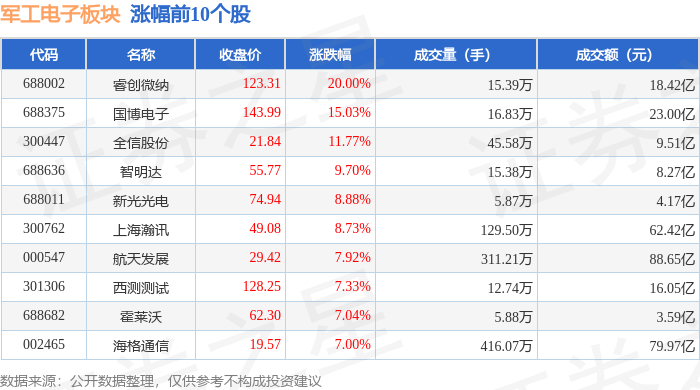
军工电子板块1月23日涨5.39%,睿创微纳领涨,主力资金净流入25.42亿元
Zheng Xing Xing Ye Ri Bao· 2026-01-23 09:07
Market Performance - The military electronics sector increased by 5.39% compared to the previous trading day, with Ruichuang Micro-Nano leading the gains [1] - The Shanghai Composite Index closed at 4136.16, up 0.33%, while the Shenzhen Component Index closed at 14439.66, up 0.79% [1] Stock Highlights - Ruichuang Micro-Nano (688002) closed at 123.31, up 20.00% with a trading volume of 153,900 shares and a transaction value of 1.842 billion [1] - Yuanbo Electronics (688375) closed at 143.99, up 15.03% with a trading volume of 168,300 shares and a transaction value of 2.300 billion [1] - Quanxin Co., Ltd. (300447) closed at 21.84, up 11.77% with a trading volume of 455,800 shares and a transaction value of 0.951 billion [1] - Other notable stocks include Zhimingda (688636) up 9.70%, Xinguang Optoelectronics (688011) up 8.88%, and Shanghai Jianxun (300762) up 8.73% [1] Capital Flow - The military electronics sector saw a net inflow of 2.542 billion from institutional investors, while retail investors experienced a net outflow of 1.513 billion [2] - The table of capital flow indicates that major stocks like Shanghai Hantong (300762) had a significant net inflow of 5.39 billion from institutional investors [3] - Other stocks such as Beidou Star (002151) and Guode Electronics (688375) also showed varying degrees of net inflow and outflow from different investor categories [3]


今日1091只个股突破五日均线
Zheng Quan Shi Bao Wang· 2026-01-23 07:49
Group 1 - The Shanghai Composite Index closed at 4136.16 points, above the five-day moving average, with a gain of 0.33% [1] - The total trading volume of A-shares reached 31,181.08 billion yuan [1] - A total of 1,091 A-shares have prices that surpassed the five-day moving average, with notable stocks including Dongfang Risheng, Jinko Solar, and Xinke Mobile, showing divergence rates of 16.59%, 15.85%, and 15.78% respectively [1] Group 2 - The top stocks with significant divergence rates from the five-day moving average include: - Dongfang Risheng (300118) with a price increase of 20.00% and a divergence rate of 16.59% [1] - Jinko Solar (688223) also increased by 20.00% with a divergence rate of 15.85% [1] - Xinke Mobile (688387) rose by 18.41% with a divergence rate of 15.78% [1] - Other notable stocks with divergence rates include: - Jiejia Weichuang (300724) at 20.00% increase and 15.34% divergence [1] - Ruichuang Micro (688002) with a 20.00% increase and 14.83% divergence [1]


商业航天引爆太空光伏需求!科创50ETF(588000)午后翻红,光伏股集体大涨,晶科能源涨停,天合光能涨超14%!
Mei Ri Jing Ji Xin Wen· 2026-01-23 06:50
Group 1 - The A-share market experienced fluctuations on January 23, with the Sci-Tech 50 ETF (588000) rebounding in the afternoon, showing a gain of 0.43% and a trading volume exceeding 3.5 billion yuan, indicating a significant increase in trading activity [1] - Solar energy stocks surged, with JinkoSolar hitting the daily limit, Trina Solar rising by 14.92%, GuoBo Electronics increasing by 13.83%, and Canadian Solar up by 10.51%. Other companies like ZhongKong Technology and Daqo New Energy also saw gains exceeding 7% [1] - Trina Solar announced a price increase for its distributed photovoltaic standard components by 0.03 yuan/W, with the new price range set at 0.88-0.92 yuan/W. This marks the third price adjustment since 2026, with an overall increase of 0.06 yuan/W in less than a month [1] Group 2 - The outlook for the solar industry is optimistic, with brokerage reports indicating that the application for 200,000 satellites in China is accelerating the entire commercial space industry chain, leading to a surge in demand for space-based photovoltaics [1] - The planned constellation of thousands of satellites is expected to exponentially increase the demand for photovoltaic cells, while the complexity of satellite equipment is driving up the energy supply requirements per satellite [1] - Technological advancements are pushing the photovoltaic cell industry towards low-cost HJT and perovskite tandem routes, driven by commercialization [1] Group 3 - The Sci-Tech 50 ETF (588000) tracks the Sci-Tech 50 Index, with over 70% of its holdings in the electronics sector, aligning well with the current development trends in artificial intelligence and robotics [2] - The ETF also covers multiple sub-sectors, including medical devices, software development, and photovoltaic equipment, indicating a high content of hard technology [2] - Investors optimistic about the long-term development prospects of China's hard technology are encouraged to continue monitoring this ETF [2]



