
海油工程

Search documents
海油工程招标:多项项目公布中标候选人 明确资金价值导向
Xin Lang Cai Jing· 2026-02-04 00:49
2月3日消息,天眼查数据显示,海洋石油工程股份有限公司发布海油工程-深技服-总价-螺栓法兰多功能 液压拆卸机组中标候选人公示,发布时间为2026年2月3日。 ...

油气冲高回落,杰瑞股份涨超4%,再签1.8亿美元大单!油气ETF汇添富(159309)再度飘红吸金,连续15日净申购5.54亿元!
Sou Hu Cai Jing· 2026-02-03 03:17
Core Viewpoint - The oil and gas sector is experiencing increased activity, with significant capital inflows into oil and gas ETFs, indicating strong investor interest and potential growth opportunities in the sector [1][5]. Group 1: Market Activity - The oil and gas ETF Huatai (159309) saw a rise of 0.46%, with trading volume exceeding 300 million yuan, reflecting a continuous inflow of capital totaling 554 million yuan over the past 15 days [1]. - The ETF recorded a net inflow of 23 million yuan today, showcasing ongoing investor confidence in the sector [1]. Group 2: Stock Performance - Key stocks in the oil and gas sector showed mixed performance, with Jereh Holdings rising nearly 4%, while major players like China Petroleum and China National Offshore Oil Corporation (CNOOC) experienced declines of over 2% [5]. - The trading volume for significant stocks included Jereh Holdings at 1.44 billion yuan and China Petroleum at 1.08 billion yuan, indicating substantial market activity [2]. Group 3: Company Contracts and Growth - Jereh Holdings signed a gas turbine generator sales contract worth 181.5 million USD (approximately 1.265 billion yuan) with a U.S. client, marking a total of 487.5 million USD (approximately 3.4 billion yuan) in contracts secured in North America over a few months [3]. - The company has consistently secured contracts in the North American market since November 2025, indicating a strong growth trajectory [3]. Group 4: Oil Price Outlook - Analysts predict that oil prices will fluctuate between 60-80 USD per barrel in 2026 due to geopolitical tensions and supply-demand dynamics, which could benefit the petrochemical sector [4]. - The International Energy Agency (IEA) forecasts a global oil demand increase of 930,000 barrels per day in 2026, higher than the previous year's estimate, supporting a positive outlook for oil prices [4]. Group 5: Investment Strategy - The oil and gas sector is viewed as having long-term investment value due to its resilience against external uncertainties, with a focus on companies that maintain high capital expenditures and expand into natural gas markets [6]. - The Huatai oil and gas ETF is designed to concentrate on upstream and downstream sectors of the oil and gas industry, ensuring a focus on companies with quality reserves and stable dividend capabilities [6].


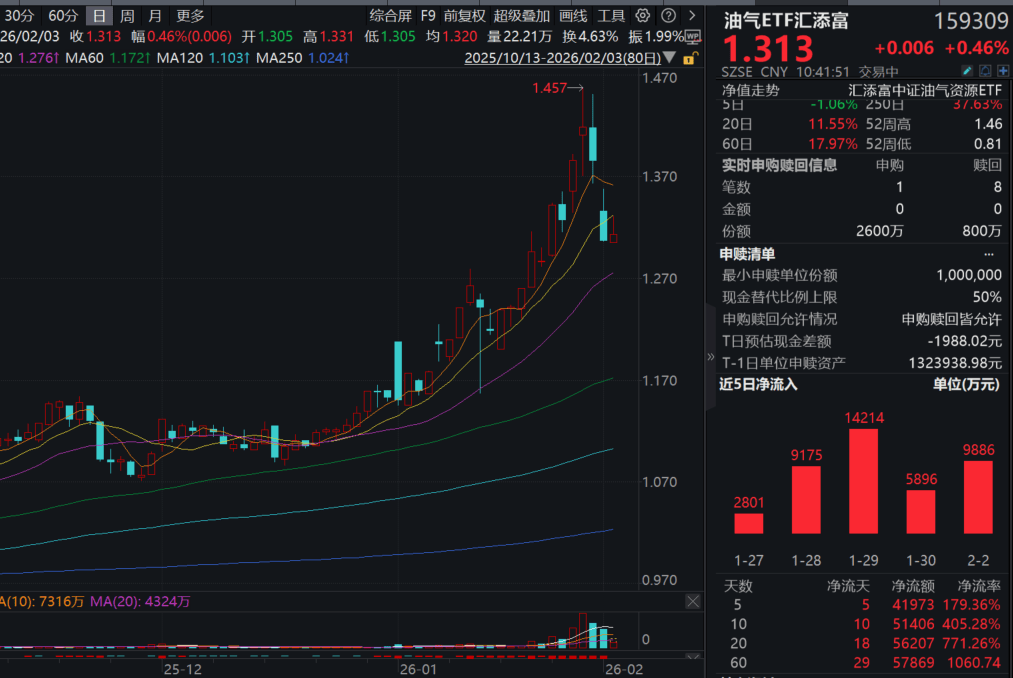
大宗商品集中宣泄,原油跌4.8%!中国海油大跌超4%!油气ETF汇添富(159309)资金逆势涌入超1亿元,连续15日吸金!“OPEC+”3月延续暂停增产
Sou Hu Cai Jing· 2026-02-02 05:45
Core Viewpoint - The A-share market is experiencing volatility and decline, particularly in the oil and gas sector, with significant net inflows into the oil and gas ETF Huatai-PineBridge (159309) despite the downturn [1][3]. Group 1: Market Performance - As of 13:22, the oil and gas ETF Huatai-PineBridge (159309) has dropped over 4%, with a net inflow of more than 106 million yuan during the day, marking a total of over 500 million yuan in inflows over the past 15 days [1]. - Major component stocks of the oil and gas ETF have mostly retreated, with Intercontinental Oil and Gas down over 9%, and China National Offshore Oil Corporation and China Petroleum down over 4% [3]. Group 2: Component Stocks - The top ten component stocks of the oil and gas ETF include: - Jerry Holdings (002353) up 1.71% - CNOOC (601857) down 3.54% - China Petroleum (600028) down 1.54% - Intercontinental Oil and Gas (600759) down 9.91% [4]. Group 3: Geopolitical and Supply Factors - Geopolitical risks have eased, with the U.S. indicating a positive relationship with Venezuela, potentially sharing oil revenues, and ongoing negotiations with Iran [5]. - OPEC+ members have agreed to maintain their production cut policies, with a commitment to market stability and low inventory levels [5]. Group 4: Industry Outlook - The medium to long-term outlook for the oil and gas industry remains positive, with expected exploration and development spending to maintain historical median levels from 2024 to 2030 [7]. - Key variables affecting the market include North American data center construction progress, OPEC+ production policies, and domestic policies on refining capacity [7]. Group 5: ETF Characteristics - The oil and gas ETF Huatai-PineBridge (159309) focuses on the oil and gas industry chain, including exploration, equipment, refining, and sales, emphasizing companies with quality reserves and low-cost advantages [8]. - The ETF has a streamlined sample size of 44 stocks, ensuring high purity with all top ten component stocks being leading oil and gas companies [8].




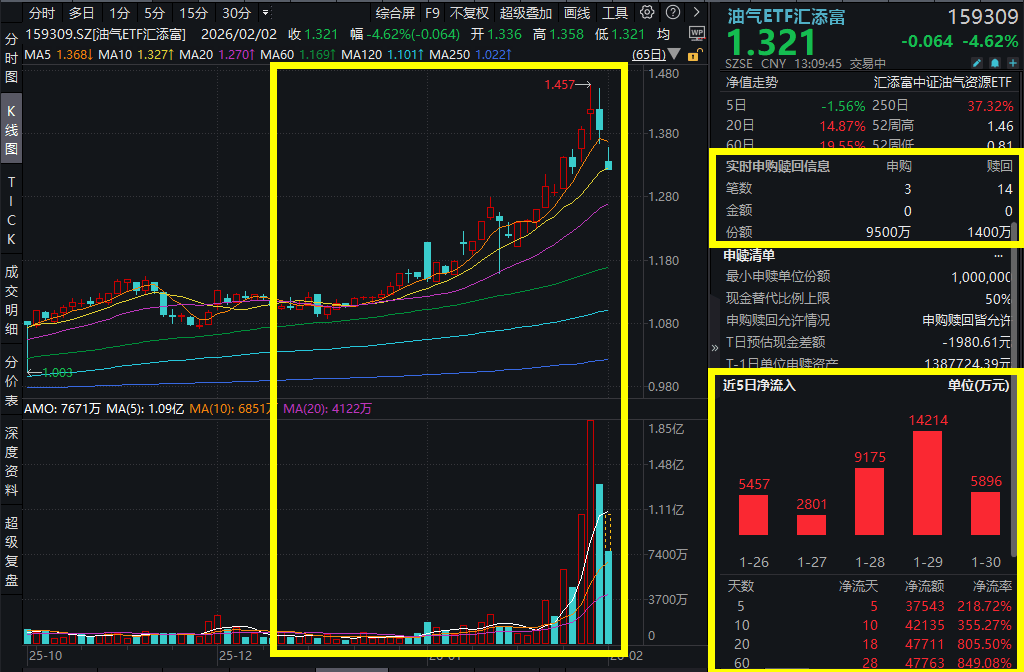
油气ETF汇添富(159309)开盘跌3.54%,重仓股中国石油跌2.90%,中国海油跌4.70%
Xin Lang Cai Jing· 2026-02-02 04:09
Group 1 - The oil and gas ETF Huatai Fu (159309) opened down 3.54% at 1.336 yuan [1] - Major holdings in the ETF saw varied performance: China National Petroleum Corporation down 2.90%, CNOOC down 4.70%, Sinopec down 1.69%, and Jereh Group up 6.74% [1] - The ETF's performance benchmark is the CSI Oil and Gas Resource Index return rate, managed by Huatai Fund Management Co., Ltd. [1] Group 2 - Since its inception on May 31, 2024, the ETF has returned 38.77%, with a one-month return of 20.14% [1]
利柏特(605167):全球FPSO投资加速,看好公司南通基地投运后海工业务成长
GF SECURITIES· 2026-02-01 14:17
Investment Rating - The report maintains a "Buy" rating for the company with a current price of 18.30 RMB and a fair value of 20.41 RMB [9]. Core Insights - The modular design and manufacturing are critical components in the FPSO midstream sector, with significant advantages over non-modular construction methods [9][27]. - The domestic offshore oil and gas development is accelerating due to energy security policies, with the FPSO upper module market expected to reach approximately 10 billion USD annually [9][32]. - The company has demonstrated competitive manufacturing capabilities in the FPSO sector, with plans to expand its production capacity at the Nantong base [9][53]. Summary by Sections 1. Modular Design and Manufacturing - The FPSO industry is primarily composed of three segments: upstream (raw materials and equipment suppliers), midstream (module design and manufacturing), and downstream (client companies) [23]. - Modular construction significantly reduces construction time and costs while improving quality and safety compared to traditional methods [27]. 2. Energy Security and Market Growth - The Chinese government is promoting deep-sea economic development, which is expected to enhance offshore oil and gas capital expenditures [32]. - The annual market size for FPSO upper modules is projected to be around 10 billion USD, driven by domestic policies and international investments, particularly from Brazil [32][45]. 3. Competitive Landscape - The FPSO market is characterized by a few dominant players, with Chinese companies like the company in question, CNOOC Engineering, and CIMC Raffles gaining prominence due to their manufacturing capabilities and cost advantages [49][50]. - The company has engaged in significant projects, including its first FPSO design and manufacturing contract with a Dutch firm, showcasing its growing capabilities in the sector [53]. 4. Financial Projections - The company is expected to generate revenues of 2.905 billion RMB in 2025, with a projected growth rate of 5.5% in 2026 and 30.5% in 2027 [4]. - The net profit forecast for 2025 is 215 million RMB, with expected growth rates of -10.7% in 2025, 21.9% in 2026, and 35.5% in 2027 [4][60].

石油化工行业周报(2026、1、26—2026、2、1):油价冲高反映地缘风险,中长期或回归基本面逻辑-20260201
Shenwan Hongyuan Securities· 2026-02-01 13:51
Investment Rating - The report maintains a positive outlook on the oil and petrochemical industry, indicating a "Buy" rating due to the current geopolitical risks and potential for price recovery in the medium to long term [1]. Core Insights - The report highlights that the recent surge in oil prices reflects geopolitical risk premiums, particularly due to ongoing tensions between the U.S. and Iran, which significantly impact global oil supply security [4][7]. - It is anticipated that oil prices will exhibit characteristics of being "geopolitically driven with fundamental support" around the Chinese New Year, with potential further increases if conflict expectations materialize [7]. - The medium to long-term outlook suggests a return to fundamental pricing logic as the oil supply-demand balance is expected to loosen, limiting upward price movement without sustained geopolitical conflict [7]. Summary by Sections Upstream Sector - As of January 30, Brent crude oil futures closed at $70.69 per barrel, a 7.30% increase from the previous week, while WTI futures rose by 6.78% to $65.21 per barrel [15]. - U.S. commercial crude oil inventories decreased to 424 million barrels, down 2.296 million barrels week-on-week, which is 3% lower than the five-year average [17]. - The report notes a trend of increasing oil service activity, with drilling day rates remaining stable despite low levels, indicating potential for future increases as global capital expenditures rise [15][35]. Refining Sector - The Singapore refining margin for major products fell to $9.40 per barrel, a decrease of $2.69 from the previous week [54]. - The report indicates that while refining profitability has improved, the current product price differentials remain low, with expectations for gradual improvement as economic recovery progresses [51]. Polyester Sector - The report observes an increase in PTA profitability, with prices rising to 5,271.4 CNY per ton, a 4.66% increase week-on-week [1]. - The overall performance of the polyester industry is deemed average, with a need to monitor demand changes closely [1]. Investment Recommendations - The report recommends focusing on high-quality companies in the polyester sector, such as Tongkun Co. and Wankai New Materials, as well as large refining companies like Hengli Petrochemical and Rongsheng Petrochemical due to expected improvements in cost structures and competitive advantages [1][10]. - It also suggests maintaining a neutral outlook on oil companies, with a focus on those offering high dividend yields, such as China National Petroleum and China National Offshore Oil [10].


石油化工行业周报(2026/1/26—2026/2/1):油价冲高反映地缘风险,中长期或回归基本面逻辑-20260201
Shenwan Hongyuan Securities· 2026-02-01 13:49
Investment Rating - The report maintains a positive outlook on the oil and petrochemical industry, indicating a "Buy" rating due to the current geopolitical risks and potential for price recovery in the medium to long term [1]. Core Insights - The report highlights that the recent surge in oil prices is primarily driven by geopolitical risks, particularly the ongoing tensions between the US and Iran, which have led to Brent crude oil prices exceeding $70 per barrel [1][4]. - It is anticipated that oil prices will exhibit characteristics of being "geopolitically driven with fundamental support" around the Chinese New Year, with potential further increases if conflict expectations materialize [7]. - The medium to long-term outlook suggests a return to fundamental pricing logic, with oil supply and demand expected to be in a loose balance, limiting upward price movement unless geopolitical tensions persist [7]. Summary by Sections Upstream Sector - As of January 30, Brent crude oil futures closed at $70.69 per barrel, reflecting a week-on-week increase of 7.30%, while WTI futures rose by 6.78% to $65.21 per barrel [15]. - US commercial crude oil inventories decreased to 424 million barrels, down by 2.296 million barrels from the previous week, marking a 3% decline compared to the past five years [17]. - The report notes a trend of increasing oil service activity, with drilling day rates remaining stable despite low levels, indicating potential for future increases as global capital expenditures rise [15]. Refining Sector - The report indicates a decline in overseas refined oil crack spreads, with Singapore's refining margin dropping to $9.40 per barrel, down by $2.69 from the previous week [54]. - The report anticipates that refining profitability may improve as oil prices adjust, with expectations of gradual recovery in refining product margins as economic conditions stabilize [51]. Polyester Sector - The report highlights an increase in PTA profitability, with prices rising to 5,271.4 CNY per ton, reflecting a week-on-week increase of 4.66% [1]. - The overall performance of the polyester industry is described as average, with a need to monitor demand changes, but a gradual improvement is expected as new production capacities taper off [1]. Investment Recommendations - The report recommends focusing on high-quality companies in the polyester sector, such as Tongkun Co. and Wankai New Materials, as well as large refining companies like Hengli Petrochemical and Rongsheng Petrochemical, which are expected to benefit from improved cost structures and competitive advantages [1][10]. - It also suggests maintaining a neutral outlook on oil companies, with a preference for those offering higher dividend yields, such as China National Petroleum and China National Offshore Oil Corporation [10].

原油周报:伊朗地缘风险升级,油价显著走强-20260201
Xinda Securities· 2026-02-01 13:02
Investment Rating - The report maintains a "Positive" investment rating for the oil processing industry [1]. Core Insights - International oil prices have significantly strengthened due to escalating geopolitical risks in Iran and adverse weather conditions affecting U.S. oil production. As of January 30, 2026, Brent and WTI prices were reported at $69.32 and $65.21 per barrel, respectively, marking increases of 6.53% and 6.78% from the previous week [2][9]. - The oil and petrochemical sector has shown strong performance, with the sector index rising by 7.95% as of January 30, 2026, compared to a slight increase of 0.08% in the broader market index [10]. - The report highlights a notable increase in the number of active offshore drilling platforms, with a total of 376 self-elevating platforms and 134 floating platforms as of January 26, 2026 [26]. Summary by Sections Oil Price Review - Brent crude futures settled at $69.32 per barrel, up $4.25 (+6.53%) from the previous week, while WTI crude futures rose to $65.21 per barrel, an increase of $4.14 (+6.78%) [23]. - The Urals crude price remained stable at $65.49 per barrel, while ESPO crude increased by $4.42 (+8.66%) to $55.46 per barrel [23]. Offshore Drilling Services - The global count of self-elevating drilling platforms remained at 376, while floating platforms increased by one to a total of 134 [26]. U.S. Oil Supply - U.S. crude oil production was reported at 13.696 million barrels per day, a decrease of 36,000 barrels from the previous week. The number of active drilling rigs remained stable at 411 [32]. - The U.S. fracking fleet decreased by 15 units to a total of 148 [32]. U.S. Oil Demand - U.S. refinery crude processing averaged 16.209 million barrels per day, down by 395,000 barrels from the previous week, with a refinery utilization rate of 90.90%, a decline of 2.4 percentage points [40]. U.S. Oil Inventory - Total U.S. crude oil inventories stood at 839 million barrels, a decrease of 1.78 million barrels (-0.21%) from the previous week. Strategic reserves increased by 515,000 barrels (+0.12%), while commercial inventories fell by 2.295 million barrels (-0.54%) [49]. Related Companies - Key companies in the sector include China National Offshore Oil Corporation (CNOOC), China Petroleum & Chemical Corporation (Sinopec), and China National Petroleum Corporation (CNPC) [3].

石油化工行业周报:伊朗推动地缘溢价进一步上升
SINOLINK SECURITIES· 2026-02-01 10:50
Investment Rating - The report indicates a positive outlook for the oil and petrochemical sector, with the sector outperforming the Shanghai Composite Index by +8.40% this week [10]. Core Insights - Geopolitical factors remain the primary driver in the current oil market, with significant attention on the potential for conflict between the US and Iran. The market is pricing in a geopolitical risk premium of approximately $8-10 per barrel related to Iran [15][17]. - The report anticipates that if the situation with Iran does not escalate into a full-blown conflict, oil prices may revert to supply-demand fundamentals, potentially leading to a price decline [15][17]. - The report highlights that the recent cold wave and reduced production in Kazakhstan have slowed the accumulation of global inventories, with expectations of a return to a higher accumulation rate in the coming weeks [17][18]. Summary by Sections Market Review - The oil and petrochemical sector has shown a weekly increase of +7.95%, with specific indices such as the oil and gas resources index rising by +7.79% and the oil and gas extraction services index by +7.96% [10][11]. Oil Sector - As of January 29, WTI crude oil was priced at $65.42, up by $6.06, while Brent crude was at $72.57, up by $6.60. The EIA reported a decrease in commercial crude oil inventories by 2.295 million barrels [16][17]. - The report notes that US crude oil production stands at 13.696 million barrels per day, with a decrease in net imports by 61.8% [16]. Refining Sector - The average operating rate of domestic refineries was reported at 80.02%, with a slight increase of 1.24 percentage points from the previous week. The average refining margin for major refineries was 659.83 yuan per ton, down by 101.65 yuan per ton [16]. Polyester Sector - The PX-Naphtha spread has increased to approximately $340 per ton, with PTA processing fees at 374.32 yuan per ton. The report indicates a decline in profitability for polyester products, with average profit levels for various types of polyester showing negative margins [16]. Olefins Sector - The average price for ethylene in the domestic market was reported at 5769 yuan per ton, a slight decrease of 0.33%. The propylene market saw an increase in average transaction prices to 6400 yuan per ton, up by 3.64% [16].


石油化工行业周报:伊朗推动地缘溢价进一步上升-20260201
SINOLINK SECURITIES· 2026-02-01 09:30
Investment Rating - The report indicates a positive outlook for the oil and petrochemical sector, with the sector outperforming the Shanghai Composite Index by +8.40% this week [10]. Core Insights - The oil market is experiencing a rapid increase in prices due to geopolitical risks, particularly concerning Iran's potential actions in the Strait of Hormuz, with a risk premium estimated at $8-10 per barrel [15][16]. - The overall supply remains in excess, with previous supportive factors like cold weather and reduced production in Kazakhstan starting to stabilize [15]. - The report highlights a mixed performance across various segments of the petrochemical industry, with oil and gas resources showing a +7.79% increase, while the polyester index decreased by -1.82% [10]. Summary by Sections Market Review - The petrochemical sector has outperformed the Shanghai Composite Index, with various indices showing significant weekly changes, including the oil and gas extraction service index at +7.96% and the refining and chemical index at +6.75% [10][11]. Oil Market - As of January 29, WTI crude oil closed at $65.42, up $6.06 from the previous week, while Brent crude closed at $72.57, up $6.60 [16]. - The EIA reported a decrease in commercial crude oil inventories by 2.295 million barrels, with a notable drop in gasoline inventories as well [16]. Refining Sector - The average operating rate of domestic refineries increased to 80.02%, with a slight rise in gasoline demand due to seasonal travel [16]. - The average refining margin for major refineries was reported at 659.83 yuan per ton, down 101.65 yuan from the previous period [16]. Polyester Sector - The PX-Naphtha spread has risen to approximately $340 per ton, with PTA processing fees reported at 374.32 yuan per ton [15]. - The report notes a decline in profitability for various polyester products, with average profit levels for POY150D at -21.03 yuan per ton [15]. Olefins Market - The average price for ethylene in the domestic market was reported at 5769 yuan per ton, a slight decrease of 0.33% from the previous week [15]. - Propylene prices in Shandong increased by 225 yuan per ton, reflecting a 3.64% rise [15].