三六零

Search documents
快讯|周鸿祎直播试吃机器人炒菜;优必选与富士康云智汇达成战略合作;OpenMind开源全球首个AI原生开源机器人系统发布
机器人大讲堂· 2025-09-22 06:40
Group 1 - Zhou Hongyi, founder of 360 Group, participated in a live cooking test with Yang Jiancheng, founder of Xianglu Robotics, highlighting the capabilities of AI cooking robots in achieving "wok hei" [3][6] - Xianglu Robotics has shipped nearly 10,000 commercial cooking robots, which ensure consistent taste and reduce the difficulty of standardization in chain restaurants [3][6] - Zhou suggested that cooking robots should expand from equipment to an ecosystem, while Xianglu plans to launch a new monthly rental business model in Q4 [3][6] Group 2 - UBTECH, known as the "first stock of humanoid robots," signed a global strategic cooperation agreement with Cloud Intelligence Technology (a Foxconn subsidiary) to advance humanoid robot manufacturing and delivery [6][9] - The agreement outlines the division of responsibilities between the two companies, with Cloud Intelligence focusing on global sales and UBTECH on R&D and production [6][9] - Both companies aim to create a "humanoid robot + smart factory" demonstration scenario to promote smart manufacturing upgrades and global expansion [6][9] Group 3 - Harbin Engineering University's agile underwater robot "Turtle" was unveiled in the South China Sea, achieving centimeter-level precision in near-seabed environmental observation [9][11] - The robot's design reduces sediment interference by 90% during navigation, and it employs a new inertial measurement method that decreases data noise by approximately 76.2% [9][11] - The "Turtle" features a 360-degree maneuverability capability, making it suitable for applications in coral observation, underwater fishing, and search and rescue [9][11] Group 4 - OpenMind released the world's first "AI-native" open-source robot system, aimed at creating a unified development platform for various types of robots [11][13] - The system is hardware-neutral and supports multiple robot forms, allowing for quick deployment and compatibility with various AI models [11][13] - It integrates SLAM technology for stable movement in complex environments and includes a front-end interface for real-time monitoring of robot status [11][13] Group 5 - NVIDIA made its first investment in a Taiwanese startup, MetAI, which specializes in creating digital twin environments for AI training [17] - MetAI's platform can generate virtual defect products to assist in AI defect detection, significantly reducing design time for manufacturers [17] - NVIDIA's interest in MetAI stems from its alignment with the demand for "physical AI," facilitating a bidirectional cycle between the real and virtual worlds [17]


华为10亿元支持鸿蒙AI生态,计算机ETF(159998)涨超2%,云计算ETF沪港深(517390)近10日“吸金”近1亿
2 1 Shi Ji Jing Ji Bao Dao· 2025-09-22 02:59
Group 1 - A-shares indices opened higher on September 22, with strong performance in the storage chip sector, particularly the Computer ETF (159998) which rose by 2.17% with a trading volume exceeding 47 million yuan [1] - Key stocks in the Computer ETF included Jiangbolong, which increased by over 11%, and other notable gainers were Zhongke Shuguang, Xiechuang Data, and 360 [1] - The Cloud Computing ETF (517390) experienced a slight decline of 0.17%, but notable stocks like Donghua Software reached the daily limit up, with other gainers including Guanghuan New Network and Aofei Data [1] Group 2 - The Cloud Computing ETF (517390) closely tracks the CSI Hong Kong-Shanghai Cloud Computing Industry Index and includes major stocks like Tencent Holdings and Zhongke Shuguang [2] - Recent developments include the establishment of the Shanghai Quantum Artificial Intelligence Joint Alliance and the release of ten application scenarios for quantum computing at the Pujiang Innovation Forum [2] - Huawei announced the "Tian Gong Plan" at the Huawei Connect 2025 conference, committing 1 billion yuan to support the Harmony AI ecosystem, focusing on AI agents as a key direction for development [2] Group 3 - CITIC Securities indicated that the third quarter is a traditional peak season for the electronics sector, with strong demand for AI computing-related products, including chips and servers, and an upward trend in both overseas and domestic computing chains [3] - The demand for storage is expected to increase, with enterprise-level demand remaining robust, and NAND and DRAM demand growth and price increases exceeding expectations since the second half of 2025 [3] - The semiconductor equipment chain is steadily advancing in domestic production, with a clear trend of mergers and acquisitions in the industry [3] Group 4 - CITIC Jinpu highlighted Huawei's upcoming product launches, including the Ascend 950 series, which will be released between 2026 and 2028, aimed at meeting the growing demand for AI computing power [4] - Huawei's Atlas 950 super node, supporting 8192 Ascend 950DT cards, is set to launch in the fourth quarter of 2026, significantly enhancing overall computing power [4] - The North American AI computing demand remains strong, with expectations of a rebound in domestic AI computing demand from September to October, and a recommendation to focus on domestic cloud service providers [4]
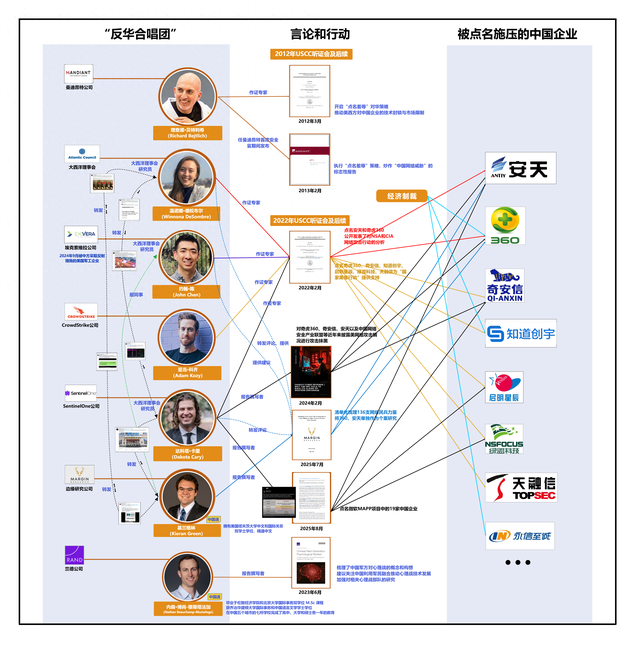
心智观察所:美国网络安全智库的“反华合唱团”
Guan Cha Zhe Wang· 2025-09-22 01:58
Core Viewpoint - The article discusses the increasing scrutiny and criticism of Chinese cybersecurity companies by U.S. experts and institutions, particularly focusing on the actions of Dakota Cary and the implications for the cybersecurity industry. Group 1: Criticism of Chinese Cybersecurity Companies - Dakota Cary, a prominent figure in U.S. cybersecurity, has accused several Chinese companies, including Alibaba and Baidu, of being "weapons suppliers" for state-sponsored hacking, distorting the nature of penetration testing services [1][3][6] - Cary's claims are seen as part of a broader strategy to isolate Chinese cybersecurity firms from international collaborations, particularly the Microsoft Active Protections Program (MAPP) [6][7] - Following Cary's accusations, Microsoft announced restrictions on Chinese companies' access to vulnerability information, which was celebrated by Cary as a victory [7][8] Group 2: Historical Context and Evolution - The article traces the origins of U.S. criticism of Chinese cybersecurity back to a 2012 congressional hearing where Richard Bejtlich accused the Chinese government of extensive cyber espionage [9][13] - This hearing marked the beginning of a decade-long focus on China as a primary adversary in cyberspace, leading to a series of reports and accusations against Chinese firms [13][14] - The narrative has evolved, with newer figures like Cary taking the lead in shaping public perception and policy against Chinese cybersecurity entities [17][20] Group 3: The Role of U.S. Cybersecurity Firms - U.S. cybersecurity firms, such as SentinelOne, have benefited from the political climate by increasing government contracts, with SentinelOne's government orders rising from 12% in 2021 to 37% by 2025 [32][33] - The article highlights a pattern where U.S. cybersecurity companies publish reports that criticize Chinese firms, which in turn helps them secure government contracts and funding [32][34] - The rise of companies like CrowdStrike and SentinelOne is linked to their ability to align with U.S. government interests and narratives against China [33][34] Group 4: Response from Chinese Cybersecurity Firms - In response to the accusations, Chinese cybersecurity companies have begun to publish their own reports exposing U.S. cyber activities, aiming to counter the narrative and assert their capabilities [36][37] - Reports from firms like Qihoo 360 and Antiy have detailed U.S. cyber attacks, marking a shift towards a more aggressive defense strategy against U.S. claims [35][36] - The article notes that these responses are part of a broader struggle for legitimacy and recognition in the global cybersecurity landscape [34][38] Group 5: Future Implications - The ongoing conflict between U.S. and Chinese cybersecurity firms reflects a larger geopolitical struggle, with implications for international cybersecurity cooperation and competition [48][49] - The article suggests that the U.S. is conducting a comprehensive assessment of China's cybersecurity capabilities, which may signal preparations for future cyber confrontations [48][49] - The narrative constructed by U.S. experts may influence policy decisions and funding allocations within the U.S. government, further entrenching the divide between the two nations in the cybersecurity domain [57][58]





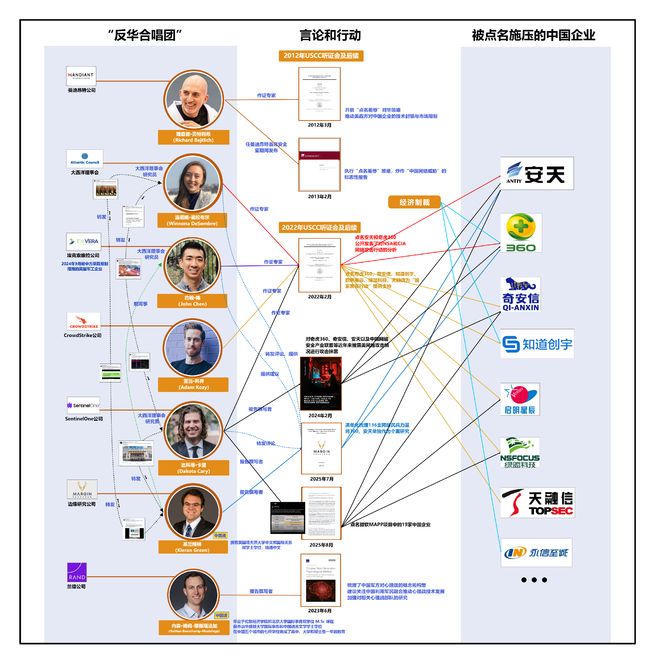
美国网络安全智库的“反华合唱团”
Guan Cha Zhe Wang· 2025-09-22 01:38
Core Viewpoint - The article discusses the increasing scrutiny and criticism of Chinese cybersecurity companies by U.S. experts and institutions, particularly focusing on the actions of Dakota Cary and the implications for the cybersecurity industry [1][3][9]. Group 1: Criticism of Chinese Cybersecurity Firms - Dakota Cary, a prominent figure in U.S. cybersecurity, has accused several Chinese companies, including Alibaba and Baidu, of being "weapons suppliers" for state-sponsored hacking [1][3]. - Cary's claims are based on the misinterpretation of penetration testing services, which are standard in the cybersecurity industry and not inherently malicious [3][7]. - The U.S. cybersecurity landscape has seen a rise in anti-China rhetoric, with Cary and others labeling Chinese firms as threats to national security [9][10]. Group 2: U.S. Cybersecurity Strategy and Actions - The Microsoft Active Protections Program (MAPP) has been a focal point, with Cary pushing for the exclusion of Chinese firms from this initiative, arguing that they pose a risk of leaking vulnerabilities to state actors [7][8]. - Following Cary's pressure, Microsoft announced restrictions on Chinese companies' access to vulnerability information, indicating a shift in U.S. cybersecurity policy [8][9]. - The article highlights a pattern where U.S. cybersecurity firms gain government contracts and funding by promoting narratives that vilify Chinese companies [34][35]. Group 3: Historical Context and Evolution - The narrative against Chinese cybersecurity firms has roots in earlier U.S. congressional hearings, such as the 2012 USCC hearing, which established China as a primary adversary in cyberspace [16][18]. - The article traces the evolution of U.S. cybersecurity firms' strategies, noting how they have leveraged political narratives to secure government contracts and enhance their market positions [19][36]. - Recent hearings in 2022 further solidified this trend, with experts calling for direct sanctions against Chinese entities, reflecting a more aggressive stance [20][23]. Group 4: Response from Chinese Cybersecurity Firms - In response to the accusations, Chinese cybersecurity firms have begun to publish reports exposing U.S. cyber activities, aiming to counter the negative narratives [36][38]. - Companies like Qihoo 360 and An Tian have released findings on U.S. cyberattacks, showcasing their capabilities and challenging the claims made by U.S. experts [37][41]. - The article emphasizes the ongoing struggle between U.S. and Chinese cybersecurity firms, with each side attempting to assert its narrative in the global cybersecurity landscape [40][49]. Group 5: Implications for the Future - The article suggests that the increasing scrutiny of Chinese cybersecurity firms may lead to a more fragmented global cybersecurity environment, with potential implications for international cooperation [49][50]. - The actions of U.S. experts and firms may also signal a broader strategy to undermine Chinese technological advancements in cybersecurity [56][59]. - The ongoing conflict in narratives and actions between U.S. and Chinese cybersecurity entities reflects a larger geopolitical struggle, with significant consequences for the industry as a whole [59].
周鸿祎有了机器人大厨
Bei Jing Shang Bao· 2025-09-21 15:57
Core Viewpoint - The discussion between Zhou Hongyi and Yang Jiancheng highlights the potential of AI cooking robots in the Chinese culinary scene, emphasizing their ability to produce dishes with the same quality as human chefs, thus addressing labor shortages and enhancing food safety standards [1][3][4]. Group 1: AI Cooking Robots - Zhou Hongyi experienced the cooking robot and found its performance satisfactory, stating that even a discerning eater like himself could not distinguish between dishes cooked by humans and robots [3]. - The company, Xianglu Robotics, has shipped nearly 10,000 units of its cooking robots since its establishment in 2021, focusing on commercial applications rather than general-purpose robotics [3][4]. - The robots utilize advanced technologies such as millimeter-level temperature control and precise ingredient dispensing, allowing them to consistently produce dishes with uniform taste [3][4]. Group 2: Addressing Industry Pain Points - The introduction of cooking robots is expected to lower labor costs, alleviate chef shortages, standardize dishes for brand expansion, and improve kitchen environments by reducing smoke and enhancing food safety [4][5]. - Zhou Hongyi pointed out that the combination of pre-prepared ingredients and robot cooking could meet consumer expectations for freshly made dishes while addressing labor shortages in restaurants [5]. - Yang Jiancheng emphasized that robots can enhance personalization in cooking, allowing for varied flavors even in pre-prepared dishes, thus catering to consumer preferences for freshness and quality [5]. Group 3: Collaboration Between Humans and Robots - The narrative of the discussion did not focus on robots replacing humans but rather on a collaborative ecosystem where robots handle repetitive tasks, freeing chefs to focus on creativity and traditional culinary skills [6]. - Yang Jiancheng's "123 formula" suggests that one chef can operate two robots, achieving the output efficiency of three chefs, which is crucial for the expansion of restaurant chains [6]. Group 4: Future Developments - Zhou Hongyi proposed that the development of cooking robots should extend beyond individual devices to encompass the entire supply chain, including ingredients and pre-prepared food [7]. - Xianglu Robotics plans to launch a new subscription model in Q4 that includes ingredient and pre-prepared food supply, aiming to integrate the restaurant industry's supply chain [7].


青海省数据局局长靳力:青海绿色算力产业“拔节生长”、量质齐升
Zhong Guo Jing Ying Bao· 2025-09-21 15:20
Core Insights - The first Qinghai Data Element Ecological Conference was held in Xining, focusing on the development opportunities and future directions of data elements in Qinghai, aiming to inject new momentum into the province's digital economy [1] Group 1: Government Initiatives and Policies - The conference aligns with the central government's directives and aims to deepen the market-oriented reform of data elements, promoting the integration of the real economy and digital economy [1] - Qinghai has been encouraged to develop a modern industrial system that reflects local characteristics and advantages, integrating clean energy with artificial intelligence and digital economy [2] - The provincial government emphasizes the importance of green development and the integration of computing power platforms with clean energy [2] Group 2: Industry Development and Achievements - Qinghai's green computing power industry has made significant progress, with 189,000 standard racks built or under construction, and a computing power scale exceeding 17,000 PFLOPS [3] - The province has established strategic partnerships with major internet companies, including Baidu and Alibaba, and launched several key projects in green computing [3] - Qinghai has become a national hub for integrated computing networks and has built the first clean energy and green computing scheduling center in the country [3] Group 3: Data Element Ecosystem and Applications - The data element ecosystem in Qinghai is continuously improving, with rapid development in the data labeling industry and the establishment of three labeling bases [4] - The province has implemented a three-year action plan to promote the application of computing power and data across various sectors, including ecological civilization and industry [5] - Qinghai is accelerating the digital transformation of key industries, creating typical application scenarios such as "Smart Salt Lake" and "Smart Agriculture" [5]
AI是击穿网络安全的矛?还是守护网络安全的盾?
Zhong Guo Xin Wen Wang· 2025-09-21 15:18
Group 1 - AI presents both new risks and opportunities in cybersecurity, with experts highlighting the complexity of AI security issues compared to traditional cybersecurity problems [1][2] - The emergence of AI-powered attack agents has lowered the cost and increased the unpredictability of cyberattacks, posing significant risks to various sectors [2][3] - AI's integration into cybersecurity is a critical research direction, with companies exploring the combination of AI and security technologies to enhance protection measures [3] Group 2 - The development of dedicated large models for security oversight is suggested to address the safety issues arising from AI's operational processes [3] - Establishing a "red domain" for large model training and management can help control risks by segmenting different operational areas [3] - High-quality data governance and monitoring mechanisms are essential to ensure AI systems function correctly and align with desired outcomes [3]
AI Agent时代「顶格配置」:华为云,重塑算力格局
36氪· 2025-09-21 11:10
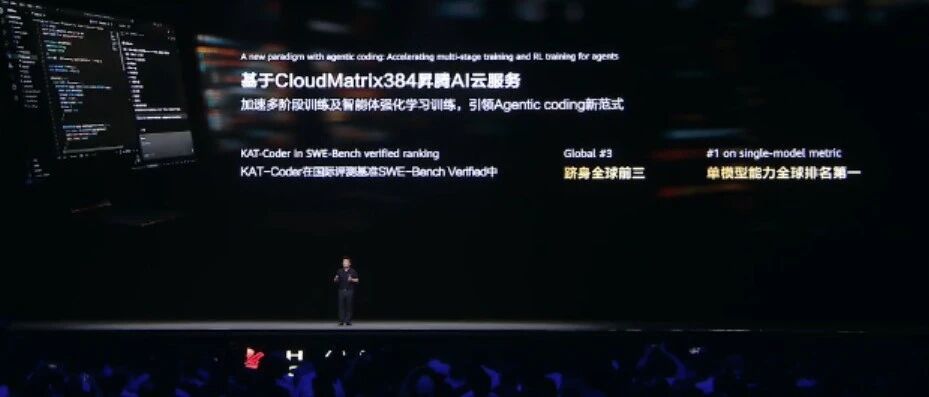
Core Viewpoint - The article highlights the explosive growth of the AI Agent market and the corresponding demand for AI computing power, emphasizing the need for robust infrastructure to support this trend [1][31]. Group 1: AI Agent Market Growth - Lovart Beta registered over 100,000 users within five days, and Genspark surpassed $10 million ARR in just nine days, indicating a rapid adoption of AI Agents [1]. - The AI Agent market is expected to exceed $100 billion by 2032, with 30% of large enterprises already establishing dedicated AI Agent teams [30][31]. Group 2: AI Computing Power Demand - The demand for AI computing power is surging, driven by the increasing complexity of models and real-time interaction needs, despite the cooling of the "hundred model war" [1][2]. - Huawei announced significant upgrades to its CloudMatrix product, enhancing its cloud supernode specifications from 384 to 8192 cards, addressing the urgent need for computing power in high concurrency scenarios [3][5]. Group 3: Technological Infrastructure - Huawei has built a comprehensive technological foundation covering hardware, computing power, large models, and application platforms to support the scaling of AI Agents [4][31]. - The introduction of the CloudMatrix384 AI Token inference service aims to simplify AI Agent development, allowing enterprises to efficiently create Agents without deep technical expertise [24][27]. Group 4: Applications and Use Cases - The article discusses the application of AI computing power in various fields, including scientific research and intelligent vehicles, highlighting the need for advanced computing capabilities to support complex tasks [11][16]. - The CloudMatrix384 supernode has been successfully utilized by Changan for intelligent driving research, demonstrating its effectiveness in training AI models for autonomous driving [18]. Group 5: Development Challenges - High development barriers have hindered the large-scale deployment of AI Agents, prompting Huawei to launch the Versatile platform, which streamlines the development process significantly [27][29]. - The platform allows users to create AI Agents with minimal input, reducing development time from 30 person-days to just 3 [27].
淘宝上的DeepSeek卖9块9,真魔幻
投资界· 2025-09-21 08:25
Core Viewpoint - The article discusses the disparity in access to AI technology, highlighting how different groups experience varying levels of information and resources in the AI landscape, ultimately leading to a significant information gap [32][34]. Group 1: AI Product Insights - The product DeepSeek is still in demand, with a notable number of users (1,000) having made purchases for a low price of 9.9 yuan [5][9]. - Users report positive experiences with the product, noting its efficiency and the absence of lag, which contrasts with expectations of poor service for such a low price [21][30]. Group 2: User Experience and Demographics - The article illustrates the journey of a typical user, a recent graduate from a lower-tier city, who seeks affordable AI solutions but faces barriers due to high costs and complex setups [30][31]. - The narrative emphasizes the emotional aspect of users feeling relieved upon finding a low-cost solution that works effectively, showcasing the human side of technology adoption [31][34]. Group 3: Information Disparity - The article categorizes users into three spaces: creators and definers of information, followers and consumers, and those isolated from information due to barriers [32][33]. - It argues that while AI should bridge information gaps, it ironically contributes to the creation of new barriers, making it harder for some users to access its benefits [32][34]. Group 4: Societal Reflection - The author reflects on the broader societal implications of technology access, suggesting that many individuals are striving to keep up with rapid advancements but are hindered by a lack of resources and knowledge [34][35]. - The narrative concludes with a call to action to address the growing information gap, emphasizing the need for collective efforts to make technology more accessible to all [35].

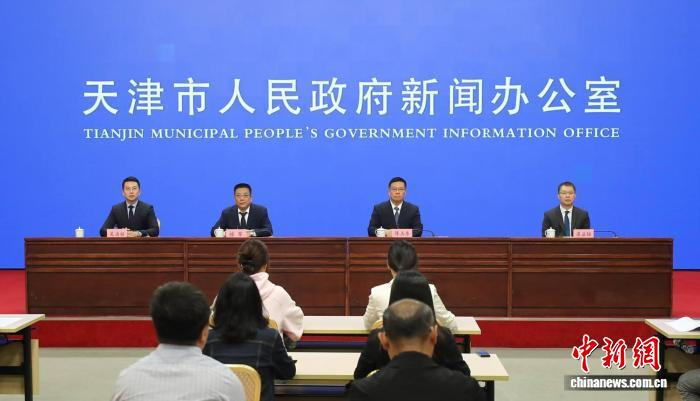
全球顶尖网络安全精英齐聚津门 第三届网络空间安全(天津)论坛将举办
Zhong Guo Xin Wen Wang· 2025-09-20 09:43
Core Viewpoint - The third Cybersecurity (Tianjin) Forum will be held from September 22 to 24, focusing on cutting-edge issues in cybersecurity and proposing a "Tianjin Plan" for collaborative governance in cyberspace [1][2]. Group 1: Forum Overview - The forum aims to enhance Tianjin's influence in the cybersecurity field by optimizing the event structure, which includes a main forum and five thematic sessions [1]. - The theme of the forum is "Building a Shared Cybersecurity Governance Framework," emphasizing collaboration, consultation, and sharing [1]. Group 2: Key Participants and Topics - Notable experts, including academicians, international law enforcement officials, and leaders from major cybersecurity firms, will deliver keynote speeches on key technological innovations in cybersecurity [2]. - Five thematic forums will be held, focusing on areas such as secure development of the information industry, data security, low-altitude security technology innovation, advanced threat defense, and the intersection of AI and cybersecurity [2]. Group 3: Competitions and Talent Development - The third "Tianwang Cup" Cybersecurity Competition will be launched, promoting talent cultivation through practical challenges in areas like product vulnerability detection and AI security [3]. - The competition aims to discover and fix critical vulnerabilities, contributing to the enhancement of national cybersecurity capabilities and the upgrade of core industries [3]. Group 4: Achievements and Future Directions - The forum is recognized as the only international official forum in China dedicated to cybersecurity, integrating various resources in the field [3]. - It has previously launched initiatives like the National Computer Virus Collaborative Analysis Platform and has made significant contributions to policy standards and comprehensive defense capabilities in cybersecurity [3].