OPPO

Search documents
2025 年全球智能手机市场预测:苹果有望在 14 年来首次在出货量上超越三星
Counterpoint Research· 2025-11-28 01:03
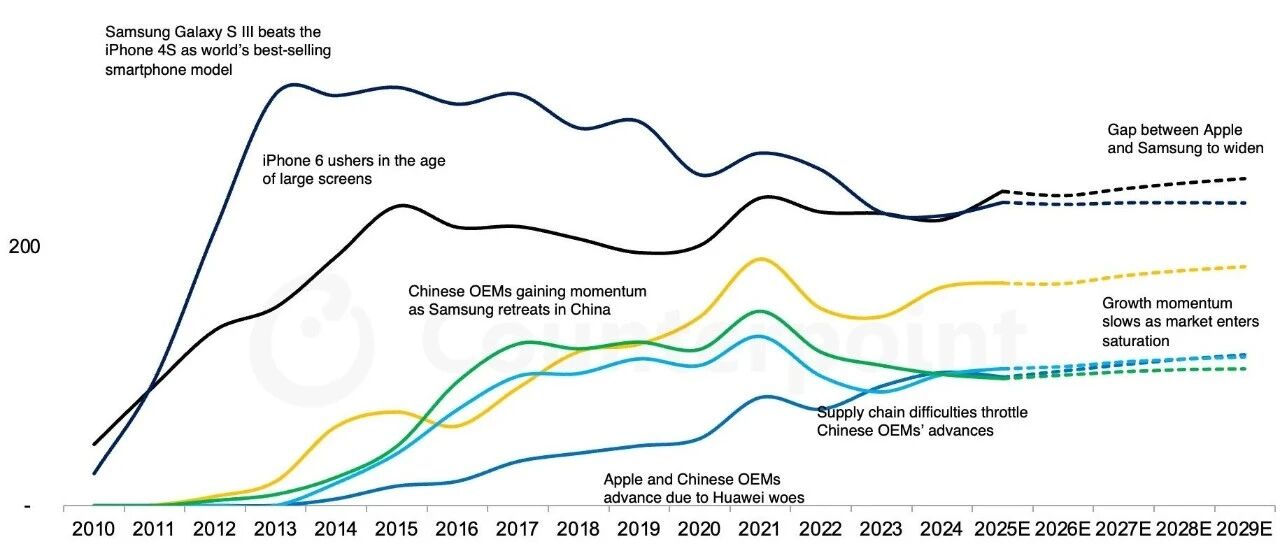
Core Insights - Counterpoint Research forecasts a 3.3% year-on-year growth in global smartphone shipments by 2025, with Apple expected to reclaim the top position in market share at 19.4%, surpassing Samsung's 18.7% [5][6][9] - The strong performance of Apple's iPhone 17 series is anticipated to drive a 10% increase in iPhone shipments in 2025, with significant growth expected in key markets like China and the US [5][6][7] - The Chinese smartphone market is expected to see a divergence in performance among its top brands due to a sluggish domestic market and increased competition [5][10] Apple Insights - Apple's iPhone shipments exceeded expectations in Q3 2025, with a 9% year-on-year increase, driven by the successful launch of the iPhone 17 series [6][7] - The upcoming iPhone 17e and the first foldable iPhone are expected to further enhance Apple's market position, with a focus on high-end consumer demand in emerging markets [8] - The company benefits from a favorable macro environment, including lower-than-expected tariff impacts and a recovery in consumer confidence in key markets [7][8] Samsung Insights - Samsung is projected to achieve a 4.6% year-on-year growth in shipments by 2025, but will still lose its long-held top position in the global market [5][9] - The A series is expected to strengthen Samsung's growth in emerging markets, particularly in regions like India and Southeast Asia [9] - Despite a stable performance in mature markets, Samsung faces intense competition from Chinese brands in the mid-to-low-end market segments [9] Chinese Brands Insights - Major Chinese smartphone brands are increasingly relying on overseas markets for growth, with a clearer path in regions like India and Southeast Asia [10] - The transition to higher price segments and investment in premium devices are strategies to enhance profitability and reduce dependence on low-end markets [10] - Supply chain uncertainties, particularly in memory supply, pose challenges for growth, with a cautious outlook for 2026 where the top four brands are expected to see only a 1.7% growth rate [10]


早报|香港大埔火灾已完成灭火程序;宗馥莉正式卸任娃哈哈董事长;李想称理想汽车将回归创业公司模式;昆明列车碰撞事故造成11人死亡
虎嗅APP· 2025-11-27 23:58
Group 1 - The fire in Hong Kong's Tai Po has resulted in 94 fatalities, with 78 injured, including 12 in critical condition [2] - Ideal Auto's CEO Li Xiang admitted to governance errors and announced a return to a startup model, moving away from a professional management system [5] - ByteDance is reportedly in negotiations to sell its subsidiary, Shanghai Mutong Technology, to Saudi Savvy Games Group, with the outcome still uncertain [13][14] Group 2 - Sichuan province has significantly increased marriage leave from 5 days to 20 days and extended maternity leave for women by 90 days, while also increasing paternity leave for men to 30 days [8][9][10] - Xiaomi, OPPO, and Vivo have canceled their Air model projects, shifting the planned eSIM features to regular models due to poor market performance of similar products [16][17] - NIO's CEO Li Bin stated that the automotive industry is entering a decisive phase, predicting a clearer competitive landscape by 2030 [31]


8点1氪|罗永浩称没有被威胁,会公布录音;宗馥莉卸任娃哈哈董事长;多家手机厂商取消Air机型
3 6 Ke· 2025-11-27 23:52
Group 1 - Luo Yonghao confirmed he was not threatened and will release the recording related to his dispute with Hua Shan [2] - Zong Fuli officially stepped down as chairman of Wahaha, with Xu Simin taking over [2] Group 2 - Multiple smartphone manufacturers, including Xiaomi, OPPO, and vivo, have canceled their Air model projects, reallocating eSIM solutions to regular models [3] Group 3 - A major fire in Hong Kong resulted in 83 confirmed fatalities and 76 injuries, with rescue operations completed [3][4] - The Hong Kong government announced a relief fund of 300 million HKD for affected residents and immediate cash assistance of 10,000 HKD per household [4] Group 4 - HP announced a global layoff plan affecting 4,000 to 6,000 employees, approximately 10% of its workforce, to streamline operations and enhance productivity through AI [10] Group 5 - TSMC accused a former executive of leaking trade secrets to Intel, which Intel denied, asserting strict policies against such actions [7] - Asahi Group reported a data breach affecting over 1.91 million personal records due to a cyberattack [8] Group 6 - Sichuan province extended marriage leave from 5 to 20 days and increased maternity leave to a maximum of 120 days [5] Group 7 - NIO's CEO Li Bin stated that the automotive industry is entering a decisive phase, with a clearer competitive landscape expected by 2030 [13] - Huawei Cloud underwent organizational restructuring, appointing Zhou Yuefeng as CEO [13] Group 8 - Apple is challenging a potential $38 billion fine in India related to new antitrust laws [14] - YouTube is launching a cheaper, music-free subscription service in South Korea following antitrust investigations [14] Group 9 - Soul App submitted its IPO application to the Hong Kong Stock Exchange, with Tencent as a strategic investor [15][16] - Avita Technology also filed for an IPO in Hong Kong [15] Group 10 - DeepSeek launched a new math reasoning model, achieving high performance in competitive evaluations [18] - Alibaba's team won the Best Paper Award at NeurIPS 2025 for their research on attention mechanisms [18]
华为/OPPO/小米等资本加持 锐石创芯IPO辅导已完成
Ju Chao Zi Xun· 2025-11-27 18:22
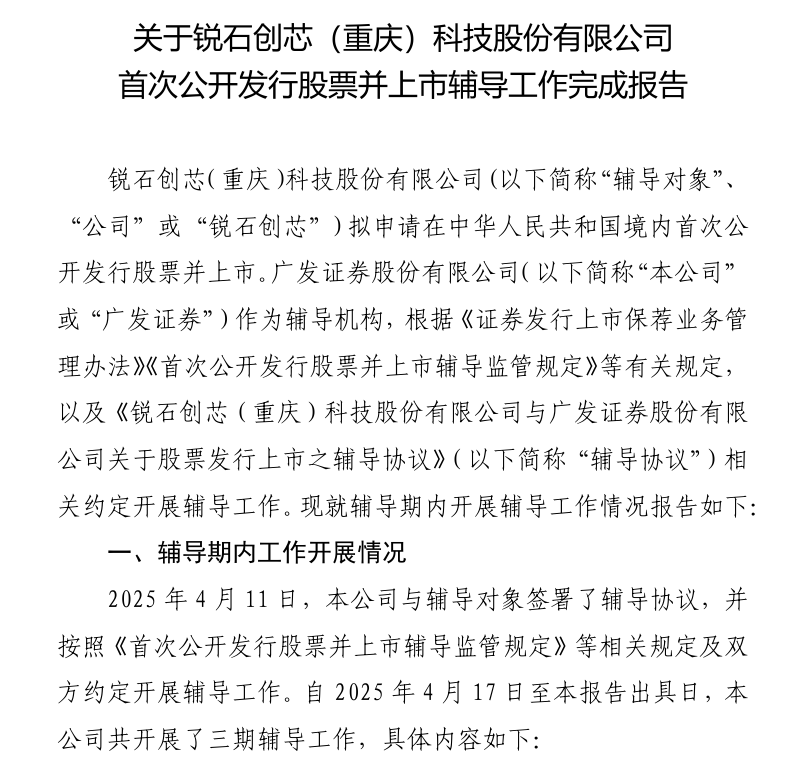
Core Viewpoint - Ruishi Chuangxin (Chongqing) Technology Co., Ltd. has completed the core preparatory work for its initial public offering (IPO), moving closer to its goal of listing on the Sci-Tech Innovation Board [1] Company Overview - Established in 2017, Ruishi Chuangxin focuses on the research, development, manufacturing, and sales of RF front-end discrete devices and modules for 4G and 5G, creating a vertically integrated system encompassing chip design, module integration, and filter wafer manufacturing [1] - The company has accumulated over 400 authorized patents, establishing strong technical barriers in key areas such as RF chip design and packaging testing [1] Product Development - The self-developed low-voltage P2N MMMB PAM product has been adopted by brand mobile phone customers, and the three-in-one satellite communication amplifier module has successfully entered the supply chain of leading flagship brands [2] - The company is promoting the mass supply of self-developed filter modules, enhancing its comprehensive competitiveness in the domestic RF front-end industry chain [2] Capital Support - Since its establishment, Ruishi Chuangxin has completed seven rounds of financing, raising over 1 billion yuan [5] - Major shareholders include OPPO (7.1761%), Huawei's Hubble Investment (6.905%), and Lei Jun's Shunwei Capital (5.87%), along with other key industry players [5][6] Market Potential - If Ruishi Chuangxin successfully lists on the Sci-Tech Innovation Board, it could become the first listed company in the integrated circuit sector in Chongqing, broadening its financing channels and accelerating technological iteration and capacity release [6] - The RF front-end market is expected to maintain growth due to the expanding applications in 5G, IoT, and satellite communications, positioning companies with full industry chain capabilities and validation from leading customers to capture larger market shares [6]
拦截第三方应用平台?市场监管总局点名手机行业不正当竞争
第一财经· 2025-11-27 15:03
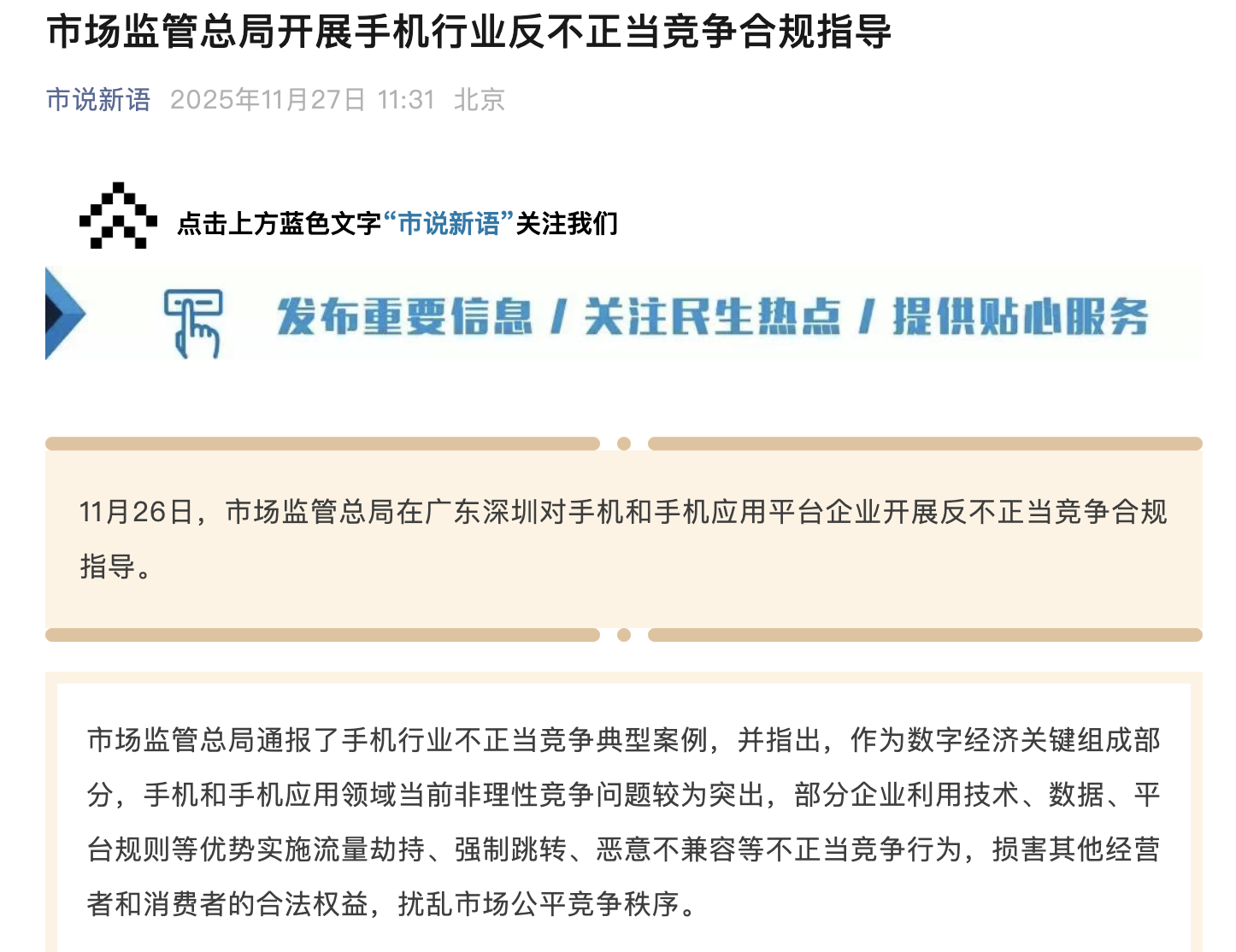
Core Viewpoint - The article discusses the recent compliance guidance issued by the State Administration for Market Regulation (SAMR) in China, focusing on unfair competition in the mobile phone and application platform industry, highlighting the shift from post-event punishment to preemptive regulation [3][4][9]. Group 1: Regulatory Actions - SAMR has identified irrational competition as a significant issue in the mobile phone industry, urging operators to enhance their awareness of responsibilities and comply with the new anti-unfair competition law [3][4]. - The guidance emphasizes the need for companies to conduct comprehensive risk assessments and establish robust internal compliance management systems to maintain a fair market environment [4][9]. Group 2: Unfair Competition Practices - Certain companies are accused of employing unfair competition tactics such as traffic hijacking, forced redirection, and malicious incompatibility, which harm the rights of other operators and consumers [4][9]. - The article highlights that mobile manufacturers often obstruct users from installing applications from third-party platforms, creating significant barriers that discourage users from proceeding with installations [6][7]. Group 3: Market Dynamics - The article notes a trend where game developers are increasingly withdrawing from mobile channels due to high costs associated with these platforms, opting instead for direct downloads to avoid restrictions imposed by phone manufacturers [12][15]. - The shift in strategy among game developers reflects a growing confidence in their products, allowing them to bypass traditional app stores and attract users through quality offerings [15][16]. Group 4: Compliance and Fair Competition - Legal experts suggest that while not all restrictions are illegal, any actions that unfairly favor a company's own applications over competitors' could be seen as self-preferential and abusive [10][16]. - The article calls for regulatory measures that consider the unique technological characteristics and business logic of the mobile industry, advocating for differentiated compliance standards based on company size and circumstances [16].

强制跳转、流量劫持,市场监管总局向手机行业“三宗罪”亮剑
Bei Ke Cai Jing· 2025-11-27 14:32
Core Points - The article discusses the recent compliance guidance issued by the State Administration for Market Regulation in Shenzhen, focusing on unfair competition in the mobile phone and application platform sectors, highlighting the prevalence of irrational competition and the detrimental practices employed by some companies [1][4] Group 1: Unfair Competition Practices - The article identifies three main unfair competition practices in the mobile industry, referred to as the "three sins": traffic hijacking, forced redirection, and malicious incompatibility [1][8] - Traffic hijacking involves companies using technical means to mislead users into downloading apps from their own stores instead of third-party platforms, thereby infringing on user choice and harming competitors [2][6] - Forced redirection is characterized by misleading prompts and technical barriers that prevent users from accessing desired applications, which has been reported as a significant pain point for users [3][8] Group 2: Impact on Users and Market - These unfair practices not only disrupt user experience but also undermine the competitive order in the market, leading to long-term harm to the innovation vitality of the digital economy [4][11] - Users have reported experiencing complex and frustrating download processes due to misleading compatibility warnings and forced redirections, which ultimately benefit the manufacturers' own app stores [2][3] Group 3: Legal and Regulatory Responses - Legal experts indicate that these practices violate various laws, including the Anti-Unfair Competition Law and the Consumer Rights Protection Law, which protect user rights and fair competition [8][9] - The article mentions ongoing efforts by regulatory bodies to establish clearer standards and guidelines to combat these unfair practices, including the introduction of safety requirements for "shake to trigger" advertisements [10][11] Group 4: Industry Reactions and Future Directions - The article notes that major smartphone manufacturers and e-commerce platforms have not yet responded to inquiries regarding compliance with the new guidelines [9] - There is a call for a multi-faceted governance approach involving government enforcement, industry self-regulation, and public awareness to effectively address and mitigate unfair competition behaviors [11]
拦截第三方应用平台?市场监管总局点名手机行业不正当竞争
Di Yi Cai Jing· 2025-11-27 12:12
Core Viewpoint - The State Administration for Market Regulation (SAMR) has identified improper competition behaviors in the mobile phone and application platform industry, including traffic hijacking, forced redirection, and malicious incompatibility, which harm the legitimate rights of other operators and consumers, disrupting fair market competition [1][2]. Group 1: Regulatory Actions - SAMR has conducted compliance guidance in Shenzhen, focusing on the mobile phone industry and highlighting the need for operators to enhance their awareness of responsibilities and comply with the new anti-unfair competition law [1][2]. - The recent compliance guidance reflects a shift from "post-event punishment" to "prevention" in regulatory practices, aiming to clarify the boundaries between technological neutrality and legal compliance [1][7]. Group 2: Industry Practices - Some mobile phone manufacturers are reportedly blocking third-party application installations, creating significant barriers for users attempting to download apps from non-native app stores, which includes multiple system prompts and permission changes [4][5]. - The practice of traffic hijacking is evident when users try to download non-native apps, facing numerous warnings that often lead them to abandon the installation process [5][7]. Group 3: Market Dynamics - The mobile application ecosystem has evolved, with third-party app stores becoming significant traffic entry points, leading some internet companies to sever ties with mobile manufacturers to avoid restrictions [8][10]. - A report indicates that major advertising platforms have become primary channels for game advertising, as strong game developers choose to withdraw from mobile channels [8][10]. Group 4: Legal Implications - Actions by mobile manufacturers to unilaterally remove specific games or obstruct third-party applications may constitute unfair competition or even monopolistic behavior under the Anti-Unfair Competition Law and Anti-Monopoly Law [7][11]. - Reasonable reviews based on legal, system security, or privacy protection needs are considered legitimate, provided they are transparent and fair, while discriminatory practices against competitors may lead to regulatory scrutiny [7][11].
荣耀中端机红海突围
Hua Er Jie Jian Wen· 2025-11-27 11:15
Core Insights - The trend in the smartphone industry is to integrate flagship technology into mid-range models, as exemplified by the launch of Honor's 500 series targeting young consumers [1][3]. Product Features and Pricing - The Honor 500 series features the Snapdragon 8s Gen4 chip in the standard version and the Snapdragon 8 Supreme chip in the Pro version, enhancing computational power [2]. - The series is priced competitively, with the standard version starting at 2,699 yuan and the Pro version at 3,599 yuan, making it one of the more affordable options in its category [2]. - The 500 series includes features such as a 2 billion-pixel portrait mode, a slim 7.75mm body, and reverse charging capabilities with Apple devices, positioning it against Apple's Air series [5]. Market Context - The mid-range smartphone market is currently facing growth challenges, with a shift towards low-end and high-end segments, as reported by Omdia [3]. - Honor's strategy to incorporate flagship technology into mid-range devices aims to capture a larger share of the budget market [3][4]. - The previous 400 series achieved significant sales, with 6 million units sold within six months, raising expectations for the 500 series [5].
智动力:作为谷歌一级供应商,通过富士康等为谷歌提供手机相关功能件
Zheng Quan Shi Bao· 2025-11-27 02:48
Core Viewpoint - The company, Zhihui Power, is primarily engaged in the research, production, and sales of functional components and structural parts for consumer electronics, establishing long-term partnerships with major brands like Samsung, Google, and OPPO [1] Group 1: Company Overview - Zhihui Power has been deeply involved in the consumer electronics sector for many years [1] - The company serves as a first-tier supplier for Google, providing mobile-related functional components such as thermal and conductive electronic devices through partners like Foxconn and Compal [1] Group 2: Partnerships and Development - The company has established stable cooperation relationships with leading consumer electronics brands [1] - Zhihui Power is currently collaborating with clients on the development of new product requirements, with specific details to be confirmed through company announcements [1]

华为、OPPO资本加持!又一射频前端“小巨人”IPO辅导完成
是说芯语· 2025-11-27 02:04
Core Viewpoint - Ruishi Chuangxin (Chongqing) Technology Co., Ltd. has completed its initial public offering (IPO) guidance work, marking a significant step towards its goal of listing on the Sci-Tech Innovation Board, backed by major industry players like Huawei and OPPO [1][3]. Group 1: Company Overview - Established in 2017, Ruishi Chuangxin focuses on the R&D, manufacturing, and sales of RF front-end discrete devices and modules for 4G and 5G, creating a unique full industry chain layout from chip design to module integration and filter wafer manufacturing [3]. - The company has accumulated over 400 authorized patents, forming a core technological advantage in key areas such as chip design and packaging testing, and has launched products like Sub6G L-PAMiF and satellite communication amplifier modules [3]. - Ruishi Chuangxin has attracted significant investment, raising over 1 billion yuan through seven rounds of financing, with OPPO as the largest external shareholder at 7.1761%, followed by Huawei's Hubble Investment and Shunwei Capital [3]. Group 2: Market Potential - If successfully listed on the Sci-Tech Innovation Board, the company will become the first listed company in the integrated circuit sector in Chongqing, which will broaden its financing channels and accelerate technology iteration and capacity release [4]. - The demand for RF front-end products is expected to grow continuously due to the expansion of emerging applications in 5G, IoT, and satellite communications, positioning Ruishi Chuangxin to capture a larger market share and contribute to the self-sufficiency of domestic RF chips [4].