三星

Search documents
华尔街见闻早餐FM-Radio|2026年1月22日
Sou Hu Cai Jing· 2026-01-21 23:47
华见早安之声 市场概述 标普500涨1.2%,收复前一日失地,创去年11月以来最大日涨幅。小盘股再成领头羊,罗素2000涨2%创新高,连续13个交易日跑赢标普500。科技七巨头中 微软独跌2.3%,甲骨文跌超3%,奈飞财报后跌超2%。Moderna飙升16%。卡夫亨氏跌5.7%,伯克希尔拟"清仓式"减持。 日债趋于稳定。10年期美债收益率下行4.7个基点。美元反弹0.2%。 特朗普"TACO",称与北约达成格陵兰协议框架。 贝森特达沃斯施压:欧洲增兵格陵兰是"异想天开",丹麦对美债的投资"无关紧要"。达沃斯闭门晚宴上,美商务部长痛批欧洲"缺乏竞争力",拉 加德愤而离席。 加拿大总理卡尼重磅演讲:基于规则的秩序已死,中等强国应团结行动,抵制某些大国胁迫。 马克龙呼吁:欧洲喜欢尊重而非霸凌、关键领域应引入中国投资。 欧洲议会宣布无限期冻结欧美贸易协定审议工作。 特朗普要败诉?美最高法对罢免美联储理事库克态度谨慎,大法官警告"粉碎"央行独立性。 特朗普态度软化后,比特币自盘中创下的去年12月低点拉涨,幅度3.5%,以太坊自日低涨超5%,突破3000美元。 现货黄金一度逼近4900美元,但随避险需求减弱,涨幅收窄。特 ...





华尔街见闻早餐FM-Radio | 2026年1月22日
Hua Er Jie Jian Wen· 2026-01-21 23:25
Market Overview - The S&P 500 rose by 1.2%, marking its largest daily gain since November of the previous year, while small-cap stocks led the rally with the Russell 2000 increasing by 2% to a new high, outperforming the S&P 500 for 13 consecutive trading days [2] - The 10-year U.S. Treasury yield decreased by 4.7 basis points, and the dollar rebounded by 0.2% [3] - Bitcoin surged by 3.5% after Trump's softened stance, while Ethereum rose over 5%, surpassing $3,000 [4] - In Asia, the Shanghai Composite Index experienced fluctuations, with the SSE 50 ETF achieving record trading volume [5] Key News - Shanghai tax authorities imposed a fine of 100,000 yuan on Pinduoduo for failing to submit required tax information [23] - Trump emphasized Greenland as a core U.S. security interest during his Davos speech, stating that the U.S. would not use force to acquire it and sought immediate negotiations [24] - The European Parliament announced an indefinite freeze on the review of the EU-U.S. trade agreement [26] - Canada’s Prime Minister Carney stated that the rules-based order is dead and called for medium powers to unite against coercion from larger nations [7] Company Updates - Berkshire Hathaway plans to "clear out" its stake in Kraft Heinz, proposing to sell 325.4 million shares, leading to a 4.9% drop in Kraft Heinz's stock price [43] - Tianfu Communication expects a net profit growth of 40%-60% year-on-year, driven by stable demand for high-speed optical devices [14] - Moer Thread anticipates a revenue increase of 230%-247% in 2025, with a reduction in losses by 34.5%-41.3% [15] - Demingli forecasts a staggering net profit increase of 1051.59%-1262.41% year-on-year in Q4, driven by surging AI storage demand [16] Industry Insights - The AI storage demand is igniting significant growth in the storage industry, with companies like Demingli and Moer Thread poised for substantial revenue increases [16][15] - The semiconductor industry is experiencing a K-shaped recovery, with AI storage chips in high demand benefiting companies like Samsung and SK Hynix, while downstream manufacturers face cost pressures [33] - The electric power sector is seeing increased demand due to a cold wave, with the State Grid reporting record electricity loads [44] - The Chinese government is advancing its 6G technology trials, having completed the first phase and initiated the second phase of testing [34]

国产手机海外角逐
2 1 Shi Ji Jing Ji Bao Dao· 2026-01-21 23:11
Core Insights - The global smartphone market is projected to grow in 2025, with an expected shipment volume of 1.26 billion units, reflecting a year-on-year increase of 1.9% [1] - Chinese smartphone manufacturers have established a significant presence in the global market, capturing approximately 60% of global shipments, with brands like OPPO, vivo, Xiaomi, and Honor leading the way [1] - Honor is expected to see rapid growth in overseas shipments, with a projected year-on-year increase of about 55% in the first three quarters of 2025 [1][2] Industry Trends - Chinese companies are adopting two main strategies for overseas markets: full AI integration and brand premiumization, with a focus on "Glocal" strategies that combine global thinking with local actions [2] - Honor's international business has undergone a structural transformation, with overseas shipments rising from less than 10% of total shipments in early 2021 to nearly 50% by the third quarter of 2025 [2] - The competition in emerging overseas markets is intense, particularly in the entry-level segment priced below $200, which remains a primary focus for many manufacturers despite profit pressures [2] Market Positioning - Increasingly, Chinese smartphone manufacturers are shifting towards the mid-to-high-end market to balance scale and profitability, with Honor targeting the $300-$500 price range, which accounted for approximately 23% of its overseas shipments in the first three quarters of 2025 [3] - The high-end market, particularly in Europe, is becoming a battleground for Chinese manufacturers, who are transitioning from a scale competition to a capability competition, emphasizing high-end product offerings [4] Product Innovation - To penetrate the high-end market, product capability is essential, with manufacturers upgrading their high-end product lines, such as Honor's Magic8 series and Huawei's Mate80Pro [5] - Honor is set to showcase its ROBOT PHONE, a unique product that integrates AI capabilities, at the 2026 International Consumer Electronics Show (CES) [5] AI Integration - Since 2025, there have been significant advancements in AI capabilities for consumer applications, with Honor achieving breakthroughs in on-device AI technologies that enhance real-time processing and user experience [6] - Huawei's strengths lie in its foundational system capabilities, with HarmonyOS 6 enabling multi-device AI computing, enhancing the processing of complex tasks [6] Future Outlook - The market is expected to continue evolving, with two prominent trends: premiumization and globalization, driven by improvements in AI capabilities and a focus on high-end user experiences [6] - Globalization is a core theme for Chinese companies, emphasizing the need to not only expand internationally but also to enhance their global presence and competitiveness [6]
苹果、三星季度出货量增长强劲,消费电子ETF(159732.SZ)上涨1.01%
Mei Ri Jing Ji Xin Wen· 2026-01-21 22:53
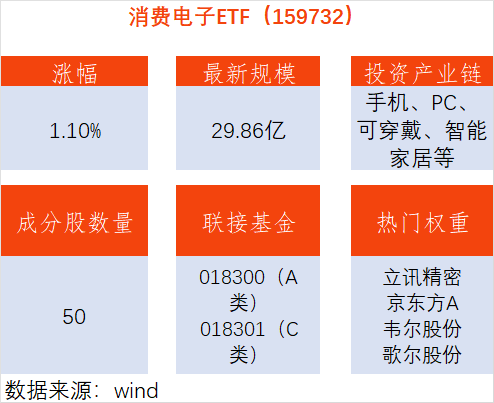
Group 1 - The A-share market saw all three major indices rise collectively, with the Shanghai Composite Index increasing by 0.19% during the session, driven by strong performances in the electronics, defense, and telecommunications sectors, while coal and retail sectors lagged behind [1] - The Consumer Electronics ETF (159732.SZ) rose by 1.01%, with notable increases in component stocks such as Zhaoyi Innovation (up 5.08%), Hengxuan Technology (up 3.71%), Jingce Electronics (up 3.51%), Jinghe Integrated (up 3.15%), and Wentai Technology (up 2.88%) [1] Group 2 - According to IDC's latest report, global smartphone shipments are projected to grow by 2.3% year-on-year in Q4 2025, reaching 336.3 million units, with Apple and Samsung being the two fastest-growing manufacturers, showing year-on-year growth rates of 6.3% and 7.9%, respectively [3] - Despite challenges from storage chip shortages, the smartphone market is experiencing growth driven by the continued demand for high-end models, strong performance of foldable screens, and consumer anticipation of future price increases leading to early upgrades [3] - The Consumer Electronics ETF (159732) tracks the Guozheng Consumer Electronics Index, primarily investing in 50 A-share listed companies involved in the consumer electronics industry, with significant focus on electronic manufacturing, semiconductors, and optical electronics [3]




免费领取!100+硅碳负极项目清单(第1批)——企业、产能、技术、进度......
DT新材料· 2026-01-21 16:05
| 800+ 200+ 30+ 50,000m | | --- | | 企业参展 科研院所 | | 2026 . 06 . 10 → 06 . 12 | 在新能源产业迭代升级的浪潮中,固态电池已成为撬动行业变革的核心支点,是衡量国家高端制造实力的重要 标志。 在固态电池体系中,负极直接决定电池的能量密度、循环寿命, 是制约电池整体性能升级的关 键环节 。 相比于传统石墨负极, 硅基负极凭借优异的性能 ( 硅理论 比容量 是传统石墨负极的10倍以上 )和与固态 电池体系的高匹 配 度( 降低 固-固界面阻抗,抑制锂 枝晶析出 ), 已成为当前固态电池体系主流选择 。 作为高能量密度电池的核心材料, 硅碳负极已成为固态电池产业链的关键布局方向。 2025年,国内硅碳负极 赛道更是呈现全面开花、项目密集落地的火热态势。 据 DT 新材料不完全统计,2025年国内硅碳负极落地项 目数量突破 100 个,规划总产能超 30 万吨,行业总投资额高达800 亿元! 我们已梳理2025年硅碳负极项目(涵盖受理、公示、开工、投产等全阶段)的核心信息 , 囊括产能规划、技 术路线、项目规模等关键内容。 扫描下方二维码,转发即可领 ...
价格暴涨好几倍,雷军在关注,蔚来李斌直言“根本抢不过”!华尔街巨头:恐慌性购买迹象已现,车企要留心
Mei Ri Jing Ji Xin Wen· 2026-01-21 14:39
Group 1 - The automotive industry is facing significant cost pressures due to rising prices of memory chips, which are critical for vehicle electronics and smart systems [5][6][8] - Demand for DRAM and NAND flash memory is surging, driven by the growth of AI applications and data centers, leading to a supply shortage that affects automotive manufacturers [2][3][4] - Major semiconductor manufacturers are prioritizing high-margin clients in the AI and cloud sectors over automotive clients, exacerbating the supply challenges for the automotive industry [2][5] Group 2 - The price of DDR4 memory has increased by over 150% since September 2025, with predictions of further increases of 40% to 50% by the end of Q1 2026 [3][8] - Automotive manufacturers are struggling to secure memory supplies, with reports indicating that supply satisfaction rates may fall below 50% in the near future [8][9] - The automotive sector's share of the global DRAM market is less than 10%, placing it at a disadvantage compared to other industries [2][5] Group 3 - The transition to new memory technologies like LPDDR5 is being hindered by the high demand from AI applications, leading to a mismatch between automotive memory needs and available supply [7][9] - Companies in the automotive sector are unlikely to fully pass on the increased costs to consumers due to competitive market conditions, which may lead to internal cost absorption strategies [8][9] - Experts suggest that automotive companies should consider long-term agreements with local memory manufacturers to stabilize supply and mitigate price volatility [9]


价格暴涨好几倍 雷军在关注 蔚来李斌直言“根本抢不过”!
Mei Ri Jing Ji Xin Wen· 2026-01-21 14:34
Core Insights - The automotive industry is facing significant cost pressures due to rising prices of memory chips, which are critical for smart vehicle systems, as demand from AI and data centers outpaces supply [1][2][6][8]. Group 1: Market Dynamics - The demand for DRAM and NAND flash memory is surging, driven by AI applications and data centers, leading to a supply shortage that is expected to worsen [2][4]. - Memory chip prices have seen dramatic increases, with DDR5 prices rising over 300% and DDR4 over 150% since September 2025 [3]. - The automotive sector, which accounts for less than 10% of the global DRAM market, is at a disadvantage as chip manufacturers prioritize higher-margin clients in the AI and cloud sectors [2][6]. Group 2: Supply Chain Challenges - Major semiconductor manufacturers are reallocating production capacity to meet the growing demand from AI, leaving automotive manufacturers to compete for limited resources [6][7]. - The transition to new memory technologies, such as LPDDR5, is hampered by the ongoing demand from AI, leading to a mismatch between automotive needs and available supply [7][8]. Group 3: Cost Implications - Automotive manufacturers are currently unable to fully pass on the increased costs of memory chips to consumers due to competitive market pressures [8][10]. - There are concerns that the supply of memory chips may not meet automotive production needs, with forecasts suggesting that supply satisfaction could fall below 50% [8][9]. Group 4: Strategic Recommendations - Industry experts suggest that automotive companies should consider long-term agreements with local memory manufacturers to secure supply and stabilize prices [10]. - A balanced approach to product memory configuration and transparent communication with consumers regarding pricing adjustments is recommended to manage cost pressures effectively [10].
AI是“最大基建”还是新泡沫?黄仁勋在达沃斯回应:万亿美元投资才刚开始
智通财经网· 2026-01-21 13:41
Core Insights - AI is initiating the largest infrastructure build in human history, requiring more energy, land, and skilled workers [1][2] - The AI infrastructure is described as a "five-layer cake," with energy at the base, followed by chips and computing infrastructure, cloud services, AI models, and finally applications [2] - Significant investments are being made in AI, with over $100 billion expected in venture capital by 2025, primarily directed towards AI-native companies in sectors like healthcare, robotics, manufacturing, and financial services [3] AI Infrastructure - The infrastructure build has already seen investments in the thousands of billions, with a need for tens of trillions more [2] - TSMC plans to build 20 new chip factories, while Foxconn collaborates on 30 new computer factories that will support AI data centers [2] Employment Impact - The infrastructure development is expected to create numerous job opportunities in traditional trades such as plumbing, electrical work, construction, and network technology [4] AI Market Dynamics - The demand for NVIDIA GPUs is high, with rental prices for GPUs increasing due to the surge in AI startups and the shift in R&D budgets towards AI [5] - The perception of an AI bubble is linked to the massive scale of investments needed to build the necessary infrastructure for AI [5] European AI Opportunities - Robotics presents a unique opportunity for European countries to leverage their strong industrial manufacturing base and transition into the AI era [6] - NVIDIA's CEO highlighted the importance of integrating industrial capabilities with AI to enter the physical AI or robotics world [6] Collaboration and Investment - NVIDIA and Microsoft have committed to significant investments in Anthropic, with NVIDIA pledging up to $10 billion and Microsoft up to $5 billion for the development of the AI chatbot Claude [7] - Anthropic has also committed to spending $30 billion on Microsoft Azure's computing capabilities [7]
“DRAM风暴”正在卷向汽车业?
Hua Er Jie Jian Wen· 2026-01-21 13:22
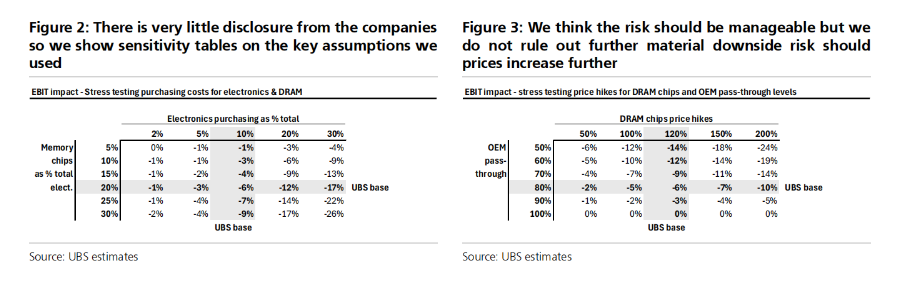
据追风交易台,瑞银最新发布的全球汽车行业研究报告显示,一场由DRAM(动态随机存取存储器)芯片引发的供应链震荡正逼 近汽车产业。受生成式AI爆发导致全球晶圆产能向高性能芯片倾斜的影响,汽车级内存芯片正面临价格暴涨与供应短缺的双重挤 压,其负面冲击预计将从2026年第二季度开始显现。 瑞银指出,全球三大DRAM供应商三星、SK 海力士和美光为追求更高利润,正将产能重心转向AI服务器所需的高带宽内存 (HBM)。这一战略调整直接挤压了汽车级DDR内存的供给空间。截至报告发布时,DRAM芯片价格已上涨超100%,且涨势预 计将持续传导至汽车级产品,导致汽车业在技术过渡期内面临严峻的供应真空。 瑞银模型显示,在DRAM价格大幅上涨且成本无法完全转嫁的压力下,零部件供应商的盈利能力将遭受显著打击。基准情景下 (DRAM芯片涨价120%、OEM成本回收比例80%),瑞银测算得出汽车零部件供应商2026年EBIT将下滑5%-6%。若进入更悲 观的极端情景——DRAM涨价幅度扩大至200%,且OEM成本回收比例降至50%,EBIT下滑幅度将飙升至24%,盈利缩水规模 可达4.8亿欧元,接近其原本EBIT规模的一半。 对于整车 ...
存储芯片“贫富差距”拉大,赢家输家到底怎么选?
Hua Er Jie Jian Wen· 2026-01-21 13:03
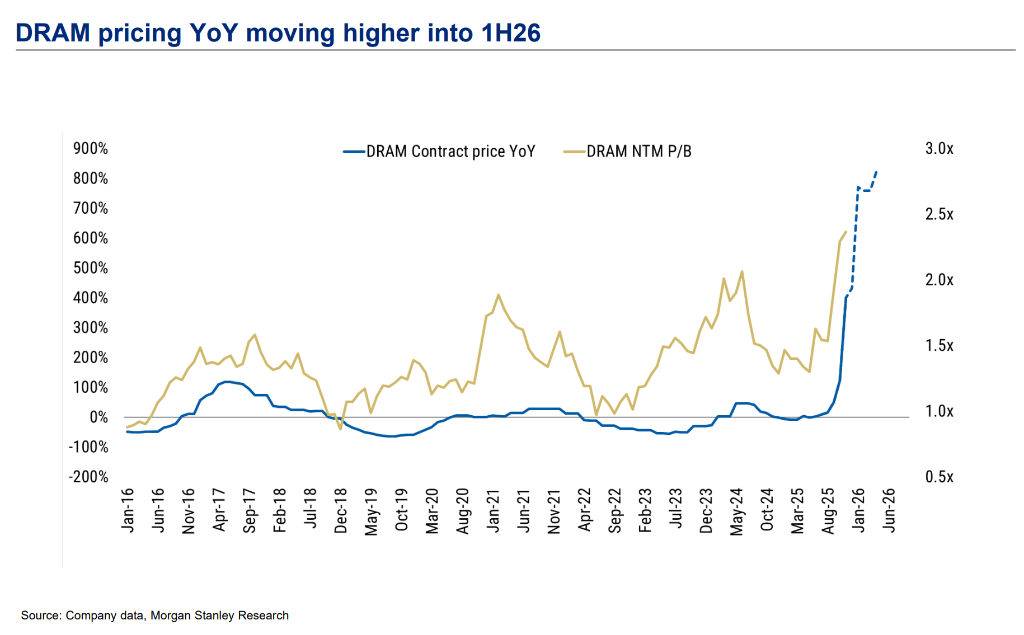
人工智能浪潮正在重塑半导体行业的估值逻辑,随着AI驱动的需求爆发,存储芯片市场正经历一场显著的分化。 据追风交易台,摩根士丹利1月20日发布的研报显示,在2026年上半年,DRAM(动态随机存取存储器)价格同比持续走高,但这并非一场"雨露 均沾"的盛宴。市场正迅速划分为两大阵营:受益于AI推理和高性能计算需求的"赢家",以及受制于宏观逆风与成本通胀的"输家"。 大摩分析,AI带来的技术通胀正在加剧供应链的成本压力,导致存储芯片与传统硬件制造商之间的"贫富差距"拉大。分析师指出,AI不仅推动了 对HBM(高带宽存储器)和企业级SSD的强劲需求,甚至导致DDR4等传统存储产品也出现持续短缺。然而,这种上游存储成本的上涨,对于下 游PC和智能手机OEM厂商而言,正演变为严峻的利润阻力。 在这场"K型"复苏中,投资者应高度关注那些处于AI供应链核心位置的企业。大摩明确将SK海力士、三星以及闪迪公司等列为"最受青睐"的标 的,理由是它们直接受益于AI驱动的大宗商品周期和NAND超级周期。相反,对于无法将上涨的存储成本转嫁给消费者的传统PC外设和OEM厂 商,如宏碁和罗技,市场前景则依然承压。 这一趋势的核心逻辑在于AI ...