美的集团

Search documents
多家企业回应空调涨价
Jing Ji Wang· 2026-01-08 02:44
Group 1 - The air conditioning industry is experiencing price adjustments, with major companies like Midea and Meibo announcing price increases of 5% for their products, while Gree Electric has committed to not raising prices [1] - The rise in raw material costs, particularly for copper and aluminum, is a significant factor driving the price adjustments in the air conditioning sector, with expectations of further increases by 2026 [1][2] - Industry experts suggest that the air conditioning market is shifting from a strategy of "price for volume" to "intelligence for profit," emphasizing the need for companies to leverage artificial intelligence and product innovation to enhance profitability [2][3] Group 2 - Companies are focusing on high-end product structures and innovative technologies to cope with rising costs, which is expected to accelerate industry consolidation [2] - The continuation of government subsidies for replacing old appliances is seen as a favorable opportunity for companies to promote high-efficiency and intelligent products, aiding the transition to a more profitable business model [3] - The recent price hikes reflect a deeper evolution in the competitive logic of the home appliance industry, driven by cost pressures, policy opportunities, and market reshuffling [3]



从CES看2026智能家电新品趋势
2026-01-08 02:07
Summary of Key Points from the Conference Call Industry Overview - The conference discusses trends in the smart home appliance industry, particularly focusing on the CES 2026 event where the number of Chinese companies participating significantly decreased from 1,100 in 2024 to 837 in 2026, indicating a shift in the overseas ecosystem [2][1]. - Major listed companies continue to participate due to strong cash flow and overseas market shares, showcasing a variety of products [1][2]. Core Insights and Arguments - **Product Diversification**: Companies like Ecovacs and XGIMI are accelerating their expansion into multiple product categories, such as companion robots and AI glasses, leveraging their technological advantages to find new growth avenues [1][3][4]. - **Market Dynamics**: The robotic vacuum cleaner market has seen nearly a decade of iteration, with a focus on embodied functionalities. The lawn mower robot segment is converging on RTK and laser radar navigation technologies, with anti-dumping measures potentially reshaping market dynamics [1][6][7]. - **Regional Focus**: The lawn mower robot market is primarily targeting Europe, while the U.S. market presents more complex challenges due to varied yard environments, leading to increased attention from companies to enhance their product offerings in the U.S. [8][1]. Emerging Trends - **New Product Categories**: AI glasses and 3D printing are in the early stages of market penetration, with no unified technical solutions yet. The demand is being stimulated by innovative designs, necessitating continuous tracking of potential mainstream technologies and capable companies [11][1]. - **Competitive Landscape**: The overseas robotic vacuum market remains stable, with iRobot's market share declining. Leading companies maintain their shares through differentiated strategies. The competition in the floor washing machine market is intensifying, with companies like Roborock increasing their presence [18][3]. Company-Specific Developments - **Ecovacs**: Focused on expanding its overseas presence with products like the rolling washing machine and pool cleaning robots, while also addressing domestic sales uncertainties due to subsidy policies [15][12]. - **Roborock**: Showcased a wheeled robotic vacuum at CES 2026, emphasizing its commitment to quality in a single product category. The company plans to maintain a limited number of washing machine models overseas while optimizing its cleaning solutions [13][16]. - **Ninebot**: Launched a significant number of lawn mower robots at CES 2026, incorporating advanced technologies like RTK and laser radar to meet diverse consumer needs [21][1]. - **XGIMI**: Introduced a high-end projector and several AI glasses, leveraging its existing market channels for rapid product promotion [23][1]. Additional Insights - **Market Evolution**: The lawn mower robot industry is transitioning from a single product focus to a multi-SKU cost control and channel management competition phase, similar to the early stages of the robotic vacuum cleaner market [10][9]. - **Investment Recommendations**: Large domestic appliance companies like Midea and Haier are recommended for their stability and diversified strategies. Companies with clear overseas trends, such as Ninebot and Roborock, are also favored. In emerging categories, 3D printing is highlighted as a promising direction [25][26].


合法飙车警车开道,“村GT”飙成国产速激
3 6 Ke· 2026-01-08 01:48
Group 1 - The article discusses the emergence of "Village GT Racing" in Guizhou, China, which is a new form of street racing that allows participants to race on public roads with police escort, challenging traditional perceptions of racing in China [1][3][5] - The event features various activities such as dual car drifting races and city street races, creating an immersive atmosphere that attracts both participants and spectators [5][9] - The "Village GT" event has evolved from a previous rally racing format that has been held for 15 years, indicating a long-standing tradition of racing culture in Guizhou [19][21] Group 2 - Guizhou has a rich sports culture, exemplified by events like "Village BA" and "Village Super," which have gained national attention and participation, showcasing the region's unique approach to grassroots sports [26][28][30] - The article highlights the creativity and resourcefulness of Guizhou residents in organizing various unconventional competitions, such as bullfighting and pig-catching contests, reflecting a vibrant local culture [32][37][39] - The "Village GT" event is characterized by its inclusivity, allowing anyone to participate regardless of skill level, thus fostering a sense of community and shared experience among participants and spectators [48]


重大工程再上新台阶 去年上海完成投资首破2500亿元 “十四五”总投资额超1.12万亿元
Jie Fang Ri Bao· 2026-01-08 01:45
2025年,有30个重大项目开工,30个重大项目基本建成。教育资源方面,交大医学院浦东校区等新 校区建成投用,上大嘉定校区扩建等高校项目开工建设。看病就医方面,一批市级三甲医院建成投用, 中山医院青浦新城院区一期工程结构封顶,上海国际医学科创中心部分地上结构完成至6层。交通出行 方面,军工路快速化、外环东段改建等建成通车,漕宝快速路西线盾构始发。崇明线盾构全线贯通,轨 道交通2号线西延伸和轨道交通18号线二期投运。沪渝蓉高铁宝山站正全面加快地下工程建设,计划于 2027年具备通车运营条件,将成为上海第三大高铁站。文旅休闲方面,金山乐高乐园建成开放,上海大 歌剧院建设基本竣工,三林楔形绿地城市森林项目已"出形象"。 围绕国家战略,一批重点项目取得突破。聚焦建设国际经济中心,格科半导体、长电科技等三大先 导产业项目建设如火如荼,特斯拉储能超级工厂建成投用,雷克萨斯项目开工建设。美的第二总部等产 业项目建成投用,支撑带动区域高质量发展。围绕建设国际航运中心,罗泾港二期工程开工建设,小洋 山北作业区全面铺开,东方枢纽上海东站主体结构全面封顶,浦东机场四期顺利推进。C919总装一体 化厂房结构封顶。围绕建设国际科创中心 ...
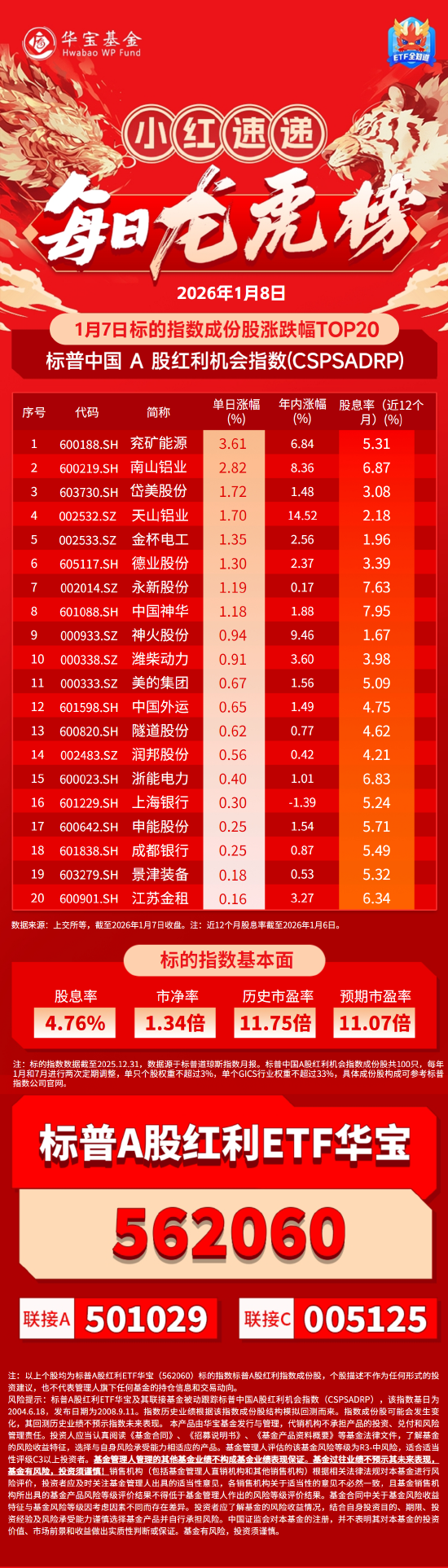
小红日报 | 红利板块小幅回调,标普A股红利ETF华宝(562060)标的指数收跌0.6%
Xin Lang Cai Jing· 2026-01-08 01:14
Group 1 - The article presents the top 20 stocks in the S&P China A-Share Dividend Opportunity Index (CSPSADRP) based on their daily and year-to-date performance as of January 7, 2026 [1][5] - The top performer is Tuke Mining (600188.SH) with a daily increase of 3.61% and a year-to-date increase of 6.84%, along with a dividend yield of 5.31% [1][5] - Nanshan Aluminum (600219.SH) ranks second with a daily increase of 2.82% and a year-to-date increase of 8.36%, offering a dividend yield of 6.87% [1][5] Group 2 - Other notable stocks include Daimay Co. (603730.SH) with a daily increase of 1.72% and a year-to-date increase of 1.48%, and Tianshan Aluminum (002532.SZ) with a daily increase of 1.70% and a year-to-date increase of 14.52% [1][5] - The list also features companies like Midea Group (000333.SZ) and China Shenhua (601088.SH), which have year-to-date increases of 1.56% and 1.88%, respectively, with dividend yields of 5.09% and 7.95% [1][5] - The data is sourced from the Shanghai Stock Exchange and reflects the closing prices as of January 7, 2026, with dividend yields calculated up to January 6, 2026 [1][5]



高盛维持中国股市超配评级,贝莱德加仓多只港股
Huan Qiu Wang· 2026-01-08 01:08
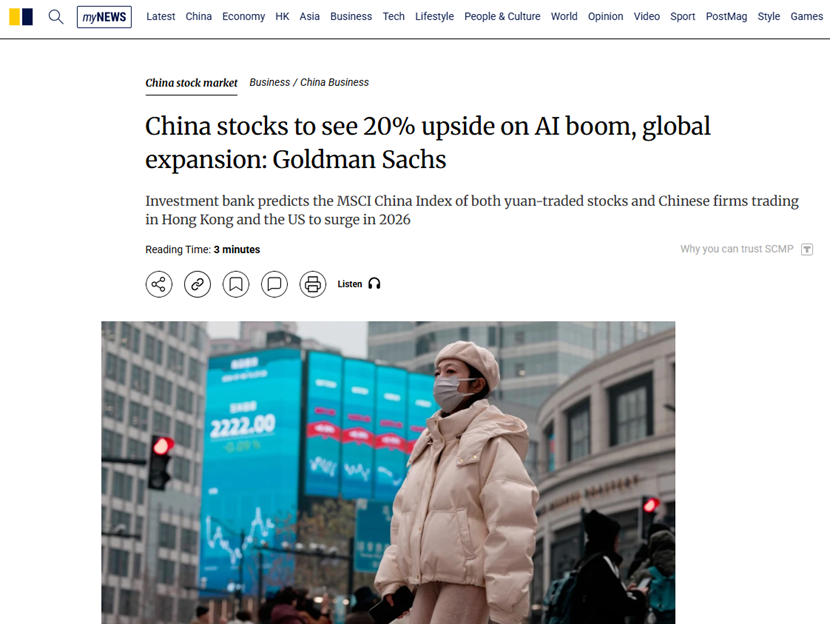
Group 1 - Goldman Sachs projects a 20% increase in the MSCI China Index and a 12% increase in the CSI 300 Index by 2026, maintaining an overweight rating on A-shares and H-shares [1] - The report highlights a potential 14% growth in profits for Chinese listed companies in 2026, significantly better than the single-digit growth expected in 2025, driven by the rise of artificial intelligence and international expansion of listed companies [1] - The favorable risk-reward ratio for the Chinese stock market is indicated by low to mid-single-digit earnings growth rates, moderate valuations, and generally low levels of investor holdings [1] Group 2 - Internet and hardware companies are expected to achieve approximately 20% annual profit growth in 2026 due to the monetization of AI and advancements in AI-related capital expenditures [3] - The automotive sector's profits are predicted to double from low levels in 2025, with expected price-to-earnings ratios of 12.4 times for the next 12 months and 14.5 times for the CSI 300 Index, approaching reasonable valuation levels of around 13 times and 15 times [3] - Southbound capital inflows are anticipated to reach $200 billion, surpassing the record $180 billion net inflow in 2025, with domestic asset reallocation potentially bringing an additional 3 trillion RMB to the Hong Kong stock market [3]


2025年,我观察到企业组织的四个变化
3 6 Ke· 2026-01-08 01:08
Core Insights - In 2025, Chinese companies are undergoing a collective adjustment in organizational logic, moving away from "performative diligence" towards efficiency and human-centered management [1][11] Group 1: Efficiency Revolution - Leading companies are initiating an efficiency revolution, focusing on eliminating the illusion of productivity that busywork creates [2][6] - Midea serves as a benchmark for this movement, implementing measures to simplify work processes, resulting in a reduction of average working hours from 10.1 to 7.6 hours and a 20% increase in productivity [2][6] - DJI and Miniso are also adopting similar practices, such as enforcing strict work hours and minimizing unnecessary meetings to enhance effective work periods [3][4][5] Group 2: Organizational Restructuring in Real Estate - The real estate sector is experiencing a shift towards "organizational precision," with companies like Poly and China Jinmao restructuring to reduce management layers and bring decision-making closer to the frontline [7] - This restructuring involves merging or eliminating regional companies and compressing middle management, allowing younger and more qualified managers to take on direct responsibilities [7] Group 3: AI Talent Acquisition and Organizational Reconfiguration - In contrast to the real estate sector's downsizing, tech companies are focusing on talent acquisition and organizational restructuring to enhance their AI capabilities [8][9] - Tencent's restructuring of its technology engineering division exemplifies this shift, moving from a business-driven to a technology-driven approach, and planning to hire 28,000 new positions over three years, with a significant focus on AI roles [8][9] Group 4: Emphasis on Human-Centric Management - Amidst the push for efficiency, some companies are recognizing the importance of human-centric management, as seen in delivery platforms providing social security for riders [10] - The case of Pang Donglai highlights the growing trend of prioritizing employee well-being and creating a collaborative environment, which is becoming a management philosophy for many private enterprises [10] Group 5: Collective Organizational Adjustment - The year 2025 marks a significant change in organizational logic, with companies adjusting their value measurement standards, decision-making proximity, technology collaboration, and individual relationships [11]

多家企业回应空调涨价 行业加速转向“以智换利”
Zheng Quan Ri Bao Zhi Sheng· 2026-01-07 17:06
Group 1 - Major air conditioning companies, including Midea and Meibo, have announced price increases, with Midea implementing a "tiered" price increase strategy and Meibo raising prices by 5% across all products [1] - Other brands, such as Aux, have also indicated price hikes, raising concerns about the overall price trend in the air conditioning industry [1] - The fluctuation in raw material prices, particularly copper and aluminum, is cited as a key factor driving these price adjustments, with expectations of further increases by 2026 [2][3] Group 2 - Gree Electric Appliances has committed to not raising prices for its home air conditioners, emphasizing a focus on benefiting consumers in response to national subsidy policies [2] - Hisense has stated that while there is significant pressure from rising raw material costs, it will maintain stable pricing for its products [2] - Industry experts suggest that the air conditioning sector is transitioning from a strategy of "price for volume" to "intelligence for profit," with a focus on innovation and artificial intelligence to enhance product value [3][4] Group 3 - The air conditioning industry is expected to undergo significant restructuring by 2026, with leading companies leveraging diverse strategies such as scale procurement and supply chain management to mitigate cost pressures [3] - The introduction of high-end, intelligent products is seen as a crucial opportunity for companies to improve average product prices and profitability, supported by ongoing government subsidies for energy-efficient appliances [4] - The current price increases reflect a deeper evolution in the competitive logic of the home appliance industry, driven by cost pressures, policy opportunities, and market consolidation [4]
逆势不涨价 格力不从容
Xin Lang Cai Jing· 2026-01-07 16:09
Core Viewpoint - The air conditioning industry is shifting from growth expansion to optimizing existing stock, with rising copper prices and price wars pushing companies to make strategic choices [1] Group 1: Industry Trends - The air conditioning market is experiencing a transition where the demand for replacements is expected to exceed 60% in 2024, indicating a shift towards a stock replacement model [1] - The cost pressure from copper, which constitutes 15%-20% of air conditioning costs, is significant, with copper prices projected to exceed 90,000 yuan per ton by the end of 2025, reflecting a year-on-year increase of over 35% [1] - The copper-aluminum price ratio has reached 3.9:1, making the idea of substituting aluminum for copper appealing to many companies [1] Group 2: Cost Pressures - The long-term trend of rising copper prices is exacerbating cost pressures in the air conditioning industry, with a cumulative return of 92.13% in the copper index over the past year [4] - The global copper supply is expected to face zero or negative growth by 2026 due to constraints on supply, while demand is rising due to factors like AI expansion and increased investment in power grids, leading to a projected supply gap of approximately 830,000 tons [5] Group 3: Technological Developments - Companies like Midea, Haier, and TCL are exploring aluminum as a substitute for copper, but the technology is still in its early stages and not yet a mainstream solution [5][6] - The penetration rate of aluminum in air conditioning heat exchangers is currently limited, and the risks associated with aluminum, such as higher electrochemical corrosion, pose additional challenges [5] Group 4: Market Dynamics - The air conditioning market is showing signs of differentiation, with online sales increasing by 9.48% and 11.41% in volume, while offline sales are declining [7] - The average price of online air conditioners decreased by 1.73% to 2,688 yuan, and offline prices fell by 3.05% to 4,174 yuan, indicating a price competition driven by market share concerns [7] - Major brands are under pressure to maintain high profit margins while competing with lower-cost alternatives, leading to a decline in market share for top brands [10][11] Group 5: Company Performance - Gree Electric's revenue for the first three quarters of 2025 was 137.18 billion yuan, a year-on-year decline of 6.5%, with net profit down 2.3% [10] - The company is facing multiple pressures, including rising consumer demand for cost-effectiveness and competition from digital reforms by rivals [10] - The competitive landscape is shifting, with lower-tier brands gaining market share through aggressive pricing strategies, while top brands are losing ground [11]

格力高管炮轰创维海报抄袭,“彩电大王”跨界造车难圆千亿梦?
凤凰网财经· 2026-01-07 14:14
Core Viewpoint - Gree Electric Appliances' executive Zhu Lei publicly accused Skyworth of plagiarizing Gree's advertising design style, highlighting a growing tension in the air conditioning market regarding material technology and branding strategies [1][5][6]. Group 1: Market Dynamics and Competition - The air conditioning market remains competitive, with ongoing discussions about the use of aluminum instead of copper in core materials, which has become a focal point for public scrutiny [5]. - Gree has stated it will not increase prices or adopt aluminum technology, while competitors like Haier and Midea are moving forward with such applications [6]. - Gree emphasizes its "true copper" product positioning, asserting that all key components of its air conditioners are made from pure copper, contrasting with Skyworth's ambiguous stance on aluminum technology [9][13]. Group 2: Skyworth's Business Challenges - Skyworth, once a leading television brand, is struggling with a transition from home appliance manufacturing to diversification, including ventures into smart cars and global markets [14][20]. - The company has repeatedly failed to meet its ambitious revenue target of 100 billion yuan, with 2023 revenues at 69.031 billion yuan, a 29.1% increase, but a projected decline in 2024 to 65.013 billion yuan, a 5.8% drop [23]. - Complaints about Skyworth's air conditioning products have surfaced, indicating issues with warranty service and product quality, which could impact brand reputation [15]. Group 3: Automotive Ventures - Skyworth's foray into the automotive sector, initiated in 2010, has faced challenges, particularly in the domestic market, with only about 40,000 units sold in 2024 [24]. - The overseas market has become a crucial support for Skyworth's automotive division, with significant sales in the Middle East, contributing approximately 87.5% of total global sales [24]. - To achieve its revenue goals, Skyworth is considering spinning off its white goods, solar energy, and automotive divisions for additional funding, while also focusing on AI transformation in its operations [25][31].