
招商蛇口

Search documents
2025年10月房企销售数据点评:10月销售降幅扩大,政策亟待进一步呵护
Shenwan Hongyuan Securities· 2025-11-02 04:12
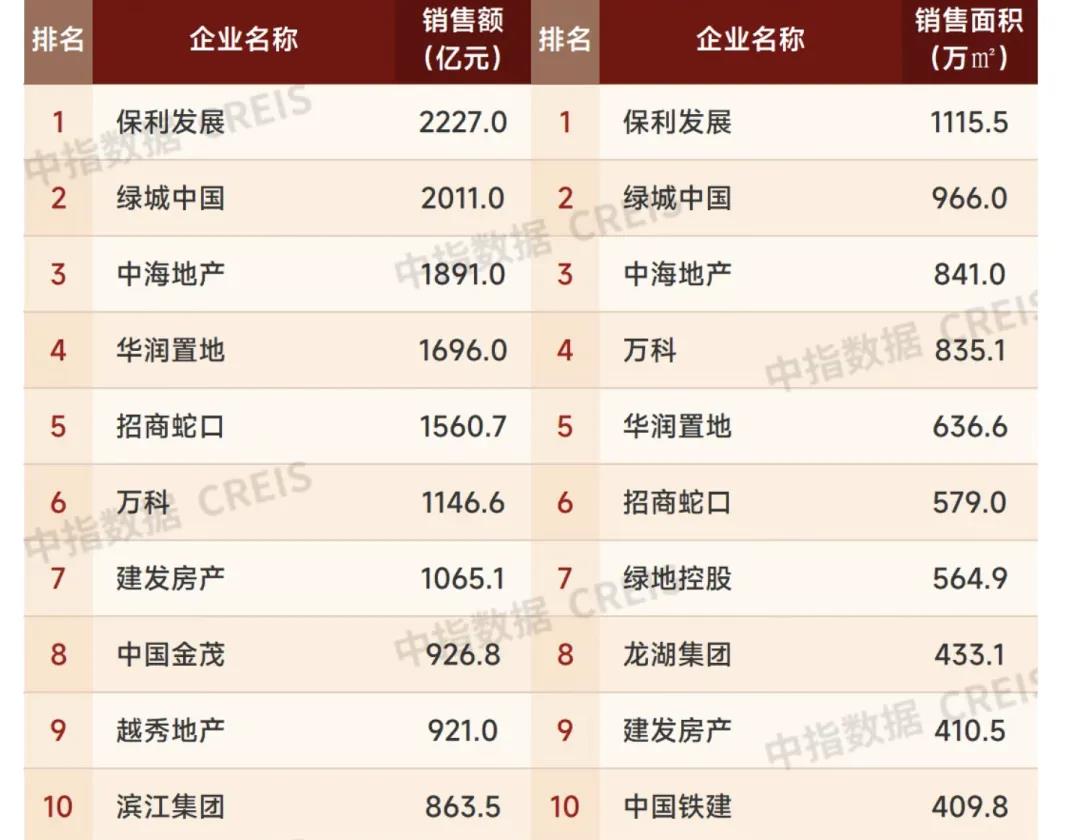
Investment Rating - The report maintains an "Overweight" rating for the real estate sector, indicating a positive outlook for the industry [4]. Core Insights - October sales for real estate companies showed a significant decline, with a year-on-year decrease of 42% and a cumulative decrease of 20% for the year [4]. - The top three companies in terms of sales for October were Poly Developments (210 billion), China Overseas (186 billion), and China Merchants Shekou (154 billion), with the threshold for the top three dropping from 310 billion last year to 154 billion this year [2][4]. - The report highlights that the market is weakening further, necessitating additional supportive policies to stabilize the sector [4]. Summary by Sections Sales Performance - In October 2025, the total sales amount for 50 real estate companies was 1,967 billion, reflecting a year-on-year decline of 41.5% [4]. - The sales area for October was 10 million square meters, down 42.1% year-on-year [4]. - Cumulatively, from January to October 2025, the sales amount reached 19,384 billion, a decrease of 20.4% year-on-year [4]. Company Rankings - For October sales, the rankings were led by Poly Developments (210 billion, YOY -50%), followed by China Overseas (186 billion, YOY -55%) and China Merchants Shekou (154 billion, YOY -31%) [4]. - Cumulative sales from January to October showed Poly Developments leading with 2,227 billion (YOY +22%), followed by China Overseas (1,891 billion, YOY -21%) and China Resources (1,696 billion, YOY -17%) [4]. Investment Recommendations - The report suggests focusing on companies that are likely to benefit from favorable policies, including China Resources, Greenland, and China Jinmao, among others [4]. - It also highlights the potential for commercial real estate to be revalued positively during the current monetary easing cycle [4].
专题回顾 | 房企好房子体系和产品趋势研究
克而瑞地产研究· 2025-11-02 03:07
Group 1 - The core viewpoint of the article emphasizes that the construction of "good houses" is a strategic development direction for residential products, transitioning from policy concepts to industry practices, and is expected to become a long-term trend in the real estate market [1][3][72] - The demand for better housing quality is driven by urbanization and changing consumer expectations, with buyers increasingly prioritizing quality, environment, and amenities over mere availability [3][5][6] - The implementation of price control policies has led to a decline in housing quality, prompting the industry to shift focus from scale to quality in response to growing consumer complaints and a crisis of trust [4][5][6] Group 2 - Leading real estate companies are launching "good house" strategies that focus on safety, comfort, green living, and smart technology, with measurable technical standards to ensure implementation [7][8][10] - Companies like China Overseas and Greentown are establishing comprehensive technical standards that cover the entire lifecycle of design, construction, and service, reflecting a trend towards refined management [8][9][10] - The shift from being mere "space providers" to "technology solution service providers" is evident, as companies leverage standardized technology and service ecosystems to create long-term value [9][10] Group 3 - The article outlines five key dimensions of "good houses": safety performance, comfort and livability, green and low-carbon design, smart technology, and community environment [3][31][54] - Innovations in spatial efficiency and flexible design are becoming critical indicators of housing quality, with companies optimizing building structures and multifunctional spaces to enhance living experiences [31][32][36] - Health and environmental quality are being addressed through comprehensive solutions that go beyond basic physical indicators, incorporating multi-sensory experiences to improve overall living conditions [45][49] Group 4 - The future of "good house" construction is expected to be a continuous process of deepening and refining, with policies evolving to support differentiated designs and technical standards for various market segments [72][73] - The industry is transitioning from traditional scale expansion to quality enhancement, with a focus on the four dimensions of safety, comfort, green living, and smart technology, leading to a more integrated and innovative development approach [72][73]






地产及物管行业周报:十五五规划明确推动房地产高质量发展,商务部等五部门支持商业地产发行REITs-20251102
Shenwan Hongyuan Securities· 2025-11-02 02:44
Investment Rating - The report maintains a "Positive" rating for the real estate and property management sectors [4][27]. Core Views - The "15th Five-Year Plan" emphasizes promoting high-quality development in real estate, aiming to establish a new development model and integrate real estate into the social security system [4][27]. - The report highlights a rebound in new home sales, with a week-on-week increase of 9.9% in 34 key cities, while second-hand home sales saw a slight decline [4][5]. - The report identifies potential investment opportunities in the "Good House" policy and the revaluation of commercial real estate [4][27]. Industry Data Summary New Home Sales - New home sales in 34 key cities totaled 2.835 million square meters, up 9.9% week-on-week, with first and second-tier cities increasing by 12.5% [4][5]. - Year-on-year, new home sales in October decreased by 26.8%, with first and second-tier cities down 25.4% and third and fourth-tier cities down 41.2% [4][7]. Second-Hand Home Sales - Second-hand home sales in 13 key cities totaled 1.152 million square meters, down 1.1% week-on-week, and down 22.2% year-on-year for October [4][13]. Inventory and Supply - In 15 key cities, 770,000 square meters were launched for sale, with a sales-to-launch ratio of 1.59, indicating a healthy demand [4][22]. - The total available residential area in these cities was 89.296 million square meters, down 0.5% week-on-week [4][22]. Policy and News Tracking - The report notes that the Ministry of Commerce and other departments support the issuance of REITs for commercial real estate, providing long-term financing support [4][27]. - Various local governments have introduced measures to stimulate housing demand, including purchase subsidies and adjustments to rental withdrawal ratios [4][30]. Company Performance - Several real estate companies reported weaker performance in Q3 2025, with notable declines in net profits for companies like New Town Holdings and China Overseas Development [4][33]. - The report highlights the successful listing of China Overseas Development's commercial REIT, which raised 1.58 billion yuan [4][33].


今年金九银十,成色如何?
Sou Hu Cai Jing· 2025-11-01 23:18
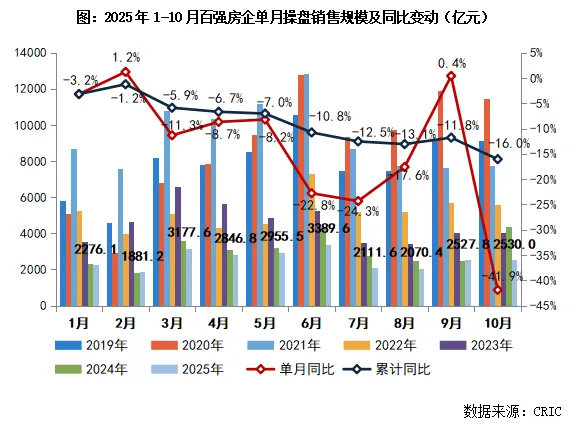
Core Viewpoint - The real estate market in October showed a mixed performance, with new home sales experiencing a slight month-on-month increase but a significant year-on-year decline, indicating a lack of confidence among buyers and a potential need for stronger policy support [2][4][8]. Market Performance - In October, new home transactions increased by 1% month-on-month but fell by 36% year-on-year. The top 100 real estate companies achieved sales of 253 billion yuan, a mere 0.1% increase from the previous month but a drastic 41.9% decrease compared to the same month last year [2][4]. - Cumulatively, from January to October, 30 monitored cities recorded a total transaction volume of 98.25 million square meters, with a year-on-year decline of 7%, worsening from a 2% drop the previous month. The top 100 real estate companies reported total sales of 25,766.6 billion yuan, down 16% year-on-year, marking the worst performance since 2019 [4][5]. Regional Insights - In Shanghai, new home sales reached 11,054 units in October, with a 0.3% month-on-month price increase and a 5.6% year-on-year increase, making it a leader in the market [8]. - Beijing's new home sales were 3,168 units, down 2.16% month-on-month and 23.09% year-on-year. The second-hand home market saw 12,087 transactions, reflecting a 23.71% month-on-month decline and a 30.4% year-on-year drop [14]. - In Shenzhen, new home sales fell by 14.09% month-on-month and 34.46% year-on-year, while second-hand home transactions decreased by 16.90% month-on-month but increased by 27.28% year-on-year [14]. Price Trends - The second-hand home price index showed a 0.84% month-on-month decline, with no cities reporting price increases in September. In contrast, new home prices rose by 0.28% month-on-month [18][20]. - High-end properties continue to perform well, with significant sales recorded in luxury segments, indicating a divergence in market performance between luxury and affordable housing [21][23]. Market Sentiment - The current market reflects a dual reality: while ordinary buyers are hesitant due to fears of falling prices, wealthy individuals are actively purchasing high-value properties, creating a stark contrast in market dynamics [25][28]. - The market is characterized by a "K-shaped" recovery, where demand for affordable housing remains weak, while demand for premium properties is robust, suggesting a complex future landscape for the real estate sector [28].
前10月楼市以2.9万亿元收官 多家房企销售表现强劲
Mei Ri Jing Ji Xin Wen· 2025-11-01 11:19
Core Viewpoint - Despite a challenging market environment, several real estate companies have shown unexpected sales growth in October, with the top 100 real estate firms achieving a total sales volume of approximately 2.9 trillion yuan in the first ten months of the year [1][3]. Group 1: Sales Performance - Poly Developments leads the sales rankings with a cumulative sales figure of 222.7 billion yuan, followed by Greentown China at 201.1 billion yuan [2]. - In October alone, the top 100 real estate companies experienced a month-on-month sales increase of 3.7%, with Greentown China achieving the highest monthly sales of 22.6 billion yuan, closely followed by Poly Developments at 21 billion yuan [3][4]. - The cumulative sales amount for the top 100 firms from January to October saw a year-on-year decline of 16.3%, with the decline rate widening by 4.1 percentage points compared to the previous month [3]. Group 2: Market Dynamics - The total operational amount for the top 100 real estate companies in October was 253 billion yuan, reflecting a slight month-on-month increase of 0.1% but a significant year-on-year decrease of 41.9% [4]. - In October, 48 of the top 100 firms reported month-on-month performance growth, with 20 companies experiencing growth rates exceeding 30% [4]. - The new housing market in Beijing showed a positive trend with a 19% month-on-month increase in transaction volume, although it still faced a 19% year-on-year decline [5]. Group 3: Regional Performance - Guangzhou's transaction volume in October reached 610,000 square meters, marking a 6% month-on-month increase, but still a 46% year-on-year decline [6]. - Among second-tier cities, Chengdu led with a monthly transaction volume of 800,000 square meters, while Qingdao saw a 30% year-on-year increase in transaction area [6]. - The overall performance of second-tier cities showed significant divergence, with some cities maintaining high transaction volumes while others faced substantial declines [6].

前10月重点房企拿地总额同比增长26.4%
Zheng Quan Shi Bao Wang· 2025-11-01 03:40
Core Insights - The total land acquisition amount by the top 100 enterprises from January to October reached 783.8 billion yuan, representing a year-on-year increase of 26.4% [1] - The leading companies in terms of new value added are China Overseas Land & Investment, China Merchants Shekou, and Greentown China, with new values of 187 billion yuan, 180.7 billion yuan, and 120.9 billion yuan respectively [1] - The trend of land acquisition continues to grow, but the growth rate has significantly narrowed compared to the previous months due to large-scale land mergers and acquisitions in September [1] Group 1: Land Acquisition Trends - The top 100 enterprises' land acquisition amount continues to show growth, with a total of 783.8 billion yuan from January to October [1] - The majority of land acquisition is dominated by state-owned enterprises, with 8 out of the top 10 companies being state-owned [1] - Private enterprises are also actively acquiring land, particularly in regions like Zhejiang and Sichuan [1] Group 2: Regional Insights - The Yangtze River Delta leads the four major city clusters in terms of land acquisition [2] - Major land acquisition activities are concentrated in first-tier cities like Shanghai and Beijing, as well as hot second-tier cities like Hangzhou and Chengdu [2] - The trend of joint land acquisition is emerging, primarily to mitigate market uncertainties, with many projects being developed through a "state-owned enterprise + local state-owned capital" model [2] Group 3: Project Development Models - Joint land acquisition is becoming a common strategy among real estate companies to share market risks such as poor sales and price fluctuations [2] - Some projects are being developed through a management contract model, where the management company takes on the project development after securing the land [2] - The involvement of management companies in early project phases is increasingly common, allowing for innovative collaboration models with investors [2]
2025年1-10月中国房地产企业新增货值TOP100排行榜
克而瑞地产研究· 2025-11-01 03:19
Core Viewpoint - The real estate market in China is experiencing a downturn, with a significant decline in land acquisition activities among major companies, reflecting a cautious investment attitude due to reduced land supply and market pressures [15][16][30]. Group 1: Land Acquisition Trends - In October, over half of the 30 monitored companies did not engage in land acquisition, with only four companies acquiring land worth over 5 billion yuan [16]. - The total land acquisition value for the top 100 real estate companies reached 19,443 billion yuan, with a year-on-year increase of 27% [24]. - The average premium rate for land transactions in October was 2.7%, marking the lowest level of the year [18]. Group 2: Market Performance Metrics - The total area of land sold through public bidding in China was 60.57 million square meters, a 13% decrease month-on-month and a 25% decrease year-on-year [18]. - The total transaction amount for land was 151.9 billion yuan, reflecting a 20% month-on-month decline and a 35% year-on-year decrease [18]. - The threshold for the top 100 companies in terms of new land value decreased by 5% year-on-year to 4.28 billion yuan [21]. Group 3: Investment Behavior - The investment amount of the top 100 companies increased by 45% year-on-year, indicating a rebound in land acquisition despite the overall market decline [23][24]. - The land acquisition ratio for the top 100 companies was 0.29, with the top 10 companies showing a higher ratio of 0.42, indicating more aggressive investment strategies [26]. - Companies are focusing on acquiring quality land in core first- and second-tier cities, maintaining a rational approach to avoid overpaying [30][33]. Group 4: Future Outlook - The fourth quarter is expected to see continued cautious and rational land acquisition strategies, with over 40% of the top sales companies likely to maintain zero new land reserves [33]. - Central government policies are anticipated to optimize land supply, focusing on improving housing quality and urban renewal projects [33].

中指研究院:前10月TOP100企业拿地总额同比增长26.4%
Zheng Quan Shi Bao Wang· 2025-11-01 00:45
Core Insights - The total land acquisition amount by the top 100 real estate companies in China for the period from January to October 2025 reached 783.8 billion yuan, representing a year-on-year increase of 26.4% [1] - The growth trend continues, but the growth rate has significantly narrowed compared to the previous month due to several large-scale land acquisitions in September [1] - State-owned enterprises remain the dominant players in land acquisition, with China Overseas Land & Investment, China Merchants Shekou, and Greentown China ranking as the top three in terms of new land value [1]
中指研究院:1-10月TOP100房企拿地总额同比增长26.4%
Zhi Tong Cai Jing· 2025-11-01 00:37
Core Insights - The total land acquisition amount by the top 100 real estate companies in China reached 783.8 billion yuan from January to October 2025, marking a year-on-year increase of 26.4%, although the growth rate has significantly narrowed compared to the previous months due to large-scale land acquisitions in September [1][2] Group 1: Land Acquisition Trends - The top 100 companies' land acquisition continues to be dominated by state-owned enterprises, with 8 out of the top 10 companies being state-owned [2] - China Overseas Land & Investment, China Merchants Shekou, and Greentown China ranked as the top three companies in terms of new land value, with 187 billion yuan, 180.7 billion yuan, and 120.9 billion yuan respectively [2] - The total new land value for the top 10 companies reached 1,044.9 billion yuan, accounting for 48.1% of the total new land value of the top 100 companies [2] Group 2: Joint Acquisition Strategies - Many land acquisitions in October were conducted in joint ventures, primarily in first and second-tier cities such as Shanghai and Beijing, to share risks associated with market uncertainties [3] - The joint acquisition model often involves a combination of state-owned enterprises and local state-owned assets, as well as partnerships between real estate companies and financial investors [3] - Some projects are being developed through a construction agency model, where the agency is involved early in the project to secure development rights [3] Group 3: Regional Land Acquisition - The Yangtze River Delta region led the four major city clusters in land acquisition, with the top 10 companies acquiring 261.7 billion yuan worth of land [4] - In key cities, state-owned and local state-owned enterprises remain the primary players, while private enterprises are supplementing land reserves in specific areas [4] - Companies like China Merchants Shekou and Jianfa have made significant land acquisitions in cities like Beijing, Shanghai, and Chengdu, focusing on core urban areas [4] Group 4: High-Value Land Transactions - In October, high-value land transactions were concentrated in Shanghai and Beijing, with Shanghai accounting for 4 of the top 10 highest total price land parcels [5] - The highest transaction was for two underground space parcels in Shanghai's Jing'an District, totaling 7.7 billion yuan [5] - Joint ventures were involved in 4 of the top land parcels acquired [5]
北京新盘“变形记”:改规划、调产品
Zhong Guo Jing Ying Bao· 2025-10-31 20:18
Core Viewpoint - The real estate market in Beijing is experiencing intensified competition, leading developers to adjust their project plans to enhance product appeal and align with the "good housing" policy, aiming to improve sales performance [1][7]. Group 1: Project Adjustments - The Qingyuefu project in Changping has reduced the number of buildings from 28 to 26 and increased the usable area ratio to approximately 90% [1]. - Other projects, such as Jiahuatianjun in Haidian and Manyun ONE in Tongzhou, have also made similar adjustments, including reducing the proportion of large units and enhancing community amenities [1][6]. - The Qingyuefu project, which has been slow in sales, reported a cumulative sales rate of 49% for its first phase, with a current average price of 4.3 million yuan per square meter, significantly lower than the initial guidance price [2][4]. Group 2: Market Conditions - The Changping area is facing pressure on new home sales due to an oversupply of new developments, leading to a dilution of potential buyers [4][5]. - The overall sales performance of Beijing Zhuzong's real estate business has been underwhelming, with a revenue of 2.763 billion yuan in the first half of the year, a year-on-year increase of 10.6%, but a net profit drop of 54.8% [5]. - The market is characterized by fierce competition among new projects, with many developers enhancing their offerings in terms of area and community facilities to attract buyers [5][7]. Group 3: Regulatory Influence - The "good housing" policy has prompted developers to align their new projects with higher standards for usable area and community quality, leading to significant adjustments in project designs [7][9]. - The adjustments are driven by both regulatory requirements and real market demand, with developers responding to customer feedback by reducing larger unit sizes and increasing smaller units [9].