福田汽车

Search documents
智启越野新纪元,创领性能新体验丨2025第二届汽车越野性开发研讨会开幕
Zhong Guo Qi Che Bao Wang· 2025-11-06 02:01
Core Insights - The "2025 Second Off-Road Development Seminar" was held in Yancheng, Jiangsu, focusing on the theme "Intelligent Off-Roading New Era, Leading New Performance Experience" [1][3] - The event attracted over 150 top experts, scholars, and engineers from domestic automotive manufacturers and research institutions to share the latest research findings and trends in off-road development [1] Group 1: Industry Direction and Goals - The core theme of the seminar emphasizes the future direction of off-road vehicle development in the industry [3] - The China Automotive Research Center aims to integrate internal and external resources to advance standards, testing, and certification, while establishing a scientific evaluation system for off-road performance [3][7] Group 2: Technological Advancements - The establishment of the "Intelligent Technology Off-Road Joint Innovation Laboratory" aims to focus on key areas such as safety verification, thermal management, energy consumption testing, and durability in off-road conditions [7] - The laboratory will promote deep integration of industry, academia, and research to drive innovation in intelligent off-road technology [7] Group 3: Performance Testing and Certification - The results of the 2024-2025 "Off-Road Level Challenge Test" were announced, showcasing the off-road performance limits of various vehicles, including models from Great Wall and Tank [9] - This certification system provides consumers with authoritative references for vehicle purchases and encourages manufacturers to enhance product performance [9] Group 4: Talent Development and Collaboration - The seminar included the appointment of expert advisors from leading automotive companies to focus on standard formulation and technological breakthroughs in intelligent off-road technology [11] - A certificate awarding ceremony for off-road driving and development training students highlighted the industry's commitment to professional talent cultivation and knowledge transfer [12] Group 5: Seminar Activities - The seminar featured nearly 20 presentations on off-road standards, theories, applications, and cultural aspects, along with immersive test drive activities at the Intelligent Off-Road Square [14]


北汽张建勇:依托本地化研发,与奔驰一起深耕中国新能源汽车市场
Bei Ke Cai Jing· 2025-11-06 01:48
Core Insights - Beijing Benz is celebrating its 20th anniversary in 2025, highlighting a long-standing partnership with BAIC Group focused on innovation and growth in the automotive sector [1][3] - The launch of the all-electric Mercedes-Benz CLA, priced starting at 249,000 yuan, represents a significant step in the collaboration between BAIC and Mercedes-Benz, aimed at enhancing their presence in the Chinese new energy vehicle market [3] Company Developments - The new electric CLA is built on the MMA platform and produced by Beijing Benz, showcasing the company's commitment to local development and production [3] - BAIC Group has successfully localized 14 models of Mercedes-Benz vehicles, with total production exceeding 5 million units, indicating strong manufacturing capabilities and market penetration [4] Industry Trends - The introduction of the electric CLA aligns with the broader industry shift towards electrification and smart technology in the automotive sector, reflecting changing consumer expectations for luxury electric vehicles [3] - BAIC and Mercedes-Benz plan to deepen their collaboration to create electric luxury products tailored to the Chinese market, signaling a strategic focus on meeting local consumer demands [3]


透过汽车企业三季报看账期变化:付款时间有所缩短
Zheng Quan Shi Bao· 2025-11-05 23:57
Core Viewpoint - The automotive industry in China is making progress in addressing payment terms, with major A-share listed companies reducing their accounts payable turnover days in the third quarter of 2025, following commitments to pay suppliers within 60 days [1][2]. Group 1: Payment Term Improvements - A total of 11 A-share listed passenger car companies showed a decrease in accounts payable turnover days in Q3 2025, with GAC Group having the shortest at 76.14 days and Qianli Technology the longest at 154.61 days [2]. - Notably, Beiqi Blue Valley saw a significant reduction from 112.32 days to 83.79 days, a drop of 28.53 days or 25% [2]. - Despite improvements, some companies like SAIC Group and Changan Automobile still have substantial accounts payable, with SAIC reporting 76.9 billion yuan in payable notes [2]. Group 2: Cash Flow Management - Most car companies maintained positive cash flow in Q3, with SAIC, Great Wall Motors, and Changan reporting over 10 billion yuan in net operating cash flow, while BYD exceeded 9 billion yuan [3]. - However, some companies are experiencing cash flow pressure, indicating a mixed financial health across the industry [3]. Group 3: Best Practices from Leading Companies - GAC Group has consistently kept supplier payment terms under 60 days, leveraging a digital management system for real-time tracking of payment processes [5]. - Seres has innovated with a "factory within a factory" model to streamline production and reduce costs, enhancing payment execution efficiency [6]. - China FAW has implemented a 100% cash payment policy for small and medium-sized suppliers, moving away from mixed payment methods [6]. Group 4: Ongoing Challenges - Despite improvements, operational bottlenecks remain, particularly with legacy orders that do not meet the new payment terms, leading to discrepancies in treatment between new and old orders [7]. - Suppliers express concerns about potential repercussions from complaints, often opting for negotiation over formal disputes [7]. - Industry experts highlight that while shortening payment cycles may strain cash flow for automakers, it also necessitates better financial management and operational efficiency [8].
6G技术勾勒未来图景 “新技术正在改变生活”
Ren Min Ri Bao· 2025-11-05 22:00
Core Insights - Qualcomm showcased a variety of new terminals at the China International Import Expo, featuring 12 flagship smartphones equipped with the fifth-generation Snapdragon 8 Gen 2 chip, marking their first large-scale offline exhibition in China [1] - The exhibition highlighted innovative technologies across different platforms, including advanced automotive interfaces and AI-powered devices, demonstrating the integration of technology into daily life [1] - The immersive experience zone attracted significant attention, featuring augmented reality (AR) projects that provided interactive experiences, showcasing the potential of future technologies like 6G [1] Group 1 - Qualcomm's booth featured 12 flagship smartphones with the Snapdragon 8 Gen 2 chip, representing their debut at a major offline event in China [1] - The exhibition included various "black technologies," such as multi-screen collaboration in vehicles and AI glasses for payment and communication [1] - The immersive experience area offered AR experiences, allowing visitors to engage with virtual environments and characters [1] Group 2 - The demonstration of 6G technology at the booth illustrated Qualcomm's vision for the future and its collaboration with operators and ecosystem partners [1] - The diverse scenarios presented at Qualcomm's booth showcased the integration of smart technologies across multiple sectors, from mobile devices to automotive solutions [1]

固态电池“文字游戏”,要到头了!
电动车公社· 2025-11-05 16:18
Core Viewpoint - Solid-state batteries are considered the ultimate solution for power batteries, but the term has become muddled with various interpretations and marketing tactics, leading to confusion in the industry [2][4][6]. Group 1: Definition and Standards - The China Society of Automotive Engineers released the "Full Solid-State Battery Determination Method," establishing a standard for solid-state batteries based on the weight loss of the electrolyte after vacuum baking [5]. - The definition helps clarify the concept but does not address the ambiguity surrounding semi-solid batteries, which remain a gray area without clear standards [8][12]. Group 2: Industry Developments - Recent discussions suggest that regulatory bodies are considering standardizing the term "semi-solid battery" to "solid-liquid battery," which would clearly differentiate it from traditional liquid and full solid-state batteries [14][16]. - Solid-liquid batteries have already been implemented in various applications, including electric vehicles and mobile devices, indicating their commercial viability [19][20][22]. Group 3: Technical Advantages - Solid-liquid batteries can address interface issues that hinder full solid-state batteries, as their electrolyte's fluidity helps fill gaps between the electrode and electrolyte, improving conductivity [27][31]. - The production cost of solid-liquid batteries is close to that of liquid batteries, with estimates showing they can be produced at 1.2 times the cost of liquid batteries, potentially decreasing to 10% or even 5% more in the future [45][48]. Group 4: Comparison with Liquid Batteries - Solid-liquid batteries offer significant safety advantages, reducing the risk of combustion by replacing flammable liquid electrolytes with non-flammable solid electrolytes [51]. - They also exhibit better low-temperature performance, maintaining 85-90% capacity at -20°C, compared to liquid batteries that can drop to 60-70% capacity [59][60]. Group 5: Challenges and Future Outlook - Despite their advantages, solid-liquid batteries face challenges in conductivity compared to liquid batteries, which can achieve higher charging speeds [64][66]. - The transition from liquid to solid-liquid batteries is seen as a crucial step towards the eventual adoption of full solid-state batteries, with expectations for small-scale applications by 2030 and broader adoption by 2035 [74][76][80].

“车企链”正在逐步退场
第一财经· 2025-11-05 12:20
Core Viewpoint - The automotive industry is shifting away from the "chain" settlement method, which has been a long-standing practice, towards more direct payment methods such as wire transfers and commercial acceptance bills, aiming to shorten the payment cycle for suppliers [3][5]. Group 1: Changes in Settlement Methods - Several automotive companies, including BYD and Great Wall Motors, are transitioning from the "chain" settlement method to a combination of wire transfers and commercial acceptance bills, which significantly reduces the payment cycle from over three months to around 60 days [3][5]. - Some suppliers have reported receiving their first wire transfer under the new 60-day payment term, indicating a positive shift in cash flow management [3]. - However, not all suppliers have experienced this change, with some still using the "chain" method, leading to dissatisfaction among those who have not yet received updates on their payment terms [5]. Group 2: Supplier Perspectives - Suppliers have expressed a preference for cash settlements over commercial acceptance bills, viewing the latter as a mere change in form rather than substance, although commercial acceptance bills offer legal protection and transparency [4]. - There are concerns among suppliers regarding the slow pace of change in settlement methods, with some suppliers feeling frustrated about the lack of uniformity in payment practices across different automotive companies [5]. Group 3: Regulatory Context - The implementation of the "Regulations on Payment of Small and Medium-sized Enterprises" mandates that large enterprises must pay small and medium-sized enterprises within 60 days of delivery, prohibiting the forced acceptance of non-cash payment methods that could extend payment periods [6]. - A coalition of 17 major automotive companies has committed to adhering to the 60-day payment term, although there are still concerns about the consistency and transparency of the payment process [6].



“车企链”正在逐步退场
Di Yi Cai Jing· 2025-11-05 12:17
Core Viewpoint - The "chain" settlement method that has troubled suppliers for a long time is expected to phase out as automotive companies shift towards cash and electronic transfer methods, aiming to shorten the payment cycle for suppliers [2][3]. Group 1: Changes in Settlement Methods - Automotive companies are gradually moving away from the "chain" settlement method, such as BYD's "Di Chain" and Great Wall's "Great Wall Chain," towards a combination of electronic transfers and commercial acceptance bills [2][3]. - Some suppliers have already received payments via electronic transfers after the adjustment of the payment period to 60 days, which previously required over three months for the "chain" method [2]. - While some suppliers have transitioned to commercial acceptance bills, others still maintain the "chain" settlement method, indicating a mixed response to the changes [2][3]. Group 2: Industry Regulations and Responses - The "60-day payment period" policy, effective from June, mandates large enterprises to pay small and medium-sized enterprises within 60 days of delivery, prohibiting forced acceptance of non-cash payment methods [4]. - A commitment was made by 17 major automotive companies to ensure payment to suppliers does not exceed 60 days, although the settlement methods have not uniformly shifted to cash or electronic transfers [4]. - The Ministry of Industry and Information Technology has opened a platform for complaints regarding the adherence of key automotive companies to the payment cycle commitments, addressing concerns from small and medium enterprises [4].
副驾也能坐!坐标广深,小马智行最新自动驾驶车型上路接单了
Nan Fang Du Shi Bao· 2025-11-05 09:16
Core Insights - The launch of the seventh-generation Robotaxi by Pony.ai marks a significant milestone in China's Robotaxi industry, transitioning to large-scale operations with the introduction of fully compliant L4 autonomous vehicles [2][4] Group 1: Vehicle Features and Technology - The new Robotaxi features advanced smart capabilities, including automatic door unlocking via Bluetooth and pre-ride climate control through an app [4] - Safety is enhanced with over 20 redundant systems and more than 1,000 monitoring designs, ensuring operational safety [4] - The vehicle's design includes a reconfigured interior space, allowing for the first-time use of the front passenger seat, improving space utilization and user experience [4][6] Group 2: Cost Reduction and Efficiency - The seventh-generation Robotaxi achieves a 70% reduction in total cost compared to the previous generation, primarily due to self-developed domain controllers and optimized supply chain costs [7][9] - The cost of LiDAR technology has significantly decreased from $100,000 to approximately 2,000 RMB, benefiting from China's advanced smart driving industry chain [9] - The company emphasizes lifecycle cost management, designing vehicles for a 5-year, 600,000 km operational lifespan to ensure lower operational costs [9] Group 3: Market Expansion and Future Plans - As of October 2025, Pony.ai's fleet has grown to 726 vehicles, a 127% increase since the beginning of the year, with plans to exceed 1,000 vehicles by year-end [9] - The successful deployment of the seventh-generation models is crucial for the company to achieve operational self-sufficiency [9]
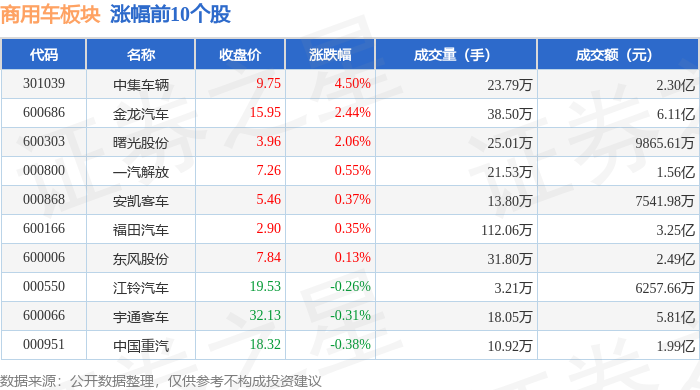
商用车板块11月5日跌0.51%,汉马科技领跌,主力资金净流出2.87亿元
Zheng Xing Xing Ye Ri Bao· 2025-11-05 08:42
Market Overview - The commercial vehicle sector experienced a decline of 0.51% on November 5, with Hanma Technology leading the drop [1] - The Shanghai Composite Index closed at 3969.25, up 0.23%, while the Shenzhen Component Index closed at 13223.56, up 0.37% [1] Stock Performance - Notable gainers in the commercial vehicle sector included: - Zhongshun Vehicles (301039) with a closing price of 9.75, up 4.50% and a trading volume of 237,900 shares [1] - Jinlong Automobile (600686) closed at 15.95, up 2.44% with a trading volume of 385,000 shares [1] - Shuguang Co. (600303) closed at 3.96, up 2.06% with a trading volume of 250,100 shares [1] - Conversely, Hanma Technology (600375) led the decline with a closing price of 7.63, down 3.05% and a trading volume of 768,700 shares [2] - Other notable decliners included: - Jianghuai Automobile (600418) down 2.15% to 47.70 [2] - Zhongtong Bus (000957) down 0.60% to 11.67 [2] Capital Flow - The commercial vehicle sector saw a net outflow of 287 million yuan from institutional investors, while retail investors contributed a net inflow of 286 million yuan [2] - The sector's overall capital flow indicated a mixed sentiment among different investor types [2] Detailed Capital Flow Analysis - Key stocks and their capital flow: - Jinlong Automobile (600686) had a net inflow of 72.80 million yuan from institutional investors, while retail investors saw a net outflow of 74.83 million yuan [3] - Hanma Technology (600375) experienced a net outflow of 22.53 million yuan from institutional investors [3] - Other stocks like Foton Motor (600166) and Dongfeng Motor (600006) also showed significant net outflows from institutional investors [3]


10月新能源牵引车大增148%!徐工/解放/三一激烈争冠 重汽和TA暴涨2.7倍 | 头条
第一商用车网· 2025-11-05 08:00
Core Viewpoint - In October 2025, the sales of new energy heavy trucks in China continued to maintain a high level, with overall sales exceeding 17,000 units, a year-on-year increase of 153% [1]. New Energy Tractor Truck Market Performance - In October 2025, 13,300 new energy tractor trucks were added, marking a year-on-year increase of 148% and a month-on-month decrease of 26% [4]. - The year-on-year growth rate of 148% for new energy tractor trucks was 5 percentage points lower than the overall growth rate of new energy heavy trucks [4]. - 30 provincial-level administrative regions saw new additions of new energy tractor trucks, with Shanghai leading by adding over 2,000 units [4]. - Cumulatively, by October 2025, 29 provincial-level regions had sales exceeding 100 units, and 23 regions exceeded 1,000 units [6]. Company Sales Performance - In October 2025, 12 companies sold over 100 new energy tractor trucks, with 7 companies exceeding 1,000 units [7]. - XCMG topped the monthly sales chart with 2,239 units sold, followed by Jiefang with 1,955 units and SANY with 1,841 units [8][9]. - The top ten companies mostly achieved year-on-year growth, with XCMG, Shaanxi Automobile, and Heavy Truck showing significant increases of 231%, 244%, and 273% respectively [10]. Cumulative Sales Data - From January to October 2025, cumulative sales of new energy tractor trucks reached 109,800 units, a year-on-year increase of 239% [13]. - The top three companies in cumulative sales were Jiefang (18,200 units), XCMG (17,400 units), and SANY (15,600 units) [14]. - The market share of the top five companies exceeded 10%, with Jiefang holding 16.58% and XCMG 15.84% [17]. Market Outlook - The performance of the new energy tractor truck market in October was strong, with expectations for continued high sales and growth rates in the remaining months of 2025 [19].