博时基金

Search documents
“贫富差距”拉大!多只“固收+”,凭借权益领跑
券商中国· 2025-10-27 23:30
Core Viewpoint - The "fixed income +" products have shown diverse net value curves in the context of a strong stock market and weak bond market, with some products achieving outstanding performance through high elasticity allocations in stocks and convertible bonds, while others focusing on long-duration bonds performed relatively poorly [1][2]. Group 1: Performance of "Fixed Income +" Products - The average increase of "fixed income +" products this year is approximately 4.8%, with top performers like Huazhong Zhili rising by 47.77% and Huashang Shuangyi by 44.4% [4]. - The leading products have significant allocations in equity assets, with over 40% of assets in stocks for top performers, benefiting from high-elasticity technology stocks [4]. - The performance of other high-ranking products, such as Fuguo Jiuli and Minsheng Jiayin, also shows a strong focus on convertible bonds, with allocations exceeding 70% [4]. Group 2: Risk Level Adjustments - Several public funds and distribution channels have raised the risk levels of their "fixed income +" products, with many being upgraded from R2 (medium-low risk) to R3 (medium risk) [8]. - The adjustments in risk levels are influenced by regulatory requirements, market conditions, and changes in target customer profiles [8][9]. Group 3: Market Outlook - The bond market is expected to maintain a stable operation, while the equity market is anticipated to continue with structural trends, leading to a consensus on seeking higher risk-return ratios through "fixed income +" products [2][12]. - The overall scale of "fixed income +" funds reached 1.48 trillion yuan by the end of the second quarter, with a significant increase of over 100 billion yuan in a single quarter [11]. - The current economic indicators suggest a weak recovery, providing a stable foundation for the bond market, while also presenting new challenges [12].


这只“ST”股获多只公募青睐,什么原因?
Zheng Quan Shi Bao· 2025-10-27 22:46
Group 1 - ST Huatuo has been heavily invested by multiple public funds, including Yongying Fund, Rongtong Fund, and Nord Fund, with a year-to-date increase of 265.18% and a quarterly increase exceeding 125% [1][4] - The company reported total revenue of 17.207 billion yuan, an increase of 85.50%, and a net profit of 2.656 billion yuan, up 129.33%, marking a historical high [4] - The mobile game "Whiteout Survival" launched by its subsidiary has become a significant growth driver, with projected cumulative revenue exceeding 3.3 billion USD by August 2025 [3][4] Group 2 - Public funds are cautious about investing in ST stocks, with a rigorous selection process that emphasizes fundamental analysis and liquidity [6][8] - The transition from the alternative stock pool to the core stock pool is critical, requiring in-depth research reports and approval from the research department [7] - The focus on new consumption trends is evident, with fund managers shifting towards growth sectors like gaming and IP derivatives, while remaining cautious about traditional consumption recovery [10][11] Group 3 - The gaming sector has seen significant growth, with the China gaming sector index rising over 40% this year, driven by policy benefits, technological innovation, and market expansion [11] - The upcoming quarterly reports are expected to serve as a benchmark for the industry's performance and provide strong support for future trends [11] - The gaming industry is transitioning from an adjustment phase to a high prosperity phase, with dual drivers of performance and valuation growth [11]
本周25只新基启动发行 权益类占八成
Zheng Quan Ri Bao· 2025-10-27 17:16
Core Insights - The public fund issuance market is experiencing a unique pattern of "reduced volume but increased efficiency" with a decrease in the number of new products issued this week compared to the previous week, while the fundraising efficiency has significantly improved [1][2] Group 1: Market Trends - A total of 25 new public fund products were issued this week, down 16.67% from 30 products the previous week, indicating a contraction in supply [1] - The average subscription days for new products decreased from 27.8 days to 21.92 days, showing a faster fundraising pace [1] Group 2: Investor Sentiment - Market participants exhibit a complex mindset, with some investors showing caution due to concerns about the sustainability of profits, leading to a "fear of heights" mentality [1] - Public fund institutions are adopting a more prudent approach in their issuance strategies, focusing on stability and control over the pace of new product launches [1] Group 3: Product Structure - Equity assets remain the dominant focus for public fund institutions, with 20 out of 25 new products being equity funds, accounting for 80% of the total [2] - Among the new equity products, there are 11 stock funds primarily consisting of passive index products and 9 equity-mixed funds [2] Group 4: Institutional Activity - 22 public fund institutions launched new funds this week, indicating a relatively concentrated market activity [2] - Most institutions (20 out of 22) issued only one new product, while 2 institutions launched two or more new funds [2] Group 5: Notable Fund Issuances - Huaxia Fund had the highest issuance activity with three new equity funds focusing on resource and renewable energy sectors [3] - Bosera Fund followed closely with two new equity funds, further emphasizing the strategic focus on equity funds in the current market environment [3]
天府证券ETF日报-20251027
天府证券· 2025-10-27 11:16
Report Overview - Report date: October 27, 2025 [5] - Analyst: Ma Yaoshi [5] - Qualification certificate: S1330524050001 [5] - Contact email: mayst@hxzb.cn [5] - Contact phone: 15201282186 [5] Market Overview - A-share market: The Shanghai Composite Index rose 0.71% to 3,950.31 points, the Shenzhen Component Index rose 2.02% to 13,289.18 points, and the ChiNext Index rose 3.57% to 3,171.57 points. The total trading volume of A-shares in the two markets was 1.9918 trillion yuan [2][6] - Leading gainers: Communications (4.73%), electronics (4.72%), and national defense and military industry (2.34%) [2][6] - Leading losers: Petroleum and petrochemicals (-1.36%), coal (-1.29%), and food and beverages (-1.18%) [2][6] Stock ETF - Top trading volume: The top three were the Harvest Shanghai - Science and Technology Innovation Board Chip ETF (up 5.40% with a discount rate of 5.47%), the ChinaAMC Shanghai - Science and Technology Innovation Board 50 ETF (up 4.21% with a discount rate of 4.31%), and the ChinaAMC CSI A500 ETF (up 1.38% with a discount rate of 1.49%) [3][7] Bond ETF - Top trading volume: The top three were the Haitong Fortune CSI Short - Term Financing Bond ETF (up 0.01% with a discount rate of 0.01%), the Bosera CSI Convertible and Exchangeable Bond ETF (up 0.43% with a discount rate of 0.54%), and the ChinaAMC Shanghai Benchmark Market - Making Treasury Bond ETF (down 0.02% with a discount rate of - 0.02%) [4][9] Gold ETF - Gold prices: AU9999 fell 0.60%, and Shanghai Gold fell 0.49% [12] - Top trading volume: The top three were the Huaan Gold ETF (down 0.49% with a discount rate of - 0.60%), the E Fund Gold ETF (down 0.50% with a discount rate of - 0.58%), and the Bosera Gold ETF (down 0.51% with a discount rate of - 0.63%) [12][13] Commodity Futures ETF - Performance: The Dacheng Non - Ferrous Metals Futures ETF rose 1.22% with a discount rate of 1.67%, the CCB Yisheng Zhengzhou Commodity Exchange Energy and Chemical Futures ETF fell 0.40% with a discount rate of - 0.03%, and the ChinaAMC Feed Soybean Meal Futures ETF fell 0.26% with a discount rate of 4.36% [13][14] Cross - Border ETF - Overseas indices: The Dow Jones Industrial Average rose 0.31%, the Nasdaq Composite rose 0.89%, the S&P 500 rose 0.58%, and the German DAX rose 0.23% the previous day. The Hang Seng Index rose 0.74%, and the Hang Seng China Enterprises Index rose 0.68% today [15] - Top trading volume: The top three were the E Fund CSI Hong Kong Securities Investment Theme ETF (up 1.28% with a discount rate of 1.65%), the Huatai - Peregrine CSI Korea Exchange Sino - Korean Semiconductor ETF (up 4.36% with a discount rate of 4.36%), and the Huatai - Peregrine Hang Seng Technology ETF (up 1.01% with a discount rate of 2.05%) [15][16] Money ETF - Top trading volume: The top three were the Yin Hua Day - to - Day Profit ETF, the Hua Bao Add - Benefit ETF, and the CCB Add - Benefit Money ETF [17][19]
基金双周报:ETF市场跟踪报告-20251027
Ping An Securities· 2025-10-27 10:04
ETF Market Overview - As of October 24, the performance of ETF products varied, with the Shanghai 50 index showing the highest increase among major broad-based ETFs, while the dividend-themed ETFs had the largest gains among industry and thematic products [2][9] - In the past two weeks, major broad-based ETFs such as the CSI A50, CSI 2000, and Shanghai 50 saw net inflows, while the CSI A500 ETF experienced the largest net outflow [2][9] - The recent trend indicates a shift in fund flows, with the New Energy ETF moving from net inflow to net outflow, while the Pharmaceutical ETF transitioned from net outflow to net inflow [16] ETF Fund Flow Analysis - The cumulative fund flow for major broad-based ETFs has shown a trend of outflows turning into inflows and then back to outflows since the beginning of 2025, with significant inflows into the CSI 300 ETF in April, followed by continued outflows in subsequent months [10][12] - Recent data indicates that, apart from the Shanghai 50 ETF, which shifted from net outflow to net inflow, other major broad-based ETFs have transitioned from net inflows to net outflows in the past two weeks [10][12] Thematic ETF Tracking - For technology-themed ETFs, those tracking the Hang Seng Technology index saw significant net inflows, while products tracking the CS Artificial Intelligence index experienced net outflows [32] - Dividend-themed ETFs tracking the low-volatility dividend index had the highest net inflows, whereas those tracking the dividend index saw net outflows [35] New ETF Products and Market Growth - In the past two weeks, a total of 8 new ETFs were launched, with a combined issuance of 2.997 billion shares, all of which were stock ETFs [26] - Compared to the end of 2024, the scale of various ETFs has increased significantly, with bond ETFs, commodity ETFs, industry + dividend ETFs, QDII ETFs, and broad-based ETFs growing by 293.33%, 197.82%, 112.34%, 52.18%, and 13.97% respectively [26] Fund Management Scale Distribution - As of October 24, Huaxia Fund has the largest ETF scale at 912.812 billion, with E Fund's ETF management scale expanding by over 250 billion compared to the previous year [27][28]
天府证券ETF日报2025.10.27-20251027
天府证券· 2025-10-27 09:48
Report Summary Market Overview - On October 27, 2025, the Shanghai Composite Index rose 1.18% to 3996.94 points, the Shenzhen Component Index rose 1.51% to 13489.40 points, and the ChiNext Index rose 1.98% to 3234.45 points. The total trading volume of A-shares in the two markets was 2356.8 billion yuan. The top-performing sectors were communication (3.22%), electronics (2.96%), and comprehensive (2.68%), while the bottom-performing sectors were media (-0.95%), food and beverage (-0.20%), and real estate (-0.11%) [2][6]. Stock ETFs - The top-traded stock ETFs on this day were Huaxia SSE STAR 50 ETF, which rose 1.50% with a discount rate of 1.48%; Harvest SSE STAR Market Chip ETF, which rose 1.96% with a discount rate of 1.85%; and Huaxia CSI A500 ETF, which rose 1.28% with a discount rate of 1.33% [3][7]. Bond ETFs - The top-traded bond ETFs were Haifutong CSI Short-term Financing Bond ETF, which fell 0.00% with a discount rate of 0.00%; Cathay CSI AAA Sci-tech Innovation Corporate Bond ETF, which rose 0.02% with a discount rate of -0.03%; and Huaxia SSE Benchmark Market-making Corporate Bond ETF, which rose 0.06% with a discount rate of -0.31% [4][9]. Gold ETFs - Gold AU9999 fell 0.51% and Shanghai Gold fell 0.47%. The top-traded gold ETFs were Huaan Gold ETF, which fell 0.40% with a discount rate of -0.41%; Boshi Gold ETF, which fell 0.40% with a discount rate of -0.44%; and E Fund Gold ETF, which fell 0.46% with a discount rate of -0.44% [12]. Commodity Futures ETFs - Dacheng Non-ferrous Metals Futures ETF rose 0.72% with a discount rate of 1.30%; Jianxin Yisheng Zhengzhou Commodity Exchange Energy and Chemical Futures ETF rose 1.04% with a discount rate of 0.71%; and Huaxia Feed Soybean Meal Futures ETF rose 0.77% with a discount rate of 4.30% [15]. Cross-border ETFs - The previous trading day, the Dow Jones Industrial Average rose 1.01%, the Nasdaq rose 1.15%, the S&P 500 rose 0.79%, and the German DAX rose 0.13%. On this day, the Hang Seng Index rose 1.05% and the Hang Seng China Enterprises Index rose 1.10%. The top-traded cross-border ETFs were E Fund CSI Hong Kong Securities Investment Theme ETF, which rose 2.45% with a discount rate of 1.49%; Huatai-PineBridge Hang Seng Tech ETF, which rose 1.99% with a discount rate of 2.15%; and Huatai-PineBridge CSI KRX China-South Korea Semiconductor ETF, which rose 4.58% with a discount rate of 4.61% [18]. Money ETFs - The top-traded money ETFs were Yin Hua Ri Li ETF, Hua Bao Tian Yi ETF, and Money ETF Jian Xin Tian Yi [20].
上证50指数ETF今日合计成交额33.23亿元,环比增加31.38%
Zheng Quan Shi Bao Wang· 2025-10-27 09:37
Core Insights - The total trading volume of the SSE 50 Index ETF reached 3.323 billion yuan today, an increase of 794 million yuan from the previous trading day, representing a growth rate of 31.38% [1] Trading Performance - The Huaxia SSE 50 ETF (510050) had a trading volume of 3.043 billion yuan today, up by 873 million yuan from the previous day, with a growth rate of 40.21% [1] - The GF SSE 50 ETF (510950) recorded a trading volume of 18.1936 million yuan, an increase of 8.8147 million yuan, with a growth rate of 93.98% [1] - The Tianhong SSE 50 ETF (530000) saw a trading volume of 5.7914 million yuan, up by 3.8692 million yuan, marking a growth rate of 201.29% [1] Market Performance - As of market close, the SSE 50 Index (000016) rose by 0.78%, while the average increase of related ETFs tracking the SSE 50 Index was 0.86% [1] - The top performers included the E Fund SSE 50 Enhanced Strategy ETF (563090) and the SSE 50 ETF Dongcai (530050), which increased by 1.45% and 1.18% respectively [1] Detailed Trading Data - The trading data for various ETFs shows significant increases in trading volumes and price changes, with the Tianhong SSE 50 ETF leading in growth percentage [1]
ETF收评 | A股盘中站上3999点!AI硬件涨势不止,5G通信ETF、5GETF涨5%
Ge Long Hui· 2025-10-27 08:51
Core Points - The three major A-share indices collectively rose today, with the Shanghai Composite Index increasing by 1.18%, reaching a peak of 3999.07 points, close to the 4000-point mark [1] - The Shenzhen Component Index rose by 1.51%, and the ChiNext Index increased by 1.98%, while the North Stock 50 Index fell by 0.2% [1] - The total trading volume in the Shanghai and Shenzhen markets was 23.566 billion yuan, an increase of 3.65 billion yuan compared to the previous day [1] - Over 3300 stocks in the market experienced gains, with notable increases in sectors such as storage chips, small metals, controllable nuclear fusion, steel, and computing hardware [1] - Conversely, sectors such as wind power equipment, gaming, Hainan Free Trade Zone, Shenzhen, and cultural media saw declines [1] ETF Performance - The AI communication sector continued its upward trend, with the Huaxia 5G Communication ETF and the Yinhua 5G ETF both rising by 5% [1] - The Bosera 5G 50 ETF and the Guotai 5G Communication ETF increased by 4.88% and 4.86%, respectively [1] - The storage chip sector saw a comprehensive rally, with the Huatai Bairui China-Korea Semiconductor ETF, Huaxia Semiconductor Materials ETF, and Guotai Semiconductor Equipment ETF rising by 4.58%, 3.99%, and 3.99% respectively [1] - The Nikkei 225 ETF from Huazhang Fund rose by 3.77%, as Japanese stocks reached a historical high above 50,000 points [1] Sector Declines - The gaming sector experienced significant declines, with the Gaming ETF and Huatai Bairui Gaming ETF falling by 1.77% and 1.57%, respectively [1] - Gold weakened, leading to a 0.4% drop in gold ETFs and gold fund ETFs [1]
受市场回调影响 多只公募REITs扩募份额折价
Zhong Guo Ji Jin Bao· 2025-10-27 07:23
Core Viewpoint - The A-share market continues to strengthen, but public REITs with quasi-fixed income attributes have experienced a pullback, with five out of six completed public REITs trading at a discount compared to their expansion prices [1][2]. Group 1: Market Performance - Since the third quarter, the public REITs market has been in a state of fluctuation and pullback, with the CSI REITs Total Return Index dropping over 7% from a peak of 1124.91 points on June 23 to 1045.13 points on October 24 [2]. - Among the six public REITs that have completed expansion, five are currently trading at a discount, with an average discount rate of 12.34% [2]. Group 2: Discount Analysis - Specific REITs have shown significant discounts, such as Huazha Zhangjiang Industrial Park REIT at over 19%, and both CICC ProLogis REIT and Bosera Shekou Industrial Park REIT at over 17% [2]. - The discounts are attributed to the timing of the expansion, which occurred when the REITs market was at a high valuation, leading to a decline in market prices shortly after the expansions [2][4]. Group 3: Long-term Implications - While the short-term impact of discounts may affect market confidence, it is believed that this could lead to a return to value investing in the long run [4]. - The underlying assets' ability to generate stable cash flows and the establishment of effective price discovery and liquidity mechanisms are crucial for long-term market health [4]. Group 4: Investment Value - Current issues in the REITs market include a lack of significant positive changes in the underlying factors that previously drove valuations, such as declining interest rates [5]. - The absolute distribution rates of REITs have improved but still do not present a significant advantage compared to dividend stocks, indicating a need for positive changes on both the asset and parent company levels for price appreciation [5].
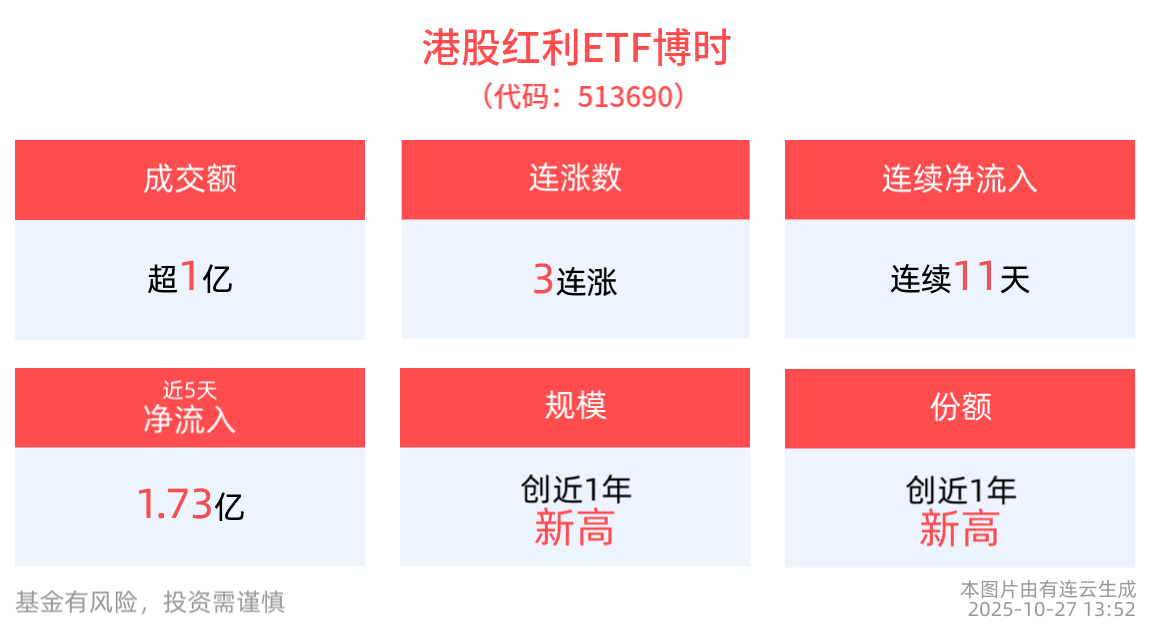
港股红利ETF博时(513690)冲击3连涨,连续11日获资金净流入,备受资金青睐
Sou Hu Cai Jing· 2025-10-27 06:06
Core Viewpoint - The Hang Seng High Dividend Yield Index has shown resilience, with a notable increase of 0.74% as of October 27, 2025, amidst a broader market decline, indicating a shift towards dividend-focused investments in a volatile environment [3][4]. Group 1: Market Performance - The Hang Seng High Dividend Yield Index increased by 0.74%, with notable gains from stocks such as China Hongqiao (+3.25%) and CITIC Limited (+3.10%) [3]. - The BoShi Hang Seng Dividend ETF rose by 0.72%, marking its third consecutive increase, with a recent price of 1.12 yuan [3]. - Over the week leading up to October 24, the BoShi Hang Seng Dividend ETF accumulated a total increase of 2.40% [3]. Group 2: Liquidity and Fund Flows - The BoShi Hang Seng Dividend ETF recorded a turnover rate of 1.78% and a trading volume of 105 million yuan [3]. - The ETF has seen a consistent inflow of funds over the past 11 days, with a peak single-day net inflow of 148 million yuan, totaling 336 million yuan in net inflows [4]. Group 3: Investment Strategy - Analysts suggest a "barbell strategy" for investors, combining defensive dividend assets with growth-oriented technology stocks to balance risk and return [4]. - The BoShi Hang Seng Dividend ETF has reached a new high in scale at 5.829 billion yuan and a new high in shares at 5.275 billion [4]. Group 4: Index Composition - As of October 8, 2025, the top ten weighted stocks in the Hang Seng High Dividend Yield Index accounted for 28.98% of the index, including companies like Orient Overseas International and China Shenhua [5].