
OPPO

Search documents
广东省终端快充行业协会赋能产业实现国际突破
Zhong Guo Jing Ji Wang· 2025-11-10 07:39
Core Points - The International Telecommunication Union's Telecommunication Standardization Sector (ITU-T) has officially released a global fast charging standard, with China's Unified Fast Charging Standard (UFCS) being the only case included as a best practice [1][5][6] - The UFCS protocol addresses the long-standing issue of incompatible fast charging protocols across different brands, promoting sustainability by reducing electronic waste from unused chargers [2][5] - The Guangdong Terminal Fast Charging Industry Association (FCA) has played a crucial role in the development and international recognition of the UFCS protocol, collaborating with major companies and national organizations [3][4] Group 1 - The UFCS protocol has been recognized in the ITU-T L.1004 international standard, marking a significant achievement for China's fast charging industry [1][3] - The standard aims to provide a unified charging solution that enhances compatibility across various devices, thereby reducing consumer costs and environmental impact [2][4] - As of October 31, 2025, 245 products have passed compliance certification, indicating a robust ecosystem involving 45 companies and a wide range of devices [4] Group 2 - The establishment of the UFCS standard reflects China's commitment to innovation and its active participation in global technology governance [5][6] - The standard is expected to guide global enterprises towards a more standardized and efficient charging industry, addressing the fragmentation of charging protocols [6] - The initiative aligns with ITU-T SG5's focus on environmental sustainability and circular economy, emphasizing the importance of integrating charging technology with green practices [5][6]
基础化工新材料周报:电解液龙头被签订近400亿订单,Q3全球半导体销售额增至2084亿美元-20251110
Huafu Securities· 2025-11-10 05:07
Investment Rating - The industry rating is "Outperform the Market" [5] Core Insights - The report highlights significant orders for electrolyte products, with Tianqi Materials signing contracts worth nearly 40 billion yuan for the supply of 87,000 tons to Guoxuan High-Tech and 72,500 tons to Zhongxin Innovation [3][28] - Global semiconductor sales reached 208.4 billion USD in Q3 2025, marking a 15.8% increase from the previous quarter, driven by rising demand for various semiconductor products [3][33] Market Overview - The Wind New Materials Index closed at 5201.04 points, up 1.11% week-on-week. Among sub-industries, the semiconductor materials index fell by 1.43%, while the organic silicon materials index rose by 10.04% [2][10] - The top five gainers this week included Dongyue Silicon Materials (22.5%), Sanxiang New Materials (20.65%), and Zhejiang Zhongcheng (18.52%) [24][25] Recent Industry Trends - The report notes a major adjustment in BASF's new materials business, consolidating its PolyTHF™ operations in China and ceasing production in South Korea by 2026 [28][29] - The global smartphone market saw shipments reach 320 million units in Q3 2025, with Samsung leading in market share at 19% [30]
打造百年建筑的焕新样本,OPPO华北首家旗舰店落地天津
Huan Qiu Wang· 2025-11-10 05:01
Core Insights - OPPO has opened its first flagship store in North China, located in a historical building in Tianjin, blending modern technology with cultural heritage [1][3][10] Group 1: Store Concept and Design - The flagship store is designed as a "city park for young people," integrating the historical essence of the building with modern artistic elements [1][3] - The store is situated in a culturally rich area, surrounded by significant historical architecture, enhancing its appeal [4] - OPPO collaborated with experts and used traditional materials and techniques to restore the building while preserving its historical features [7][9] Group 2: Cultural Integration and Target Audience - The store aims to merge "Tianjin culture" with modern gaming trends, creating a space that resonates with younger consumers [10][14] - It features interactive areas, including a coffee lounge and gaming zones, to foster social connections among young users [12][14] Group 3: Business Strategy and Growth - OPPO's strategy focuses on establishing flagship stores in key urban areas based on market potential and user density, rather than merely increasing the number of stores [15][16] - The company plans to open 50 new flagship stores in major cities over the next three years, alongside 1,000 additional mall stores annually [15]


科技大事件 丨 荣耀前 CEO 赵明回忆华为遭遇制裁;荷兰将归还安世控制权
Sou Hu Cai Jing· 2025-11-10 04:57
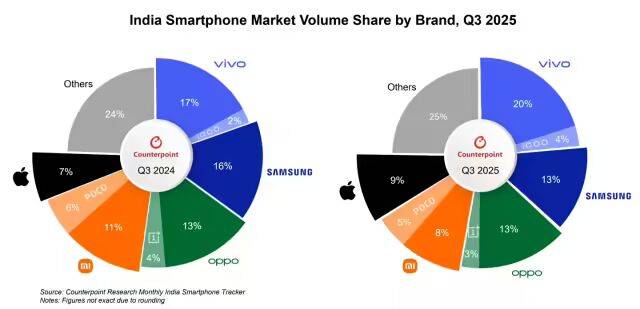
Group 1: Apple Market Performance - Apple entered the top five smartphone brands in India for the first time in Q3 2025, becoming the third-largest iPhone market globally [3][5] - The Indian smartphone market saw a 5% year-on-year increase in shipment volume and an 18% increase in shipment value, reaching a historical quarterly high [1][3] - The high-end smartphone segment (priced over 30,000 INR, approximately 339 USD) experienced a 29% year-on-year growth, driven by strong demand for flagship models from Apple and Samsung [3] Group 2: Cybersecurity Concerns - A new phishing scam targeting iPhone users has emerged, where scammers send fake notifications claiming lost devices have been found, aiming to steal personal account information [4][6] - The scam utilizes publicly available information from the "Find My" app, making the messages appear credible by including device details [4] Group 3: Product Developments - A redesigned MacBook Pro is expected to launch between late 2026 and early 2027, featuring an OLED touchscreen and M6 Pro/Max chips, marking the first major redesign since 2021 [5][6] - The new MacBook Pro will include significant upgrades such as a thinner design, potential 5G connectivity, and a larger "Dynamic Island" display cutout [5] Group 4: Semiconductor Supply Chain - The Dutch government is set to lift a control order on Nexperia, a semiconductor manufacturer, which will restore the supply of critical automotive chips [10][11] - This decision aims to ease trade tensions with China and stabilize the global semiconductor supply chain, following a previous halt in exports due to economic security concerns [11] Group 5: New Product Launches - Xiaomi launched a new 45W GaN charger priced at 54.9 CNY, which is compatible with Apple's fast charging and supports multiple fast charging protocols [12] - The charger is compact, utilizing gallium nitride technology, and is 47% smaller than conventional 45W chargers [12]

手机厂商入场,能治好AI潮玩的“人工智障”吗?
创业邦· 2025-11-10 03:38
Core Viewpoint - The article discusses the rapid growth and challenges of the AI toy industry, highlighting the duality of increasing sales and consumer dissatisfaction due to technological limitations and subscription models [5][10][36]. Group 1: Market Trends and Growth - The year 2025 is anticipated to be the "Year of AI Trendy Toys," with significant investments and product launches from various companies, including major tech firms and traditional toy manufacturers [5][10]. - AI toys are experiencing explosive growth, with sales on platforms like JD.com increasing sixfold month-on-month and over 200% year-on-year in the first half of 2025 [15]. - The market is seeing a diverse range of entrants, from startups to established companies like Baidu and ByteDance, all leveraging their technological and ecological advantages [10][15]. Group 2: Consumer Insights and Feedback - Consumers express mixed feelings about AI toys, with some praising their interactive capabilities while others criticize their performance, such as slow response times and lack of emotional engagement [13][28]. - The core audience for AI toys includes children and young adults aged 18-35, with a growing demand for emotional companionship rather than just play [20][24]. - A viral video highlighted the emotional impact of AI toys, showing how they can provide companionship to lonely individuals, particularly among the younger generation [22]. Group 3: Challenges and Limitations - Despite the hype, AI toys face significant challenges, including immature technology, poor user experience, and controversial subscription models that deter consumers [27][36]. - Common complaints include weak multi-turn dialogue capabilities, reliance on stable internet connections, and a lack of personalized responses, leading to a disconnect between expectations and reality [28][29]. - The subscription model for AI toys, which often requires ongoing payments for functionality, is viewed unfavorably by consumers accustomed to traditional one-time purchases [30][31]. Group 4: Industry Dynamics and Future Outlook - The entry of smartphone manufacturers into the AI toy market is seen as a potential game-changer, leveraging their advanced technology and extensive distribution networks to enhance product offerings [38][44]. - Collaboration between AI toy companies and established tech firms could lead to improved user experiences and more innovative products, addressing current limitations [45][46]. - The future success of AI toys may depend on their ability to integrate into broader smart ecosystems and provide meaningful emotional connections rather than just functional interactions [47].

华虹三季报创新高,半导体景气向上动能强劲
Ping An Securities· 2025-11-10 02:58
Investment Rating - The industry investment rating is "Outperform the Market" [1][38] Core Views - Huahong Semiconductor reported impressive results for Q3 2025, achieving record highs in multiple key operational metrics [3] - The semiconductor industry is entering a high prosperity cycle driven by AI demand and domestic substitution [6] - The global semiconductor market is showing strong recovery, with Q3 2025 global sales reaching $208.4 billion, a 15.8% increase quarter-on-quarter and a 25.1% increase year-on-year [6] Summary by Sections Company Performance - Huahong Semiconductor achieved sales revenue of $635.2 million in Q3 2025, marking a historical high with a year-on-year growth of 20.7% and a quarter-on-quarter growth of 12.2% [4] - The gross margin for Q3 improved to 13.5%, exceeding company guidance, with a year-on-year increase of 1.3 percentage points and a quarter-on-quarter increase of 2.6 percentage points [4] - The overall capacity utilization rate reached 109.5% by the end of Q3, up 1.2 percentage points from the previous quarter, indicating full operational capacity [4] Market Trends - The embedded non-volatile memory revenue grew by 20.4% year-on-year, driven by increased demand for MCU products, while standalone non-volatile memory saw a remarkable revenue surge of 106.6% year-on-year [4] - Consumer electronics remained the largest market for Huahong Semiconductor, contributing $407.5 million in sales, accounting for 64.1% of total revenue, with a year-on-year growth of 23.2% [4] - The semiconductor industry is experiencing a significant increase in advanced process demand, with expectations for global advanced process capacity to grow at a CAGR of 14% [6] Investment Recommendations - It is recommended to focus on key companies in the semiconductor manufacturing sector, such as SMIC and Huahong Semiconductor, as well as the storage industry chain [6]
荣耀归位 李健阶段性答卷过关
Bei Jing Shang Bao· 2025-11-09 16:17
Core Insights - In Q3 2025, Honor regained its position in the smartphone market with a shipment of 9.9 million units and a market share of 14.4%, ranking fifth alongside OPPO, marking its return to the top five for the first time in recent quarters [1][2] - The recovery was driven by strong performance in the mid-range segment, particularly the Honor X70 series, which features a large battery and high cost-performance ratio, solidifying its sales base [2][3] - Despite the improved ranking, overall sales for Honor still declined year-on-year, indicating that the market recovery is more about relative stability than active growth [3][5] Market Environment - The Chinese smartphone market continued to face challenges in Q3 2025, with total shipments around 68.46 million units, a slight year-on-year decline of 0.5%, while other reports indicated larger declines of 3% and 2.7% [2] - The competitive landscape among leading manufacturers is intensifying, with most brands experiencing a decline in shipment volumes, except for a few like Apple that managed to grow [2][5] - The market is characterized by a focus on maintaining existing market share rather than expanding, as companies struggle with the challenges of natural replacement cycles [2][3] Strategic Initiatives - Honor's CEO, Li Jian, has implemented product and channel adjustments, focusing on solidifying the mid-range market while pursuing an "Alpha Strategy" aimed at transforming the company into a leading AI terminal ecosystem [1][3] - The company has also restructured its organization to promote open collaboration and break down system barriers, establishing new departments to support its strategic goals [1][3] Competitive Challenges - The upcoming Q4 is expected to be a critical period for the smartphone industry, with intense competition as major brands release flagship products, putting pressure on Honor to maintain its market share [5][6] - The industry is facing rising costs for key components like storage, which has led to price increases for new products across various brands, complicating pricing strategies and profit margins [6][7] - Honor's reliance on the mid-range market for recovery poses a challenge as it seeks to compete in the high-end segment, where brand strength and pricing power are crucial [6][7]
荣耀归位,李健暂时松了一口气
Bei Jing Shang Bao· 2025-11-09 13:28
Core Insights - Honor's market share has shown signs of recovery, with a 14.4% market share in Q3 2025, ranking fifth alongside OPPO, after a decline in 2024 [1][4] - The recovery is attributed to strong performance in the mid-range segment, particularly the Honor X70 series, which has bolstered sales [4][5] - Despite the improved ranking, overall sales still declined year-on-year, indicating that the increase in market share is more about relative stability in a declining market rather than active growth [5][6] Group 1: Market Position and Performance - In Q4 2024, Honor's market share was 14.9%, down 8.1% year-on-year, reflecting significant pressure on the brand [1] - The overall smartphone market in China saw a slight decline of 0.5% in Q3 2025, with major brands like Apple experiencing growth while most others faced declines [4][5] - The competitive landscape is tightening, with brands focusing on maintaining their positions amid a challenging market environment [4][11] Group 2: Strategic Initiatives - Honor's CEO Li Jian has implemented product and channel adjustments, including the "Alpha Strategy" aimed at transitioning to a leading AI terminal ecosystem [1][6] - The company has established new departments to foster open collaboration and break down system barriers, aiming to build an intelligent platform [1][7] - The anticipated impact of the AI transformation strategy has yet to materialize in terms of sales growth, with the upcoming flagship Magic 8 series needing time to prove its market value [6][8] Group 3: Competitive Challenges - The upcoming Q4 2025 is expected to intensify competition as major brands launch flagship products, making it a critical period for Honor [10][11] - The pressure from rising storage costs and supply chain challenges is affecting pricing strategies across the industry, with Honor needing to balance cost management with maintaining competitiveness in both mid-range and high-end markets [13][14] - The need for differentiation through technology and ecosystem integration is crucial for Honor's long-term success in a saturated market [7][14]

拉餐饮外卖入局 “双11”从“囤货”转向“即享”
Bei Jing Shang Bao· 2025-11-09 12:58
Core Insights - This year's "Double 11" has shifted from traditional e-commerce competition to a focus on instant retail, with players like Taobao, Meituan, and JD engaging in rapid delivery battles [1][12] - The participation of food delivery services in "Double 11" marks a significant change, transforming the event into a "life festival" rather than just a shopping spree [1][5] Group 1: Participation of Food Delivery Services - Food delivery brands, previously sidelined, have now taken center stage in "Double 11," with Taobao Flash Sale launching a "hot stores" channel and offering significant discounts [5] - As of November 5, Taobao Flash Sale reported over 1 billion orders during "Double 11," with 19,958 restaurant brands seeing sales growth exceeding 100% compared to pre-event levels [5] - JD's food delivery service also joined the "Double 11" festivities, with a reported 13-fold increase in daily orders for its top 300 restaurant brands since the launch of the service [7] Group 2: Instant Retail Competition - The competition has evolved to focus on "minute-level" delivery, with brands like Meituan reporting over 100% sales growth for nearly 800 brands during the first day of the event [11] - Meituan has integrated nearly one million offline stores into its instant delivery network, significantly boosting sales for various product categories, including electronics and beverages [11] - Taobao Flash Sale's entry into "Double 11" represents a strategic move to enhance its presence in instant retail, with 37,000 brands and 400,000 stores participating [12] Group 3: Market Strategy and Adaptation - The shift towards instant retail indicates a need for platforms to adapt their strategies, focusing on increasing customer spending domestically and expanding user bases internationally [13] - Companies are leveraging offline resources and partnerships to enhance their service offerings, with Meituan and JD employing strategies like exclusive product deals and inventory management [13] - The reconfiguration of the instant retail market necessitates upgrades in supply chain, warehousing, and delivery systems to meet the demand for rapid delivery [13]

AI周观察:AMD绩后表现反映市场高预期,Kimi K2 Thinking发布
SINOLINK SECURITIES· 2025-11-09 12:26
Investment Rating - The report does not explicitly state an investment rating for the industry Core Insights - The report highlights significant growth in the AI sector, particularly driven by AMD's strong performance and Astera Labs' rapid revenue increase, indicating a robust market for AI infrastructure and solutions [11][23] - The smartphone market in China shows a slight increase in sales, with Apple leading the market share, suggesting a stable demand for consumer electronics [30] - The report emphasizes the importance of AI workload deployment in data centers as a new catalyst for growth in the computing sector [21] Summary by Sections Overseas Market Review - The report notes the performance of AI-related stocks, with significant fluctuations in their prices, indicating a volatile market environment [6] AMD Performance - AMD reported a revenue of $9.2 billion for Q3 FY25, a 36% year-on-year increase, with a non-GAAP EPS of $1.20, exceeding market expectations [11][21] - The data center segment generated $4.3 billion, growing 22% year-on-year, driven by the adoption of the EPYC "Turin" processors and increasing AI workload deployments [17][21] - AMD's collaboration with OpenAI for GPU deployment has the potential to generate over $100 billion in revenue, showcasing its strategic positioning in the AI market [21][22] Astera Labs Performance - Astera Labs achieved a revenue of $230.6 million in FY25Q3, doubling year-on-year, with a gross margin of 76.4% and an operating margin of 41.7% [23][28] - The company is focusing on AI infrastructure interconnects, with its Scorpio X series expected to ramp up production in 2026, positioning it as a key player in the AI data center market [28][29] Consumer Electronics Dynamics - In September 2025, China's smartphone sales reached approximately 26 million units, a 2.48% increase year-on-year, with Apple holding the largest market share at 21.12% [30][36] - The PC market showed mixed results, with desktop sales increasing by 2.35% while laptop sales declined by approximately 10.83% [37]