华鲁恒升

Search documents
美油供应三重收紧;资金连续10日加仓,化工行业ETF易方达(516570)受市场关注
Sou Hu Cai Jing· 2026-02-03 04:27
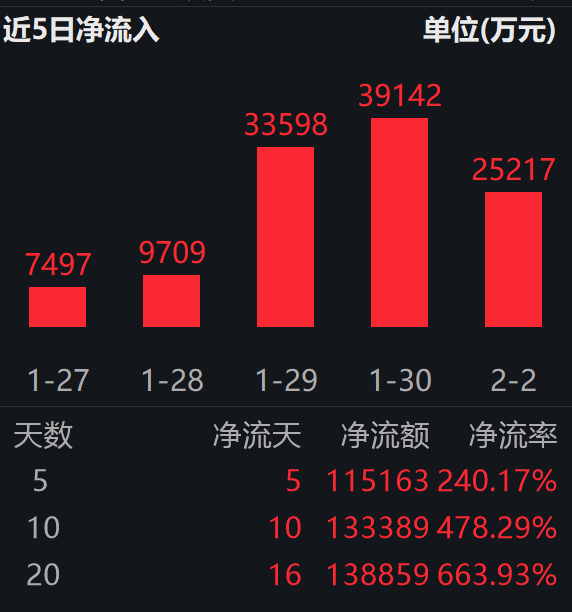
Group 1 - The China Petroleum and Chemical Industry Index (H11057) increased by 0.65%, with major stocks like Wanhua Chemical, Salt Lake Potash, Cangge Mining, Hualu Hengsheng, and Yuntianhua rising over 1% [1] - As of February 2, the index has risen by 41.19% over the past year [1] - The E Fund Chemical Industry ETF (516570), which tracks the index, has seen a net inflow of over 1.3 billion in the last 10 days, with its latest fund size reaching 1.537 billion [1] Group 2 - U.S. crude oil inventories fell to 24.785 million barrels, a decrease of 1.11%, nearing warning levels [1] - U.S. crude oil production decreased by 36,000 barrels per day to 13.696 million barrels per day [1] - A winter storm in the U.S. has caused short-term production cuts of up to 2 million barrels per day, affecting refinery operations and tightening supply [1] Group 3 - A report from Bank of America Securities on January 29 indicated that commodities are showing moderate support, led by oil [1] - Historically, Brent crude oil tends to trend upward in February, with strong performance typically occurring in the last third of the month [1] Group 4 - The E Fund Chemical Industry ETF (516570) covers major oil companies, providing a low-cost investment opportunity in the traditional energy sector with a total management and custody fee of only 0.2% per year [2]
石油煤炭加工1月价格指数迎改善;化工行业ETF易方达(516570)连续10日“吸金”合超13亿
Sou Hu Cai Jing· 2026-02-03 02:48
相关产品: 化工行业ETF易方达(516570)一键打包石化产业龙头,管理费率+托管费率合计仅0.2%/年,助力投资 者低成本布局传统能源产业机会。 易方达中证石化产业ETF联接A(020104.OF) 易方达中证石化产业ETF联接C(020105.OF) 【免责声明】本文仅代表作者本人观点,与和讯网无关。和讯网站对文中陈述、观点判断保持中立,不 对所包含内容的准确性、可靠性或完整性提供任何明示或暗示的保证。请读者仅作参考,并请自行承担 全部责任。邮箱:news_center@staff.hexun.com 截至10:12,中证石化产业指数(H11057)涨1.63%,权重股中,万华化学、盐湖股份、藏格矿业、华 鲁恒升、云天化涨超2%。截至2月2日,该指数近一年上涨41.19%。 化工行业ETF易方达(516570)跟踪中证石化产业指数,备受资金青睐。数据显示,该基金连续10日获 资金净流入,合计超13亿;最新基金规模攀升至15.37亿元。 消息面上,国家统计局数据显示,1月份石油煤炭及其他燃料加工业的生产指数和新订单指数均低于临 界点,相关行业市场需求放缓,企业生产有所回落。同时,主要原材料购进价格指数和出 ...



大化工上涨好于景气-主要原因及后市展望如何
2026-02-03 02:05
Summary of Conference Call Records Industry Overview: Chemical Industry Key Points - The chemical sector has seen a significant increase of approximately 60% since July 1, 2025, outperforming the CSI 300 and the CSI All Share Index by over 35% [5][6] - Despite the rise in stock prices, product prices have not shown a significant increase, raising concerns about the divergence between market performance and economic fundamentals [5][6] - The chemical industry has a beta value of 1.25, indicating high elasticity and potential for significant returns during economic upturns [5][6] - The macroeconomic outlook is optimistic, with expectations of gradual improvement in demand and supply-side changes due to global supply chain constraints and domestic capital expenditure reductions [6][7] Future Outlook - Oil prices are expected to reach $70-80 during peak seasons and $65-70 during off-peak seasons in 2026 and 2027, with a generally optimistic view on future oil prices [4][6] - The chemical industry is anticipated to benefit from long-term supply-demand improvements, driven by supply-side constraints and the dual carbon policy [6][7] - Investment recommendations include cyclical alpha leaders such as Wanhua and Hualu, as well as bottom-tier stocks in the silicon chemical sector [2][7] Subsector Insights Petrochemical Sector - Recent performance has been strong, particularly in oil prices influenced by geopolitical events [3][4] - Specific sub-industries such as polyester, urea, PVC, and rubber have shown price increases, with polyester prices reaching around 7,000 CNY [3][8] Fuel Industry - Currently in a bottoming phase, with significant market share held by leading companies in disperse and reactive dyes [9] - Fuel prices have fluctuated but are showing signs of recovery due to rising raw material costs [9] Urea Market - Urea prices have recently increased due to winter storage and upcoming spring farming demand [12] - The market is expected to remain volatile, influenced by domestic production levels and export policies [12] PVC Market - PVC prices have risen due to oil price increases and futures market influences, with potential long-term benefits from dual carbon policies [13] Soda Ash Market - Prices are stable, with a slight profit increase due to reduced coal costs, but many companies are currently facing losses [14] Tire Market - Raw material costs for tires, including rubber and carbon black, have increased, impacting profit margins [15] Additional Insights - The chemical industry is expected to undergo a transformation towards high-quality development, driven by supply-side optimization and industry upgrades [6][7] - The dual carbon policy is likely to extend the upward cycle in the chemical sector, with a focus on sustainable practices [7]
未知机构:化工核心中游白马资产逻辑不变风偏阶段性下降或给予绝佳配置机会为-20260203
未知机构· 2026-02-03 01:45
Summary of Conference Call Notes Industry Overview: Chemical Sector - The chemical industry is characterized by global and diversified long-term demand growth [1] - Supply factors include a turning point in domestic capital expenditure, exit of overseas production capacity, anti-involution support, and long-term valuation enhancement due to dual carbon goals [1] - Domestic leading companies are positioned to meet global demand, with a focus on industries with favorable supply and demand dynamics, making price increases inevitable [1] Key Price Increases - Recent price increases have been observed in various chemical products, including TDI, adipic acid, oxalic acid, octanol, spandex, glyphosate, ortho-nitrochlorobenzene, nylon-6 caprolactam, VB3, methionine, and dyes, providing a solid foundation for post-holiday market conditions [1] Investment Recommendations - Recommended investments include leading companies in spandex, polyester, and organic silicon sectors [1] - Leading companies have significantly expanded production capacity over the past few years, with detailed calculations provided [1] - If prices and price spreads return to historical averages, profitability is expected to increase substantially, supported by detailed calculations [1] - Specific companies highlighted for investment include Wanhua, Hualu, Jushi, Baofeng, and Weixing for leading firms; Huafeng and Xinxiang for spandex; Tongkun and Xinfoning for polyester; and Xingfa, Luxi, and Xin'an for organic silicon [1] Market Outlook - The post-Spring Festival demand release is anticipated to further drive price increases, presenting an excellent investment opportunity [2]
煤化工策略月报-20260202
Guang Da Qi Huo· 2026-02-02 11:26
1. Report Industry Investment Rating No relevant content provided. 2. Core Viewpoints of the Report Urea - In January, urea supply increased steadily, demand was strong due to pre - holiday stocking, and prices rose. In February, supply is expected to further increase, and demand will first decline and then recover after the Spring Festival. From March to May, urea prices are usually demand - driven, with strong support, but price increases may trigger price - stabilizing mechanisms [5][6][8]. Soda Ash - In January, soda ash supply increased, demand was weakly stable, and enterprise inventory slightly accumulated. In February, supply will continue to increase, and demand will shrink. The supply - demand situation will be looser, and inventory pressure will increase. However, external factors may have a positive impact on futures prices [11][12][13]. Glass - In January, glass supply decreased slightly, and demand was supported. In February, supply is expected to decline slightly, but demand will decline seasonally more than supply, and inventory pressure will remain high. In the long - term, the supply - demand contradiction is still not effectively resolved, but external factors may lead to short - term fluctuations [15]. 3. Summaries According to the Table of Contents 3.1 Futures Market and Raw Material Situation in the Industry Chain 3.1.1 Futures Prices - Urea: In January, the futures price of urea fluctuated strongly at a high level. As of January 30, the main 05 contract was reported at 1,790 yuan/ton, with a monthly increase of 2.7% [5]. - Soda Ash: In January, the futures price of soda ash fluctuated within a range. As of January 30, the main 05 contract was reported at 1,204 yuan/ton, with a monthly decrease of 0.41% [11]. - Glass: In January, the futures price of glass fluctuated widely. As of January 30, the main 05 contract was reported at 1,056 yuan/ton, with a monthly decrease of 2.94% [15]. 3.1.2 Futures - related Varieties - Various futures - related varieties such as glass - soda ash, urea - methanol, etc. are presented in the form of price difference trend charts [23]. 3.1.3 Raw Material Prices - Coal: The prices of different types of coal showed different changes in January [26]. - LNG: The ex - factory prices of LNG in various regions increased in January [30]. - Raw Salt: The prices of raw salt in some regions decreased slightly in January [33]. - Synthetic Ammonia: The price of synthetic ammonia in Shandong decreased by 4.45% in January [34]. 3.2 Urea: Demand Varies Before and After the Spring Festival, and There are Many Factors Restricting the Price Increase 3.2.1 Spot Price - In January, the spot price of urea increased. As of January 29, the prices in Shandong and Henan were 1,780 yuan/ton and 1,770 yuan/ton respectively, up 70 yuan/ton and 80 yuan/ton from the end of December [38]. 3.2.2 Basis - The basis of urea in different regions showed different changes in January [41]. 3.2.3 Industry Operating Rate - The overall operating rate of the urea industry increased in January. The weekly capacity utilization rate of urea in January 30 was 88.28%, up 7.98% month - on - month [46]. 3.2.4 Weekly and Daily Output - The daily output of urea increased in January. As of January 28, the daily output was 21.11 tons, up 8.75% month - on - month [53]. 3.2.5 Enterprise Inventory and Port Inventory - In January, the enterprise inventory of urea decreased by 7.29% month - on - month, and the port inventory decreased by 16.28% month - on - month [55]. 3.2.6 Profit and Cost - The production costs of different urea production processes changed in January, and the production profits also changed accordingly [59]. 3.2.7 Apparent Consumption and Production - Sales Ratio - The weekly apparent consumption of urea in January increased by 2.28% month - on - month, and the production - sales ratio decreased by 4.64% month - on - month [62]. 3.2.8 Downstream Demand - The operating rate and output of downstream industries such as melamine, compound fertilizer, etc. showed different changes in January [65][72]. 3.2.9 Monthly Import and Export Quantities - In December 2025, the import volume of urea decreased by 82.11% month - on - month, and the export volume decreased by 53.75% month - on - month [84]. 3.2.10 International Market - India's latest tender only purchased 970,000 tons of urea, far less than the planned 1.5 million tons, increasing the expectation of another tender. International urea prices rose significantly in January [7]. 3.2.11 Related Products - The prices of related products such as phosphate fertilizer, potash fertilizer, and small nitrogen fertilizers showed different changes in January [89][92]. 3.2.12 Urea Option Volatility - The historical volatility and volatility cone of urea options are presented in the report [95]. 3.3 Soda Ash: Fundamental Pressure Remains, and External Factors May Provide Support 3.3.1 Spot Price - In January, the domestic soda ash market price was weak. The prices of light and heavy soda ash in some regions decreased [102]. 3.3.2 Basis - The basis of soda ash in the Shahe area increased in January [107]. 3.3.3 Industry Operating Rate - The overall operating rate of the soda ash industry decreased slightly in January. The industry - wide operating rate on January 30 was 84.19%, down 2.23% month - on - month [112]. 3.3.4 Production - The weekly production of soda ash increased in January. The weekly production on January 30 was 783,100 tons, up 12.34% month - on - month [122]. 3.3.5 Enterprise Inventory - In January, the enterprise inventory of soda ash increased by 2.37% month - on - month [126]. 3.3.6 Monthly Import and Export Quantities - In December 2025, the import volume of soda ash increased by 1278.00% month - on - month, and the export volume increased by 22.92% month - on - month [132]. 3.3.7 Cost - The production costs of ammonia - soda and combined - soda processes decreased slightly in January [134]. 3.3.8 Profit - The production profits of ammonia - soda and combined - soda processes increased slightly in January [138]. 3.3.9 Apparent Consumption and Production - Sales Ratio - The weekly apparent consumption of soda ash increased by 4.51% month - on - month, and the production - sales ratio decreased by 7.27% month - on - month [142]. 3.3.10 Heavy Soda Ash Demand - The daily melting volume of float glass and photovoltaic glass decreased in January [144]. 3.3.11 Light Soda Ash Downstream - The operating rates of downstream industries such as the printing and dyeing industry decreased in January [149]. 3.3.12 Soda Ash Option Volatility - The historical volatility and volatility cone of soda ash options are presented in the report [154]. 3.4 Glass: Supply and Demand of Glass Decline in February, and the Market Game Continues 3.4.1 Spot Price - In January, the domestic glass spot price increased slightly. As of January 30, the average market price of float glass was 1,107 yuan/ton, up 34 yuan/ton from the end of December [15]. 3.4.2 Operating Rate and Production - The operating rate and weekly production of float glass decreased in January. The operating rate on January 30 was 71.86%, down 1.17% month - on - month [162]. 3.4.3 Daily Melting Volume - The daily melting volume of float glass decreased in January. As of January 30, it was 151,000 tons, down 0.11% month - on - month [166]. 3.4.4 Enterprise Inventory - In January, the enterprise inventory of glass decreased by 7.57% month - on - month [169]. 3.4.5 Cost and Profit - The production costs of different glass production processes changed slightly in January, and the production profits also changed accordingly [174]. 3.4.6 Apparent Consumption - The weekly apparent consumption of float glass decreased by 8.61% in January [178]. 3.4.7 Deep - processing - The operating rate of Low - E glass decreased by 2.90% in January, and the monthly output of deep - processed glass products showed different changes [180][183]. 3.4.8 Terminal Demand - Real estate - related data such as the cumulative year - on - year growth rate of commercial housing sales area showed different trends. The production and sales of the automobile industry and the production of household appliances also showed different changes [187][190][192]. 3.4.9 Monthly Import and Export Quantities - In December 2025, the export volume of float glass increased by 2.59% month - on - month, and the import volume decreased by 5.95% month - on - month [195]. 3.4.10 Glass Option Volatility - The historical volatility and volatility cone of glass options are presented in the report [198].
四个方面发力,德州海关2025年助力企业进出口扩能升级
Qi Lu Wan Bao· 2026-02-02 10:34
齐鲁晚报.齐鲁壹点李梦晴 2月2日,德州市召开"2025回望记"系列主题新闻发布会第九场,介绍德州市2025年度外贸发展成效,并回答记者提问。 在优化营商环境、支持企业扩大进出口方面,2025年,德州海关将监管职责与服务效能深度融合,实施了一系列具体工作,主要从以下四个方面着力: 第一,深化政策服务,提升企业获得感。变"企业找政策"为"政策送上门",赴8个县市区开展"关企直通车"—惠企"四季行动"政策宣讲,惠及企业510余 家,现场解决问题30余项。落实税收优惠政策,为10家单位减免税款1740.3万元。开展AEO企业赋能活动,新增AEO企业4家,总数达到11家。指导华鲁 恒升(600426)等2家企业参与危化品"批次检验"改革,批次检验出口1270批,检验时长压缩98%。推动药食同源商品进口通关便利化改革落地生效,关 区首票食药物质分类管理货物在我关顺利通关。 第二,强化科技应用,提升通关便利度。全国首推"自报享惠"等减免税快审模式,快审率80%,居济南关区首位。推广检验检疫证单"云签发"模式,自助 打印比例52%,居关区前三。作为关区首批试点,参与"智赋核查"远程核查模式改革工作。联合建设银行启动"关银一 ...

ETF盘中资讯|化工板块重挫,三股跌停!化工ETF(516020)跌近6%,后市如何看?
Sou Hu Cai Jing· 2026-02-02 05:51
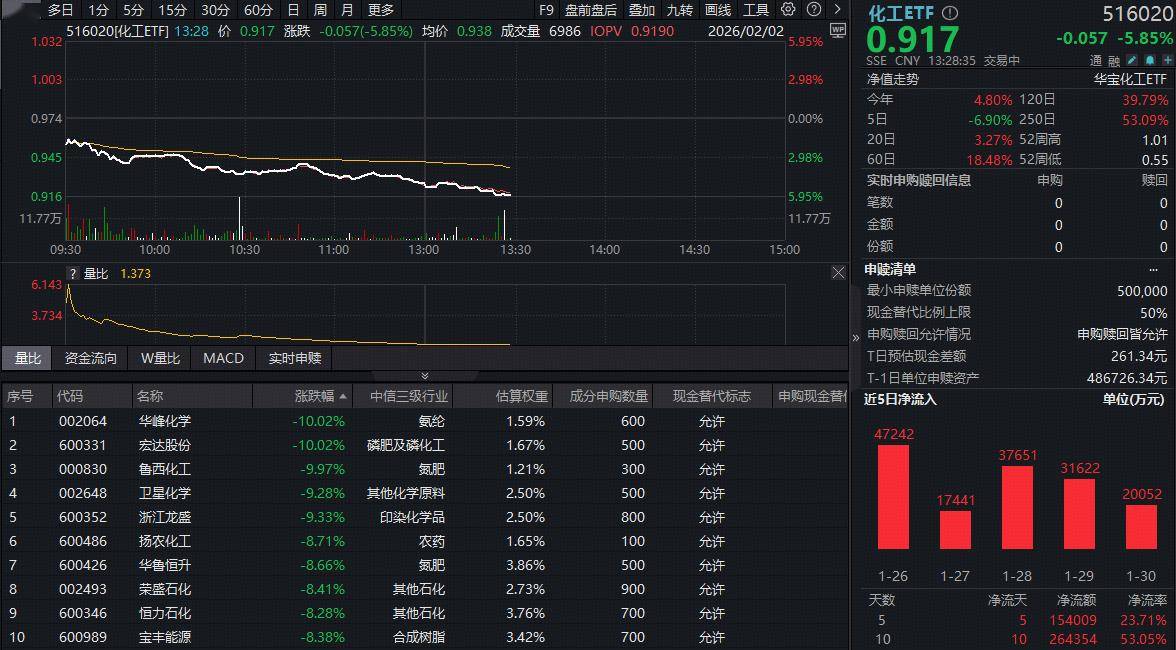
化工板块今日(2月2日)深度回调,反映化工板块整体走势的化工ETF(516020)开盘后单边下行,截至发稿,场内价格跌5.85%。 如何把握化工板块反弹机遇?借道化工ETF(516020)布局效率或更高。公开资料显示,化工ETF(516020)跟踪中证细分化工产业主题指数,成份股覆盖 AI算力、反内卷、机器人、新能源等热门主题。场外投资者亦可通过化工ETF联接基金(A类012537/C类012538)布局化工板块。 来源:沪深交易所等,截至2026.2.2。 机构观点来源:(1)方正证券2026年1月25日基础化工行业事件点评报告《十五五碳排放双控加速化工业绿色转型,看好能效领跑龙头及生物制造》; (2)中国银河证券2026年1月25日基础化工行业周报《化工品价格表现偏强,关注周期弹性机会》 注:投资者在申购或赎回基金份额时,申购赎回代理券商可按照不超过0.5%的标准收取佣金,其中包含证券交易所、登记机构等收取的相关费用。化工ETF 不收取销售服务费。 成份股方面,氨纶、磷化工、氮肥等板块部分个股跌幅居前。截至发稿,华峰化学、宏达股份、鲁西化工三股跌停,卫星化学、浙江龙盛跌超9%,扬农化 工、华鲁恒升、荣盛石 ...
化工板块重挫,三股跌停!化工ETF(516020)跌近6%,后市如何看?
Xin Lang Cai Jing· 2026-02-02 05:42
Core Viewpoint - The chemical sector experienced a significant pullback on February 2, with the chemical ETF (516020) declining by 5.85% during trading, reflecting a broader downturn in the industry [1][7]. Market Performance - The chemical ETF (516020) opened lower and saw a decline of 5.85%, with a trading price of 0.917 as of the latest update [2][7]. - Key stocks in the sector, including Huafeng Chemical, Hongda Co., and Luxi Chemical, hit the daily limit down, while others like Satellite Chemical and Zhejiang Longsheng fell over 9% [1][7]. Supply Chain and External Factors - A cold wave in the U.S. Gulf Coast has led to the shutdown of several chemical plants, affecting over 30% of the chemical production capacity in Texas, which accounts for about one-third of the U.S. chemical output [3][10]. - The cold weather has increased natural gas prices, raising the costs of ethylene and polyethylene, while supply constraints are expected to strengthen the pricing outlook for chemical products [10]. Future Outlook - Analysts predict that the chemical industry will face low demand in 2025, but measures to counteract "involution" may help restore profitability by 2026, alongside growth in new materials driven by rapid downstream demand [10]. - The current low valuation of the industry presents potential opportunities for investors, particularly through the chemical ETF (516020), which tracks a specialized index covering various themes including AI and new energy [10]. Investment Strategy - Investors are encouraged to consider the chemical ETF (516020) for efficient exposure to the sector, as it tracks the CSI segmented chemical industry index and includes stocks related to trending themes [10].


化工ETF(159870)受国家原油价格下跌影响有回调,机构称当前时点回调仍是布局的好时机
Xin Lang Cai Jing· 2026-02-02 03:41
Group 1 - The chemical sector is experiencing capital inflow, with the chemical ETF (159870) seeing a net subscription of 80 million units during trading [1] - Short-term price adjustments for PX/PTA are influenced by declining national crude oil prices, but the overall upward price trend remains intact, making this a good time for investment [1] - The global refining industry is facing long-term losses, particularly in Europe due to high costs and aging facilities, leading to capacity reductions, while new capacity is mainly concentrated in the Asia-Pacific region [1] Group 2 - As of February 2, 2026, the CSI sub-industry chemical theme index (000813) shows mixed performance among its constituent stocks, with Tianqi Lithium leading at a 0.52% increase, while Luxi Chemical is among the laggards [1] - The latest price for the chemical ETF (159870) is 0.88 yuan, closely tracking the CSI sub-industry chemical theme index [1] - The top ten weighted stocks in the CSI sub-industry chemical theme index (000813) as of January 30, 2026, include Wanhua Chemical and Yilong Co., with these stocks collectively accounting for 44.82% of the index [2]
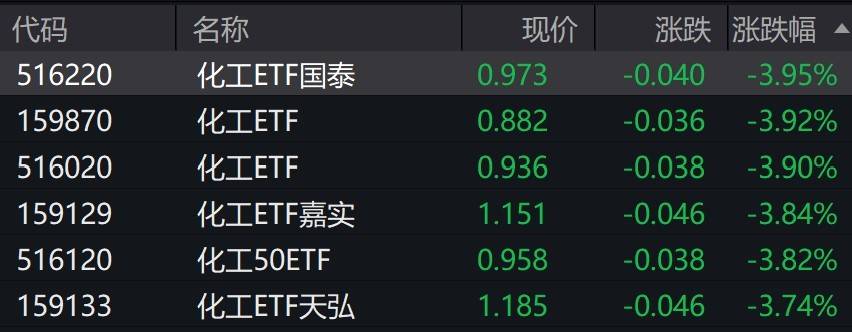
化工概念股走低,相关ETF跌近4%
Sou Hu Cai Jing· 2026-02-02 02:55
Group 1 - Chemical concept stocks declined, with Wanhua Chemical, Hengli Petrochemical, and Baofeng Energy dropping over 6%, while Hualu Hengsheng fell over 5% and Yuntianhua decreased over 4% [1] - Affected by the market, chemical-related ETFs fell nearly 4% [1] Group 2 - Various chemical ETFs reported declines, with the Guotai Chemical ETF at 0.973 (-3.95%), the Chemical ETF at 0.882 (-3.92%), and the Chemical 50 ETF at 0.958 (-3.82%) [2] - Analysts indicate that the chemical industry, being a typical cyclical sector, usually follows a five-year cycle consisting of "profit upturn - capacity expansion - profit bottoming - capacity clearance/demand expectation improvement" [2] - Current industry conditions are at the cycle bottom, with expectations for supply-demand dynamics to improve and accelerate the recovery of industry prosperity [2]