博通

Search documents
美股中资光伏股大涨
第一财经· 2026-01-23 14:51
Group 1 - The US stock market opened mixed on January 23, with the Nasdaq slightly up while the Dow Jones and S&P 500 indices were down [1] - As of the report, the Dow Jones fell by 0.5% to 49,137.34, the Nasdaq decreased by 0.12% to 23,407.04, and the S&P 500 dropped by 0.17% to 6,901.67 [2] - The semiconductor sector weakened significantly, with Intel plummeting nearly 15%, and other companies like SanDisk and Western Digital falling over 4% [2] Group 2 - The Wind US-listed Chinese photovoltaic index surged over 7%, with JinkoSolar rising nearly 9% and Daqo New Energy and Canadian Solar both increasing over 6% [3] - Among the tech giants, Nvidia rose over 2%, while Tesla and Apple experienced declines [3][4] - Specific stock performances included Nvidia at 189.08 (+2.29%), Amazon at 236.04 (+0.73%), and Microsoft at 453.525 (+0.53%), while Tesla was at 447.49 (-0.42%) and Apple at 246.06 (-0.92%) [4]

深夜,全线大涨!重磅数据发布
证券时报· 2026-01-22 15:24
Economic Data Release - On January 22, the U.S. Department of Commerce and the Bureau of Labor Statistics released multiple macroeconomic data, leading to a collective high opening of the U.S. stock market [1][5]. Price Indicators - The core PCE index for Q3 2025 showed an annualized final value increase of 2.9%, matching expectations, while the PCE price index increased by 2.8%, below the expected 3.5% [3]. - The core CPI for November 2025 rose by 2.6%, down from 3% in September, indicating a potential decrease in PCE data for the same month [3]. Employment Data - Initial jobless claims for the previous week were reported at 200,000, below the expected 210,000, with the four-week average revised to 201,500 [4]. - Continuing claims were at 1.849 million, also below expectations of 1.9 million [4]. GDP Growth - The annualized real GDP growth rate for Q3 2025 was reported at 4.4%, slightly above the expected 4.3% [4]. - The total annualized real GDP for Q3 2025 was finalized at $240.268 billion, slightly revised from the initial estimate [4]. Stock Market Performance - The U.S. stock market saw a rebound, with major indices rising over 1% on January 21 due to easing geopolitical tensions following President Trump's decision to abandon tariff increases on eight European countries [6][7]. - As of January 22, the Dow Jones increased by 0.93%, the S&P 500 by 0.75%, and the Nasdaq by 0.96% [7][8]. Sector Performance - Major technology stocks experienced gains, with Meta rising over 3% and other tech giants like Google and Nvidia increasing by over 1% [8][9]. - Bank stocks also saw significant increases, with Deutsche Bank rising nearly 3% and other major banks gaining over 1% [9]. Market Sentiment - The easing of geopolitical concerns has led to a reversal of recent sell-offs, particularly benefiting traditional value sectors such as financials and energy [9].

英特尔、AMD产能被曝售罄,CPU也要大涨价?
Guan Cha Zhe Wang· 2026-01-22 09:44
Core Viewpoint - Intel has regained investor interest on Wall Street, with its stock price rising significantly due to strong demand for server CPUs driven by data center needs [1][3]. Group 1: Stock Performance - Intel's stock opened at $54.25, closing up 11.72%, marking a 148% increase from its low of under $20 in the past year [1]. - AMD also saw an 8% increase in its stock price during the same period [1]. Group 2: Market Demand and Pricing - KeyBanc's report indicates that demand from large cloud service providers has led to Intel and AMD's server CPU capacity being nearly sold out for 2026 [1]. - Both companies are considering raising their server CPU average prices by 10% to 15% due to this demand [1]. Group 3: Analyst Sentiment - Over the past two months, at least 10 brokerages have raised Intel's target price or rating, reflecting a generally optimistic outlook [3]. - Analyst Ryuta Makino noted that the current sentiment towards Intel is the most positive in a long time, with expectations of at least double-digit price increases for server CPUs by 2026 [3]. Group 4: Business Segments - Despite the positive outlook for server CPUs, demand for Intel's PC CPUs is weakening, with UBS analysts predicting a 4% decline in global PC shipments by 2026 due to rising storage prices [3]. - Intel's data center and AI-related sales for Q4 were estimated at $4.433 billion, a 30% year-over-year increase, while overall sales are expected to decline by 6% to $13.4 billion [4]. Group 5: Manufacturing and Partnerships - Intel's foundry business has received positive news, including a long-term order from the U.S. Missile Defense Agency, likely involving mature process and packaging technologies [5]. - There are rumors that Apple is considering using Intel's 18A process for its future SoCs, with plans for low-end M-series chip production potentially starting in Q2 to Q3 of 2027 [5].
苹果Siri AI升级落地!国泰君安:算力+AI应用赛道迎机遇
Ge Long Hui· 2026-01-22 08:31
1月22日,据媒体报道,苹果正推进代号为"Campos"的重大项目,计划将沿用15年的Siri彻底改造为首 款系统级AI聊天机器人。全新Siri将于今年6月的苹果WWDC全球开发者大会上正式发布,并在9月随 iOS 27、iPadOS 27等新系统同步推送。 新版AI聊天机器人将取代现有界面,但在交互方式上,用户仍可通过语音指令"Siri"或按住设备侧键来 唤醒服务,功能将比当前版本更丰富,具备类似ChatGPT或谷歌Gemini的对话式交互能力。 具体到能力类别方面,新Siri将支持语音和文字双模式,能够连续多轮自然对话,不再局限于短指令。 系统可分析屏幕内容与打开窗口,控制设备功能,调用个人数据(文件、日历、短信等)。此外还包括内 容创作、图像生成、信息总结、文件分析、网络搜索等功能,并联动邮件、音乐、照片等苹果核心应 用,执行复杂任务。 值得注意的是,未来Siri将作为系统组件而非独立App提供。实现此功能的底层技术,则由定制版谷歌 Gemini模型驱动,依托谷歌云与TPU芯片运行。 投资建议方面,国泰君安认为可重点关注以下几个方向: 1)算力方向:推荐英伟达(NVDA.O)、台积电(TSM.N)、阿斯 ...
海外AI年度复盘及财报综述:狂欢将尽还是新周期开启?
Soochow Securities· 2026-01-21 09:57
Investment Rating - The report maintains an "Overweight" rating for the industry [1] Core Insights - The AI industry is transitioning from a period of rapid expansion (2024-2025) to a new phase characterized by demand realization and efficiency competition. The report suggests that while there are localized bubbles, a systemic collapse is unlikely [5][7] - Major cloud service providers like Microsoft, Google, and AWS are experiencing strong order growth and cash flow stability, while emerging players face significant challenges due to high valuations and debt pressures [2][3] - The competitive landscape in the AI model layer is evolving, with a narrowing gap between the US and China in terms of technological capabilities. The report highlights the importance of algorithm efficiency and the emergence of new architectures [6][7] Summary by Sections AI Investment - Discussions around AI bubbles have intensified, with many tech stocks experiencing price corrections post-earnings reports. The market is shifting from a belief in universal AI success to a more discerning view of companies with viable business models [15][19] - Concerns regarding capital expenditures (CapEx), depreciation, and return on investment (ROI) are prevalent, but the report argues that the growth in CapEx is supported by clear, sustainable drivers [10][19] Computing Power - Nvidia's dominance is being challenged as competitors emerge, with the report noting that while Nvidia's data center revenue has doubled, alternative chip solutions are gaining traction [5][6] - Google and Amazon are highlighted for their strategic advantages in the cloud computing space, with Google leveraging its TPU technology and Amazon expanding its Trainium deployments [5][6] Cloud Services Market - The report identifies a divergence in the cloud services market, where established giants are thriving while newer entrants struggle with high debt and rapid depreciation of assets [2][3] - The cloud market is seen as a critical foundation for supporting the explosion of AI demand, with significant growth expected in this sector [5][6] Model Layer - The report notes a shift from the myth of AGI to a focus on engineering paradigms, with significant advancements in model efficiency and multi-modal applications expected in 2026 [6][7] - The competitive dynamics between US and Chinese AI models are highlighted, with Chinese firms rapidly gaining ground through innovation and open-source strategies [6][7] Application Layer - The report emphasizes the commercial potential of AI in business-to-business (B2B) markets, with significant growth in enterprise spending on generative AI expected [6][7] - The consumer market is characterized by a dominance of general chatbots, while specific applications in programming and companionship show resilience [6][7] Investment Recommendations - The report suggests focusing on companies with real monetization capabilities, cost advantages, and long-term competitive moats. Key recommendations include Nvidia in the hardware space, Google and Amazon in cloud services, and specific AI application firms like MiniMax and Zhizhu [7]
昨夜,美国“股汇债”三杀
Zheng Quan Shi Bao· 2026-01-21 00:25
Market Overview - The US stock market experienced a significant decline on January 20, with all three major indices falling sharply. The Dow Jones Industrial Average dropped by 870.74 points, closing at 48,488.59, marking a 1.76% decrease and the largest single-day drop in three months [2][3] - The S&P 500 index fell by 2.06% to 6,796.86 points, while the Nasdaq index saw a decline of 2.39%, closing at 22,954.32 points [2][3] Currency and Bond Market - The US dollar index decreased by approximately 0.8% during the day, ultimately closing down nearly 0.5% [1] - US Treasury yields rose, with the 10-year yield increasing by 6.76 basis points to 4.2906%, and the 30-year yield rising by 7.92 basis points to 4.9158%, reaching the highest levels since early September of the previous year [1] Sector Performance - Major technology stocks experienced significant declines, with Nvidia and Tesla both dropping over 4%. Other notable declines included Apple and Amazon, which fell by more than 3%, while Meta and Google saw declines of over 2% [3][4] - Financial stocks also faced losses, with Citigroup down over 4%, and both JPMorgan and Morgan Stanley declining by more than 3% [4] - Airline stocks mostly fell, with Delta Air Lines and United Airlines both dropping over 4% [5] - Semiconductor stocks were generally down, with the Philadelphia Semiconductor Index falling by 1.68%. However, Intel saw an increase of over 3% [5] International Market Trends - International gold and silver prices continued to rise, reaching new historical highs due to geopolitical tensions [6][7] - COMEX gold futures surpassed $4,770 per ounce, marking a 2% increase, while silver futures approached $96 per ounce before retreating [7]




美国股债汇三杀,纳指跌超2%,芯片股、中概股普跌,晶科能源跌超12%,黄金白银再创新高
21世纪经济报道· 2026-01-20 23:09
Market Overview - The US stock market experienced a significant decline, with the S&P 500 and Nasdaq dropping over 2%, and the Dow Jones falling by 870 points, a decrease of 1.76% [1] - Major technology stocks also saw substantial losses, with Nvidia and Tesla down over 4%, and Apple and Amazon falling more than 3% [2][3] - The Chicago Board Options Exchange Volatility Index (VIX), known as the "fear index," surged above 20, indicating increased market volatility [1] Sector Performance - Bank stocks fell across the board, with Citigroup down over 4% and JPMorgan Chase and Morgan Stanley dropping more than 3% [4] - Chinese concept stocks mostly declined, with JinkoSolar down 12.5% and Century Internet falling over 10% [4][5] - Semiconductor stocks also faced a downturn, with Broadcom and Skyworks Solutions dropping over 5% [2] Commodity and Currency Movements - Gold and silver prices reached new highs, with spot gold exceeding $4,763 per ounce and silver surpassing $94 per ounce [8][9] - The US dollar index fell by 0.41%, marking its worst two-day performance in about a month [5] - The US Treasury yields rose to their highest levels in over four months, with the 10-year yield reaching 4.292% [6] Cryptocurrency Market - The cryptocurrency market saw a widespread decline, with Bitcoin dropping below $90,000 and Ethereum falling below $3,000 [10] - Approximately 163,000 traders were liquidated in the market downturn [10] Geopolitical Context - US President Trump reiterated his stance on Greenland, indicating a potential for aggressive policies regarding trade and tariffs, which may impact market sentiment [11]

美股科技股,全线下跌
Di Yi Cai Jing Zi Xun· 2026-01-20 15:09
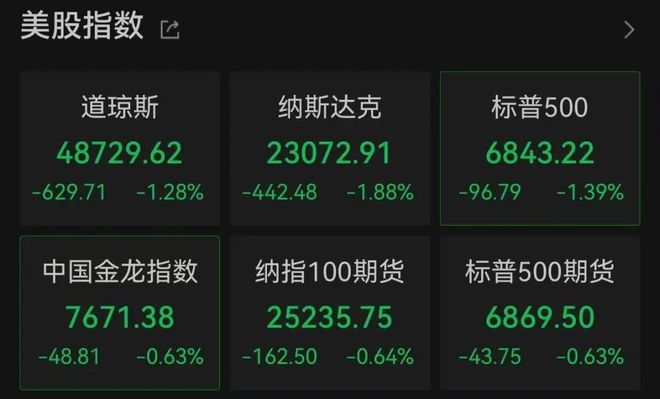
Core Viewpoint - The U.S. stock market experienced significant declines on January 20, with major indices falling sharply, indicating a bearish sentiment among investors. Group 1: Market Performance - The Dow Jones Industrial Average fell by 629.71 points, or 1.28%, closing at 48729.62 [1] - The S&P 500 index decreased by 96.79 points, or 1.39%, ending at 6843.22 [1] - The Nasdaq Composite dropped by 442.48 points, or 1.88%, closing at 23072.91 [1] Group 2: Sector Performance - Major technology stocks saw widespread declines, with Broadcom falling over 3%, and Tesla, NVIDIA, Amazon, META, and Microsoft each dropping more than 2% [2] - Other notable declines included Google, Apple, and TSMC, which also experienced losses [2] Group 3: Chinese Stocks - Chinese stocks mostly fell, with Bilibili dropping over 4%, and both Canadian Solar and Century Internet declining by more than 3% [4] Group 4: Gold Market - Gold stocks surged against the market trend, with Kinross Gold rising over 7%, Harmony Gold increasing by more than 6%, and Barrick Gold gaining nearly 3% [5] - Spot gold prices broke above $4750 per ounce, marking a new historical high with a daily increase of 1.67% [5]
美股科技股,全线下跌
第一财经· 2026-01-20 15:01
Group 1 - NVIDIA stock price is at 181.140, down 2.73% [1] - Tesla stock price is at 425.925, down 2.65% [1] - AppLovin stock price is at 546.640, down 3.89% [1] - Alphabet stock price is at 323.490, down 1.97% [1] - Alibaba stock price is at 164.340, down 0.64% [1] - Pinduoduo stock price is at 104.111, down 2.48% [1] - Apple stock price is at 254.685, down 0.33% [1] Group 2 - TSMC stock price is at 340.960, down 0.42% [2] - Microsoft stock price is at 449.360, down 2.28% [2] - Meta Platforms stock price is at 602.920, down 2.79% [2] - AMD stock price is at 231.115, down 0.31% [2] - Broadcom stock price is at 340.620, down 3.15% [2] - Oracle stock price is at 185.055, down 3.16% [2] - Chinese concept stocks mostly declined, with Bilibili dropping over 4% and Canadian Solar and Century Internet falling over 3% [2] - Gold stocks rose against the trend, with K92 Mining up over 7%, Harmony Gold up over 6%, and Barrick Gold up nearly 3% [2] - Spot gold broke above $4750 per ounce, reaching a new historical high with a daily increase of 1.67% [2]

中金公司:中美AI投资的“差异”
Ge Long Hui· 2026-01-20 14:01
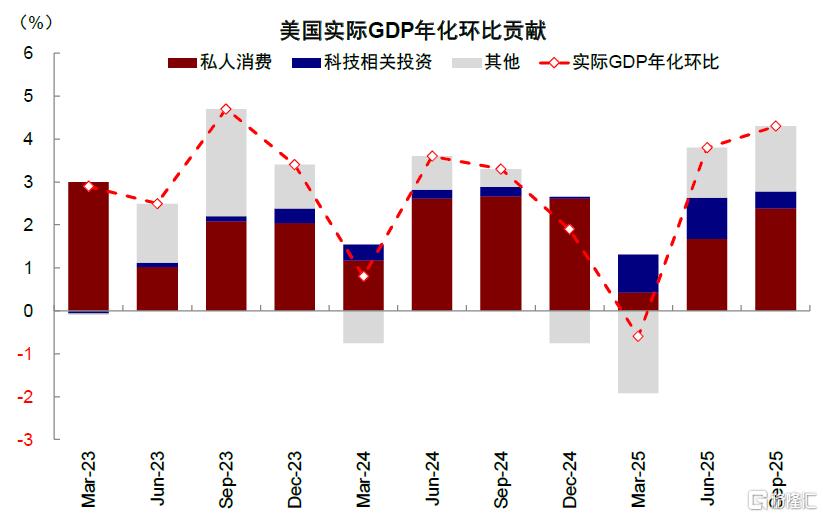
Core Insights - The article emphasizes the significant impact of AI on global economic growth and stock market performance, particularly in the U.S. and China, highlighting the importance of AI investments in driving GDP growth and stock returns [1][11]. Economic Contribution - U.S. technology hardware and software investments are projected to contribute 0.8 percentage points to the annualized GDP growth of 2.5% in the first three quarters of 2025 [2]. - Since 2023, U.S. non-farm business sector labor productivity has increased by 7.2% [4]. Stock Market Performance - Since the launch of ChatGPT at the end of 2022, the "Magnificent Seven" stocks in the U.S. contributed 45 percentage points to the S&P 500 index returns, accounting for over half of the total returns [1]. - In Hong Kong, seven leading tech stocks contributed 14 percentage points to the Hang Seng Index returns, representing 40% of the total returns since the launch of DeepSeek in early 2025 [7]. AI Industry Dynamics - The U.S. has a first-mover advantage in AI infrastructure, models, and talent, while China is rapidly catching up, particularly in open-source models [16][19]. - The global cloud computing market is expected to reach $692.9 billion in 2024, with North America holding a 54.3% market share and China at 16.8% [20]. Investment Landscape - U.S. nominal investment in AI technology hardware and software is approximately $1.05 trillion, accounting for 3.4% of nominal GDP, while China's investment is around $650 billion, also about 3.3% of nominal GDP [42]. - The AI investment landscape shows that the U.S. is primarily driven by private sector investments, while China's investments are significantly supported by government funding [52]. Funding Sources - U.S. AI investments are predominantly led by the private sector, with a total investment of $552 billion, compared to China's $900 billion, which includes substantial government support [52]. - The Chinese government has invested approximately $750 billion in AI, significantly higher than the U.S. government's $110 billion [57]. Investment Focus - U.S. investments are heavily focused on data centers and supporting infrastructure, while China is investing more in chip development and AI models [58]. - In 2025, U.S. leading companies are expected to invest $4 billion in the foundational layer, with 88% directed towards infrastructure [59]. Talent and Research - The number of AI researchers in China has grown significantly, with Chinese researchers holding three times as many AI patents as their U.S. counterparts [41]. - The rapid increase in AI talent in China is enhancing its research capabilities, narrowing the gap with the U.S. [41]. Future Outlook - The article suggests that the U.S. will continue to invest heavily in data centers and energy equipment, which will drive demand for related supply chains in China [88]. - China's ongoing need for chips and AI infrastructure indicates a sustained demand and policy support in the semiconductor sector [88].