拜耳

Search documents
JPM医疗年会Day1-2回顾:从中国管线到全球竞争格局
GLP1减重宝典· 2026-01-15 15:45
Core Insights - The JPM Healthcare Conference 2026 highlighted a significant shift in the narrative surrounding Chinese innovation assets, which are increasingly recognized as critical components for multinational pharmaceutical companies' long-term growth strategies [4][5][24] - The conference emphasized the importance of clinical advancement efficiency and global development pace for Chinese pharmaceutical companies, marking the entry of their innovation pipelines into the core narratives of multinational firms as just the beginning [24] Group 1: Chinese Companies' Innovations - Chinese companies are now being integrated into the core strategies of multinational pharmaceutical firms, moving beyond previous "single-point licensing" narratives to being key contributors in oncology, neuroscience, and metabolic diseases [5][9] - Notable collaborations include SystImmune's BL-B01D1, which has a potential total deal value of $800 million with Bristol-Myers Squibb, and the KarXT project, which is prioritized for development in the psychiatric pipeline [5][7] - The partnership between 3SBio and Pfizer on the PD-1 and VEGF bispecific antibody SSGJ-707 is highlighted as a significant transaction, indicating its strategic importance in the next-generation oncology immunotherapy landscape [7][9] Group 2: Multinational Companies' Strategies - Multinational companies are focusing on a 2030 pricing framework, with strategic decisions revolving around which assets will shape the next industry reshuffle [10][24] - Bristol-Myers Squibb plans to launch 10 new drugs by 2030, emphasizing a multi-pillar approach to mitigate risks associated with patent cliffs [10][12] - Vertex Pharmaceuticals and Madrigal Pharmaceuticals are adopting a focused strategy on single disease areas, with Madrigal positioning itself as a leader in the MASH field and Vertex concentrating on cystic fibrosis and gene therapy [12][15] Group 3: Market Dynamics and Challenges - The second day of the conference shifted focus to practical execution challenges, including competition in metabolic diseases, patent expirations, and supply chain management [16][24] - Eli Lilly expressed uncertainty regarding the market performance of its oral GLP-1 candidate, while Novo Nordisk acknowledged significant competitive pressures and emphasized direct patient channel management [16][18] - Bayer updated its assessment of patent expirations for Xarelto and Eylea, indicating a gradual approach to managing revenue impacts while relying on new product launches for future growth [18][19] Group 4: Supply Chain and Manufacturing - The importance of local manufacturing capabilities was underscored, with Samsung Biologics discussing its U.S. production capacity to meet growing demand [21][24] - Companies like Teva and Sandoz are focusing on the strategic value of biosimilars in light of upcoming patent expirations, indicating a long-term structural adjustment rather than a short-term fix [19][21]

中国蓝观察丨外企为何纷纷看好中国市场前景?
Xin Lang Cai Jing· 2026-01-15 14:15
Group 1 - In 2025, China's economy demonstrates strong resilience and vitality, continuously consolidating a "stable" pattern and enhancing "progress" momentum, injecting valuable confidence into the world economy [1][16] - Foreign enterprises are optimistic about China's development prospects and are increasing their investment, sharing the broad opportunities brought by China's high-level opening and high-quality development [1][16] - Foreign business leaders believe that China's policies to expand openness and optimize the business environment have created a more transparent, stable, and predictable investment environment [1][16] Group 2 - Michelin's joint venture in Shenyang, established in 1995, reflects the company's long-term commitment to the Chinese market, which has become the world's largest automotive consumer market [2][17] - The Shenyang factory has an annual production capacity of 17.1 million passenger car tires and has produced a cumulative total of 100 million tires [4][19] - Bayer has invested over 1 billion yuan in its crop science supply center in Hangzhou, which has recently launched a new manufacturing center with an annual output value of 2 billion yuan [4][19] Group 3 - Messer's new factory project in Hangzhou, with an initial investment of 50 million USD, aims to produce 300,000 tons of industrial and specialty gases annually [6][21] - BMW's Shenyang plant has implemented approximately 200 artificial intelligence applications, significantly enhancing production efficiency, with one in four BMW cars sold globally manufactured in China [8][24] - The establishment of the first German center in Shenyang by the German Federal Association of Small and Medium-sized Enterprises aims to promote industrial interaction and attract more German enterprises [10][26] Group 4 - The continuous improvement of the business environment in Shenyang has attracted foreign investment, with companies like HJ Biotech expressing confidence in the market's appeal [12][28] - The local government has implemented various measures to optimize the investment environment, including establishing a business service system for foreign-invested enterprises [15][31] - Shenyang has developed a strong industrial ecosystem, particularly in high-end equipment manufacturing and new energy vehicles, providing substantial support for foreign enterprises [15][31]

15天9起合作,狂飙60亿美元!2026AI制药开门红,礼来、英伟达、赛诺菲重金押注!
Xin Lang Cai Jing· 2026-01-15 14:09
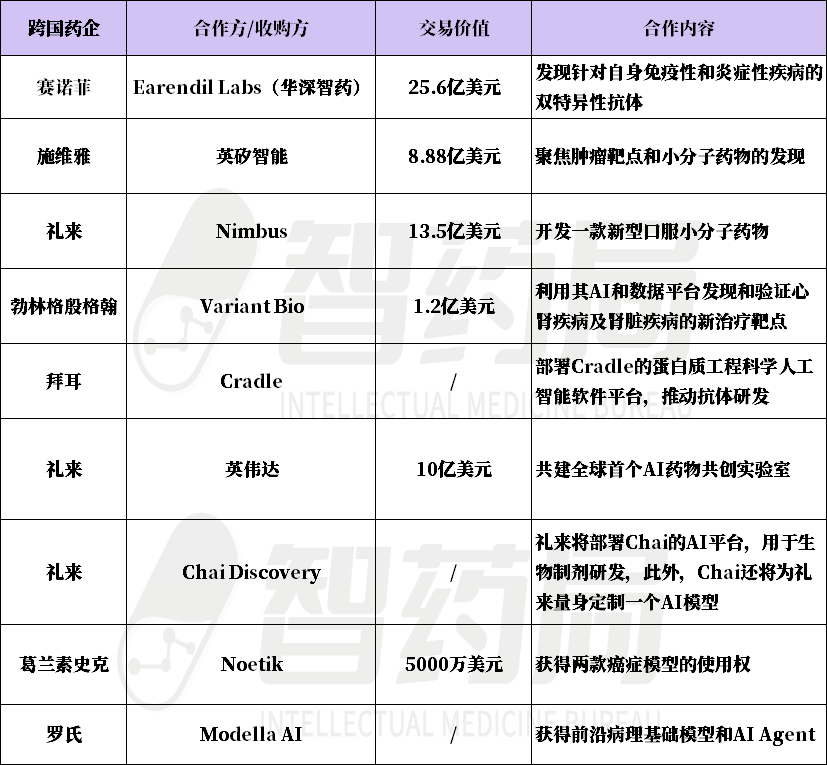
Core Insights - The pharmaceutical industry is experiencing a surge in AI drug development collaborations, with over 9 partnerships announced in just 15 days, totaling more than $6 billion [1][18] - Major pharmaceutical companies are systematically integrating AI, particularly large biopharmaceutical models, into their core R&D processes, moving beyond small-scale pilot projects to enhance efficiency and overcome R&D bottlenecks [3][20] Group 1: Collaborations and Investments - Sanofi partnered with Earendil Labs for $2.56 billion to discover bispecific antibodies for autoimmune and inflammatory diseases [2][19] - Eli Lilly invested $1 billion with NVIDIA to co-build the world's first AI drug co-creation laboratory [2][23] - Takeda renewed its collaboration with Nabla Bio for over $1 billion to strengthen its AI drug development efforts [5][21] Group 2: Shift in AI Utilization - AI is transitioning from pilot projects to foundational infrastructure within pharmaceutical companies, with a shift in investment focus from R&D expenses to strategic investments [5][22] - The collaborations are diverse, including traditional project-based agreements, model subscriptions, platform co-construction, and acquisitions [2][19] Group 3: Advancements in AI Models - The industry is increasingly investing in large biopharmaceutical models, moving from a focus on small chemical molecules to more complex biologics [6][24] - The release of AlphaFold3 has significantly improved the accuracy of predicting biological interactions, marking a turning point in the industry [28] - Companies like GSK are willing to pay substantial fees for access to advanced AI models, indicating a shift in how AI platforms are valued in drug development [13][30] Group 4: Future Trends - The demand for AI and related platforms in the pharmaceutical industry is expected to grow, with companies needing to integrate top AI capabilities with internal biological insights and clinical data [15][16] - The emergence of AI agents and automated laboratory technologies based on large models has the potential to disrupt traditional R&D logic [30]


熊猫债市场2025年回顾与2026年展望:熊猫债发行量维持高位,外资发行占比创六年新高
Lian He Zi Xin· 2026-01-15 11:36
1. Report Industry Investment Rating - Not provided in the content 2. Core Viewpoints of the Report - In 2025, the issuance scale of panda bonds exceeded 160 billion yuan, ranking second in history. Benefiting from factors such as the cost - advantage of domestic financing, continuous introduction of policy optimization, and the improvement of RMB internationalization, it is expected that panda bonds will remain popular in 2026, and the issuance volume may stay at a historically high level [1][34] 3. Summary According to the Directory 3.1 2025 Panda Bond Issuance Overview - **Issuance Scale and Quantity**: In 2025, 44 entities issued 114 panda bonds with a total scale of 163.66 billion yuan. The number of issuers remained the same as last year, the number of issuance periods increased by 4.5% year - on - year, and the scale decreased by 16.0% year - on - year but was still at a high historical level [3] - **Reasons for High - level Issuance**: Firstly, the domestic financing cost has an advantage, and the panda bond market is still attractive to overseas issuers. Although the interest rate spread has narrowed due to the continuous interest rate cuts by European and American central banks, the domestic financing cost is still low. Secondly, policies for optimizing panda bond systems were continuously introduced, providing institutional convenience. Thirdly, the internationalization of the RMB continued to improve, and the exchange rate strengthened, increasing the attractiveness of RMB assets [5][8][11] 3.2 Characteristics and New Trends of the 2025 Panda Bond Market - **Low - interest Environment and Cost Reduction**: The domestic market maintained a low - interest environment. The issuance of panda bonds was concentrated in the medium - and long - term, and the average issuance cost hit a new low. The issuance volume of panda bonds reached a peak from June to July, and there was a significant correlation between the monthly issuance scale and the domestic interest rate trend [13][14] - **Optimized Issuer Structure**: The issuer structure of panda bonds was more optimized. The proportion of panda bond issuers with foreign backgrounds reached a new high since 2019, and the sources of issuers were more diversified. The registration locations of issuers showed a decentralized trend [15] - **Diversified Industry Distribution**: The industry distribution of panda bond issuers was relatively diversified. Financial institutions ranked first in the issuance scale, and the scale of panda bonds issued by the daily consumption industry decreased significantly. There were new issuances of sovereign panda bonds [19][20] - **Reduction in Rated Bond Quantity**: The number of panda bonds issued with ratings decreased. The credit ratings of bonds were mainly concentrated in the AAA level, and the proportion of unrated panda bonds increased [21] - **Change in Sustainable Development - themed Bonds**: The issuance scale of sustainable development - themed panda bonds continued to decline. Green panda bonds accounted for the highest proportion, and product innovation was more active, with new science - and technology innovation panda bonds issued [24][25] 3.3 Outlook for the 2026 Panda Bond Market - **Low Financing Cost**: It is expected that the financing cost of panda bonds will remain low in 2026. The PBOC will continue to implement a moderately loose monetary policy, and the Fed's monetary policy may continue to be loose, but there are significant differences in the interest rate cut rhythm. The relative financing cost advantage of the RMB still exists, but the inversion of the Sino - US interest rate spread may continue to narrow [27][29] - **Continuous Improvement of External Conditions**: RMB internationalization is expected to continue to advance, and relevant panda bond regulations are expected to be continuously improved. The PBOC welcomes more overseas entities to issue panda bonds, which will provide a good external environment for the panda bond market [30][31] - **High Refinancing Demand**: In 2026, the panda bond market will face a peak of maturity and repayment. The high refinancing demand will support the issuance of panda bonds [32] - **Diversified Expansion of Issuers**: Driven by the Belt and Road Initiative and multilateral mechanisms, the panda bond market will see opportunities for the expansion of diversified issuers in 2026 [33] - **Overall Forecast**: In 2026, panda bonds are expected to remain popular, and the issuance volume may stay at a historically high level [34]
Bayer Aktiengesellschaft (BAYRY) Presents at 44th Annual J.P. Morgan Healthcare Conference Transcript
Seeking Alpha· 2026-01-13 21:46
Core Insights - Bayer Pharma is experiencing significant progress, with a focus on renewing its top line and identifying clear near-term growth drivers [2] - Innovation is emphasized as essential for the success of the pharmaceutical company, with notable advancements in the pipeline [2] - The organizational model is being optimized to enhance efficiencies, reduce costs, and streamline operations [3]



Monsanto Sues COVID-19 Vaccine Manufacturers, Alleging Copyright Infringement
ZeroHedge· 2026-01-09 02:30
Core Viewpoint - Bayer and its Monsanto division are suing COVID-19 vaccine manufacturers, claiming they used patented technology developed by Monsanto in the 1980s without permission [1][3]. Group 1: Lawsuits and Allegations - Bayer alleges that Pfizer, BioNTech, and Moderna improperly utilized technology that Monsanto developed to make plants resistant to insects, which was incorporated into their vaccines to enhance mRNA stability and immunity [3]. - The lawsuits were filed on January 6 in a U.S. court in Delaware, seeking damages for patent infringement [3]. - Bayer is not seeking to halt vaccine production but is requesting monetary compensation for the alleged infringement, stating that the defendants have profited significantly from vaccine sales [4]. Group 2: Financial Impact - Pfizer reported earnings of $11.2 billion in 2023 from its COVID-19 vaccine, highlighting the substantial financial gains made by vaccine manufacturers during the pandemic [5]. - BioNTech acknowledged the lawsuit but declined to comment further, while Moderna stated it would defend against the claims [5][6]. Group 3: Additional Legal Actions - Bayer has also filed a separate lawsuit against Johnson & Johnson, claiming infringement related to its COVID-19 vaccine, which utilized DNA delivery rather than mRNA [6]. - The complaint against Johnson & Johnson asserts that its vaccine's effectiveness relied on the patented technology developed by Bayer [7]. - A previous ruling in England found that Pfizer infringed on a Moderna patent, indicating ongoing legal disputes within the vaccine industry [8].


欧股开盘走势分化 防务股上涨与能源股下跌博弈
Xin Lang Cai Jing· 2026-01-07 09:00
MACD金叉信号形成,这些股涨势不错! 格隆汇1月7日|欧洲股市开盘表现不一,地缘政治紧张局势升温带动的防务股涨幅被能源股的跌势所抵 消。英国富时100指数开盘较周二的历史高位下跌0.25%,其中石油巨头英国石油下跌2.75%,国民威斯 敏斯特银行微跌2.7%。在其他市场,受防务公司提振,米兰富时MIB指数上涨0.15%,莱昂纳多上涨 2.1%,造船厂芬坎蒂尼大涨1.7%。德国DAX指数在西门子和拜耳等个股上涨的带动下攀升0.5%。西班 牙IBEX35指数因银行和能源股走低而下跌0.2%,而法国CAC40指数微跌0.05%,防务股的涨幅被能源 和奢侈品股的损失抵消。投资者目前正密切关注欧元区12月通胀数据以及关键的美国就业数据。 ...
Bayer to Present Updates on Pharma Growth Strategy and Pipeline Advancements at J.P. Morgan's 44th Annual Healthcare Conference
Businesswire· 2026-01-05 17:54
WHIPPANY, N.J.--(BUSINESS WIRE)--Bayer will participate in the 44th J.P. Morgan Healthcare Conference 2026 taking place from January 12–15, 2026 in San Francisco. Stefan Oelrich, Member of the Board of Management, Bayer AG, and President of Bayer's Pharmaceuticals Division, will present updates on the company's pharmaceutical growth strategy and pipeline advancements across its portfolio. The presentation will take place on Tuesday, January 13, 2026, from 11:15 to 11:55 PST. Investors, analysts. ...

专家电话会_CRO的责任与创新-没有简单答案,因此需金融服务伙伴-Expert Call_ CRO Accountability and Innovation—No Easy Answers, So FSP
2026-01-04 11:34
Summary of the Call on CRO Accountability and Innovation Industry Overview - The discussion centers around the **pharmaceutical services industry**, specifically focusing on **clinical research organizations (CROs)** and their operational models, including **Functional Service Provider (FSP)** and **Full-Service Outsourcing (FSO)** models [1][6][32]. Key Points and Arguments 1. **Successful Pharma Outsourcing**: - Successful outsourcing relies on achieving competitive cost, quality, speed, and accountability. Accountability is emphasized as a critical factor in project success [6][15]. - Internalizing capabilities at AskBio, as done previously at AstraZeneca, improved control, reduced delays, and enhanced cost and quality outcomes compared to FSO experiences [6][16]. 2. **Popularity of FSP Models**: - FSP models are gaining traction as they allow sponsors to flexibly manage resources and maintain greater control over processes. For FSO to regain popularity, conditions such as sustained biotech funding or CROs improving their cost and quality must be met [6][31]. 3. **Automation and AI in Clinical Development**: - The next wave of improvement in clinical development is expected to come from automation and AI, particularly in areas like medical writing and data collection. However, the adoption of these technologies will be gradual due to validation and regulatory requirements [6][64][71]. 4. **Performance of Smaller CROs**: - Smaller, specialized CROs often outperform larger CROs for biotech sponsors due to better understanding of unique client needs and integration [6][6]. 5. **Integrated Technology Platforms**: - Sponsors are increasingly seeking integrated technology platforms to drive innovation. Veeva is highlighted as a leading solution that offers efficiency and cost savings [6][6]. 6. **Challenges in the CRO Industry**: - The CRO industry faces challenges such as high turnover rates among study coordinators and a crowded market for clinical trial sites, particularly in oncology [56][60]. 7. **Impact of COVID-19**: - The pandemic has led to a slowdown in study starts and decision cycles, with ongoing challenges in patient recruitment and site activation [54][56]. 8. **Accountability in CRO Partnerships**: - Accountability is crucial in CRO partnerships, especially for smaller companies where project-level oversight is more detailed. The governance structures are similar across large companies, but smaller companies require more granular accountability [48][51]. 9. **Future of CROs**: - The role of CROs may evolve as automation increases, potentially leading to a reduction in the need for traditional monitoring roles. Smaller companies may still rely on CROs, but there is a trend towards bringing more functions in-house as automation capabilities grow [90][91]. 10. **Vendor Landscape**: - The vendor landscape is crowded, making it difficult to identify true innovation. Companies are exploring various AI applications to improve clinical development processes [65][66]. Additional Important Insights - **CRO Quality Variability**: The quality of CRO services can vary significantly based on the specific team assigned to a project, highlighting the importance of team selection [6][6]. - **Integration with Bayer**: AskBio's operational model benefits from Bayer's resources, allowing for a unique blend of internal capabilities and external support, which is not common in most acquisitions [41][44]. - **Regulatory Challenges**: Regulatory environments, particularly in China and Europe, continue to pose challenges for study activation and patient recruitment [60][62]. This summary encapsulates the key discussions and insights from the call, providing a comprehensive overview of the current state and future trends in the pharmaceutical services industry.


港股迎来siRNA领军企业 瑞博生物启动招股
BambooWorks· 2026-01-04 08:22
Core Viewpoint - The article highlights the significant potential of Ribobio, a company specializing in siRNA drug development, particularly with its innovative therapies targeting thrombotic diseases and hypertriglyceridemia, as it prepares for its IPO in Hong Kong and aims to capture a leading position in the growing small nucleic acid drug market [2][3][10]. Group 1: Company Overview - Ribobio has focused on small nucleic acid drugs, especially siRNA therapies, for 18 years and has established one of the largest siRNA drug pipelines globally [3][5]. - The company plans to issue approximately 27.5 million shares at a price of HKD 57.97, aiming to raise around HKD 1.59 billion (approximately USD 205 million) during its IPO scheduled for December 31, 2025 [3][5]. Group 2: Product Pipeline - Ribobio's core product, RBD4059, is the world's first siRNA drug for treating thrombotic diseases, currently in Phase 2a clinical trials, with plans to start Phase 2b trials in 2026 [6]. - RBD5044, another product targeting APOC3 for treating hypertriglyceridemia, is in Phase 2 clinical trials and has the potential to capture a share of the over USD 100 billion lipid-lowering drug market [7][8]. Group 3: International Strategy - Ribobio has established research centers in Beijing and Suzhou, China, and a subsidiary in Sweden to facilitate international clinical trials, enhancing its presence in the lucrative European pharmaceutical market [9]. - The company has formed strategic partnerships, including a collaboration with Qilu Pharmaceutical for the development of RBD7022 and with Boehringer Ingelheim for innovative therapies targeting NASH/MASH, with a combined value of USD 2 billion [9]. Group 4: Financial Performance - Ribobio has completed nine rounds of financing, with a valuation reaching CNY 5.02 billion after the latest round in June 2025, indicating strong growth potential [10]. - The company's revenue is projected to grow from nearly zero in 2023 to CNY 143 million in 2024, with a reduction in losses from CNY 142 million in the previous year to CNY 97.8 million in the first half of 2025 [10].