
联发科

Search documents
电源芯片,也要涨价了?
半导体芯闻· 2026-01-27 10:19
Group 1 - The semiconductor industry is expected to experience a new wave of price increases, with IC design firms like MediaTek indicating plans to adjust prices in response to rising costs [1] - The price increase trend in the IC design sector is anticipated to become clearer after the Lunar New Year, with power management ICs likely being the first to see successful price hikes [1] - MediaTek's CEO has expressed optimism for the company's growth this year, stating that they will strategically adjust prices and allocate production capacity to reflect rising manufacturing costs [1] Group 2 - The rising prices of metals and the increased costs from packaging and testing firms are driving the need for IC design companies to raise prices to maintain profit margins [1] - Major packaging and testing companies, such as ASE and ChipMOS, have already raised their prices by up to 20% due to severe supply shortages in semiconductor packaging and testing capacity [1] - In the wafer foundry sector, companies like SMIC have raised some capacity prices by approximately 10%, while other Taiwanese firms are also adjusting their prices in both advanced and mature processes [2]

微软新一代自研AI芯片“Maia 200”出鞘!推理狂潮席卷全球,属于AI ASIC的黄金时代到来
Zhi Tong Cai Jing· 2026-01-27 01:38
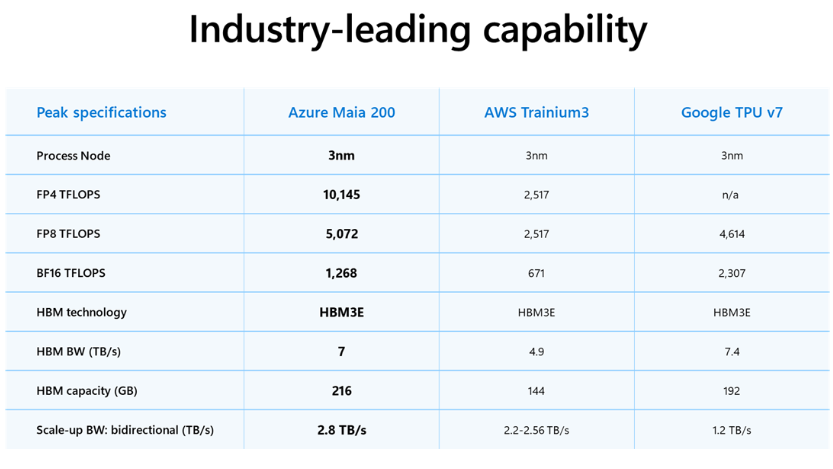
Core Viewpoint - Microsoft has launched its second-generation AI chip, Maia 200, aimed at providing a cost-effective alternative to NVIDIA's AI GPU series for cloud AI training and inference tasks [1][3]. Group 1: Product Launch and Specifications - The Maia 200 chip, manufactured by TSMC, is designed for high-performance AI inference tasks and is being deployed in Microsoft's large AI data centers [1][3]. - The chip offers a performance improvement of 30% per dollar compared to Microsoft's latest hardware, with FP4 performance three times that of Amazon's third-generation Trainium and FP8 performance exceeding Google's seventh-generation TPU [5][6]. - Maia 200 is built using TSMC's advanced 3nm process and contains over 140 billion transistors, providing over 10 petaFLOPS of performance at FP4 and over 5 petaFLOPS at FP8 within a power consumption of 750 watts [6]. Group 2: Competitive Landscape - The launch of Maia 200 positions Microsoft as a strong competitor against Amazon's Trainium and Google's TPU, with claims of superior performance in AI inference tasks [3][4]. - Other chip design giants like Marvell, Broadcom, and MediaTek are also focusing on developing custom AI ASIC solutions for cloud giants, indicating a competitive shift towards high-performance, cost-effective AI infrastructure [2]. Group 3: Industry Trends and Future Outlook - The increasing demand for AI data centers and the need for energy-efficient solutions are driving the development of AI ASIC technology across major tech companies [7][8]. - Microsoft is already planning the next generation of AI chips, named Maia 300, and has options to collaborate with OpenAI for exclusive chip designs [6][7]. - The AI ASIC technology route is seen as a critical investment for companies aiming to enhance cost-effectiveness and energy efficiency in AI computing [7][8].

微软(MSFT.US)新一代自研AI芯片“Maia 200”出鞘! 推理狂潮席卷全球 属于AI ASIC的黄金时代到来
智通财经网· 2026-01-27 00:34
Core Viewpoint - Microsoft has launched its second-generation AI chip, Maia 200, aimed at providing a cost-effective alternative to NVIDIA's AI GPU series for cloud AI training and inference tasks [1][3]. Group 1: Product Launch and Specifications - The Maia 200 chip, manufactured by TSMC, is designed for high-performance AI inference tasks and is being deployed in Microsoft's AI data centers [1][3]. - The chip features over 1.4 trillion transistors and is built on a 3nm process, offering more than 10 petaFLOPS of performance at FP4 precision and over 5 petaFLOPS at FP8 precision, all within a power consumption of 750 watts [5][6]. - Maia 200's performance per dollar is reported to be 30% better than Microsoft's current hardware, and it outperforms Amazon's Trainium by three times in FP4 performance [5][8]. Group 2: Competitive Landscape - The launch of Maia 200 positions Microsoft as a strong competitor against Amazon's Trainium and Google's TPU, with claims of superior performance in AI inference tasks [3][4]. - Major chip design companies like Marvell and Broadcom are increasingly focusing on developing custom AI ASIC solutions for cloud giants, indicating a competitive shift in the industry [2]. Group 3: Strategic Importance - The development of Maia 200 reflects Microsoft's serious commitment to in-house chip engineering, driven by the growing energy demands of large AI data centers and the need for cost-effective solutions [9]. - The AI ASIC technology route is becoming crucial for major tech companies, as they aim to enhance the cost-effectiveness and energy efficiency of their AI computing systems [10][11].
IC设计业首波涨价潮蠢动 电源管理芯片厂可能开出第一枪
Jing Ji Ri Bao· 2026-01-26 23:09
Group 1 - The semiconductor industry is expected to experience a price increase, with IC design firms like MediaTek indicating plans to adjust prices in response to rising costs [1] - The price increase trend in the IC design sector is anticipated to become clearer after the Lunar New Year, with power management ICs likely being the first to raise prices [1] - Metal prices are rising, prompting IC design firms to consider price adjustments to maintain profit margins, as packaging and testing firms have already raised their quotes by 8% to 15% [1] Group 2 - China's leading foundry, SMIC, has reportedly increased some capacity quotes by approximately 10% [2] - Taiwanese firms are also raising prices in both advanced and mature processes, with World Advanced rumored to have made adjustments, although they are currently in a quiet period [3] - IC manufacturers are weighing two strategies: raising prices in line with rising costs or holding off to gain market share, with potential price adjustments based on competitor actions [3]
携手谷歌开发AI芯片,联发科两日暴涨19%创历史新高
智通财经网· 2026-01-26 10:22
摩根士丹利分析师Charlie Chan等人在上周五的一份报告中写道,看到联发科的AI专用集成电路"潜力巨 大"。分析师补充说,尽管谷歌也在与博通(AVGO.US)合作开发TPU,但随着联发科将更多与智能手机 相关的资源转向AI相关芯片,可能会获得更多增长。 周一,联发科与其他主要科技公司(包括芯片制造商南亚科技和联华电子)一同推动台湾基准股指加权指 数创下历史新高。台积电股价下跌0.9%。 晨星公司分析师Phelix Lee表示,联发科的最新业绩指引看起来较为保守,仅反映了截至10月的前景以 及来自谷歌的订单。他认为,市场可能希望公司最终能超越其目标。 智通财经APP获悉,受与谷歌(GOOGL.US)达成AI芯片合作的利好消息刺激,联发科股价强势攀升,近 两日累计暴涨19%,刷新历史最高纪录,市场投资热情被迅速点燃。 这家在台北上市的公司股价周一飙升8.6%,实现了连续两个交易日累计19%的上涨,并收于历史新高。 随着市场对联发科参与谷歌应用于人工智能的芯片张量处理单元(TPU)开发工作的认知度不断提高,这 轮涨势延续了其为期两个月的上涨行情。 由于对台积电的持股触及上限,部分基金经理正转而涌入联发科等其他 ...

因与谷歌达成AI芯片合作,联发科股价两日暴涨19%创历史新高
Sou Hu Cai Jing· 2026-01-26 08:04
Group 1 - Media reports indicate that MediaTek's stock price achieved its best two-day gain in history, driven by investor optimism regarding its partnership with Google [1][3] - MediaTek's stock rose by 8.6% on Monday, with a cumulative two-day increase of 19%, reaching a record closing price [3] - The company's stock price has been on an upward trend for the past two months as the market recognizes its investments in Google's Tensor Processing Unit (TPU) technology [3] Group 2 - The trend highlights a diversification in investments among fund managers, shifting focus from market leader TSMC to other AI-related companies due to individual stock limits [7] - MediaTek is transitioning from its core smartphone chip business to high-margin customized AI chip products, making it a preferred alternative for investors [7] - Analysts from Morgan Stanley express optimism about the potential of MediaTek's AI-specific integrated circuits, noting that while Google collaborates with Broadcom on TPUs, MediaTek is reallocating smartphone resources towards AI chips for greater growth [7] Group 3 - MediaTek, along with other major tech firms like Nanya Technology and UMC, contributed to the Taiwan Weighted Index reaching a historical high, while TSMC's stock fell by 0.9% [7] - Morningstar analyst Felix Li mentions that MediaTek's latest earnings guidance appears conservative, based on market expectations from October of the previous year and Google's order situation, suggesting that the market may anticipate the company exceeding its performance targets [7]
春节换机潮叠加“国补”,中端机配置全面“旗舰化”
Nan Fang Du Shi Bao· 2026-01-23 06:30
Group 1 - The Chinese smartphone market is entering a competitive phase with a focus on mid-range devices as manufacturers target the demand for high cost-performance products during the pre-Spring Festival sales season [1][3] - The government subsidy policy, which extends until 2026, offers a 15% subsidy for devices priced under 6000 yuan, enhancing the attractiveness of mid-range smartphones [3] - Consumers are shifting their focus from low prices to high cost-performance, with mid-range devices now offering performance and features close to flagship models at 60%-70% of their price [3][7] Group 2 - Major brands like Honor, OnePlus, Redmi, iQOO, and realme are launching new models priced between 2000 yuan and 3000 yuan, indicating a fierce competition in the mid-range segment [3][7] - Battery life is a critical concern for users, leading manufacturers to equip mid-range devices with large-capacity batteries, such as Honor Power 2 with a 10080mAh battery [5][7] - The introduction of high-performance processors, such as Snapdragon 8 Gen 5 and MediaTek's Dimensity 9500S, is becoming standard in new mid-range devices, enhancing their appeal [5][6] Group 3 - The smartphone market in China is transitioning to a phase characterized by slight declines in total volume and structural upgrades, with an expected shipment of 278 million units in 2026, a 2.2% year-on-year decrease [8] - High-end market shares are dominated by Apple, Huawei, and Samsung, with Apple holding nearly 50% of the high-end market share in the first three quarters of 2025 [9] - The rising costs of core components are pressuring manufacturers to either raise prices or reduce specifications, leading to a focus on the 2000-3000 yuan price range for maintaining higher profit margins [9]
未知机构:股东变更锋龙股份江化微商业航天中超控股巨力索具数据中心-20260123
未知机构· 2026-01-23 02:35
Summary of Key Points from Conference Call Records Industry or Company Involved - **Aerospace Industry**: Blue Arrow Aerospace Technology Co., Ltd. (蓝箭航天) - **Retail Pharmacy**: Various companies including Yao Yi Gou (药易购), Shuyu Pingmin (漱玉平民), and others - **Quantum Technology**: Companies like Guo Dun Quantum (国盾量子), Ke Da Guo Chuang (科大国创) - **Electric Vehicle and Robotics**: Tesla and its developments in humanoid robots Core Insights and Arguments - **Blue Arrow Aerospace**: The company is undergoing an IPO process, with its status changing to "inquiry" as of January 22, marking the fastest inspection record [1][1][1] - **Commercial Space Conference**: The third Beijing Commercial Aerospace Industry High-Quality Development Conference will be held from January 23 to 25, 2026, focusing on the modernization of the industrial chain and innovation in business models [2][2][2] - **Quantum Technology Development**: The "14th Five-Year Plan" emphasizes quantum technology as a priority, with significant investments and collaborations being made to enhance capabilities in quantum computing [5][7][7] - **Retail Pharmacy Mergers**: The government encourages horizontal mergers and restructuring among retail drug enterprises to optimize the industry [8][9][10] Other Important but Possibly Overlooked Content - **Space Tourism**: Beijing Chuan Yue Zhe's "CYZ1" spacecraft is set for its first manned flight by 2028, with over 20 tourists already booked [5][5][5] - **Tesla's Robotics Future**: CEO Elon Musk indicated that Tesla's future will increasingly rely on humanoid robots, with expectations for more complex tasks by 2026 [12][14][14] - **SpaceX's Second-Generation Starlink**: Planned for launch in 2027, this system aims to provide significantly enhanced internet services, with a capacity increase of over 100 times compared to the first generation [15][15][15] - **Meta's AI Smart Glasses**: Meta is set to launch AI smart glasses powered by MTK chips, with production handled by Longqi Technology [15][15][15]
轻薄之“身”,荣耀“亲近”年轻人
Shen Zhen Shang Bao· 2026-01-22 22:44
Core Viewpoint - The smartphone industry is facing increasing external pressures, leading to price hikes across various models, including the newly launched Honor Magic8 Pro Air, which targets the young consumer demographic [1][2]. Group 1: Product Launches and Features - Honor has introduced the Magic8 Pro Air, weighing 155 grams and measuring 6.1mm thick, making it the lightest flagship smartphone of the year [1]. - The Magic8 Pro Air features a MediaTek Dimensity 9500 processor and a rear camera setup that includes a 64MP periscope lens, while competing models like Huawei's Mate70 Air and Apple's iPhone Air have different specifications [3]. - Honor also launched a limited edition "Honor 500 Pro MOLLY 20th Anniversary" phone in collaboration with the trendy brand Pop Mart, aiming to resonate emotionally with younger consumers [1][5]. Group 2: Market Trends and Pricing - The smartphone market is experiencing a price increase due to rising storage chip costs, with DDR5 memory prices up over 300% since September 2025 [2]. - Honor's new models, including the Magic8 Pro Air, have starting prices above 4000 yuan, with the Magic8 Pro Air priced at 4999 yuan (12GB+256GB) [3]. - Despite the price hikes, Honor's strategy appears to be focused on appealing to younger consumers and creating a broader ecosystem beyond just smartphones [5][6]. Group 3: Industry Performance and Competition - The Chinese smartphone market saw a 1.6% year-on-year decline in shipments in Q4 2025, with Honor holding a 13.4% market share, ranking sixth [4]. - Apple's iPhone Air has struggled in the market, with initial activation numbers significantly lower than previous models, indicating a cooling demand for lightweight smartphones [5]. - The overall smartphone industry is entering a phase of low growth, with companies like Honor adapting their strategies to seek structural growth opportunities within a stagnant market [6].

CPU:服务器中枢大脑,需求的拐点
NORTHEAST SECURITIES· 2026-01-22 09:42
Investment Rating - The report assigns an "Outperform" rating for the industry, indicating that the industry index is expected to exceed market benchmarks in the next six months [6]. Core Insights - The report highlights a significant shift in CPU demand driven by AI applications, with a notable increase in server CPU requirements due to the expansion of generative AI training and inference clusters [2]. - Supply-side constraints are evident, with major players like Intel and AMD planning to raise server CPU prices by 10%-15% by 2026, while also reallocating production capacity from consumer electronics to server CPUs [1]. - The global CPU market is projected to grow from approximately $130.2 billion in 2025 to $141.27 billion in 2026, with a compound annual growth rate (CAGR) of about 8.5% from 2025 to 2030 [3]. Supply Side Summary - Major overseas companies are increasing prices, with Intel shifting production capacity to server CPUs, leading to a significant drop in delivery assurance rates for consumer electronics [1]. - There is a persistent shortage of Intel 7/10 CPUs, exacerbated by a shift in production focus, resulting in a growing supply gap in the PC segment [1]. - Upstream material shortages, particularly in ABF substrates due to T-glass scarcity, are impacting server CPU production, with Intel prioritizing server CPU supply [1]. - The average selling price and gross margin for CPUs are expected to rise as Intel and AMD adjust their product mix towards high-end servers [1]. Demand Side Summary - The demand for AI inference is surging, leading to exponential growth in the need for server nodes [2]. - General-purpose servers are entering a significant upgrade cycle as large-scale data centers require modernization due to power consumption limits of older racks [2]. - The emergence of Agent-based computing is increasing CPU demand, as these systems require more processing power than traditional general-purpose computing [2]. - There is a reversal in the market dynamics, with general-purpose servers now presenting compensatory investment opportunities following a period of AI server dominance [2]. Industry Landscape Summary - The global CPU market is dominated by major players, with Intel and AMD holding 50% and 30% market shares in China, respectively [3]. - The Chinese CPU market is segmented into desktop CPUs (50% share), mobile CPUs (30% share), and server CPUs (20% share), with foreign companies holding a significant market share [3]. Related Companies - Domestic CPU manufacturers include Haiguang Information, Hesheng New Materials, and Loongson Technology [4]. - Upstream CPU suppliers include Huada Jiutian and Huazheng New Materials [4]. - Server manufacturers include Zhongke Shuguang, Inspur Information, and Unisplendour [4].