
三星

Search documents
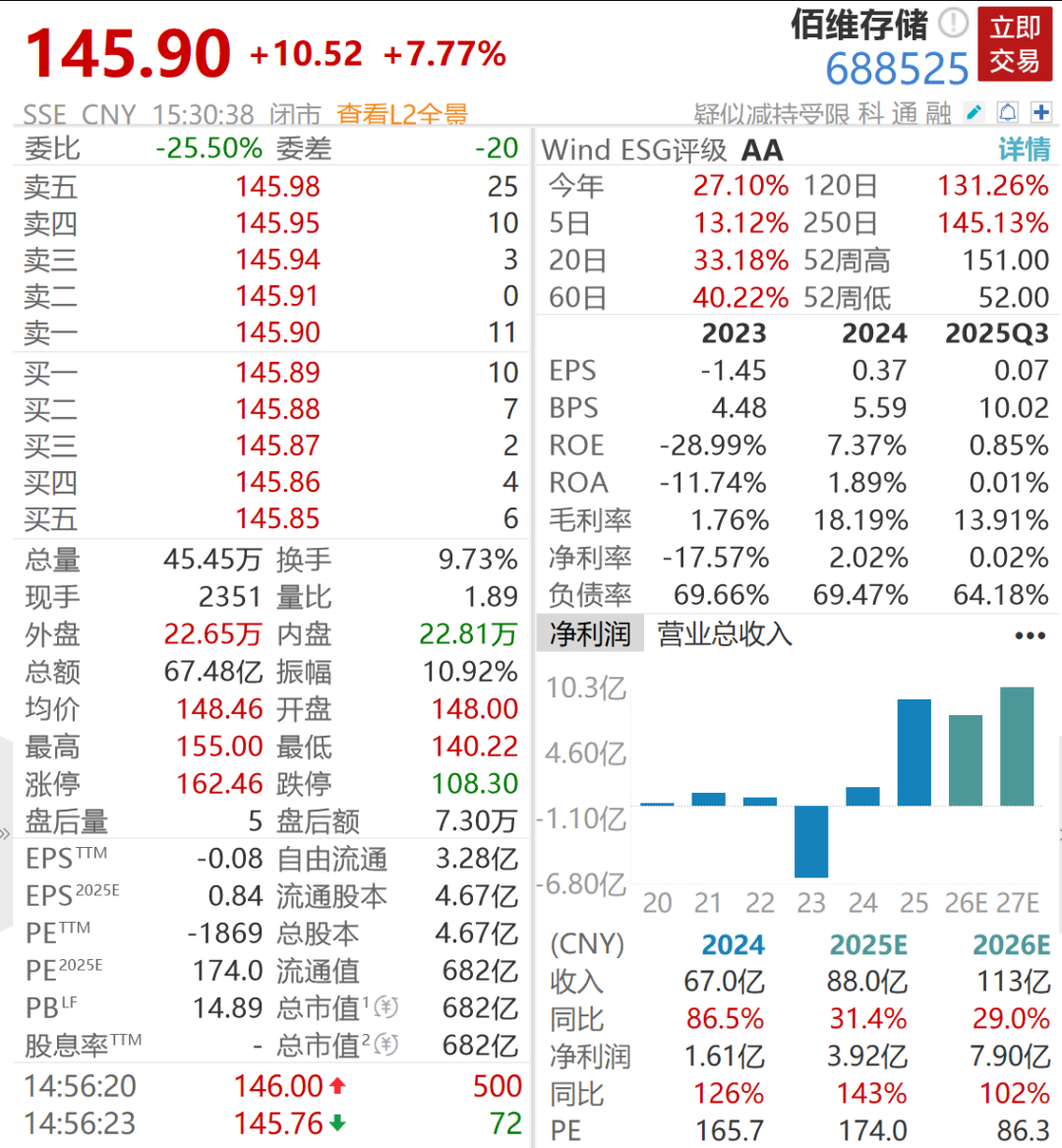
600亿存储龙头,净利润预计暴增520%
2 1 Shi Ji Jing Ji Bao Dao· 2026-01-14 08:50
Core Viewpoint - The storage chip sector in A-shares is experiencing significant activity, with Baiwei Storage's stock rising sharply following the release of its 2025 performance forecast, indicating strong growth potential in the industry driven by AI demand [1][5]. Group 1: Company Performance Forecast - Baiwei Storage expects to achieve operating revenue of CNY 10 billion to 12 billion in 2025, representing a year-on-year growth of 49.36% to 79.23% [3][5]. - The company anticipates a net profit attributable to shareholders of CNY 850 million to 1 billion in 2025, reflecting a staggering year-on-year increase of 427.19% to 520.22% [7][9]. - For Q4 2025, Baiwei Storage projects a single-quarter revenue of CNY 3.425 billion to 5.425 billion, with year-on-year growth of 105.09% to 224.85% [5][7]. Group 2: Market Dynamics - The global storage market is entering a "super cycle," with significant price increases expected in Q4 2025, driven by strong demand for memory modules, particularly in AI applications [3][11]. - The demand for high-performance storage products is being fueled by the expansion of global data centers and the increasing need for AI-driven applications [11][12]. - Major storage chip manufacturers are shifting production towards high-end chips suitable for AI and data centers, leading to a tightening supply that is expected to drive prices up [12][13]. Group 3: Strategic Initiatives - Baiwei Storage is focusing on enhancing its chip design, firmware development, and advanced packaging capabilities to improve market competitiveness [7][9]. - The company is actively investing in R&D to provide integrated storage solutions that meet the demands of AI applications, emphasizing low power consumption, high performance, and compact size [13].

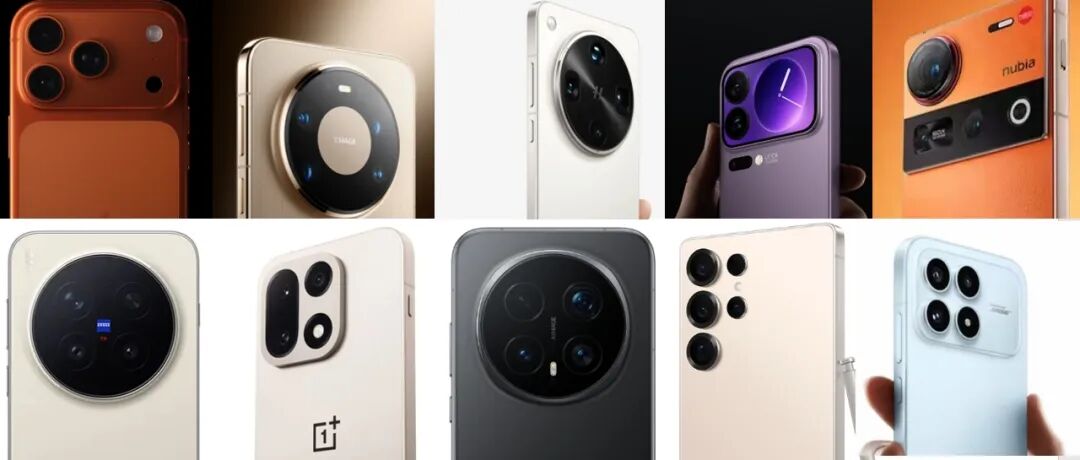
6大趋势详解:谁说手机行业没有新东西了?
3 6 Ke· 2026-01-14 07:14
Group 1 - The core message of the articles highlights the ongoing transformation in the smartphone industry, driven by AI and new technologies, which poses a challenge to traditional smartphone growth as major companies shift focus towards AI-integrated devices [2][4][5] - Major brands like Honor, Samsung, and Infinix are introducing innovative products such as the AI-integrated ROBOT PHONE, a foldable OLED panel, and a smartphone with global satellite communication capabilities, respectively [2][4] - The global smartphone market is experiencing sluggish growth, with Apple, Samsung, and Xiaomi maintaining the top three positions, while Apple shows a strong recovery, surpassing Samsung for the first time in 14 years [5][7][8] Group 2 - Apple's resurgence is attributed to competitive product offerings and pricing strategies, with the iPhone 16e and iPhone 17 series performing well in the market, particularly in China where sales surged by 37% in October [7][8] - Samsung's stability is also linked to its pricing strategy, with a 7% decrease in average selling price and the introduction of high-value A-series products [10] - The Chinese smartphone market is characterized by volatility, with frequent shifts among the top five brands, and a notable decline in overall shipment volumes in the second quarter [13][15] Group 3 - The mid-range smartphone market is expanding, driven by consumer demand for high-quality, cost-effective products, with significant sales reported for models priced between 2000-2999 yuan [16][18] - High-end smartphones face challenges due to innovation stagnation, leading to a focus on system development and unique user experiences, with brands like Huawei and Xiaomi investing in proprietary operating systems [22][24] - AI is becoming a critical component in high-end smartphones, with brands leveraging AI to enhance ecosystem connectivity and user experience, as seen in Huawei's HarmonyOS and OPPO's AI features [27][30] Group 4 - Marketing strategies in the smartphone industry are evolving, with brands facing challenges in traditional marketing approaches, leading to a shift towards more relatable and engaging campaigns [33][36] - Instant retail is gaining traction, with brands like Apple and others adopting rapid delivery services to meet consumer demand for immediate gratification, significantly impacting sales during major shopping events [40][41] - The smartphone industry is undergoing significant changes, with AI, self-developed systems, and innovative marketing strategies driving a more dynamic and competitive landscape [45]


7份料单更新!出售三星、Silergy、TI等芯片
芯世相· 2026-01-14 06:32
Group 1 - The article discusses the challenges of managing excess inventory, highlighting that holding 100,000 units incurs at least 5,000 in monthly storage and capital costs, leading to a potential loss of 30,000 over six months [1] - The company "Chip Superman" has served a total of 22,000 users and offers discounts to clear inventory, with transactions completed in as fast as half a day [10][12] - The article emphasizes the difficulty in promoting and selling excess materials, suggesting that those struggling to find buyers or achieve better prices can seek assistance from the company [1][12] Group 2 - A detailed list of available surplus materials is provided, including various brands and models, with quantities ranging from 49 to 87,000 units [4][5] - The company has a substantial inventory, with a 1,600 square meter smart storage facility housing over 1,000 models and a total of 50 million chips, valued at over 100 million [9] - The article also includes a request for specific materials, indicating ongoing demand for certain components [7]


SK海力士129亿美元建新厂,利好上游设备环节,半导体设备ETF广发(560780)盘中最高涨超4%
Xin Lang Cai Jing· 2026-01-14 06:28
Group 1: Company Developments - SK Hynix plans to invest 19 trillion KRW (approximately 12.9 billion USD) to build a new advanced chip packaging factory to meet the demand for artificial intelligence, with construction set to begin in April and completion targeted by the end of 2027 [1] - Changxin Technology's IPO application has been accepted, aiming to raise 29.5 billion CNY for production line upgrades, next-generation technology, and forward-looking research, which is expected to accelerate domestic semiconductor equipment orders [2] Group 2: Industry Trends - The demand for AI is driving the storage chip industry into a "super cycle," with supply-demand mismatches leading to significant price increases for products [2] - According to TrendForce, the contract price for general DRAM is expected to increase by 55-60% quarter-on-quarter in Q1 2026, while NAND Flash product contract prices are projected to rise by 33-38% [2] Group 3: Market Performance - As of January 14, 2026, the CSI Semiconductor Materials and Equipment Theme Index rose by 1.62%, with the semiconductor equipment ETF Guangfa increasing by 1.90%, reaching a peak gain of over 4% during the day [3] - The Guangfa Semiconductor Equipment ETF reached a new high with a total scale of 2.715 billion CNY and 1.397 billion shares, with significant net inflows totaling 1.07 billion CNY over the past five days [3]
800米华南第一“韩国街”创造年营业收入约80亿元
Xin Lang Cai Jing· 2026-01-14 06:16
Core Insights - The "Korean Street" on Yuanzheng Road in Guangzhou's Baiyun District generates an annual revenue of approximately 8 billion RMB, making it the largest Korean-themed street in South China [1][2]. Group 1: Business Overview - The Yuanzheng Road spans over 800 meters and has become a hub for Korean businesses, attracting a significant number of Korean merchants involved in clothing, leather, footwear, and cosmetics since the late 1990s [2]. - Currently, there are over 120 Korean restaurants along Yuanzheng Road, including 47 barbecue restaurants, as well as numerous beverage shops and 9 Korean supermarkets [2]. - The establishment of the Korean Street was initially aimed at providing a centralized space for Korean merchants, which has evolved into a core gathering place for Korean businesses in the region [2][3]. Group 2: Community and Economic Impact - The Guangzhou Korean Chamber of Commerce, located on Yuanzheng Road, has over 150 member companies, including well-known firms like Samsung and LG, playing a crucial role in promoting Sino-Korean economic cooperation [2][3]. - The street has been recognized as Guangzhou's first "Consumer Trust Demonstration Street," with over 100 merchants signing consumer trust commitments, enhancing consumer confidence [3]. - The local government plans to invest 32 million RMB to develop the "Yuanzheng Road Korean City" project, which aims to upgrade transportation nodes and modernize the street's appearance, integrating Korean cultural elements [3][4]. Group 3: Future Developments - The Baiyun District government is actively supporting the application for Yuanzheng Road to be designated as a metropolitan-level night market, indicating a focus on enhancing the area's commercial appeal [4].
2026面板业危中有机:大盘或微降,液晶获利稳,中尺寸OLED飙升
Di Yi Cai Jing· 2026-01-14 06:06
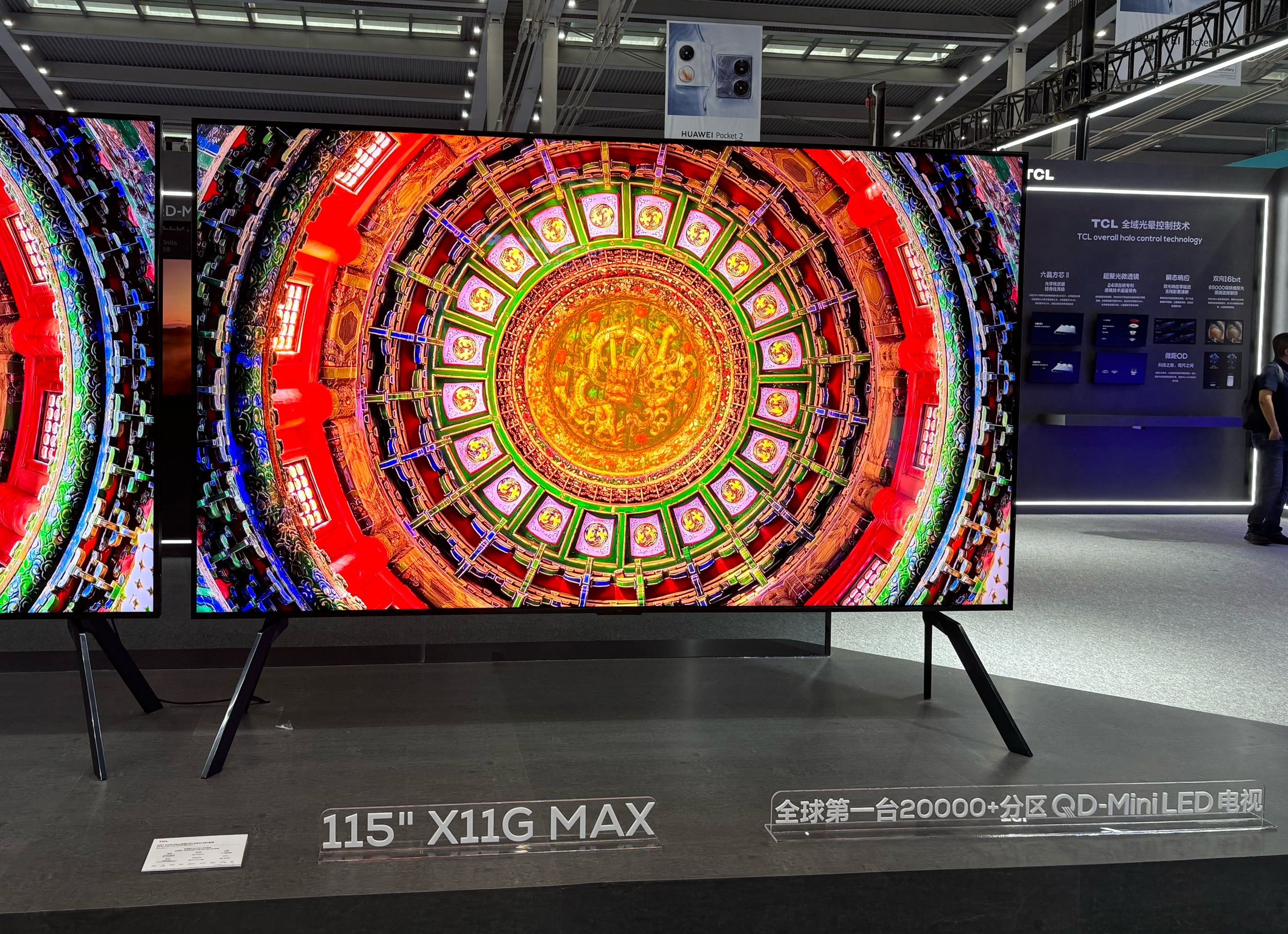
Core Viewpoint - The memory price increase is impacting terminal demand, while the supply of LCD TV panels is concentrated, with a price rebound in January. The demand for automotive displays and high-end IT products will be the main growth points in the industry. Group 1: Company Performance - TCL Technology's subsidiary TCL Huaxing is expected to achieve revenue exceeding 100 billion yuan and net profit over 8 billion yuan by 2025, attracting attention to the panel industry [4] - TCL Huaxing's revenue is projected to grow by 23% to approximately 106.3 billion yuan in 2025, with 47% coming from TV panels, marking a decline in TV panel revenue share below 50% for the first time [5] - The company has strengthened its position by acquiring LGD's Guangzhou 8.5-generation LCD panel line and increasing its stake in Shenzhen Huaxing, contributing to profit growth [5] Group 2: Industry Outlook - The global display panel industry is expected to see a revenue of $114.4 billion in 2025, a slight decline of 1.3%, primarily due to a downturn in the mobile product panel market [6] - The LCD panel sales are projected to reach $69.5 billion, while OLED panel sales are expected to be $44.7 billion, both showing slight declines [6] - The overall sales of the global panel industry are anticipated to decrease by 1.8% to $112.4 billion this year, with a 2% decline in the shipment of mainstream consumer electronics expected [6] Group 3: Market Dynamics - The top three companies, BOE, TCL Huaxing, and Huike, account for 70% of the global LCD TV panel market shipment, with a projected 3% increase in global LCD TV panel shipments in 2025 [6][7] - The profitability of LCD panels is expected to stabilize due to production control and price stability, with a focus on large-size panels and a shift towards high-end products [7] - The demand for mid-size OLED panels is expected to grow significantly, with a projected sales increase of over 20% in 2026 [8] Group 4: Competitive Landscape - The competition in the mid-size OLED market is expected to intensify, particularly as new production lines from BOE and Samsung enter mass production [9] - The demand for automotive displays and high-end IT products is anticipated to be the main growth drivers in the future market [9]


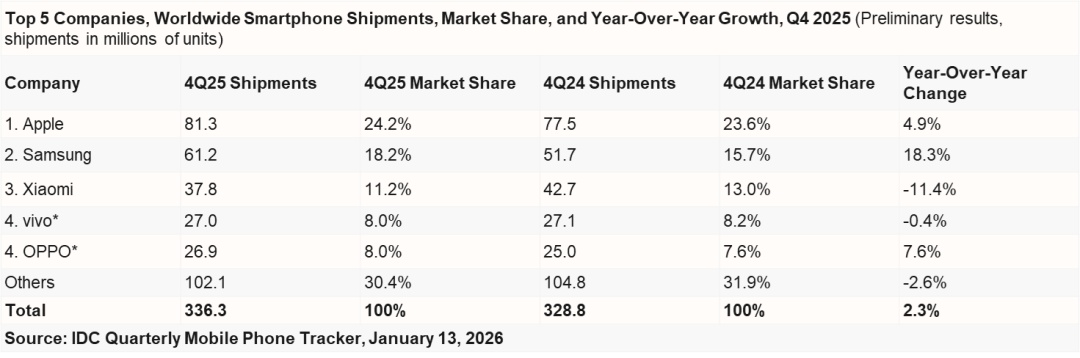
IDC:2025年第四季度全球智能手机出货量同比增长2.3% 达到3.363亿部
智通财经网· 2026-01-14 05:53
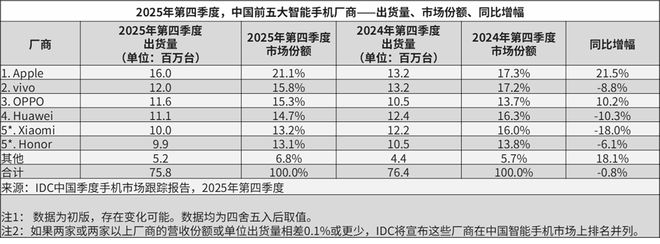
Core Insights - The global smartphone market is projected to grow by 2.3% year-on-year in Q4 2025, reaching 336.3 million units, driven by high-end model demand, strong performance of foldable phones, and consumer anticipation of price increases [1][2] - Apple and Samsung are the primary growth engines in the smartphone market, with year-on-year growth rates of 6.3% and 7.9% respectively, leading to a combined market share increase to 39% [2][3] - The overall smartphone market in 2025 is expected to reach 1.26 billion units, reflecting a 1.9% year-on-year growth despite challenges such as tariff fluctuations and supply chain disruptions [2][5] Global Market Performance - In Q4 2025, Apple shipped 81.3 million units, capturing 24.2% of the market share, while Samsung shipped 61.2 million units with an 18.2% market share [6] - The average selling price (ASP) of smartphones is expected to reach a historical high due to the strong performance of high-end models [3][5] - The overall market share of other manufacturers decreased slightly, with a total of 102.1 million units shipped, representing 30.4% of the market [6] Chinese Market Dynamics - The Chinese smartphone market saw a slight decline of 0.8% year-on-year in Q4 2025, with shipments around 75.8 million units [7][8] - Apple led the Chinese market with 16.0 million units shipped, achieving a market share of 21.1%, while vivo and OPPO faced challenges with year-on-year declines [8][9] - The overall annual shipment for the Chinese smartphone market is estimated at 284.6 million units, reflecting a 0.6% decrease compared to the previous year [9] Future Outlook - The smartphone market is expected to face challenges in 2026 due to a significant shortage of storage chips, which may lead to a market contraction [5] - Manufacturers' ability to manage supply chains and scale will be crucial in navigating the anticipated downturn [5] - Despite potential declines in shipments, the ASP is likely to continue rising due to increased costs [5]
开源证券:AI 成 CES2026 主旋律 硬件产业链迎上行周期
Ge Long Hui· 2026-01-14 05:51
Group 1: AI Integration and Hardware Innovation - AI remains the main theme of CES 2026, with a significant shift from software to physical world integration, empowering various AI terminals [1] - Generative AI is driving a new wave of innovation, with AI smartphones and AI PCs expected to benefit from consumer upgrade cycles, entering an upward trend [1] - AI glasses and embodied intelligent robots have transitioned from the "0 to 1" stage to the "1 to N" stage, with product shipments anticipated to maintain rapid growth [1] Group 2: AI Chip Development - Major tech companies like NVIDIA, AMD, Intel, and Qualcomm showcased advancements in AI chips at CES 2026, with continuous iteration in chip architecture and manufacturing processes [1] - NVIDIA announced the full production of the Vera Rubin platform, integrating six key chips and achieving a tenfold reduction in AI inference costs [1] - AMD's Helios platform, based on MI455X, demonstrated a tenfold performance improvement over previous generations, gaining recognition from leading clients like OpenAI [1] Group 3: Traditional Consumer Electronics - Lenovo introduced innovative AI PCs with rollable screens and foldable designs, enhancing AI interaction experiences through its "hybrid AI" strategy [2] - Dell and HP upgraded their flagship AI PC products, significantly improving edge AI performance [2] - Samsung and Honor showcased advancements in AI smartphones, with Samsung presenting a foldable OLED display and Honor unveiling the world's first robot phone [2] Group 4: New AI Terminals - New AI terminals, particularly AI glasses, are innovating rapidly, with Chinese brands leading the charge [2] - Thunderbird showcased the world's first eSIM smart AR glasses, marking a shift towards independent communication for AR devices [2] - AI models are moving beyond software, enabling personalized applications in emotional companionship, health, and pet care, indicating a new phase for the AI terminal industry [2] Group 5: Automotive and Robotics - NVIDIA's open-source Alpamayo system is lowering the development threshold for Level 4 autonomous driving, while Chinese automakers like Geely and Great Wall are advancing full-stack autonomous driving solutions towards mass production [3] - Innovations in mobility are diversifying, with products like the Strutt smart wheelchair and Verge solid-state battery electric motorcycle reshaping future travel experiences [3] - Embodied intelligence is gaining traction, with NVIDIA's Jetson Thor chip and Isaac platform fostering an open ecosystem, while Boston Dynamics and LG are pushing for large-scale industrial applications [3]


2025中国手机出货:苹果四季度第一,华为全年第一
Guan Cha Zhe Wang· 2026-01-14 05:44
Core Insights - The Chinese smartphone market is projected to have a shipment volume of approximately 75.78 million units in Q4 2025, showing a slight year-on-year decline of 0.8%, with an annual total of about 285 million units, down 0.6% from the previous year [1][3] Q4 2025 Market Performance - Apple leads the Q4 2025 shipments with 16 million units, capturing a market share of 21.1%, marking a significant year-on-year increase of 21.5% [2] - Vivo ranks second with 12 million units shipped, holding a market share of 15.8, but experiencing a decline of 8.8% year-on-year [2] - OPPO follows closely with 11.6 million units, a year-on-year increase of 10.2%, and a market share of 15.3% [2] - Huawei's shipments are approximately 11.1 million units, down 10.3% year-on-year, with a market share of 14.7% [2] - Xiaomi and Honor are tied for fifth place, with Xiaomi shipping 10 million units (down 18%) and Honor shipping 9.9 million units (down 6.1%) [2] Annual Market Overview - For the entire year of 2025, Huawei tops the market with 46.7 million units shipped, a slight decline of 1.9%, and a market share of 16.4% [4] - Apple follows closely with 46.2 million units, reflecting a 4% increase year-on-year, and a market share of 16.2% [4] - Vivo's annual shipments are 46.1 million units, down 6.6% from the previous year, also sharing a market share of 16.2% with Apple [4] - Xiaomi and OPPO have annual shipments of 43.8 million and 43.4 million units, respectively, with Xiaomi showing a growth of 4.3% and OPPO a growth of 2.1% [4] Global Smartphone Market Insights - The global smartphone shipments reached 1.26 billion units in 2025, with Apple and Samsung leading the market shares at 19.7% and 19.1%, respectively [5][6] - Despite challenges such as storage chip shortages, the global market is driven by high-end model growth and consumer anticipation of price increases [5][6] - The average selling price is expected to continue rising, even as overall shipments face pressure [6]
2025中国手机市场:苹果四季度第一,华为全年第一
Guan Cha Zhe Wang· 2026-01-14 05:38
Core Insights - The Chinese smartphone market is projected to see a slight decline in shipments, with approximately 75.78 million units expected in Q4 2025, representing a year-on-year decrease of 0.8% [1][2] - Apple leads in Q4 shipments with 16 million units, achieving a market share of 21.1%, while Huawei tops the annual rankings with 46.7 million units shipped [1][3] Q4 2025 Performance - Apple: 16 million units shipped, 21.1% market share, 21.5% increase year-on-year [2] - Vivo: 12 million units shipped, 15.8% market share, 8.8% decrease year-on-year [2] - OPPO: 11.6 million units shipped, 15.3% market share, 10.2% increase year-on-year [2] - Huawei: 11.1 million units shipped, 14.7% market share, 10.3% decrease year-on-year [2] - Xiaomi: 10 million units shipped, 13.2% market share, 18% decrease year-on-year [2] - Honor: 9.9 million units shipped, 13.1% market share, 6.1% decrease year-on-year [2] Annual Performance 2025 - Total shipments in China are estimated at 285 million units, down 0.6% from the previous year [3][4] - Huawei: 46.7 million units, 16.4% market share, 1.9% decrease year-on-year [4] - Apple: 46.2 million units, 16.2% market share, 4% increase year-on-year [4] - Vivo: 46.1 million units, 16.2% market share, 6.6% decrease year-on-year [4] - Xiaomi: 43.8 million units, 15.4% market share, 4.3% increase year-on-year [4] - OPPO: 43.4 million units, 15.2% market share, 2.1% increase year-on-year [4] Global Market Overview - Global smartphone shipments reached 1.26 billion units in 2025, with Apple (19.7% market share) and Samsung (19.1% market share) leading the market [5][6] - The global market is expected to face challenges in 2026 due to ongoing storage chip shortages, which may lead to a decline in shipments [6]
