
快手

Search documents
严监管下小贷行业加快清退步伐 迈向合规经营新阶段
Jin Rong Shi Bao· 2026-01-15 01:35
Core Viewpoint - The small loan industry in China is undergoing significant restructuring due to stringent regulations and a shift towards compliance-based high-quality development, leading to the exit of numerous non-compliant companies [2][3][4]. Group 1: Regulatory Changes and Industry Restructuring - The Shandong Provincial Financial Management Bureau has announced the cancellation of pilot qualifications for eight small loan companies, including Vanke and Huatiantong [1]. - The implementation of the "Interim Measures for the Supervision and Administration of Small Loan Companies" in January 2025 aims to standardize operations and enhance risk management within the industry [2][3]. - A nationwide cleanup action has been initiated, resulting in the exit of many "lost" and "shell" small loan companies, with significant cancellations reported in regions like Hunan and Chongqing [3][4]. Group 2: Industry Exit and Company Statistics - By the end of September 2025, there were 4,863 small loan companies in China, a decrease of 111 from the second quarter of 2025, with total loan balances dropping by 319 billion yuan [4]. - The exit of major players, such as Alibaba's small loan company and Sohu's Fox Loan, signifies the end of an era dominated by internet giants in the small loan sector [4]. Group 3: Capital Strengthening and Financing Trends - Over 30 small loan companies have increased their capital in 2025, with notable examples including the capital increase of Tencent's small loan company from 10.526 billion yuan to 15 billion yuan [5]. - The financing activities of small loan companies have accelerated, particularly among internet-based firms, with several companies raising over 10 billion yuan through asset-backed securities [6]. - The trend of "the strong getting stronger and the weak getting weaker" is becoming more pronounced in the small loan industry as leading companies enhance their financial capabilities while weaker firms exit [6].


港股开盘:恒指跌0.1%、科指跌0.55%,科网股走势分化,黄金股持续走高,汽车股多数下挫
Jin Rong Jie· 2026-01-15 01:27
1月15日,港股集体低开,其中恒生指数跌0.1%,报26972.36点,恒生科技指数跌0.55%,报5875.78 点,国企指数跌0.11%,报9305.13点,红筹指数平收,报413768点。 北京北辰实业股份(00588.HK):预计截至2025年12月31日止年度利润将继续亏损。 越秀地产(00123.HK):2025年度累计合同销售金额约为1062.1亿元,同比下降约7.3%,约占销售目标的 88.1%。其中12月销售金额约89.96亿元,同比下降约33.4%。 交个朋友控股(01450.HK):2025年第四季度,集团合计完成商品交易总额(GMV)约人民币64.9亿元,同 比增长约4.34%;2025年累计完成GMV约人民币160.2亿元,同比增长约6.23%。 赛晶科技(00580.HK):预计2025年度收入约人民币22.5亿元,同比增加约40%,主要由于来自柔性输电 业务领域的收入增加,得益于有关工程订单产品陆续交付及收入确认。 中广核新能源(01811.HK):2025年累计完成发电量1.9万吉瓦时,同比减少0.8%。其中,中国风电项目 减少0.4%,中国太阳能项目增加31.3%,中国燃气项 ...
海外“屠榜”、国内强敌环伺:可灵AI月收入飙至1.4亿元,但视频生成大战才刚打响
Sou Hu Cai Jing· 2026-01-15 00:57
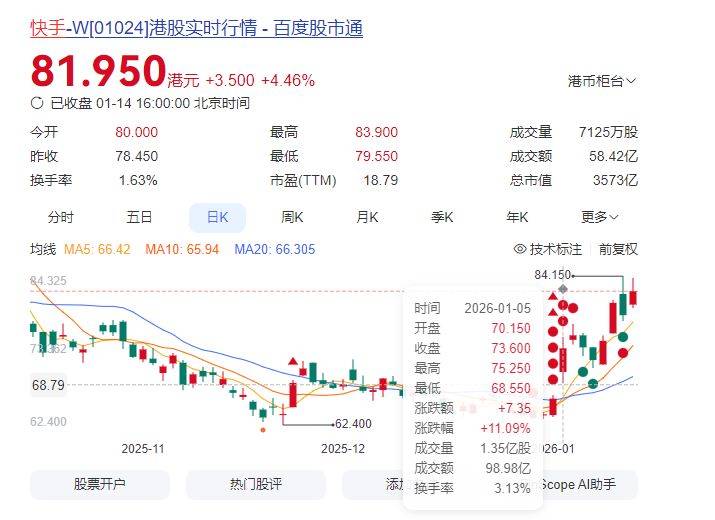
Core Insights - Kuaishou's AI product, Keling AI, has rapidly increased its monthly revenue from 150 million yuan to 140 million yuan in less than a year, with an annual recurring revenue (ARR) projected to reach 240 million USD (approximately 1.68 billion yuan) by December 2025 [1][4] - The launch of the "Motion Control" feature during the New Year holiday significantly boosted Keling AI's downloads, leading to a 28.15% increase in Kuaishou's stock price by January 14 [1][4] Revenue Growth - Keling AI's revenue surpassed 140 million yuan in December 2025, showing a noticeable acceleration in commercialization compared to 150 million yuan in Q1 2025 [4] - The growth in revenue is attributed to increased demand for video generation models and Kuaishou's ongoing investment in computational power [4][5] Competitive Landscape - The competition in the domestic video generation sector is intensifying, with Alibaba Cloud's Wanxiang 2.6 and Volcano Engine's Seedance 1.5 Pro targeting the same market as Keling AI [3][6] - Keling AI's revenue structure indicates that nearly 70% comes from paid subscriptions by professional users, such as content creators and marketers [6] Future Directions - Kuaishou plans to focus its capital expenditures on computational upgrades and technological advancements over the next 1-2 years [5] - To expand its user base, Keling AI aims to enhance its product offerings for ordinary users and integrate social interaction features [9][10] Product Innovation - Keling AI has launched several innovative models, including the "Keling O1" and "Keling 2.6," which support advanced features like audio-visual synchronization and multi-angle generation [6][7] - The recent success of the "Motion Control" feature, which allows users to create dynamic videos from static images, exemplifies Keling AI's strategy to simplify user experience and broaden its appeal [10]

突发!美国白宫宣布对特定半导体等加征25%关税;大厂80亿资产遭侵吞?宝能董事长姚振华实名举报;梁文锋旗下幻方量化,去年收益率56.6%
雷峰网· 2026-01-15 00:35
Key Points - The U.S. White House announced a 25% tariff on certain imported semiconductors and related products starting January 15, 2026, following a previous statement by former President Trump regarding tariffs on chips and semiconductors [4][5] - Baoneng Group's chairman, Yao Zhenhua, accused local authorities of undervaluing assets of Qoros Auto, claiming a third-party evaluation valued the assets at approximately 8 billion yuan, while they were set to be auctioned at 1.5 billion yuan [7][8] - Ctrip Group is under investigation for alleged monopolistic practices by the State Administration for Market Regulation, with the company stating it will cooperate with the investigation [10] - RoboSense announced it expects to sell 303,000 units of its robotic lidar products in 2025, marking a 1141.8% year-on-year increase [13] - Liang Wenfeng's company, Huanfang Quantitative, achieved a 56.6% return in 2025, with assets exceeding 70 billion yuan [10][11] - Tesla will discontinue the one-time purchase option for its Full Self-Driving (FSD) software, transitioning to a subscription-only model starting February 14, 2026 [39][40] - The Chinese smartphone market saw Huawei leading in shipments with 46.7 million units, followed closely by Apple with 46.2 million units, while the overall market experienced a slight decline of 0.6% year-on-year [27][28] - Meta plans to double its production capacity for AI smart glasses to 20 million units by 2026, focusing on AI integration [46][47] - TSMC is reportedly planning to invest significantly in the U.S. by building at least five new semiconductor factories, despite facing high production costs compared to its Taiwan facilities [50]



智通港股通持股解析|1月15日





智通财经网· 2026-01-15 00:31
智通财经APP获悉,根据2026年1月14日披露数据,中国电信(00728)、绿色动力环保(01330)、凯 盛新能(01108)位居港股通持股比例前3位,分别为71.10%、69.65%、67.73%。此外,腾讯控股 (00700)、快手-W(01024)、小米集团-W(01810)在最近有统计数据的5个交易日内,持股额增 幅最大,分别为+43.92亿元、+31.64亿元、+27.00亿元;盈富基金(02800)、恆生中国企业(02828)、 阿里巴巴-W(09988)在最近有统计数据的5个交易日内,持股额减幅最大,分别为-69.19亿 元、-29.74亿元、-23.42亿元。 具体数据如下(交易所数据根据T+2日结算): 1、港股通最新持股比例排行(前20名) | 公司名称 | 持股数量 | 最新持股比例 | | --- | --- | --- | | 中国电信(00728) | 98.67亿股 | 71.10% | | 绿色动力环保(01330) | 2.82亿股 | 69.65% | | 凯盛新能(01108) | 1.69亿股 | 67.73% | | 天津创业环保股份(01065) | 2.29亿 ...
四条“战线”齐头并进,港股冲刺AI企业聚集地
Xin Lang Cai Jing· 2026-01-15 00:29
Core Viewpoint - The Hong Kong stock market is becoming a key hub for Chinese AI companies, with a surge in listings across various sectors, including hardware and software, amidst the ongoing US-China tech rivalry [1][11]. Group 1: AI Hardware Sector - The first "battle line" is the AI computing power industry chain, highlighted by the listings of domestic GPU leaders, Wallen Technology and Tensyn, which filled a gap in the Hong Kong market [2][12]. - Wallen Technology, known as the "first GPU stock in Hong Kong," focuses on high-end general-purpose GPUs and large-scale data center computing platforms [2][12]. - Tensyn, the first domestic company to achieve mass production of general-purpose GPUs, delivered over 52,000 units by June 2025 [2][12]. - Hong Kong also hosts major players like SMIC, which became the third-largest professional wafer foundry globally with a 5% market share by Q3 2025 [2][12]. Group 2: AI Software Sector - The second "battle line" involves AI software, with the listing of Zhipu, recognized as the "first global large model stock," and MiniMax, which saw a 109% increase on its first trading day [3][13]. - Zhipu reported revenue of 190 million yuan in the first half of 2025, establishing itself as one of the largest independent large model vendors in China [3][13]. - MiniMax's revenue is primarily driven by its AI companion application, Talkie, and it achieved a market capitalization exceeding 100 billion HKD [3][13]. - Established companies like Meitu are also leveraging their AI technology to enhance their product offerings across various applications [3][13]. Group 3: AI Hardware Applications - The third "battle line" encompasses AI hardware, including smartphones, automobiles, and robotics, which are crucial for the large-scale implementation of AI technologies [4][14]. - In the smartphone sector, AI penetration is expected to reach 34% by 2025, with companies like Xiaomi and ZTE leading the market [4][14]. - The automotive sector features companies like BYD and Horizon Robotics, with predictions that autonomous driving will become one of the fastest-growing tech industries in the next decade [4][14]. - Over 30 robotics companies have applied for listings in Hong Kong since December 2024, indicating a trend towards public offerings in this sector [5][14]. Group 4: Internet Giants - The fourth "battle line" includes major internet companies such as Alibaba, Tencent, and Kuaishou, which are enhancing their AI capabilities across various domains [5][15]. - Kuaishou's self-developed video generation model achieved monthly revenues exceeding 20 million USD by December 2025 [5][15]. - The integration of AI across these companies is establishing a solid foundation for the AI sector in the Hong Kong market [5][15]. Group 5: Strategic Positioning of Hong Kong - Hong Kong is emerging as a strategic "buffer zone" for Chinese tech companies, facilitating connections with global capital amidst the US-China tech rivalry [6][16]. - The presence of significant investors from the Middle East and East Asia in Hong Kong-listed AI companies indicates a shift towards a new "non-US capital alliance" [6][16]. - The Hong Kong stock market provides a platform for AI companies to diversify their investor base and mitigate market risks [6][17]. Group 6: Market Dynamics and Future Outlook - The surge in AI company listings is a response to the maturation of the AI industry, which is transitioning from a technology exploration phase to one requiring substantial capital for validation and industrialization [7][17]. - The implementation of the special technology listing rules by the Hong Kong Stock Exchange has increased inclusivity for unprofitable tech companies, creating critical financing channels [7][18]. - Predictions suggest that the Hong Kong market could see new stock fundraising exceeding 280 billion HKD in 2025, with AI, semiconductors, and robotics playing significant roles [8][19].

智通港股沽空统计|1月15日
智通财经网· 2026-01-15 00:24
Group 1 - The core point of the news highlights the top short-selling ratios and amounts for various companies, indicating significant market sentiment towards these stocks [1][2]. - AIA Group Limited (友邦保险-R) and Anta Sports Products Limited (安踏体育-R) both have a short-selling ratio of 100.00%, indicating a high level of bearish sentiment [1][2]. - The top three companies by short-selling amount are Alibaba Group Holding Limited (阿里巴巴-W) with 4.031 billion, Tencent Holdings Limited (腾讯控股) with 2.553 billion, and Alibaba Health Information Technology Limited (阿里健康) with 1.776 billion [1][2]. Group 2 - The top short-selling ratio rankings show that AIA Group Limited (友邦保险-R) leads with a short-selling amount of 1.9534 million and a ratio of 100.00% [2]. - JD.com, Inc. (京东集团-SWR) has a short-selling ratio of 99.19% with a short-selling amount of 0.6316 million, indicating strong market pressure [2]. - The deviation values indicate that JD.com (京东集团-SWR) has the highest deviation at 44.47%, suggesting significant divergence from its historical short-selling average [2].



四条“战线”齐头并进,港股冲刺AI企业聚集地
证券时报· 2026-01-15 00:17
Core Viewpoint - The Hong Kong stock market is emerging as a key hub for AI companies, with a significant increase in listings from Chinese AI firms, particularly in the GPU and software sectors, amidst the ongoing US-China tech rivalry [1][3][8]. Group 1: AI Companies and Market Dynamics - In 2026, several Chinese AI companies have listed on the Hong Kong Stock Exchange, including GPU leaders like Biren Technology and Tensyn, filling a gap in the GPU sector [1][3]. - The number of Hong Kong-listed companies related to AI has surpassed 40, categorized into four main "battle lines" [3]. - The first "battle line" focuses on the AI computing power industry, with Biren Technology being the first GPU company to list in Hong Kong, and Tensyn being the first to achieve mass production of general-purpose GPUs [3][4]. Group 2: AI Software and Applications - The second "battle line" involves AI software, highlighted by the listing of Zhipu AI, which has become one of the largest independent large model vendors in China, reporting revenue of 190 million yuan in the first half of 2025 [4]. - MiniMax, another AI company, saw its stock price surge by 109% on its first day of trading, with a market capitalization exceeding 100 billion HKD [4]. - Established companies like Meitu are also leveraging their AI technology to enhance their product offerings, indicating a robust presence in the AI software sector [4]. Group 3: AI Hardware and Robotics - The third "battle line" encompasses AI hardware, including smartphones and autonomous vehicles, with predictions that AI smartphone penetration will reach 34% by 2025 [5]. - Companies like BYD and Xiaomi are involved in the automotive sector, while over 30 robotics companies have applied to list in Hong Kong since December 2024, indicating a trend towards robotics firms seeking public funding [5][6]. Group 4: Internet Giants and AI Integration - The fourth "battle line" features major internet companies such as Alibaba and Tencent, which are enhancing their AI capabilities across various domains, including AI computing power and applications [6]. - The collective shift of these internet giants towards AI is establishing a solid foundation for the AI sector in the Hong Kong market [6]. Group 5: Strategic Positioning of Hong Kong - Hong Kong is becoming a crucial offshore hub for Chinese tech companies, providing a platform for international capital access amidst the US-China tech competition [8][9]. - The presence of significant foreign investors, including sovereign wealth funds from the Middle East and Asia, indicates a shift in capital sources towards a "non-US capital alliance" [9]. - The Hong Kong Stock Exchange's regulatory framework has become more accommodating for unprofitable tech companies, facilitating critical financing avenues for AI firms [10]. Group 6: Future Outlook and Challenges - The influx of AI companies is expected to elevate Hong Kong's status as a "hard tech financing hub," with projections indicating that new stock fundraising could exceed 280 billion HKD in 2025 [12]. - However, many AI companies may not achieve commercial viability until 2026 or 2027, posing risks of valuation corrections if revenue growth falls short of expectations [12][13]. - The Hong Kong market must address challenges such as sustaining high-quality asset supply and enhancing liquidity to fully realize its potential as a global tech financing center [13].

抖音也要做二次元电子春晚
3 6 Ke· 2026-01-15 00:05
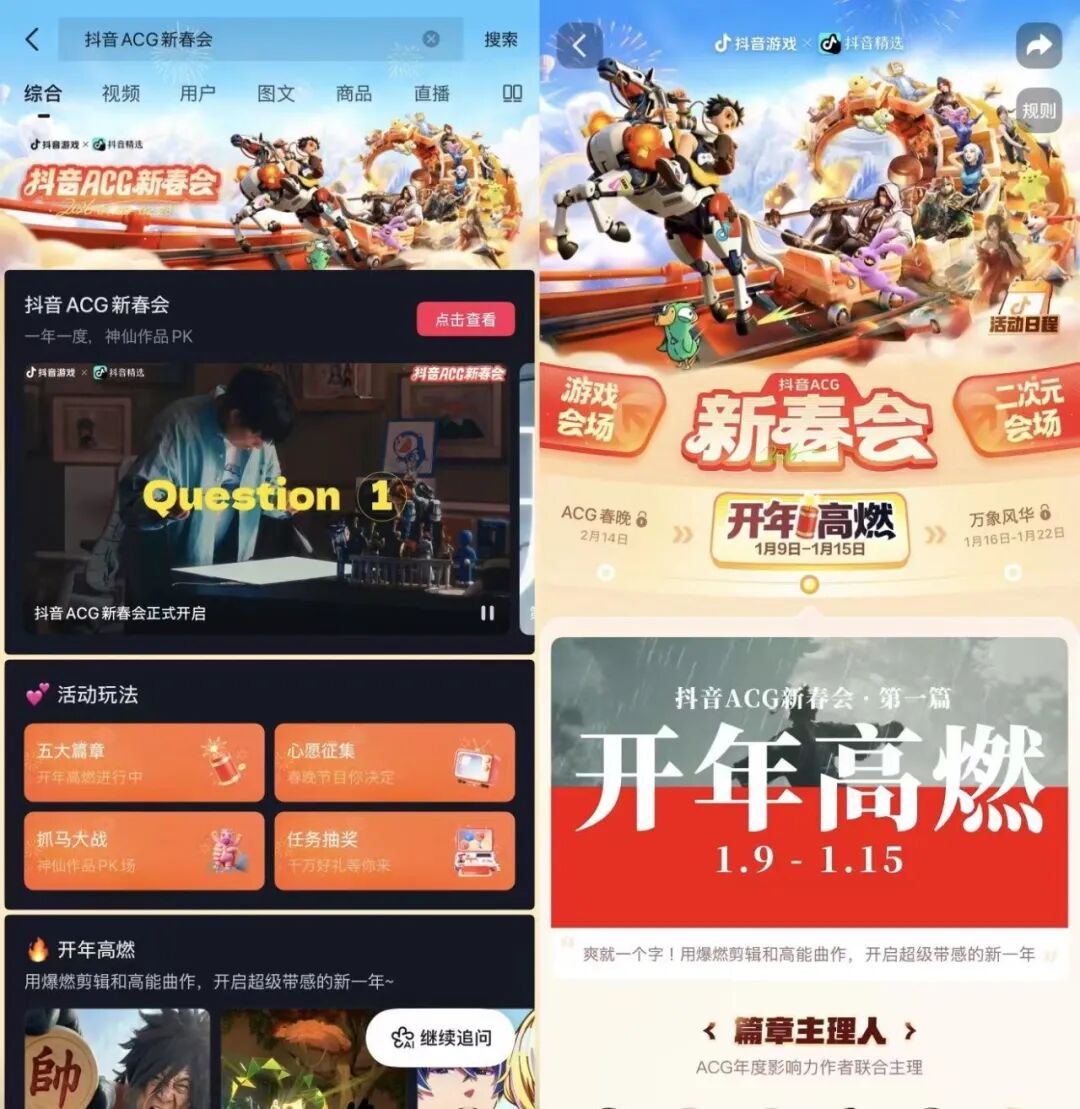
Core Viewpoint - Douyin is launching its first ACG Spring Festival event, integrating elements of the ACG (Anime, Comic, Game) culture with user interaction, aiming to create a unique online celebration that resonates with the audience during the peak content consumption period of the Spring Festival [1][4][12] Group 1: Event Details - The ACG Spring Festival event will officially air on February 14, following a submission and voting phase, and is designed as a "customized electronic Spring Festival Gala" for users [1] - The event will feature a theme submission mechanism, cash incentives for creators, user voting, and various interactive elements, encouraging a dual interaction structure between content creators and users [4][6] - The event will be divided into two main sections: games and ACG, covering a wide range of content including cosplay performances, remixes, and original creations [4][6] Group 2: Market Context - The ACG Spring Festival event is strategically timed during the Spring Festival, a critical period for content supply and consumption, maximizing user engagement and content creation [4][10] - The past year has seen significant growth in ACG content across various platforms, with Douyin's event serving as a pivotal observation point in this trend [3][10] - The ACG user base in China is projected to reach 503 million by 2024, with a notable 95% of Gen Z identifying as ACG enthusiasts, indicating a broadening user demographic [10][11] Group 3: Competitive Landscape - Douyin's initiative reflects a shift in the competitive landscape of short video platforms, moving from traffic efficiency to content structure and user segmentation [9][12] - The event aims to establish a high-visibility aggregation point for ACG content, which is crucial for defining content labels and user engagement strategies [9][12] - Other platforms like Bilibili have historically hosted similar events, indicating a competitive environment where Douyin seeks to carve out its niche in the ACG space [6][10] Group 4: User Engagement and Feedback - Initial user feedback on the ACG Spring Festival event is mixed, with some expressing curiosity while others question the depth of Douyin's ACG atmosphere [9][12] - The success of the event will depend on Douyin's ability to address user perceptions and enhance its ACG community presence [9][12] Group 5: Broader Industry Trends - The transition of ACG content from niche to mainstream platforms is evident, with Douyin's approach aligning with the trend of ACG becoming a significant part of comprehensive content culture [10][12] - The expansion of ACG consumption now includes various sectors beyond traditional media, such as gaming, virtual idols, and live streaming, indicating a diversification of the ACG ecosystem [10][11]
智通港股通资金流向统计(T+2)|1月15日
智通财经网· 2026-01-14 23:37
Core Insights - The article highlights the net inflow and outflow of capital in the Hong Kong stock market, with Kuaishou-W, Tencent Holdings, and Southern Hang Seng Technology leading in net inflows, while China Mobile, Meituan-W, and the Tracker Fund of Hong Kong experienced the highest net outflows [1][2]. Group 1: Net Inflows - Kuaishou-W (01024) recorded a net inflow of 2.25 billion, representing a 33.62% increase in its closing price to 80.250, up by 7.43% [2]. - Tencent Holdings (00700) saw a net inflow of 2.00 billion, with a net inflow ratio of 11.73%, closing at 623.000, an increase of 1.96% [2]. - Southern Hang Seng Technology (03033) had a net inflow of 857 million, with a net inflow ratio of 12.00%, closing at 5.740, up by 3.14% [2]. Group 2: Net Outflows - China Mobile (00941) experienced the highest net outflow of -1.03 billion, with a net outflow ratio of -40.96%, closing at 81.150, up by 0.25% [2]. - Meituan-W (03690) had a net outflow of -488 million, with a net outflow ratio of -4.32%, closing at 105.000, an increase of 6.60% [2]. - The Tracker Fund of Hong Kong (02800) saw a net outflow of -425 million, with a net outflow ratio of -4.65%, closing at 26.800, up by 1.52% [2]. Group 3: Net Inflow Ratios - Qinhuangdao Port Co., Ltd. (03369) led with a net inflow ratio of 76.18%, with a net inflow of 1.0376 million, closing at 2.680, up by 0.37% [3]. - China Water Affairs Group (00855) followed with a net inflow ratio of 58.76%, net inflow of 16.8665 million, closing at 5.660, up by 2.35% [3]. - Uni-President China Holdings Ltd. (00220) had a net inflow ratio of 51.73%, with a net inflow of 45.0968 million, closing at 8.450, up by 5.23% [3]. Group 4: Net Outflow Ratios - Country Garden Services Holdings Company Limited (06098) had the highest net outflow ratio of -61.71%, with a net outflow of -29.9428 million, closing at 6.250, down by 0.48% [3]. - Zhiyuan Holdings Limited (00990) followed with a net outflow ratio of -60.45%, net outflow of -21.7419 million, closing at 0.730, up by 4.29% [3]. - Hong Kong Travel (00308) experienced a net outflow ratio of -55.01%, with a net outflow of -17.0295 million, closing at 1.360, unchanged [3].
