成都银行

Search documents
又一千亿上市银行,触发强赎!
Zhong Guo Ji Jin Bao· 2025-05-27 14:08
Core Viewpoint - Hangzhou Bank has announced the early redemption of its convertible bonds, indicating a potential further shrinkage in the scale of bank convertible bonds in China [1][7]. Group 1: Early Redemption Announcement - Hangzhou Bank triggered the conditional redemption clause for its convertible bonds (Hangyin Convertible Bonds) on May 26, as the stock price exceeded the conversion price for 15 trading days [3][5]. - The conversion price for the bonds is set at 11.35 CNY, while the stock price reached a new high of 16.02 CNY on May 27, resulting in a conversion premium rate of approximately -0.11% [1][3]. Group 2: Financial Implications - The early redemption allows Hangzhou Bank to utilize the funds to strengthen its capital base, enhancing its financial stability [1][7]. - The mechanism of forced redemption is designed to protect both the issuing company and investors, while also maintaining market stability [5]. Group 3: Market Trends - The market for bank convertible bonds has been declining, with several small and medium-sized banks opting for early redemption as their stock prices rise [7][10]. - Currently, there are only 10 types of bank convertible bonds remaining in the market, indicating a significant reduction in the overall scale of bank convertible bonds [8][9].

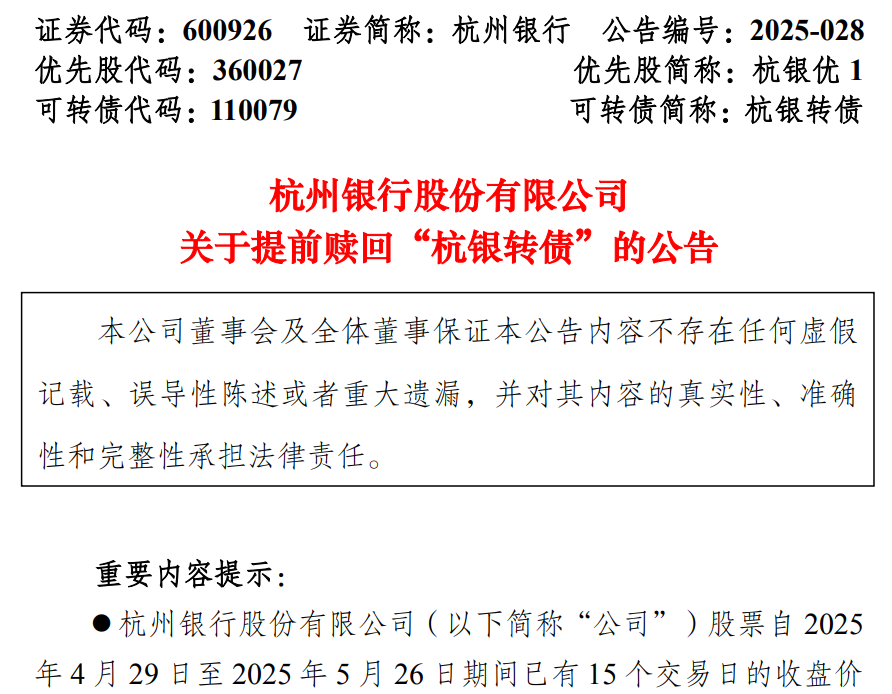
又见银行转债强赎!
证券时报· 2025-05-27 13:14
Core Viewpoint - Hangzhou Bank has decided to exercise the early redemption rights of its convertible bonds, marking the third bank convertible bond to be redeemed early this year, following Chengyin and Suhang convertible bonds [1][3]. Group 1: Early Redemption of Hangzhou Bank Convertible Bonds - Hangzhou Bank's convertible bonds (Hangyin Convertible Bonds) will be redeemed at face value plus accrued interest, as the stock price has exceeded 130% of the conversion price for 15 trading days [3][4]. - The Hangyin Convertible Bonds were issued on March 29, 2021, with a total of 150 million bonds, each with a face value of 100 yuan, and a maturity date of March 29, 2027 [4]. Group 2: Market Context and Trends - The early redemption of bank convertible bonds is linked to the recent strong performance of bank stocks, which have seen a significant recovery from previous undervaluation [4]. - Hangzhou Bank's stock has increased over 70% since the beginning of 2024, contributing to the favorable conditions for early redemption [4]. Group 3: Trends in AAA-rated Convertible Bonds - The scale of AAA-rated convertible bonds has decreased from 2,912.69 billion yuan at the end of 2024 to approximately 2,527.34 billion yuan as of May 27, 2023, a reduction of nearly 400 billion yuan in less than six months [7][8]. - The number of AAA-rated convertible bonds has also decreased, indicating a shrinking market for high-quality convertible bonds [8]. Group 4: Supply and Demand Dynamics - The demand for bank convertible bonds is expected to strengthen due to regulatory changes that emphasize performance benchmarks for public funds, leading to a potential decrease in the total outstanding amount of bank convertible bonds from around 1,700 billion yuan to approximately 1,000 billion yuan [9]. - The lack of new bank convertible bond issuances since 2023, combined with the upcoming maturity of existing bonds, is likely to create a supply-demand imbalance in the market [10].


近五年年化超11%,又一只能打的深度价值基金!|1分钟了解一只吾股好基(六十一)
市值风云· 2025-05-27 10:10
Core Viewpoint - The article highlights the performance and investment strategy of Penghua Optimal Value Stock A, managed by Wu Xuan, emphasizing its ability to control risks while achieving excess returns and long-term capital appreciation [2][3]. Performance Summary - The fund has shown strong performance, with a five-year annualized return of 11.4%, consistently ranking among the top in its category [3][4]. - Year-to-date (YTD) return is 8.77%, with a one-year return of 15.21%, outperforming its benchmark and the CSI 300 index [4][8]. - The fund's maximum drawdown during Wu Xuan's management is only -19.3%, indicating effective risk management [10]. Fund Management - Wu Xuan has been managing the fund since its inception in late 2019, with a focus on deep value investing and risk control [7][13]. - The fund's total net asset size is 30.13 billion, with a low turnover rate, reflecting a long-term holding strategy [2][20]. Holdings and Sector Allocation - The fund maintains a balanced sector allocation, with significant investments in traditional sectors such as non-bank financials, banking, food and beverage, and textiles [15]. - Major holdings include China Telecom and China Mobile, which together account for over 18% of the portfolio [17][18]. Investor Composition - The fund has seen an increase in institutional ownership, reaching nearly 93% by the end of last year, indicating a preference for its stable investment style [21]. - The largest institutional holding accounts for approximately 14% of the fund, which is within regulatory limits to mitigate risks associated with large redemptions [24].

上证380指数下跌0.37%,前十大权重包含生益科技等
Jin Rong Jie· 2025-05-27 08:20
Core Viewpoint - The Shanghai 380 Index experienced a slight decline of 0.37% to 5332.24 points, with a trading volume of 69.297 billion yuan, reflecting a mixed performance over different time frames [1] Group 1: Index Performance - The Shanghai 380 Index has increased by 0.54% over the past month, decreased by 4.32% over the past three months, and has declined by 0.51% year-to-date [1] - The index is based on a sample of 380 securities selected from the Shanghai Stock Exchange, ranked by revenue growth, return on equity, trading volume, and total market capitalization [1] Group 2: Index Composition - The top ten weighted stocks in the Shanghai 380 Index include Hu Nong Commercial Bank (1.35%), Chengdu Bank (1.25%), and Chifeng Gold (1.22%) among others [1] - The index is exclusively composed of stocks listed on the Shanghai Stock Exchange, with a 100% representation [1] Group 3: Industry Breakdown - The industry composition of the index shows that industrials account for 26.74%, information technology for 14.14%, and materials for 12.41%, among other sectors [2] - The index samples are adjusted biannually, with changes implemented on the next trading day following the second Friday of June and December [2]

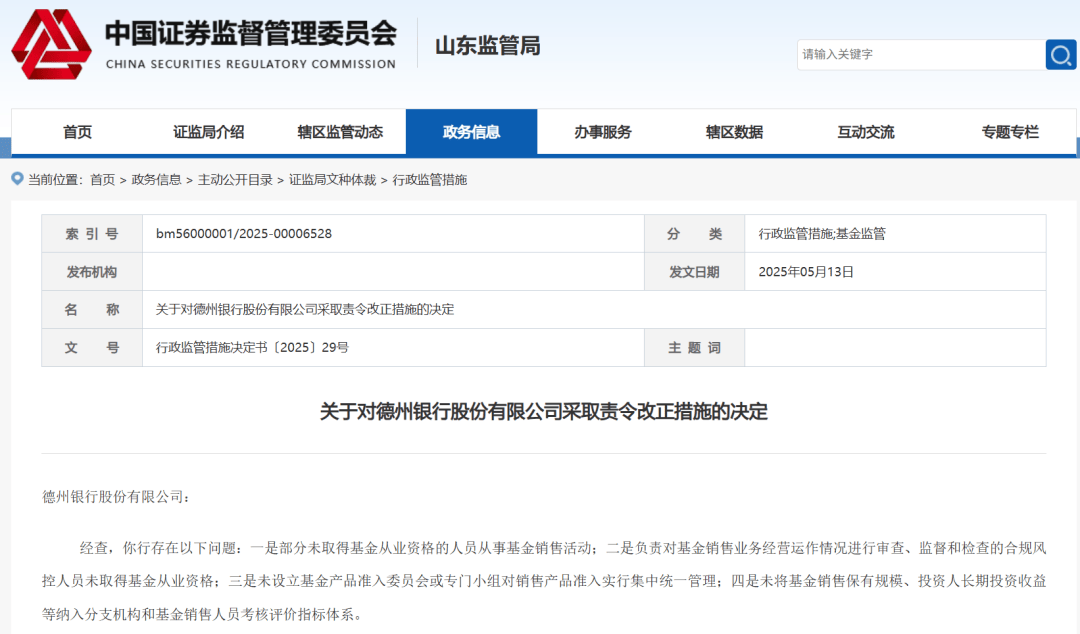
这家银行,被责令改正!
Sou Hu Cai Jing· 2025-05-27 06:19
Core Viewpoint - Dezhou Bank has been ordered to rectify multiple violations in its fund sales operations by the Shandong Securities Regulatory Bureau, highlighting ongoing regulatory scrutiny in the banking sector regarding compliance in fund sales activities [1][3]. Summary by Relevant Sections Fund Sales Violations - Dezhou Bank was found to have several violations in its fund sales, including allowing unqualified personnel to engage in fund sales activities and lacking a dedicated committee for product approval management [3][4]. - The bank's compliance and risk control personnel responsible for overseeing fund sales operations also did not possess the necessary qualifications [4]. Regulatory Actions - The Shandong Securities Regulatory Bureau has mandated Dezhou Bank to enhance its compliance management in fund sales and submit a written rectification report within 30 days of receiving the order [4]. - The violations were deemed to contravene the "Measures for the Supervision and Administration of Securities Investment Fund Sales Institutions" and related regulations [4]. Bank Background and Performance - Dezhou Bank, originally named Dezhou Commercial Bank, was established on December 7, 2004, and was the first city commercial bank approved by the former China Banking Regulatory Commission [4]. - In 2024, Dezhou Bank reported an operating income of 1.329 billion yuan, a total profit of 210 million yuan, and a net profit of 123 million yuan [4]. Industry Context - The regulatory environment for fund sales has tightened, with several banks facing penalties for similar violations this year, indicating a broader trend of increased scrutiny in the banking sector [7][8][9].
年内第三只银行可转债被提前赎回,银行股走势强劲,多只可转债逼近提前赎回线
Hua Xia Shi Bao· 2025-05-27 06:13
Core Viewpoint - The strong performance of bank stocks has led to multiple bank convertible bonds approaching early redemption lines, with Hangzhou Bank deciding to exercise its early redemption rights for its "Hangyin Convertible Bonds" [2][4]. Group 1: Early Redemption of Convertible Bonds - Hangzhou Bank announced the early redemption of its "Hangyin Convertible Bonds," which has a total issuance of 15 billion yuan, allowing investors to either convert their bonds into shares or sell them [4]. - The early redemption of bank convertible bonds is closely linked to the performance of their underlying stocks, with the recent strong performance of bank stocks facilitating this trend [4][6]. - Hangzhou Bank's stock price has increased significantly, rising over 77.5% from 8.94 yuan in December 2023 to a peak of 15.87 yuan in May 2025 [5]. Group 2: Market Conditions and Trends - The banking sector has seen a nearly 40% increase in stock prices in 2024, creating favorable conditions for convertible bond conversions [4]. - The early redemption of other bank convertible bonds, such as Chengyin and Suhang, indicates a broader trend in the banking sector [4][5]. - The current market environment has led to a decline in the issuance of new bank convertible bonds, with no new issues since 2023, as banks remain cautious due to market conditions and regulatory restrictions [8]. Group 3: Impact on Bank Capital and Financial Structure - Early redemption of convertible bonds can enhance banks' capital strength by encouraging investors to convert their bonds into equity, thus supporting business expansion and risk management [6]. - The financial cost for banks can be reduced through early redemption, optimizing their financial structure by lowering interest expenses [6]. - The low conversion rates of some past convertible bonds highlight the varying effectiveness of these instruments in enhancing banks' core tier one capital [7].

申万宏源研究晨会报告-20250527
Shenwan Hongyuan Securities· 2025-05-27 00:47
Group 1: Key Insights on Bond Market and Investment Strategies - The bond market is facing new constraints characterized by low interest rates, high volatility, narrow carry, and even negative carry, along with the trend of credit bonds becoming rate-driven and long-duration government bonds [11] - Cross-bond futures arbitrage has gained attention as a viable investment strategy in the bond market, analyzed through both theoretical and empirical perspectives [11] - The theoretical analysis indicates that the returns from cross-bond futures arbitrage consist of three main components: 1) coupon contribution, which is relatively certain; 2) capital gains contribution, benefiting from the narrowing of credit and variety spreads, which are often strongly correlated with basis; 3) basis contribution, benefiting from basis convergence [11] Group 2: Insights on Banking Sector Investment Framework - The banking sector has entered a phase of valuation recovery since 2024, despite existing external economic pressures, indicating a need to revise the traditional investment framework that assumes "good economy equals bank investment" [10][12] - The report emphasizes that the long-term allocation value of banks has been overlooked, which is a significant reason for public funds' under-allocation to banks [10][12] - The analysis suggests that the stability and sustainability of bank earnings should be prioritized in investment decisions, especially during economic downturns, as banks exhibit relative advantages in these conditions [12][13] Group 3: Capital Market Dynamics and Insurance Funds - Insurance capital is increasingly drawn to high-dividend banks, with estimated incremental insurance premiums entering the market expected to bring about 200 billion yuan in new funds to the banking sector from 2025 to 2027 [16] - The report highlights that public fund reforms and index expansion will further catalyze the revaluation of bank stocks, with over 60% of mixed funds benchmarked against indices that include significant bank weights [16] - The banking sector's unique position in the financial system ensures sustainable operations, supported by a high dividend yield and stable earnings, making it attractive to long-term investors [17]
正股股价上行 银行可转债强赎再现
Zheng Quan Ri Bao· 2025-05-26 16:42
Core Viewpoint - Hangzhou Bank's convertible bonds have triggered mandatory redemption conditions due to the stock price exceeding the specified threshold, indicating strong performance in the A-share banking sector and a significant increase in the bank's stock price and convertible bond trading [1][2]. Group 1: Convertible Bonds and Redemption - Hangzhou Bank issued 150 billion RMB worth of convertible bonds in March 2021, with a conversion price adjusted to 11.35 RMB per share starting November 6, 2024 [1]. - The bank's stock price has remained above 130% of the conversion price for 15 trading days, leading to the decision to exercise early redemption of the bonds [1]. - The bonds will be redeemed at face value plus accrued interest, reflecting the bank's proactive capital management strategy [1]. Group 2: Stock Performance and Financial Results - Hangzhou Bank's stock price has increased over 6% year-to-date, contributing to a rise in the trading price of its convertible bonds, which are currently around 135 RMB [2]. - The conversion rate of the bonds has significantly increased from less than 10% at the beginning of 2025 to over 70% by May 23, 2025 [2]. - In Q1 2023, the bank reported a revenue increase of 2.22% to 9.978 billion RMB and a net profit increase of 17.30% to 6.021 billion RMB, with a stable non-performing loan ratio of 0.76% [2]. Group 3: Market Trends and Challenges - The overall conversion rate of bank convertible bonds is low, with only 4 out of 10 bonds having a conversion rate below 1%, primarily due to banks' stock prices being below their net asset values [3]. - Factors affecting conversion rates include the conversion premium, which must be negative to attract investors, and the general performance of the banks [3]. - The market for convertible bonds is expected to shift from being bank-dominated to a more diversified industry-driven structure due to a decrease in issuance and the retirement of existing bonds [4].
银行股配置重构系列四:为何本轮重点推荐优质城商行?
Changjiang Securities· 2025-05-26 15:36
Investment Rating - The report maintains a "Positive" investment rating for the banking sector, particularly favoring high-quality city commercial banks [11]. Core Insights - In the current macroeconomic environment, government leverage expansion is the clearest direction for bank operations, with state-owned banks and city commercial banks focusing on government-related business as a core strategy for balance sheet expansion [2][7]. - Leading city commercial banks are accelerating their market share acquisition, with their performance growth consistently outpacing the banking industry, driven primarily by relatively high-speed balance sheet expansion [6][10]. - The asset quality of city commercial banks, primarily engaged in government-related business, is currently the most stable, with expectations for a decline in the net generation rate of non-performing loans this year [2][9]. Summary by Sections Macroeconomic Environment - The current macroeconomic environment favors government-related business, with city commercial banks focusing on local government, urban construction, and local state-owned enterprises [7]. - The demand for government-led financing continues to expand in key economic regions, such as the Chengdu-Chongqing area and Shandong province, despite concerns about export pressures in the Yangtze River Delta [7][8]. Competitive Landscape - The competitive dynamics between state-owned banks and leading city commercial banks are evolving, with state-owned banks experiencing a significant increase in credit market share due to macro policy guidance [8]. - Regulatory measures are being implemented to protect the net interest margins of state-owned banks, indirectly slowing their loan issuance and creating a more favorable competitive environment for city commercial banks [8][9]. Asset Quality and Loan Performance - City commercial banks have maintained low non-performing loan rates due to their focus on government-related loans, which have seen reduced risk following recent debt restructuring efforts [9]. - The tightening of risk control and loan issuance in retail banking is expected to lead to a slight decrease in the net generation rate of non-performing loans this year [9]. Investment Outlook - The report is optimistic about city commercial banks becoming the core focus for institutional investors in the banking sector, with expectations for their valuations to rise above 1x PB [10]. - Specific banks, such as Hangzhou Bank, are anticipated to lead in valuation increases due to their regional economic strength, asset quality, and performance growth [10].



招商银行总行最新组织架构
数说者· 2025-05-26 13:23
Group 1 - The core viewpoint of the article highlights the financial performance and organizational structure of China Merchants Bank, emphasizing its leading position among domestic banks in terms of total assets, operating income, and net profit [1][6]. Group 2 - As of the end of 2024, China Merchants Bank's total assets reached 12.15 trillion yuan, a year-on-year increase of 10.19%. The bank achieved operating income of 337.49 billion yuan, a slight decline of 0.48%, and net profit of 149.56 billion yuan, an increase of 1.05% [1]. - The bank's major shareholders include Hong Kong Central Clearing Limited (18.06%), China Merchants Industry Holdings (13.04%), and China Ocean Shipping Company (6.24%) [1]. - The organizational structure of China Merchants Bank includes 41 first-level departments and 15 second-level departments, with recent changes such as the establishment of the Party and Mass Work Department and the Retail Customer Group Department [2][3]. - The bank employs a total of 117,201 staff and has branches in all provinces except Tibet, as well as overseas branches in locations such as Hong Kong, the United States, and the United Kingdom [3].